Categories
latest blog
Last updated: October 23, 2026 | Author: YRF Textile Emergency Preparedness Team | IDP camp supplies
When families are displaced into camps, bedding and blankets become part of the first distribution alongside shelter and water. Camp managers need blankets that are warm, easy to wash, simple to store and consistent across repeated orders. This guide sets out the specifications, quantities and packing choices for IDP camp bedding procurement and repeated distributions.
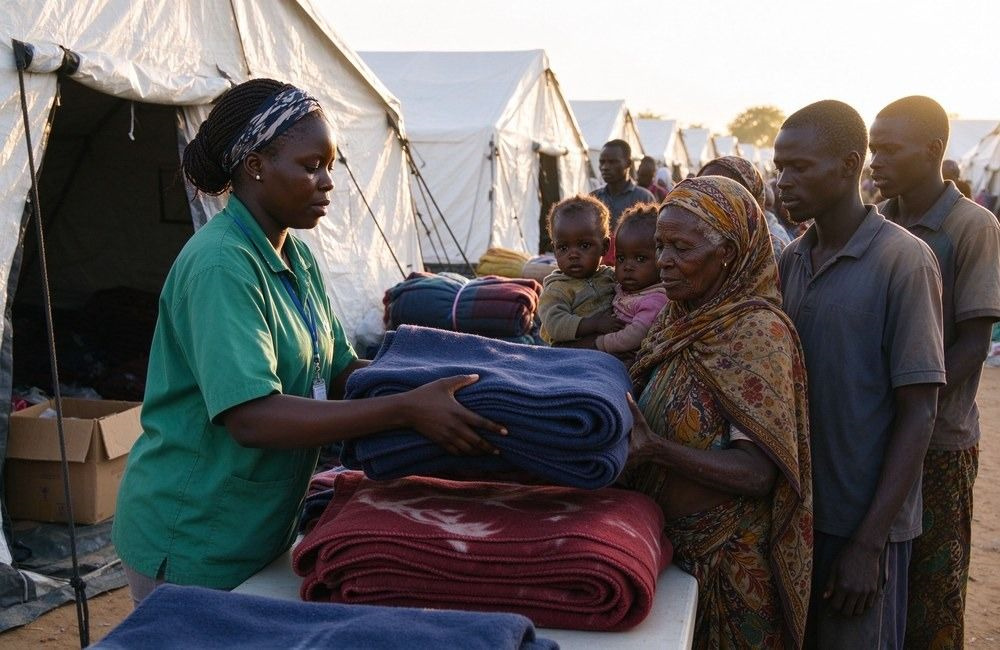
Camp workers distributing relief blankets to displaced families.
Camp workers distribute relief blankets to displaced families in the same order as the camp plan: registration first, then shelter, then bedding. Each family receives a consistent item so that repeated distributions stay fair, and the quantity at the distribution point is checked against the camp register before the supplies are handed out.
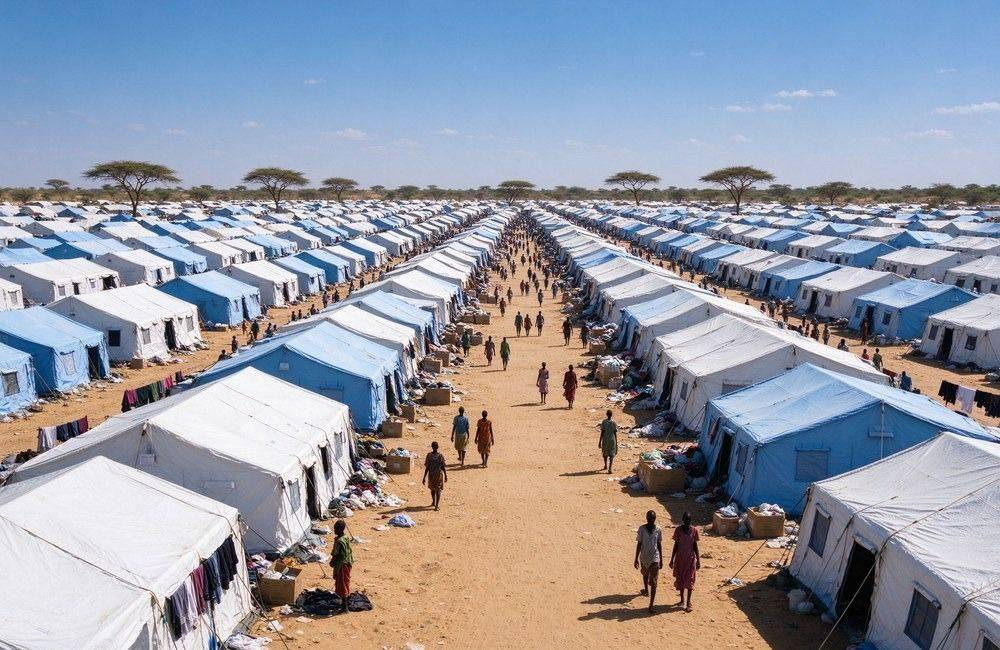
A Sahel IDP tent camp seen from above.
Most camps in Africa start with the same three items: a shelter frame, a floor cover, and something to sleep under. The floor is often bare earth or a worn tarpaulin, and the night air in the Sahel or the highlands can drop well below comfort. That is why camp relief supplies lists from agencies almost always put blankets, nets and bedding kits near the top. For buyers, the practical question is not whether camps need them, but how to order them in bulk without delays, and how to hold the specification steady across repeat orders.
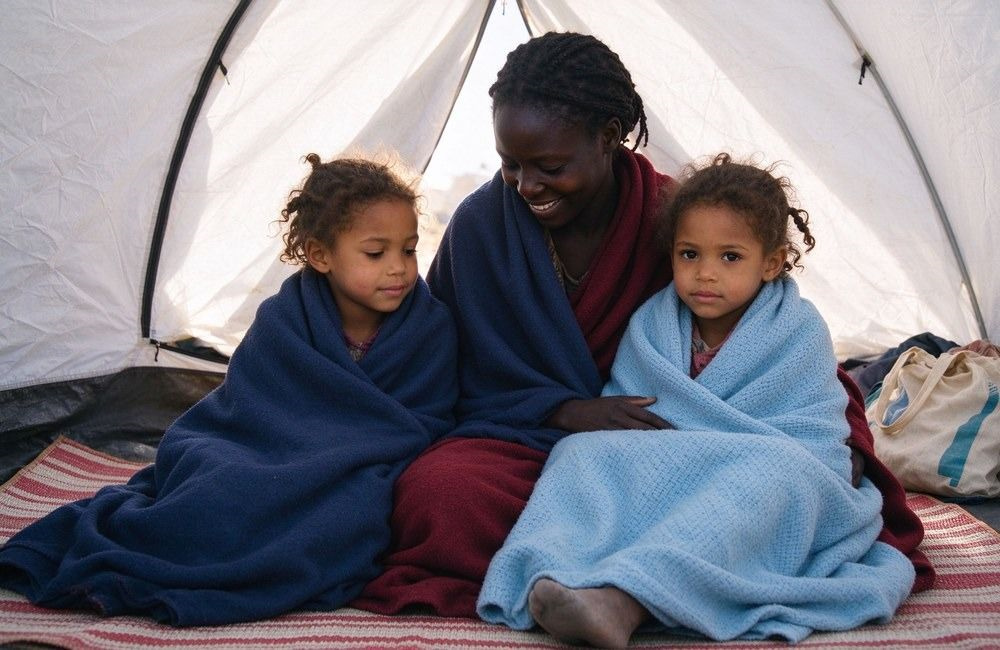
An African family wrapped in shelter blankets inside a tent.
Camp standards matter more than any single product claim. UNHCR camp coordination guidance describes minimum shelter and bedding expectations for displaced families, and most national disaster offices in Africa follow the same reference points. A blanket that meets the expected finished size, weight and washing tolerance fits straight into a distribution plan; one that does not gets rejected at inspection and holds up an entire container. The approved sample, not the brochure, is the document that unlocks production.

A mosquito net over a camp bed with orange and blue blankets.
The busiest camp supply chains in Africa run through procurement hubs that buy in volume and deliver in waves. Refugee blankets wholesale orders are quoted by the pallet, the container or the family kit, and every unit needs a clear specification. Family size relief kits bundle blankets with mosquito nets, floor mats and sometimes soap, which cuts per-household handling time at the distribution point and keeps the queue fair when camps expand quickly.
Timing is the difference between a smooth camp rollout and a stalled one. Camps grow fastest after conflict or drought pushes families onto the road, and agencies order camp relief supplies against that calendar. Buyers who confirm samples, packing and production slots before the peak season protect their delivery dates, while late orders pay premium freight and wait through backlogs. A supplier who keeps capacity open for that window becomes the first call when the next camp order opens.
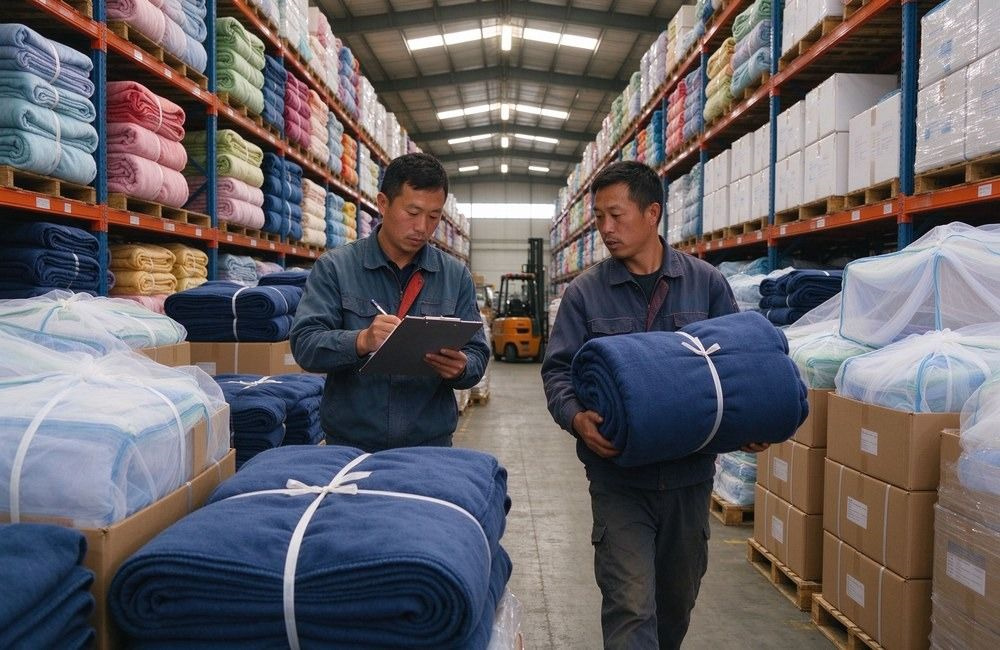
Pre-positioned camp supplies in a bright warehouse.
Displacement in Africa is rarely a single event. It is a combination of conflict, drought, floods and the slow erosion of livelihoods, and it pushes families into camps that were not built to hold them. UNHCR displacement data tracks more than 35 million internally displaced people on the continent, and the numbers climb after every major emergency.
The Sahel region shows how fast camps appear. Sudan, Chad, Burkina Faso, Mali and Niger host large displaced populations, and camp populations can double within weeks of a security or climate shock. For a fuller picture of the scale, the UNHCR displacement page publishes updated regional figures, and the OCHA Sudan update reports give the operating context for agencies ordering camp relief supplies on the ground.
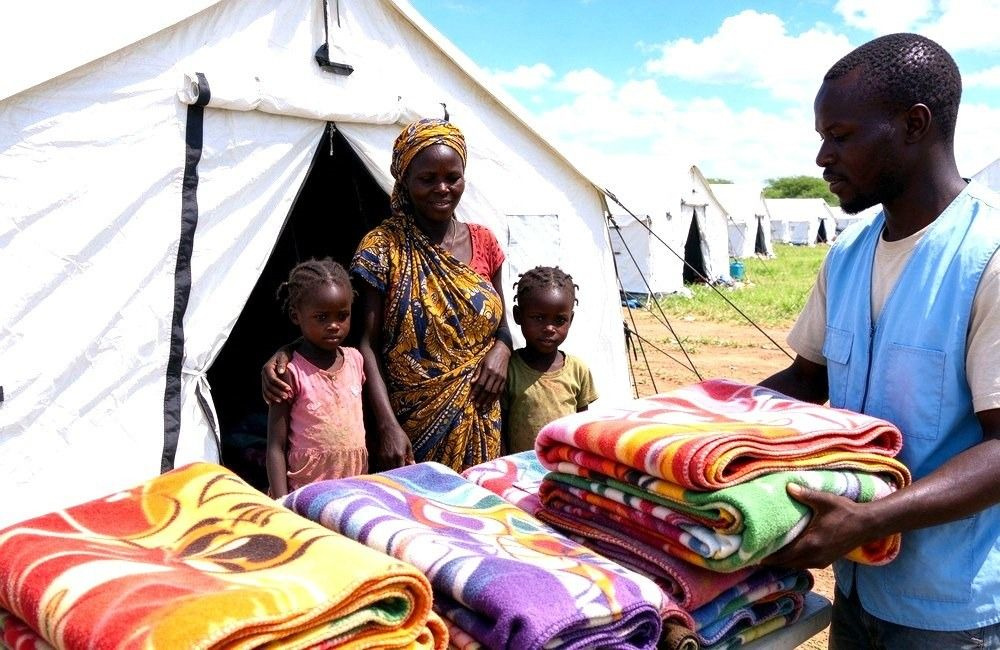
Families settled in a tent camp after displacement.
What matters to a supplier is the pattern behind the numbers. When displacement spikes, agencies reopen framework agreements, extend blanket orders and look for suppliers who can deliver consistent IDP camp supplies without repeated quality surprises. Camps buy in volume, and volume buyers measure suppliers by reliability.
The same corridor logic applies as in other disaster lines: warehouses pre-load before the peak season, and agencies that miss the window pay peak freight and wait through backlogs. Suppliers who plan production slots around the displacement calendar win repeat orders. For related guidance on flood-season bedding, the flood relief bedding guide covers the same planning sequence for river-basin responses.
Regional patterns shape camp demand. In East Africa, camps cluster around drought corridors and grow through the dry season; in West and Central Africa, conflict drives shorter, faster displacement waves; and in Southern Africa, floods create camps along river basins. Each pattern changes the timing of orders, but the product list stays the same: blankets, nets, mats and tarpaulins.
Replenishment is part of camp procurement. A camp that opens with five thousand families grows by hundreds each week, and replacement orders follow the same specification as the original. Suppliers who keep production records aligned with the approved sample can fill those follow-ups without re-qualification, which shortens the whole supply cycle.
The tender numbers are the ones that matter. When agencies publish quantities, they quote against camp population figures and expected growth, and the per-household kit count converts population into line items. A supplier who can re-derive the tender quantity from the published camp numbers catches errors before they reach the container.
Currency and incoterms are part of the same conversation. Camp orders cross borders, and a quote stated in one currency with one set of delivery terms is easier to compare than a quote with hidden variables. Suppliers who state price, currency and incoterms on every line remove the most common source of bid disputes.
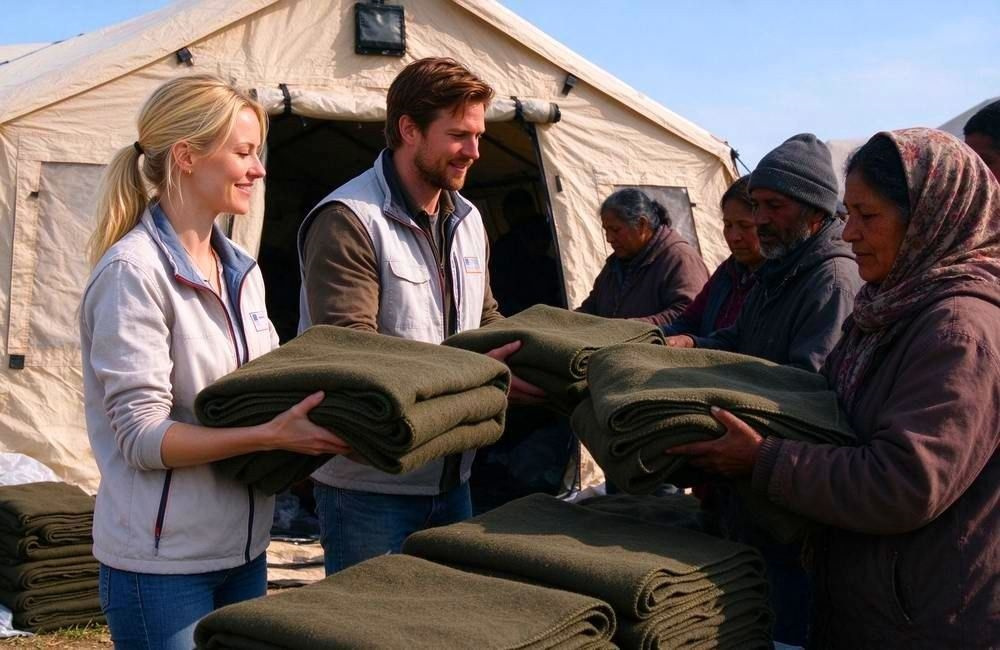
Blankets handed out at a field tent.
Camp bedding standards exist so that a blanket distributed in one camp is comparable to a blanket distributed in another. UNHCR camp standards and the shelter coordination groups that follow them describe expected sizes, weights and basic performance for bedding items, and most procurement teams quote against those references.
The standard reference for agencies is the UNHCR standard specification catalogue. It lists approved blanket specifications, including finished size, fabric weight per square meter, hemming, edge stitching and washing behaviour, and it gives suppliers a fixed target instead of a moving one. Orders written against UNHCR standard blankets are easier to inspect and easier to reorder.

A team checking a camp standard specification.
Camp bedding standards also cover mosquito nets and floor covers. Nets are quoted by size, mesh density and wash durability, while floor mats and tarpaulins are quoted by dimensions and material weight. A buyer who matches every line item to a published standard shortens the inspection step and avoids last-minute substitutions.
Inspection is where standards do their work. Most agencies run a pre-shipment inspection on a random carton sample, checking finished size, weight, stitching and washing behaviour against the approved sample. The inspection record becomes the reference for the whole order, and any deviation is documented and corrected before the container leaves the factory.
Consistency across batches is what keeps a supplier approved. A blanket that passes once must pass every time, which is why production records, batch samples and the approved specification stay linked together. Suppliers who hold the specification stable across repeat orders keep the approval, while those who let quality drift lose the framework.
Local adaptation is allowed within the standard. The UNHCR catalogue is a reference, not a straitjacket; agencies may adjust colours, labels or kit composition for the region while keeping the core specification. What matters is that the adjustment is agreed in writing before production, so the inspection record matches the order exactly.
Documentation follows the standard. The specification sheet, the approved sample record and the inspection certificate travel as one set, and agencies file them for the next reorder. Suppliers who keep this set clean save the buyer hours of re-verification when the camp expands and a follow-up order is placed.
Standards also shape the pack list. When the specification names a finished size, the packing dimension follows from it; when it names a wash tolerance, the care label follows. Suppliers who read the standard backwards from the label to the fabric keep every line of the order consistent.
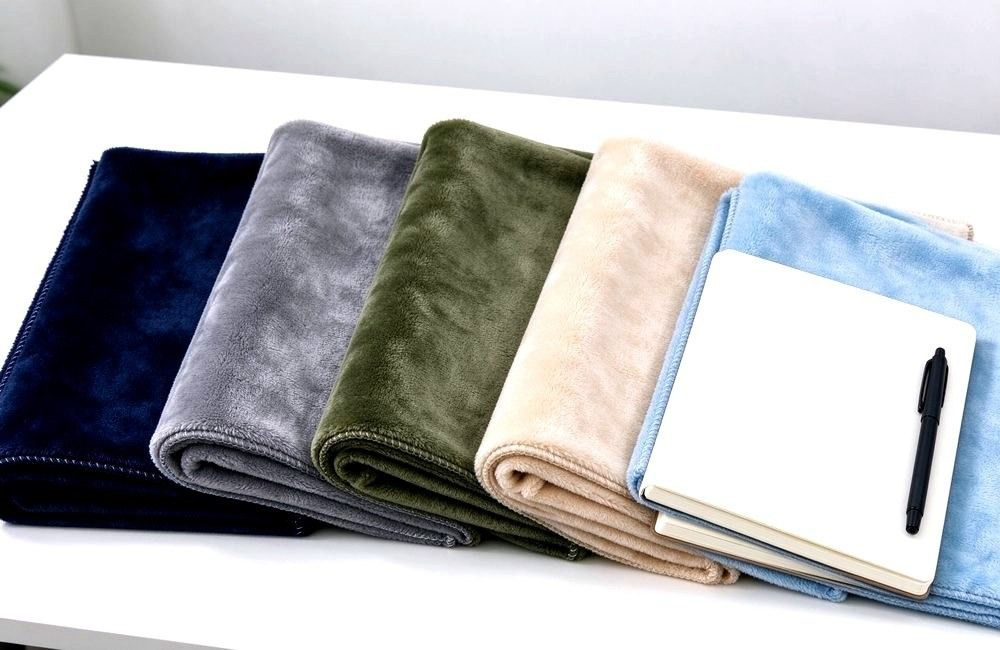
Sample swatches and colour cards for approval.
Blankets in IDP camps work harder than household blankets. They are slept on directly, rolled during the day, washed by hand in shared water points and exposed to dust, heat and humidity. The practical specification for camp blankets favours woven or fleece constructions that keep their shape after repeated washing and do not shed fibre heavily.
Weight is a real decision, not a marketing number. A mid-weight blanket around 200-250 gsm balances warmth for cool nights with packability for transport, while heavier blankets above 400 gsm suit highland camps where night temperatures drop sharply. For hot-season camps, a lighter blanket with good airflow beats a heavy one that traps heat.
Finished size matters as much as weight. Agency specifications usually expect a blanket large enough to cover an adult lying down, roughly 150 x 200 cm or the local standard equivalent, with reinforced hems and secure edge stitching. Sizes below specification get rejected at inspection, so the sample step exists to catch exactly these mismatches.
Colour and finish are worth agreeing early. Solid, low-visibility colours are common for bulk orders because they are easier to track and wash, while printed or branded blankets are ordered separately for specific programmes. Confirming colour, finish and labelling at the sample stage prevents a container of mismatched product.

Woven shelter blankets stacked in colors.
Fabric construction separates camp blankets from retail ones. Woven constructions hold their size through washing, fleece provides softness at lower weight, and a tight edge stitch prevents unravelling at the corners where camp blankets wear fastest. The sample should be washed before approval so the buyer sees how the fabric behaves, not just how it looks.
Quality control runs through every batch. Each production lot is checked for fabric weight, finished dimensions and edge stitching, with random carton sampling before packing. These checks are the difference between a blanket that matches the approved sample and a shipment that needs rework at the destination.
Thermal needs vary by season and altitude. Highland camps in Ethiopia and Kenya see cold nights all year, while Sahel camps swing between heat and cool nights within a day. A specification covering both lands at a mid-weight blanket plus a lighter layer, decided at the sample stage, not at the container.
Sample washing is the fastest education a buyer gets. A washed sample shows real shrinkage, real colour behaviour and real edge wear in ten days, where a brochure promises in ten seconds. Suppliers who include the wash test in the sample package close the sale faster because the evidence is already on the table.
Edge construction is where camp blankets fail first. Corners take the heaviest wear during rolling, carrying and washing, so reinforced hems and bar-tacked corners are the two details buyers check on the washed sample. Small construction choices translate directly into how many seasons a blanket survives in the camp.
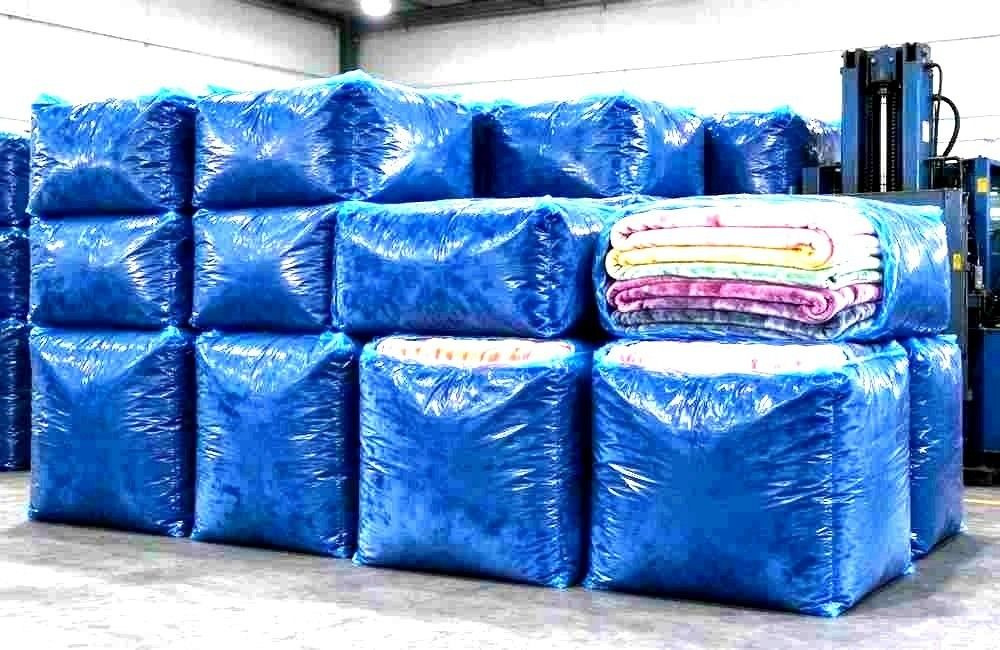
Compressed blanket bales ready for dispatch.
Mosquito nets are a core line item in IDP camp supplies because malaria is one of the first health threats in a new camp. Standing water, crowded sleeping spaces and limited access to care push transmission rates up quickly, and distributing long-lasting insecticidal nets is the standard prevention measure.
Camp buyers usually order nets by size and mesh: family-size rectangular nets with a defined mesh count, or smaller nets for single beds. The insecticide coating matters because nets are expected to stay effective across multiple washes, and agencies quote against approved net specifications rather than generic descriptions.
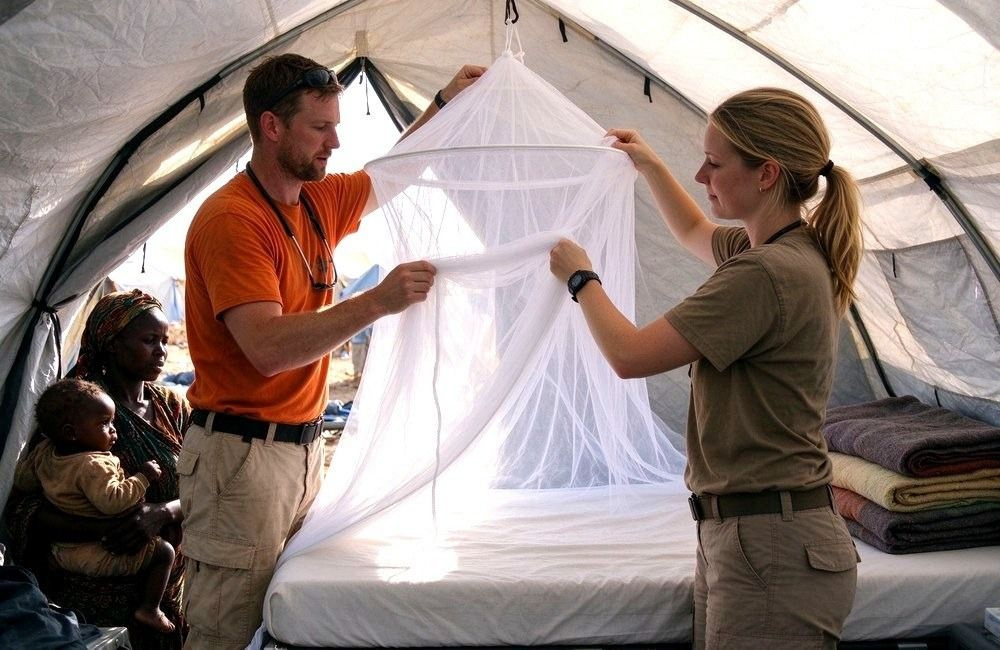
Hanging mosquito nets over camp beds.
Nets travel well in bulk. They compress flat, pack tightly into cartons, and can be bundled with blankets into family kits without wasting space. For suppliers, the useful question is whether the buyer wants nets pre-bundled with bedding or as a separate line, because that changes the packing plan and the label language.
Handling matters as much as the net itself. A net distributed with its hanging cord and fixing kit is far more likely to be used correctly than a net that arrives without installation parts. Camp buyers increasingly ask for complete net units, which is a small specification change with a large effect on usage rates.
Mesh density and wash life are the two numbers that get checked at inspection. The mesh must block mosquitoes while keeping airflow, and the coating must survive the wash cycle quoted in the specification. Confirming both at the sample stage protects the order from rejection later.
Nets and blankets are often distributed in the same session. When a family receives a net, a blanket and a mat together, the items are used together, which is why kit packing is so common in camp programmes. Suppliers who can bundle the three lines into one carton simplify the entire distribution chain and reduce handling at every checkpoint.
Net replenishment follows the same calendar as blankets. Nets wear out through washing and sun exposure, and camp programmes budget replacement units against expected net life. Suppliers who keep the approved net specification in production records can fill replacement orders without restarting the approval process.
Hanging kits belong in the same carton. A net with cord and fixing hooks installs correctly the first time, which raises usage and lowers repeat distribution. Camp buyers increasingly specify the complete unit, and suppliers who quote it as one line avoid the parts-scramble at the camp store.
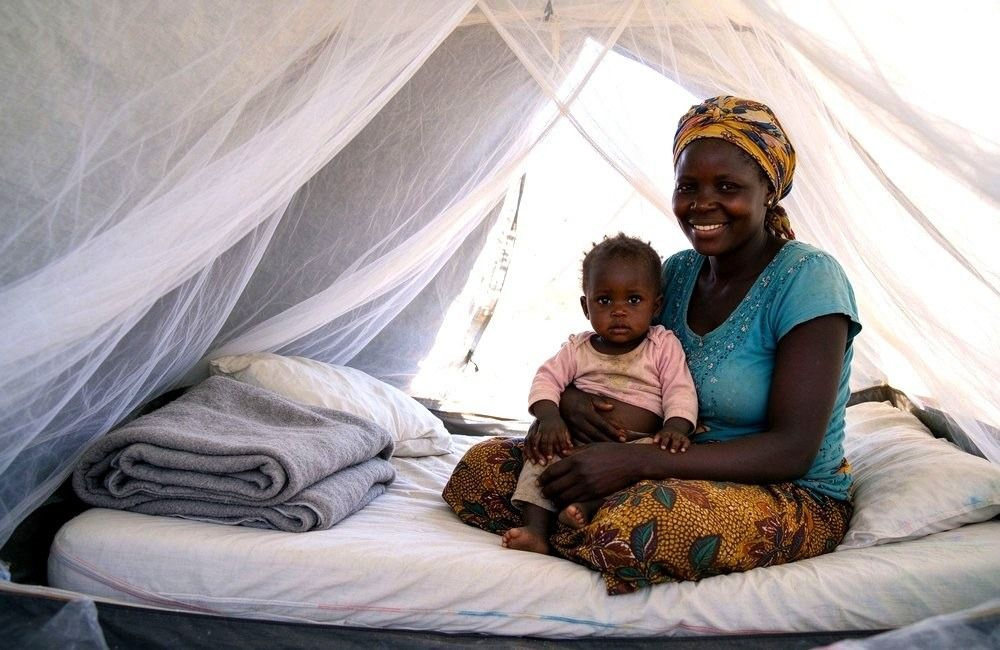
A mosquito net covering a family sleeping area.
A shelter frame keeps rain and sun off, but the floor is what keeps a family dry at night. In most camps, the floor is a tarpaulin or woven mat laid directly on the ground, with bedding on top. Tarpaulins and floor covers are therefore standard items in camp relief supplies, quoted by dimension and material weight.
The common sizes cover the practical range: a 3 x 4 m tarpaulin shelters a family sleeping area, while 2 x 3 m sheets cover individual beds or serve as ground cloths. Material weight determines lifespan; a heavier coated sheet resists tearing and lasts through more relocations, which matters in camps where families move several times.

A ground sheet under camp bedding in a tent.
Floor mats are often ordered alongside tarpaulins because they insulate against cold ground better than a single sheet. Woven polypropylene mats roll compactly, wash easily and provide a stable sleeping surface. When families move, the mat and tarpaulin are the first items packed, so durability directly reduces replacement orders.
Material choice splits into two practical camps. Coated tarpaulins win where rain is the main threat, because the coating sheds water and protects the bedding below. Woven mats win where insulation and breathability matter more, because they trap air between the ground and the sleeper. Many camp programmes order one of each per family.
Loss and wear are normal in camps, so replenishment is part of the plan. Agencies quote replacement quantities against expected camp life, and suppliers keep the specification stable so the follow-up order matches the first one. A floor cover that survives relocation after relocation is the item that saves money over the camp's lifetime.
Ground preparation affects how long covers last. Camps that clear stones and level the sleeping area protect mats and tarpaulins from early wear, and distribution teams that demonstrate proper laying get longer life from the same product. The specification is one side of the programme; usage guidance is the other, and both belong in the handover notes.
Seasonal planning applies to covers as well as blankets. Rainy-season camps need coated sheets at the front of the order; dry-season camps can prioritise woven mats. Buyers who stagger the two lines by calendar avoid paying coated-sheet prices where they are not needed, and suppliers who advise on that split build trust for the next order.
Inspection points for covers are quick and mechanical. Dimension, material weight, coating coverage and hem strength are measured on a random sample, and the record joins the batch file. Because covers wear by use rather than by wash, the inspection focus is construction rather than laundry behaviour.

A camp sleeping area prepared on ground sheets.
Camp supplies are measured in families, not in pieces. A family size relief kit standardises what each household receives, which speeds up distribution and keeps the queue fair. The usual kit bundles a blanket per sleeping person, a mosquito net per sleeping space, a floor mat or tarpaulin, and basic hygiene items.
Individual kits follow a simpler list: one blanket, one net and one mat, used for single adults or as supplements when families grow. Agencies order both formats against the same product specifications, so a supplier that stocks one quality level can quote for both without re-engineering.

Opening a labelled camp kit carton.
The table below shows a typical kit breakdown for camp programmes. Quantities are planning references, not fixed rules; the buyer confirms the final composition in the RFQ.
Kit sizing follows the household census. Agencies count families and adjust quantities by headcount, so the same kit specification produces different per-camp totals. Suppliers quote per unit and per kit, leaving the final count to the RFQ, which keeps production planning flexible while the specification stays fixed.
Label and language choices are part of kit sizing. A kit label in the language of the distribution staff reduces sorting errors, and a simple pictogram set helps families identify contents without reading. These details are confirmed in the RFQ, not improvised at the warehouse.
Kit variants are worth quoting separately. Some programmes need a basic kit, others add a hygiene pack, and the price difference is a line item, not a negotiation. Suppliers who list each variant with its own unit price make the buyer's comparison work easier and protect their own margin.
Kit contents are planning references; the final composition is fixed in the RFQ.
|
Item |
Family kit |
Individual kit |
Typical note |
|
Blanket (150 x 200 cm) |
2-4 pieces |
1 piece |
One per sleeping person |
|
Mosquito net (double) |
1-2 pieces |
1 piece |
Mesh and size per approved spec |
|
Floor mat or tarpaulin |
1 mat or 1 sheet |
1 mat |
Dimension per camp standard |
|
Soap / hygiene pack |
1 pack |
1 pack |
Optional line, confirm in RFQ |
|
Carry bag |
1 bag |
1 bag |
Helps re-packing during relocation |
Ordering family kits instead of loose items cuts distribution time per household and keeps every family to the same bedding standard, which is why most camp programmes quote kits as the base line unit, with loose blankets as a topping-up line.
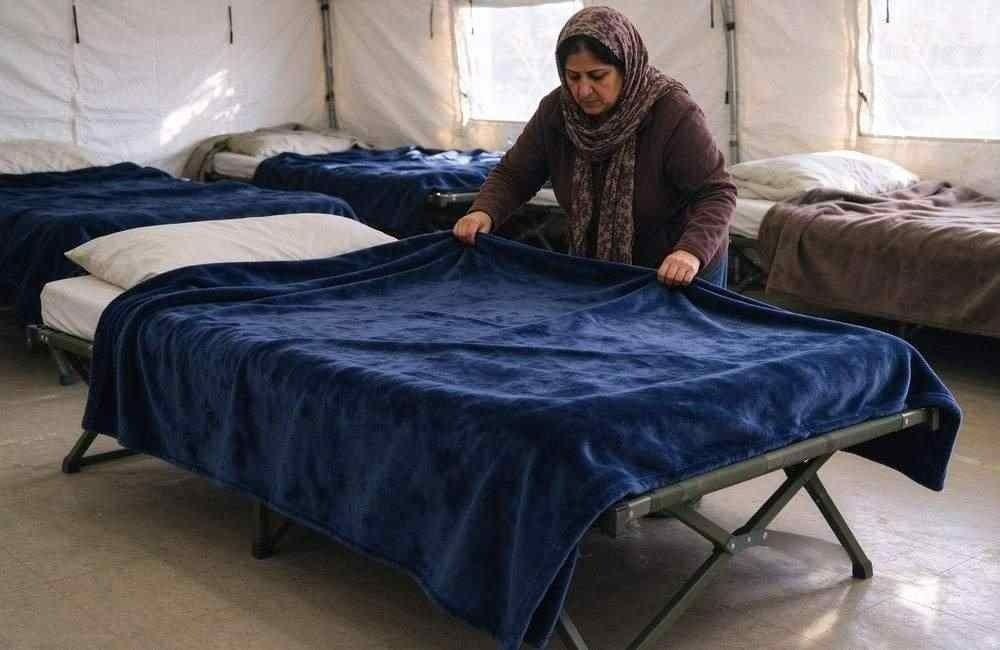
A 150 by 200 centimetre blanket on a cot.
Camp bedding is washed often and washed hard. Families wash blankets by hand in shared water points, hang them to dry in the sun, and repeat the cycle every few days. A blanket that pills, shrinks or loses colour after a handful of washes becomes unusable quickly, and replacement pressure falls back on the procurement budget.
The realistic test is the 50-wash mark. Woven blankets with tight construction and reinforced hems hold their shape and size across repeated washing, while loosely knitted or low-density fleece degrades much faster. Agencies that specify washing tolerance in the RFQ are screening for exactly this difference.
Waterproof or coated finishes are useful for flood-response lines but are not needed in most camps, where breathability and washability matter more. Durable camp blankets for repeated washing stay breathable, dry fast and keep their size, and those three properties are easier to verify than any marketing claim.

Close-up of woven blanket fabric.
Shrinkage and colour fastness are the two measurable risks. A blanket that shrinks out of specification after the first wash fails the size check; one that fades unevenly fails the colour check. Both are tested on the washed sample, which is why the sample process includes a wash cycle before approval.
Washing behaviour should be stated on the product sheet, not discovered at the camp. Expected shrinkage, recommended washing temperature and drying method are the three lines buyers look for, and suppliers who publish them reduce the number of rejected samples and the volume of clarification emails.
Storage between deliveries also matters. Blankets stored on pallets off the ground, with air flow and protection from moisture and rodents, keep their performance until distribution. Suppliers share storage guidance with the order so the product reaches families in the same condition it left the factory.
Wash instructions travel with the blanket. A simple care label stating wash temperature, drying method and expected shrinkage prevents the most common misuse, and camps that follow it see longer product life. The label language is set in the RFQ, and it is printed at production, not added later.
Grades are reference bands; the buyer fixes the required grade in the specification.
|
Grade |
Expected washes |
Best construction |
Camp use |
|
Standard |
30-50 washes |
Woven, reinforced hems |
Most camps |
|
Heavy duty |
50-100 washes |
Dense woven, double hem |
High-turnover camps |
|
Light / season |
10-20 washes |
Fleece, lighter weight |
Short-term sites |
|
Coated |
20-30 washes |
Coated or laminated face |
Flood response lines |
|
Printed |
30-50 washes |
Woven, printed colourfast |
Branded programmes |
Choosing the right grade avoids paying heavy-duty prices where standard grade suffices.
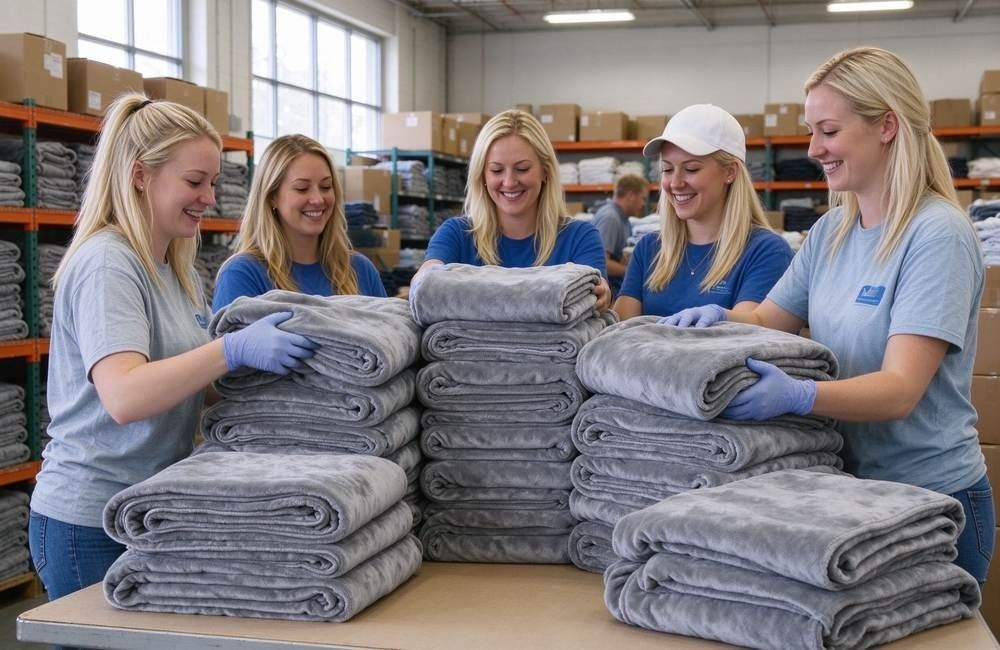
Folding camp blankets into labelled bundles.
How camp supplies are packed decides how fast they reach families. Distribution teams work from pallets and cartons, and they need to know what is inside without opening everything. Clear labelling, consistent carton counts and compressible packing save hours at every checkpoint.
Blankets pack tightly when compressed. Vacuum or strap-compressed bales reduce volume by roughly a third, which lowers freight cost and lets more units fit each truck. Nets and floor mats follow the same logic: flat, stacked and clearly counted per carton.

Blanket cartons loaded for camp relief delivery.
Family kits should be packed as kits, not as loose components. When a carton contains exactly the kit contents with a label listing each item, the distribution team hands out cartons instead of sorting components. The label language should be agreed with the buyer, because camp staff may work in French, English or Arabic depending on the region.
The packing list and the carton marks must match the order exactly. Carton numbers, item counts, bale weights and the buyer's reference number all go on the marks, and the pre-shipment inspection checks a random sample of cartons against the list. A mismatch found at the destination costs days of delay, so the pack plan is fixed before production.
Container loading follows the same discipline. Bales and cartons are loaded by destination zone so that the distribution team can unload in order, and the loading list records which cartons sit where. For remote camps the inland leg matters most: pack that survives the port may still need to survive several days of rough truck travel.
Documentation is the final packing item. The packing list, certificate of origin and inspection report travel with the consignment, and copies go to the buyer's clearing agent in advance. Complete documentation moves a container through the port without demurrage, which matters most for landlocked camp destinations.
The load plan is the last check before dispatch. Bales and cartons are staged by destination zone, counted twice, and photographed at loading so the buyer sees the state of the cargo before it moves. A clean load plan is also the fastest way to settle a damage claim, because the baseline is on record.
Transit insurance is worth quoting. Camp consignments cross ports, borders and rough roads, and insurance terms are part of the delivery contract, not an afterthought. Buyers who confirm insurance at the RFQ stage avoid a costly argument when a truck is delayed or damaged.
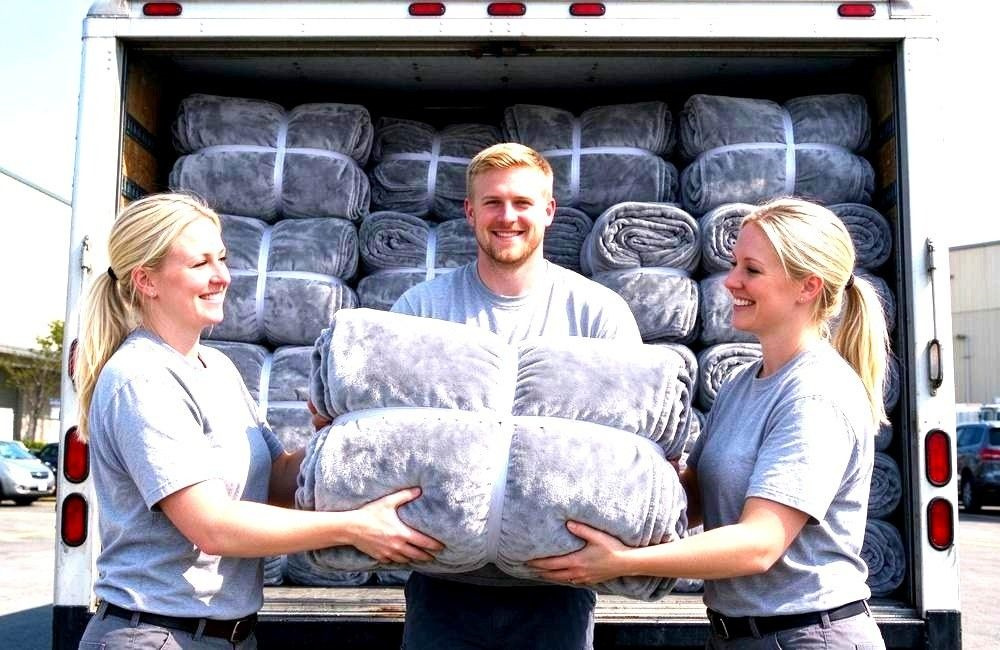
A relief truck loaded with camp bedding.
Agencies order camp supplies through a repeatable process: expression of interest, specification check, sample approval, pilot or framework order, then repeat orders. Understanding that sequence is the fastest way to keep IDP camp supplies moving through the pipeline.
The sample step is the gate that separates approved suppliers from the rest. Agencies inspect fabric, size, stitching and washing behaviour against the published standard, and they record the result. A supplier who sends a sample that matches the specification once usually wins the framework; one who sends a near-miss pays for the delay.
Framework agreements reward consistency. Once a blanket specification is approved, agencies reorder against it without repeating the full evaluation, which is why suppliers protect their approved status by holding the specification across batches. Production slots, packing and inspection stay fixed, and the only variable is the order quantity.

Comparing camp relief quotations.
Registration channels are public and free. Agencies publish supplier portals and registration guidance, and most camp supply tenders are announced through the same channels. A supplier who registers, keeps the profile updated and responds to enquiries within the stated window stays visible when the next camp order opens.
Response speed matters more than size. Camp programmes expand on short notice, and agencies compare how quickly suppliers confirm specification, samples and production slots. A supplier that answers within days and holds to the quoted timeline gets the repeat order, even when a larger competitor quoted a lower price.
Payment terms are part of the ordering conversation. Agencies commonly work on letters of credit or payment against documents, and suppliers confirm the terms early so cash flow does not stall production. Clear payment terms keep the sample and bulk stages moving at the same pace.
Framework slots reward early contact. Agencies publish tender calendars, and suppliers who confirm interest before the tender opens can shape the specification discussion instead of reacting to it. Early contact also signals capacity, which matters when the camp order window is short.
Supplier registration is a one-time cost with a recurring return. Portals ask for the same documents each year, and an updated profile with current capacities and specifications gets matched to new tenders automatically. Keeping the profile current is the cheapest marketing a camp supplies supplier does.

An agency RFQ review meeting with a supplier.
A complete RFQ protects both sides. For the buyer, it fixes the specification, quantity, packing and delivery terms so that quotes are comparable. For the supplier, it removes guesswork: every line item is a reference point, and the sample step verifies the rest.
The checklist below covers the items agencies expect in a camp supplies RFQ. Confirm each point before quoting, because a missing detail at this stage becomes a rejected container at delivery.
The most common RFQ errors are the same every season: vague specification, no sample requirement, unclear delivery terms and unstated label language. Each one surfaces later as a delay, a dispute or a rework. A buyer who fills in every checkpoint gets faster, more accurate quotes from every supplier on the list.
Response structure matters too. A quote that answers every checkpoint in the same order as the RFQ is easier to compare than one that buries the answers in free text. Suppliers who mirror the buyer's checklist get their quotes evaluated faster, a small discipline with a large effect on win rate.
Follow-up after the quote matters. A short confirmation of the quoted timeline, the open questions and the sample date keeps the buyer's evaluation moving and signals reliability. Most camp tenders are decided on responsiveness as much as price, and the follow-up is where that signal lands.
Version control on the RFQ prevents the classic error. Buyers revise specifications during the tender, and suppliers who track the revision number quote against the latest version. A quote that answers an old revision is disqualified for a reason that has nothing to do with price.
Confirm every checkpoint before quoting; each one maps to a line in the contract.
|
# |
Checkpoint |
What to confirm |
Risk if skipped |
|
1 |
Specification |
Size, gsm, fabric, finish per standard |
Rejection at inspection |
|
2 |
Quantity |
Units per line, family kits vs loose |
Wrong carton counts |
|
3 |
Sample |
Sample approval before bulk production |
Container of mismatched product |
|
4 |
Packing |
Bale, carton, label language |
Slow distribution at site |
|
5 |
Delivery terms |
Port, inland route, timeline |
Freight and delay disputes |
|
6 |
Inspection |
Third-party or buyer inspection point |
Hidden defects discovered late |
A complete RFQ turns a bulk order into a repeatable process for both sides. When every check point, quantity and delivery term is written down, the same specification can be tendered again next season without starting from zero, and the approved sample stays valid for follow-up orders.
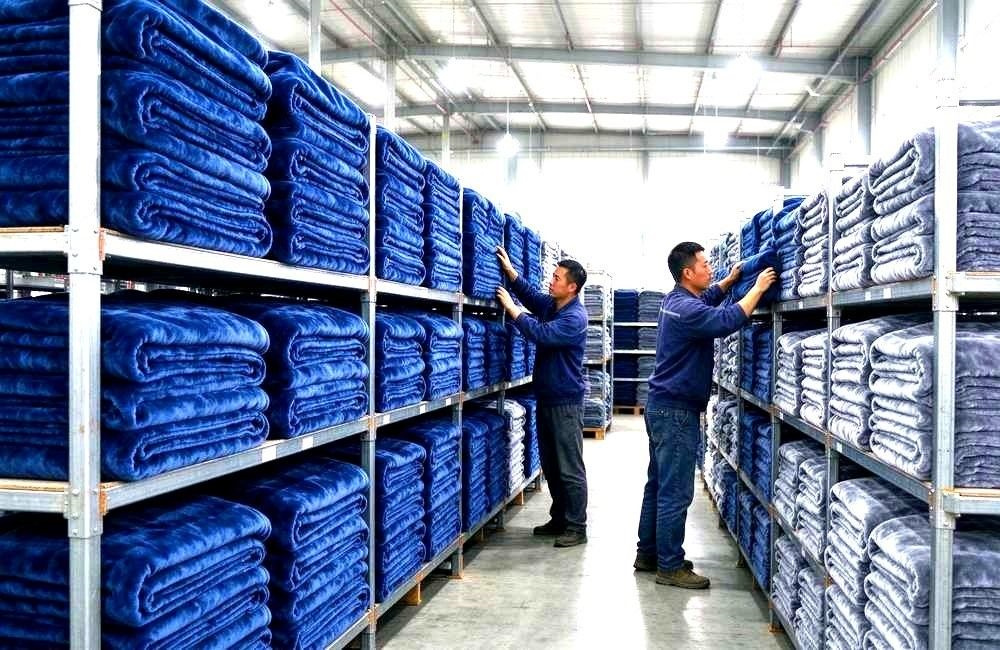
An RFQ checklist notebook for camp supplies.
Here are the questions agencies ask most often before ordering camp bedding supplies, with practical answers from field programs and the specification points that matter at tender stage.
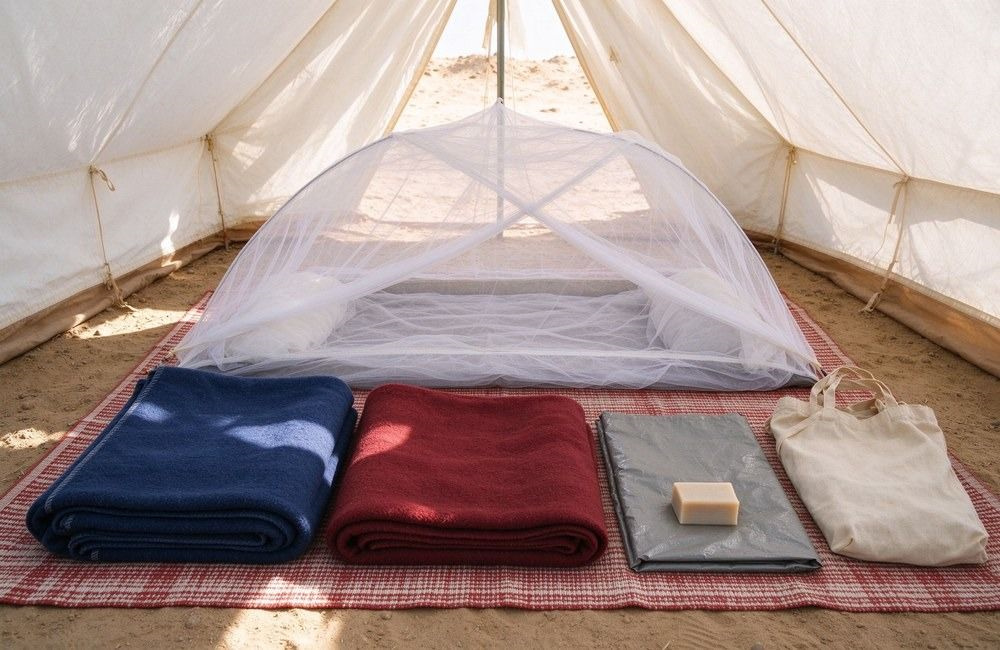
A full family bedding kit laid out for inspection.
Agencies reference UNHCR standard specification catalogues and shelter coordination guidance, covering blanket size, weight, hemming and washing performance plus net and ground sheet specs. Quoting against published standards keeps inspection short and opens more than one tender.
Distribution varies by climate and household size. A common planning reference is one blanket per sleeper, with family kits bundled two to four per household; the RFQ fixes the final number. Cold nights push the figure higher for the elderly and children.
Tightly woven blankets with reinforced hems keep size and shape after 50 or more washes. A mid-weight of roughly 200-250 gsm balances warmth, packing and washing life for most camp climates. Approval checks washed samples, and woven structures outlast loose fleece.
Yes. We supply family and single nets in the mesh and sizes written in the specification, bundled into family kits or shipped as a separate line. Packing plans are fixed at order confirmation, and you confirm whether nets ship bundled or separately.
Yes. Family kits combine blankets, mosquito nets, ground sheets and optional hygiene items in labelled cartons, cutting per-household distribution time. Kit contents are fixed by the RFQ before production, and carton labels list contents so teams hand out whole boxes.
We supply coated tarpaulins from 2 x 3 m to 3 x 4 m and woven polypropylene ground sheets in standard camp sizes. Weights and sizes are confirmed at sample stage, and both pack flat for efficient container loading. Coated sheets suit rainy seasons.
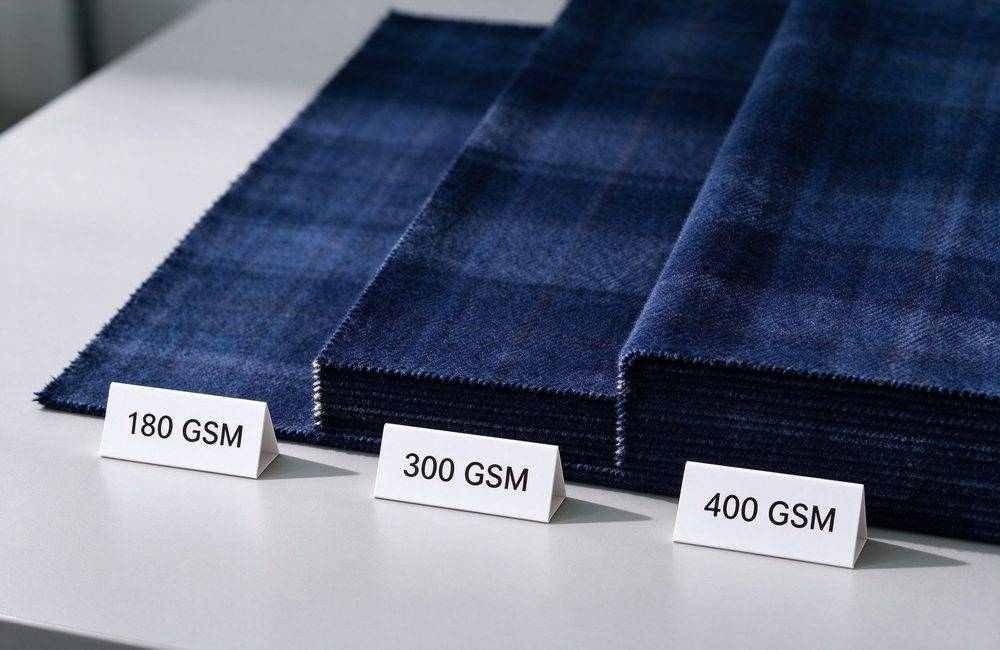
Camp blanket fabric density comparison for washing durability.
Our woven camp blankets keep size, hems and colour after 50 or more hand washes, with a heavy-duty grade for high-turnover camps. Wash tolerance is verified on approved samples including shrinkage and colour-fastness. Heavy-duty uses denser weave and double hems.
Blankets ship as strapped or vacuum-compressed bales, nets and ground sheets pack flat in counted cartons, and family kits arrive pre-packed and labelled. Cartons match the packing list, and compressed bales cut freight volume by about a third.
Yes. We quote delivery terms to the agreed port and inland route, and pack for overland truck transfer to remote sites. Delivery terms and Incoterms are fixed in the RFQ so both sides share one timeline; port and final camp location are quoted separately.
The standard order is specification check, sample submission, inspection against published standards, approval, then production. We send production-matching samples plus washed samples to verify washing performance early, and that approval unlocks the production slot.
We produce to the specification written in the RFQ, including any UNHCR standard references named by the buyer. The approved sample is the record the bulk order matches, and batch checks keep every production run aligned with that record.
Send an RFQ with specifications, quantities, packing and delivery terms. We confirm each checkpoint, produce samples, and after approval book production and issue the packing and inspection plan. Framework follow-up orders run the same process.
A family camp bedding kit normally includes blankets, a mosquito net and a ground cover or tarpaulin. Bedding for IDP camps must be washable, quick-drying and sized for repeated use so that shelter hygiene can be maintained over a long displacement.
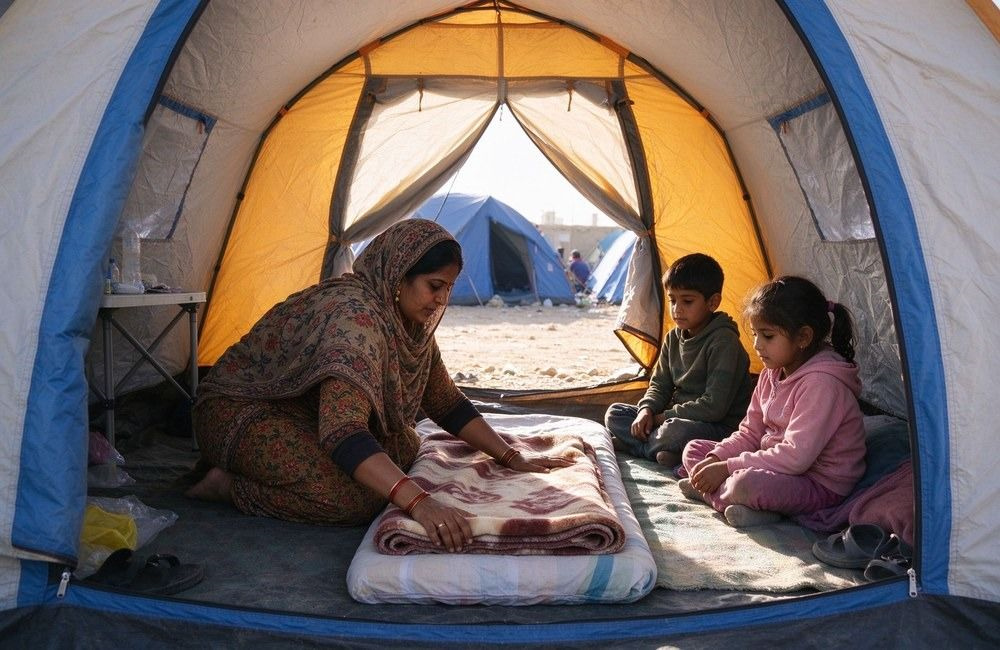
In displacement camps, bedding arrives as part of the first distribution alongside shelter and water. The blanket on the mattress is the daily-use item: warm, easy to wash, simple to store, and consistent across repeated orders so every family in the camp gets the same standard.
 |

|
Previous :
Cyclone Relief Supplies for Madagascar, Mozambique and Malawi: Blankets That Withstand High Winds, Humidity and Long Storage, Plus Bulk Ordering and Sizing for Emergency ProgrammesNext :
Malaria and Cholera Response Supplies for Africa: Treated Mosquito Nets, Bedding and Blankets for Post-Flood Disease Prevention in Emergency Health Programmes and Community ClinicsCopyright © Custom Disaster - Relief Bedding: Tents, Sleeping Bags, Blankets All Rights Reserved
the professional team to service !