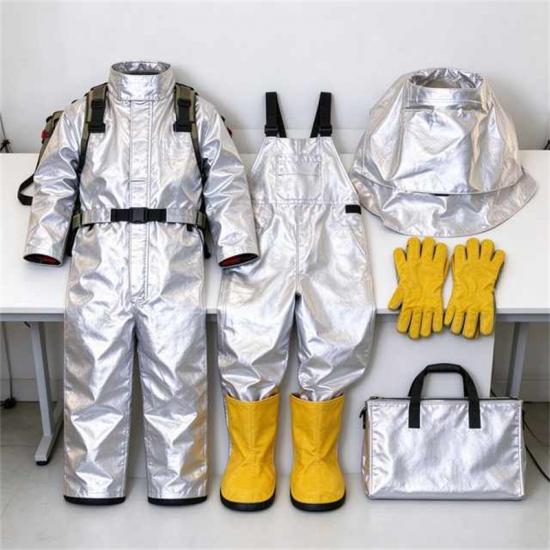
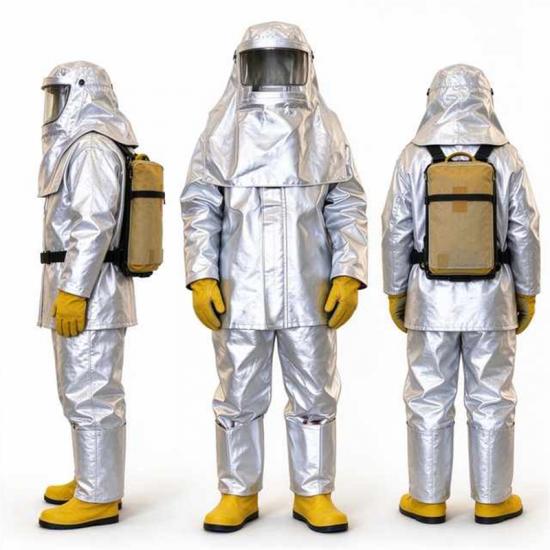
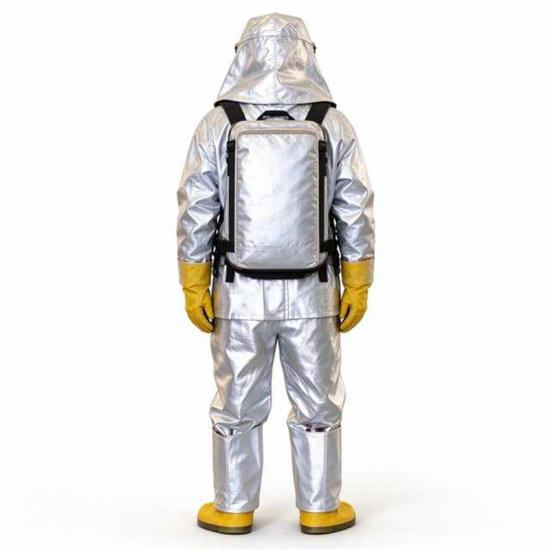
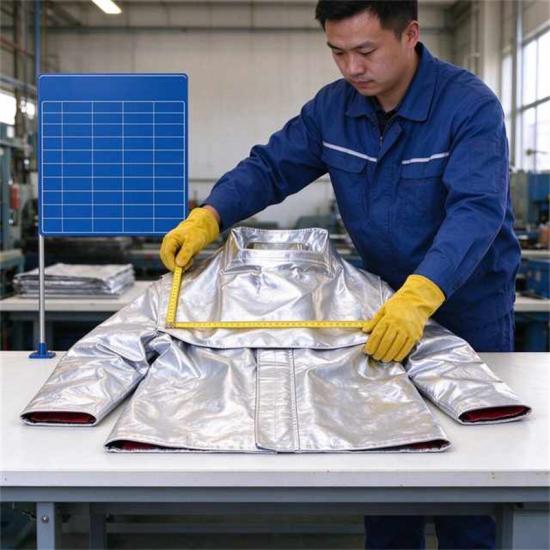
Our EN ISO 11612 heavy duty heat suit features integrated SCBA backpack, 1000°C radiant heat resistance with Costmir aluminized fabric. Rated A1 B1 C3 D3 E3 F3, it shields users from radiant heat and molten splash for power plant, petrochemical and industrial rescue. Complete kit with hood, gloves and boot covers, available for bulk wholesale procurement.
Note: Price for reference only. Exact price based on quantity, size, weight and custom details.
model no. :
XFF-03Brand:
YRFmarket price :
$119.8sale price :
$59.9price range :
30-100/$59.9Color :
Multiple Colorsport of dispatch :
Guangdong/GuangzhouPayment :
TT, Paypal, Western Unionmin order :
30original region :
Made in ChinaLead Time :
5-15daysEU Standard Heavy Duty Heat Suit | EN ISO 11612
Certified 1000°C
A heavy duty EU grade fire proximity suit per EN ISO 11612 standard with SCBA backpack integrated inside the jacket gives rescue teams full system compatibility. This aluminized thermal suit handles 1000°C radiant heat for industrial rescue, power plant maintenance, and foundry work. Full specs, certification details, sizing, and wholesale bulk pricing below for professional procurement teams.
 |

|
1. EU Standards Explained
2. Heavy-Duty Construction
3. SCBA Backpack Integration
4. Industrial & Rescue Applications
5. Sizing & Accessories
6. FAQ
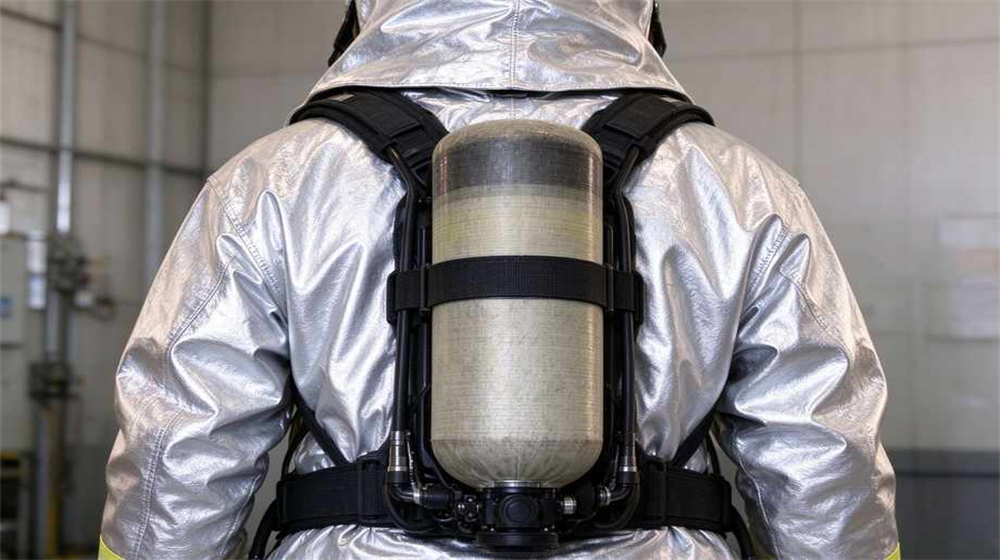
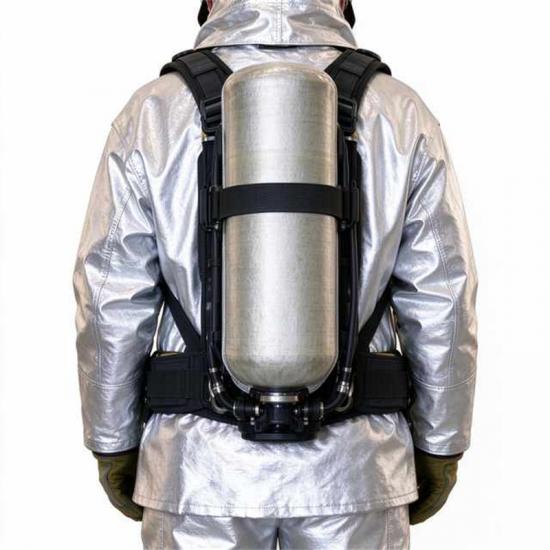
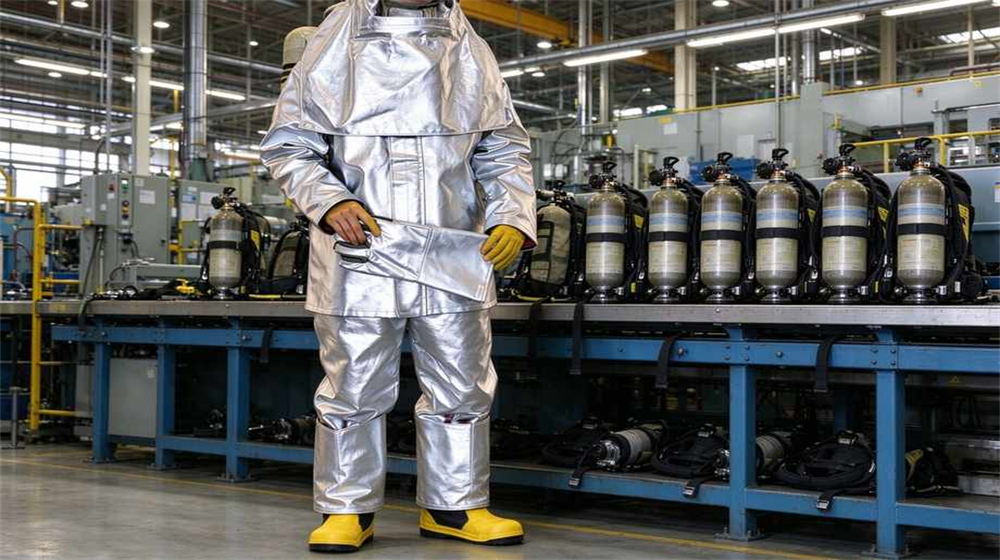
Backpack integration changes how the suit fits and how it protects. Because the SCBA compatible fire suit holds the cylinder against the back with reinforced webbing and a load-spreading frame, the weight sits low and stable, and the aluminized shell keeps one continuous reflective surface between the wearer and the heat source.
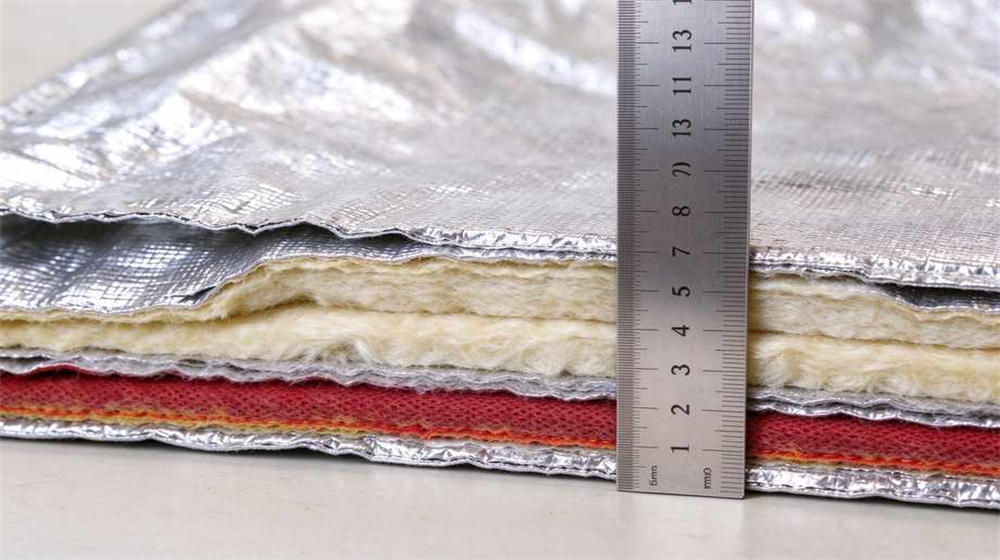
Heavy duty means the fabric stack is built thicker. The heavy duty heat suit starts with an aluminized reflective face, adds a bonded insulation core, and finishes with a permanent flame-retardant lining, all stitched with aramid fire-resistant thread so the seams hold when the surface is hottest.
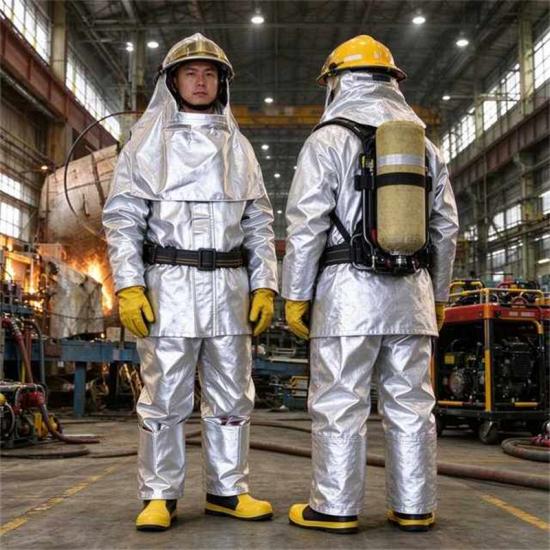
Boiler doors, inspection hatches and burner decks push radiant heat in short bursts. The industrial fire suit with air cylinder gives the crew a protected working window at the opening, then lets them step back and cool down fast, because the reflective surface rejects most of the heat before it enters the fabric.
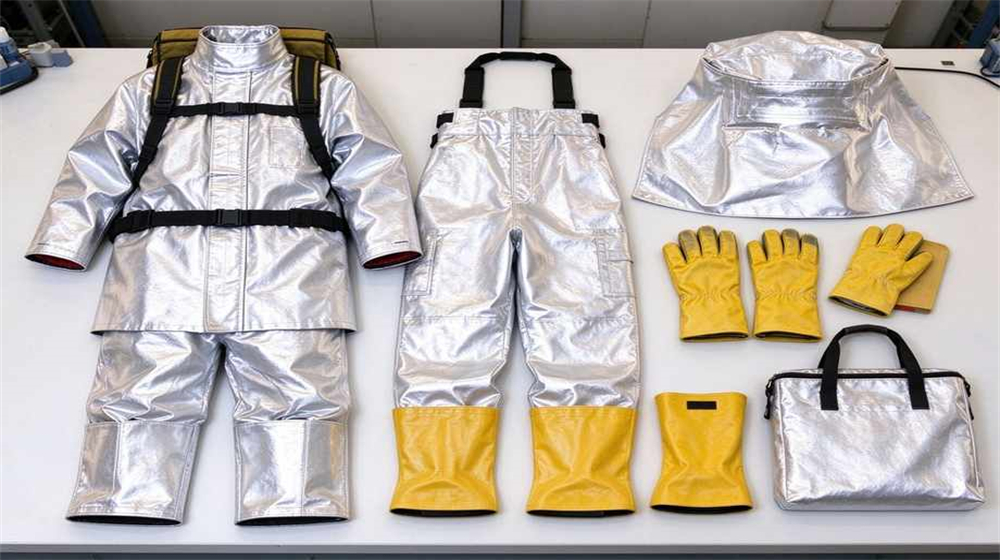
Jacket with backpack, bib pants, hood, aluminized gloves, boot covers and a carry bag: every part is matched from one supplier. That matters for procurement teams, because a heavy duty proximity suit wholesale order needs the same protection level across every component, not just the jacket.
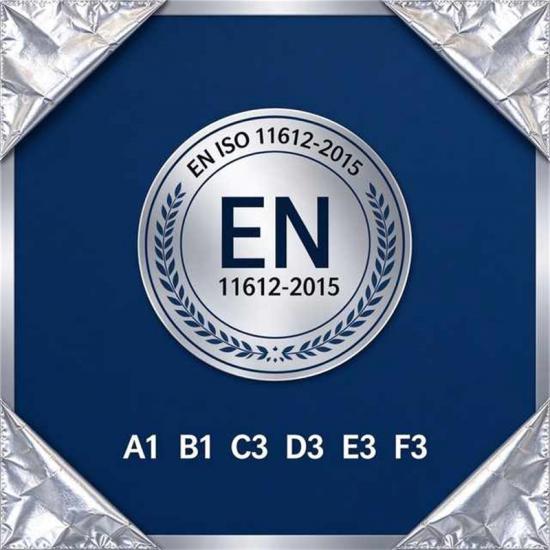
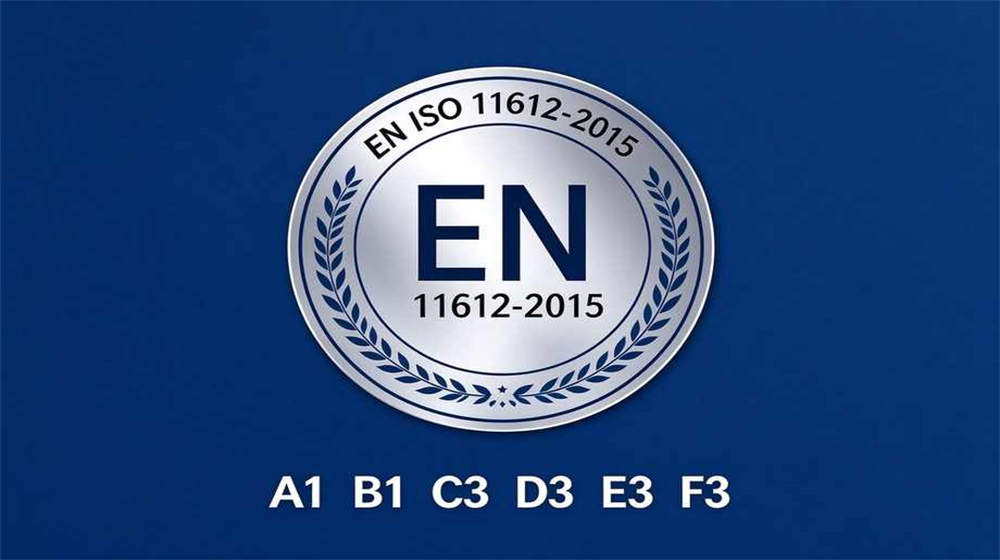
When a buyer in Europe, the Middle East or Southeast Asia specifies a heat suit, the first question is usually which standard it meets. For this model the answer is on the label: EN ISO 11612-2015 with grades A1 B1 C3 D3 E3 F3, and reading those grades is the difference between buying a label and buying protection.
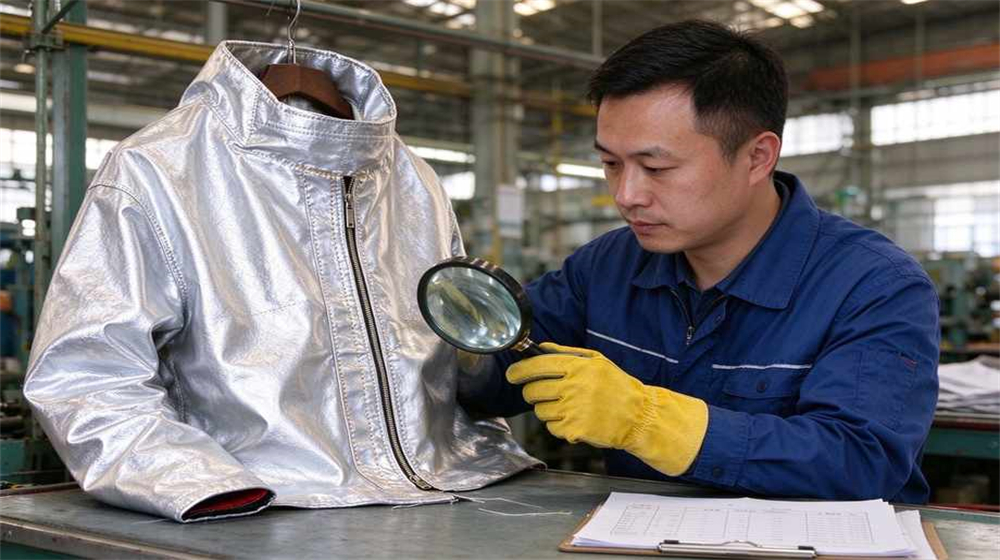
The aluminium surface itself is the first thing to check in a sample: it should look mirror-bright and uniform, without dull patches or pin-holes. If the sample already shows uneven reflectivity, the production roll will show it too, so sample inspection is a fast filter before deeper testing at no cost.
The EN system for protective clothing is performance-based: a CE certified heat protective suit is tested against defined heat and flame exposures, and the result is expressed as grades on the label. EN ISO 11612 covers clothing for heat and flame, and it is the framework most industrial buyers use when comparing EN standards fire proximity suit options from different suppliers.
For the EU market, the practical rule is simple: a suit that carries EN ISO 11612 with a full set of grades has been through repeatable, comparable laboratory testing. That is why European standard heat suits are specified for power, petrochemical and metal sectors, where procurement teams need documentation they can audit rather than marketing claims.
The grade string A1 B1 C3 D3 E3 F3 is not decoration: each letter-and-number pair is one tested property and level, so a buyer can compare suits on paper before ordering samples.
Breaking down the grades: A covers flammability (A1 is the base level), B covers convective heat and B1 resists flame spread, while C covers radiant heat — C3 is a higher level, exactly why a 1600°C heat resistant suit EN certified is ordered in the first place.
The D rating covers molten metal splash resistance and D3 is the higher tier, useful in casting and smelting. The E and F ratings cover heat transfer and flame spread. Together these grades show which exposures the suit is tested against — radiant heat and molten splash in the same job — which is why this European standard heat suit is specified for such positions.
|
EN ISO 11612 Grade |
Heat Exposure Tested |
Level |
Typical Work Position |
|
A1 |
Flame spread behaviour |
Level 1 |
Base requirement for heat suits |
|
B1 |
Convective heat |
Level 1 |
General hot work near heat sources |
|
C3 |
Radiant heat |
Level 3 |
Furnace doors, boiler hatches, kiln areas |
|
D3 |
Molten metal splash |
Level 3 |
Casting, smelting, pouring positions |
|
E3 |
Heat transfer (reverse) |
Level 3 |
Short flame contact tasks |
|
F3 |
Limited flame spread |
Level 3 |
Proximity work near open flame |
One point worth repeating in procurement meetings: the standard documents the tested performance of the EN grade heat protective clothing, while the certificate number and test report prove that a specific production batch matches the tested configuration.
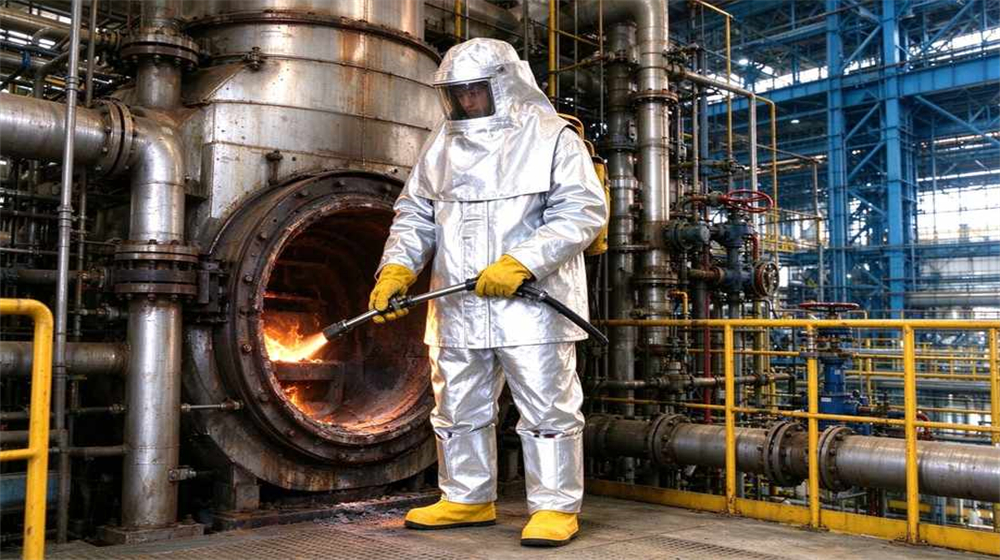
For buyers outside Europe, the same logic applies in reverse. Many importers compare an EN certified model against a local or NFPA-based option, and the honest comparison is about test coverage, not brand. EN ISO 11612 tests a defined set of heat and flame properties with published methods, which makes the CE certified heat protective suit a documentable choice for procurement teams that need an auditable file: standard, grades, certificate and batch report, all matching one configuration.
How the test is run also deserves a line in the file. EN ISO 11612 testing is done on conditioned samples under controlled laboratory conditions, with defined heat source settings and exposure times, so the result is comparable between laboratories and between production batches. That reproducibility lets a procurement team set the standard once and compare every future quotation against the same benchmark.
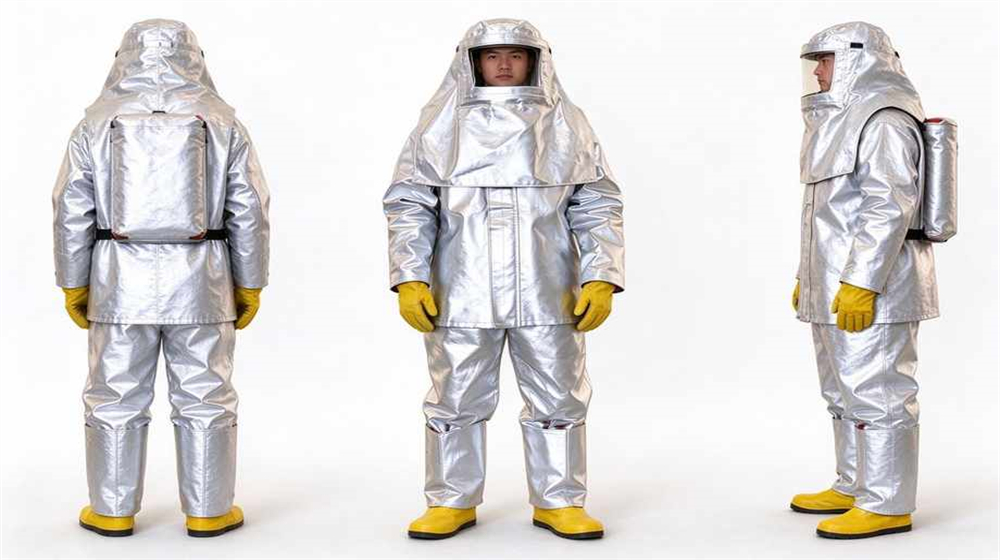
A heavy duty suit is heavier than a standard suit for a reason, and every gram is allocated to a specific protective job. Understanding the construction answers the question that every plant manager asks first: why does this heavy duty heat suit cost more per unit, and what is the weight actually buying?
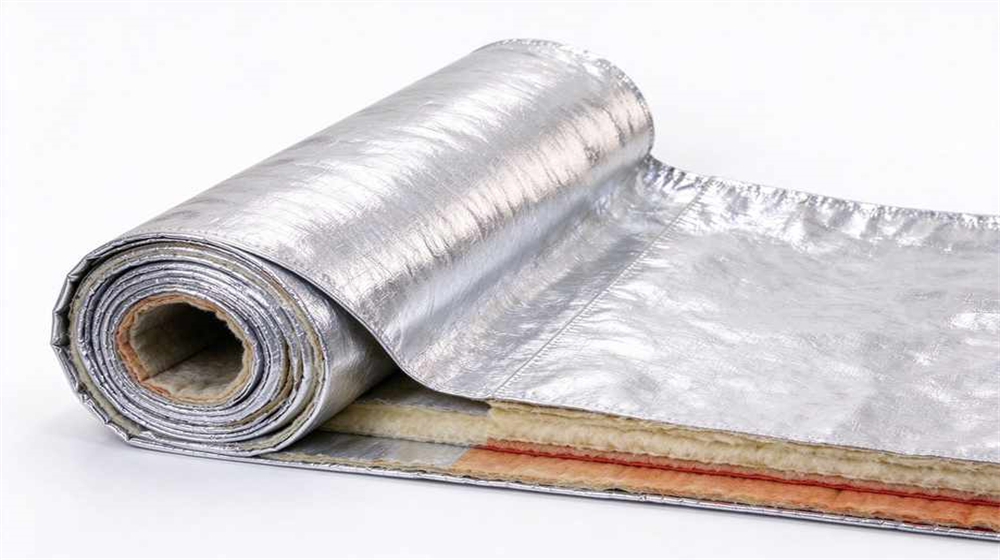
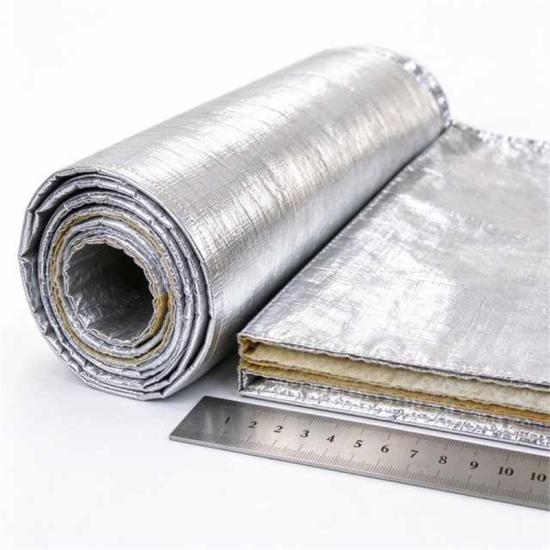
The fabric stack has three functional zones. The outer face is an aluminum foil composite bonded over special fibres, and its job is to reflect radiant heat before it reaches the insulation. The middle zone is the insulation core, which slows the small amount of heat that the reflective face cannot reject. The inner zone is a permanent flame-retardant lining that sits against the wearer's clothing and adds a final thermal buffer.
Where the suit is most exposed, the construction is reinforced rather than simply doubled. The shoulders carry a thicker insulation pad because that is the surface facing a furnace opening when a worker leans in. The knees and elbows get extra layers because those areas take repeated contact with hot equipment. The result is a heavy duty proximity suit that protects where protection is needed and keeps the rest of the suit as light as the specification allows.
Thread choice matters as much as fabric choice. The whole EU standard thermal suit is sewn with aramid fire-resistant thread, so a seam does not become the weak line where the fabric surface starts to fail. On a standard suit, thread is a cost line that gets cut; on a heavy duty model it is treated as a structural component.
The aluminized face is applied with the Costmir process, a coating method that bonds the reflective metal layer to the base cloth so it does not peel after repeated folding and flexing. That matters in daily use because the suit is folded, hung and bent for the whole shift; a reflective coating that cracks at the creases silently reduces radiant protection at exactly the points where heat reaches the fabric first.
Fabric inspection is part of production for this model. The outer surface is checked for coating continuity before cutting, the insulation core is weighed per panel so thickness stays within tolerance, and every seam is inspected at the sewing stage. Buyers who audit the batch report can trace each panel to a production record, which turns a heavy duty proximity suit quotation into a defensible procurement decision.
Requesting samples before the bulk order is the norm for this category. A physical sample shows the coating finish, the insulation feel and the seam quality in a way a photo cannot, and it gives the quality team a benchmark to check the production run against.
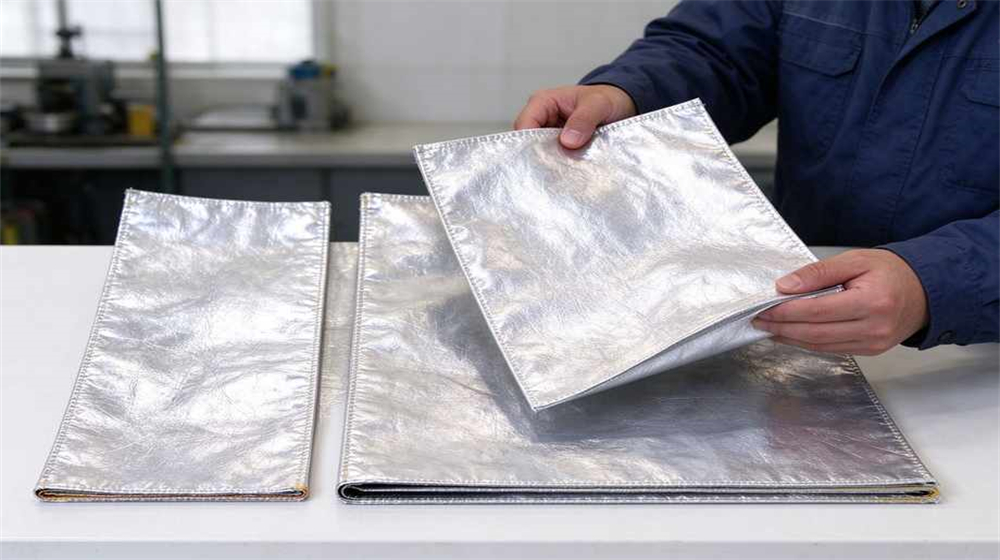
Why does a heavy duty heat suit use an aluminized face at all? Aluminized coatings reflect a large share of incident radiant heat, which is what makes the difference in front of a furnace door or a boiler hatch: the surface rejects most of the heat before it conducts into the insulation, so the wearer stays comfortable for the working window the task requires. Non-reflective heavy fabrics absorb more of the load and heat up faster, which is why proximity work in high radiant environments is consistently specified with a reflective outer layer.
The honest trade-off is that heavier protection reduces free movement for a portion of the shift. A heavy duty aluminized suit wholesale buyer should plan for that: the suit is specified for the hottest, shortest-exposure positions, while cooler parts of the plant can run with lighter clothing. Mixing the two is normal plant practice, and the heavy duty model is the correct choice where radiant heat or splash appears.
Movement is engineered, not just tolerated. Articulated sleeves and a gusseted back let the arms reach forward without dragging the torso, and the bib pants overlap the jacket in any bending position. A crew that can move freely is a crew that wears the suit correctly.
Weight distribution is easy to underestimate. With the backpack integrated into the jacket, the cylinder weight is carried by the suit's structure and shoulders together — more stable than a separate vest with a bottle on top.
Feature
Standard Suit
Heavy Duty Suit (This Model)
Aluminized face
Single reflective layer
Reflective layer + bonded insulation core + lining
Shoulders
Standard padding
Reinforced insulation pad
SCBA backpack
None, separate vest needed
Integrated into jacket
Thread
Standard thread
Aramid fire-resistant thread
Grade set
Partial grades
A1 B1 C3 D3 E3 F3
Typical use
Cooler plant areas, short exposure
Furnace doors, boiler hatches, rescue
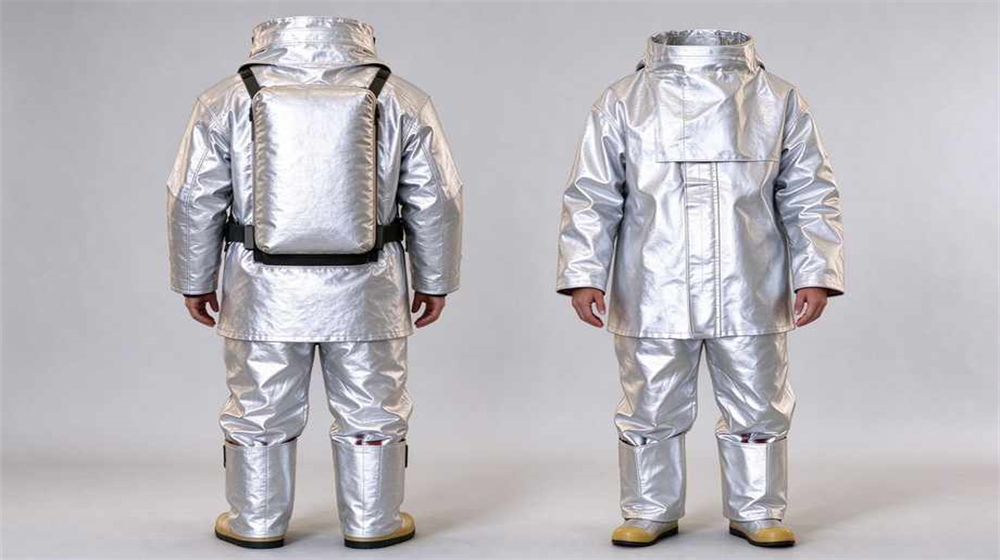
Heat is not the only hazard in these jobs; breathing air is the second one. In boiler rooms, incinerator shafts and rescue callouts, crews need supplied air at the same moment they need radiant heat protection - that is what makes the SCBA compatible fire suit a different product category from a standard heat suit.
When a separate SCBA vest is worn under or over a heat suit, the cylinder sits outside the reflective shell and the straps create pressure points. The integrated backpack solves both: the cylinder rides inside the protective envelope, and the load spreads across the back through a reinforced panel.
For rescue teams, integration also shortens donning: the wearer steps into the bib pants, pulls on the jacket with the backpack positioned, and a partner fastens the cylinder. The SCBA backpack fire suit is ready about as fast as a standard suit.
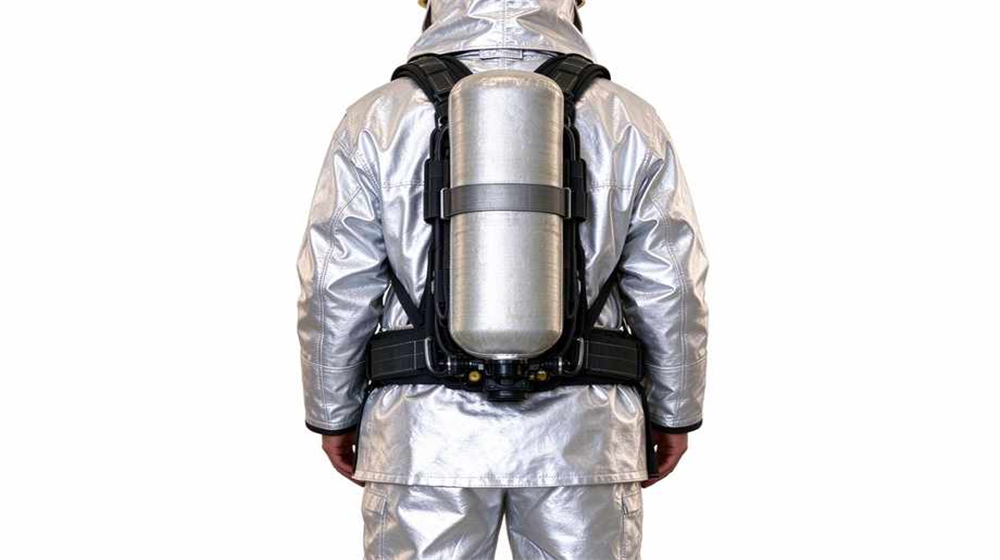
The backpack pocket fits standard 6.8-litre and 9-litre carbon cylinders with the valve facing down, the common industrial layout. The opening accepts a gloved hand, and quick-release buckles let a partner secure it from behind. Confirm your cylinder model before ordering, as valve orientation varies.
Compatibility is not only about the cylinder. The suit must work with the rest of the breathing set: the mask, the regulator and the hose routing. The industrial fire suit with air cylinder is designed with hose ports that keep the line close to the body, so it does not snag on handrails or equipment during movement.
Facepiece integration follows the same logic. The hood and visor are designed to fit over a standard full-face SCBA mask, with the aluminized visor sitting clear of the mask lens so both layers keep working without fogging or interference. When ordering, mention the mask brand your team uses, because facepiece geometry differs and the supplier checks the hood fit against the stated model before confirming the order.
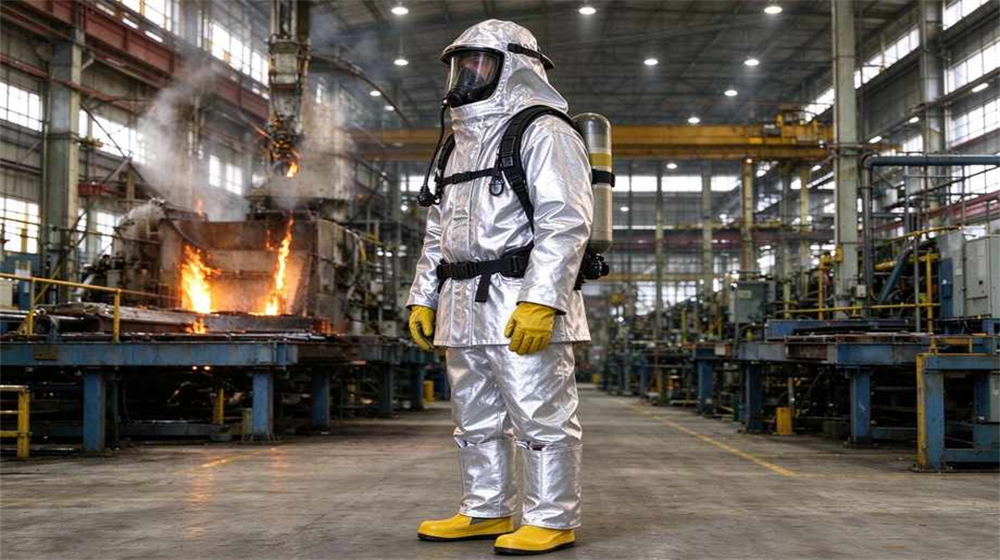
A full 9-litre cylinder adds real weight to the back, and how that weight is carried decides whether the suit is wearable for the full duration of a job. The backpack uses an aluminium backplate inside the jacket pocket, distributing the load across the shoulder blades and lower back, with a waist stabiliser that stops the cylinder from swinging when the wearer bends or climbs.
Weight support is also a safety feature. A cylinder that shifts inside the suit changes the wearer's centre of gravity at exactly the wrong moment, on a ladder or a platform edge. The stabiliser and the reinforced pocket keep the load fixed, which is why the heavy duty suit with SCBA integration is specified for positions that combine height, heat and breathing air.
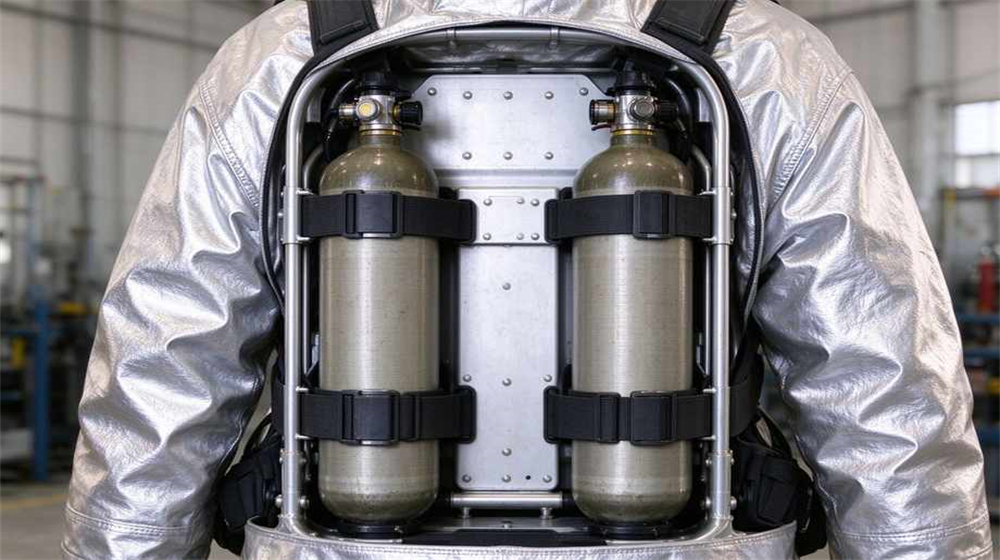
The donning routine is designed for two people. The wearer positions the suit, the partner inserts and secures the cylinder, then both check the hose routing and the buckles. That two-person check is standard practice in rescue teams and industrial emergency crews, and it is why training time for this suit is short.
Routine inspection of the backpack follows a simple checklist: the aluminium backplate for deformation, the webbing for fraying, the quick-release buckles for smooth operation, and the cylinder pocket for fabric wear at the rim. Each check takes under a minute during the regular suit inspection, and it catches the small failures that a heavy cylinder can turn into a safety problem mid-shift.
Comfort during wear is part of the protection story. A suit that makes the crew uncomfortable gets taken off early or worn incorrectly, and an improperly closed suit defeats its own reflective surface. The interior lining is breathable for its class, the sleeves are articulated so the arms can work without dragging the torso, and the jacket opens fully for rapid doffing when the worker steps out of the hot zone.
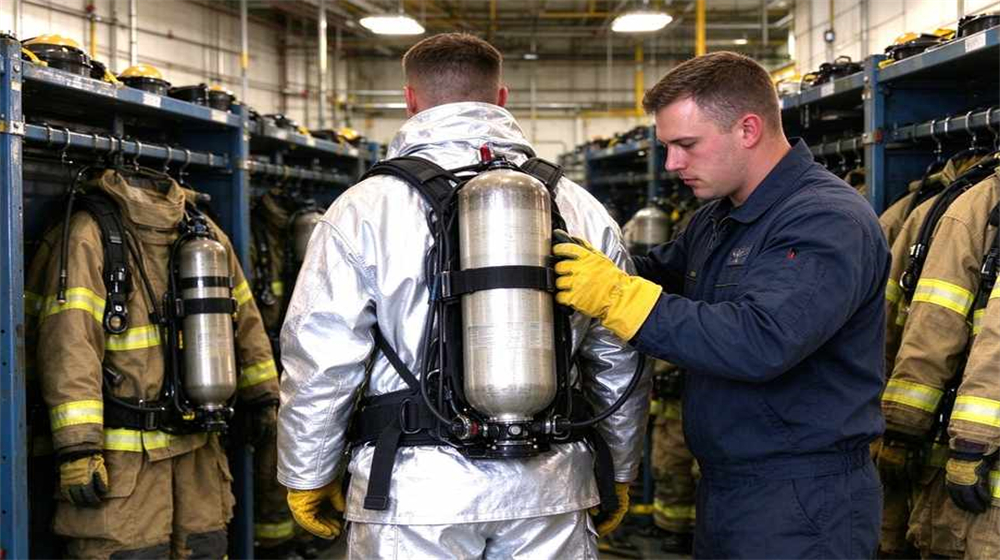
This suit is ordered for two families of work: industrial high-heat jobs where radiant heat and splash appear in short bursts, and rescue deployments where a team needs both heat protection and breathing air in the same event. The application lists below are typical, not exhaustive; the common thread is short exposure plus frequent movement.
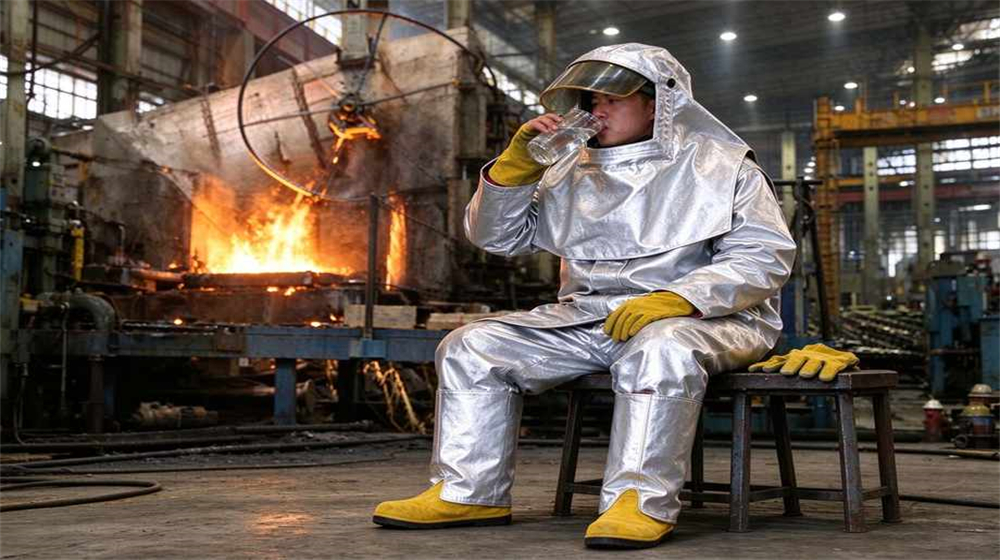
Power plants use the EU grade fire proximity suit around boiler doors, burner decks and inspection hatches, where opening a hatch releases a wall of radiant heat for the few seconds a worker needs to check or adjust. The same suit covers steam line and valve work in turbine halls, where surfaces hold heat long after the process stops.
Petrochemical plants specify it for furnace and reactor platforms. Around cracking furnaces and reformer tubes, radiant heat comes from every direction, and the reflective shell keeps the operator comfortable while the breathing set keeps the atmosphere out. For that reason the industrial fire suit with air cylinder appears on petrochemical emergency response lists as standard kit.
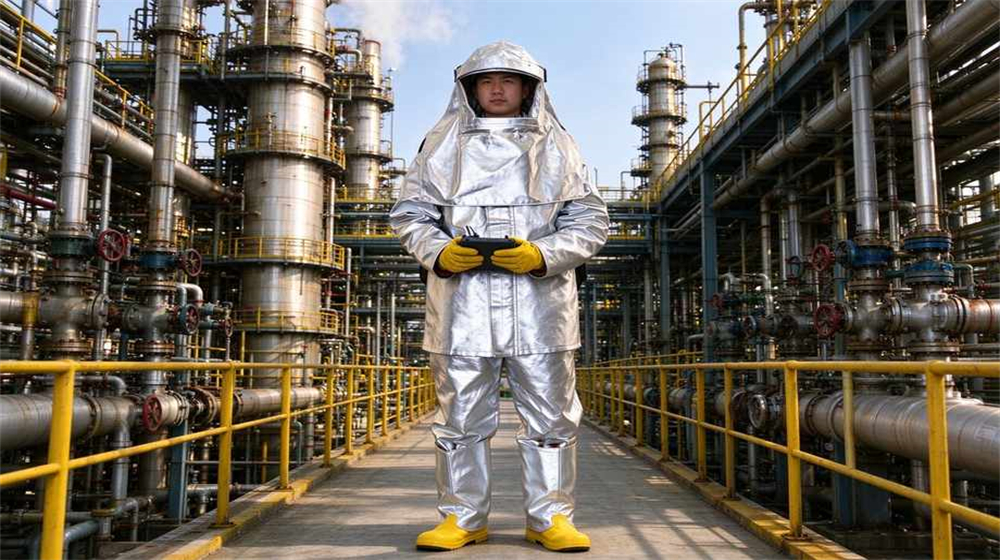
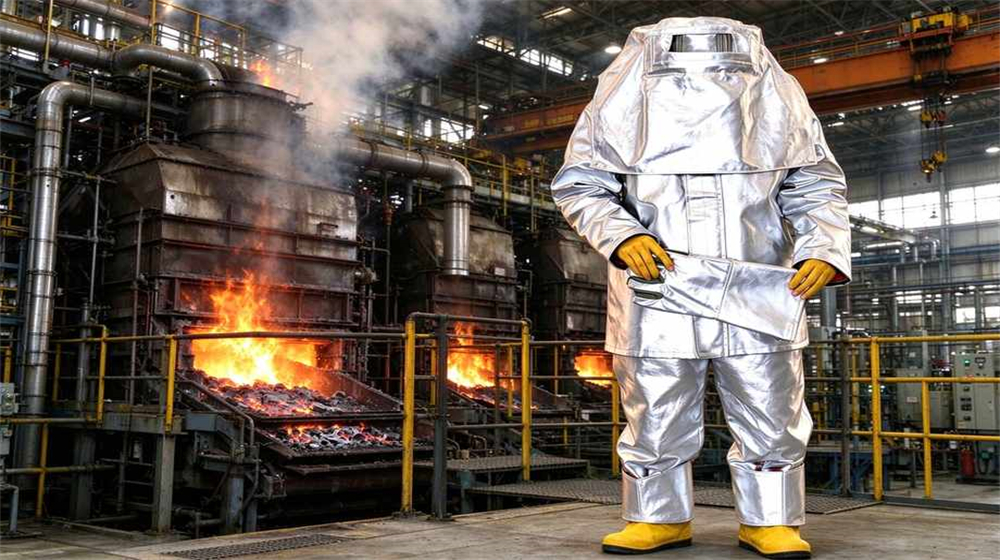
Boiler platform inspections and stack access work also fit the suit. Walking a boiler top or an inspection platform is a route task, not a single point task, so the suit has to stay comfortable for the full route, which is exactly the balance the heavy duty construction is tuned for.
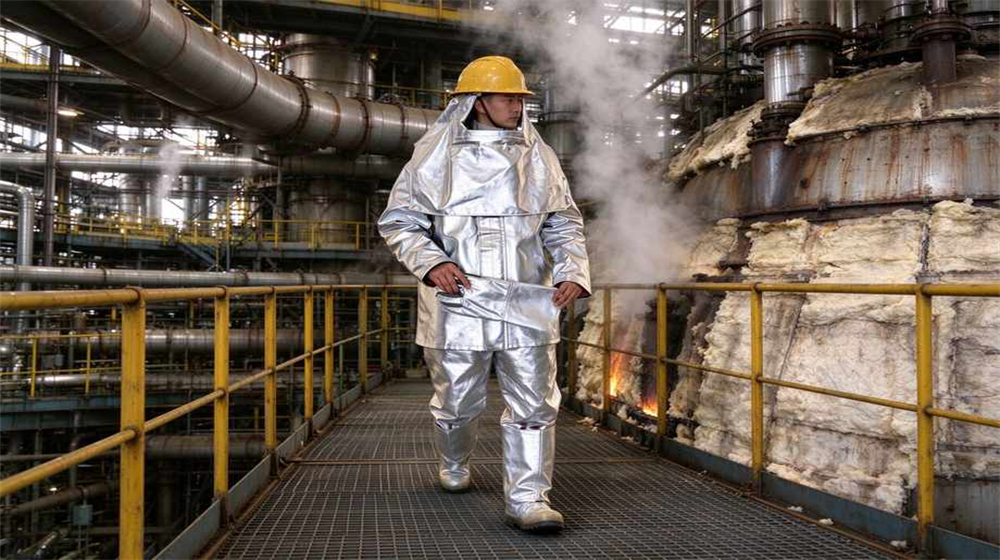
Industrial rescue teams carry this suit as part of their rapid-response kit. In a plant emergency, the first crew to reach a hot area may need to enter for a short rescue, and the rescue team heat suit with SCBA gives them both the thermal shell and the breathing air in one donning sequence. The same suit appears in municipal rescue units that respond to industrial calls.
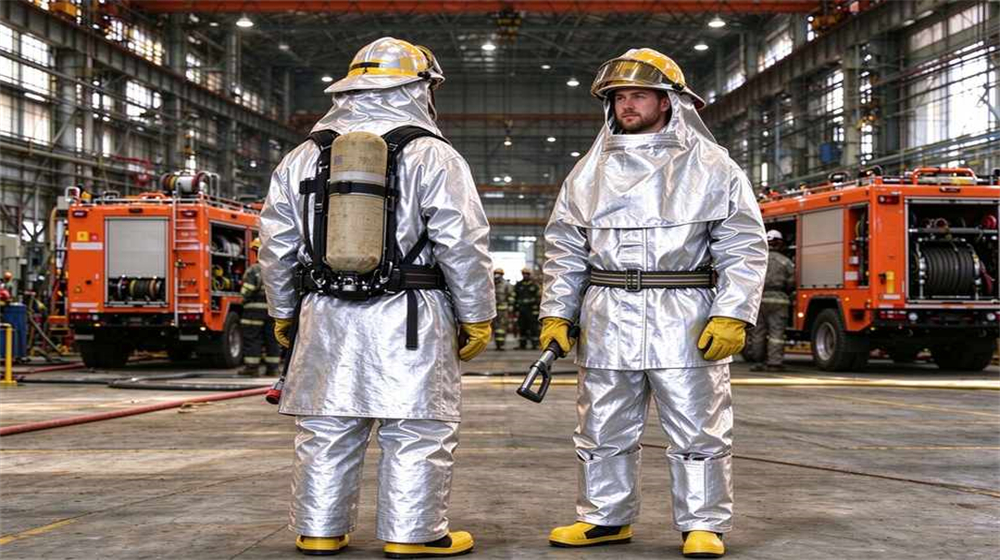
Deployment doctrine matters as much as the gear. Teams that standardise on one suit model train once and use the same routine across drills and incidents; the EU standard thermal suit is chosen for that consistency as much as for its performance grades. When the whole team wears the same configuration, the two-person donning check becomes a habit rather than a special procedure.
For plant safety managers, the rescue deployment case usually starts with an audit question: which positions combine radiant heat with the need for breathing air? Boiler rooms, incinerator basements, furnace platforms and chemical reactor areas come back on almost every list, and each of those answers points to the same configuration: a heavy duty proximity suit with the SCBA backpack built in.
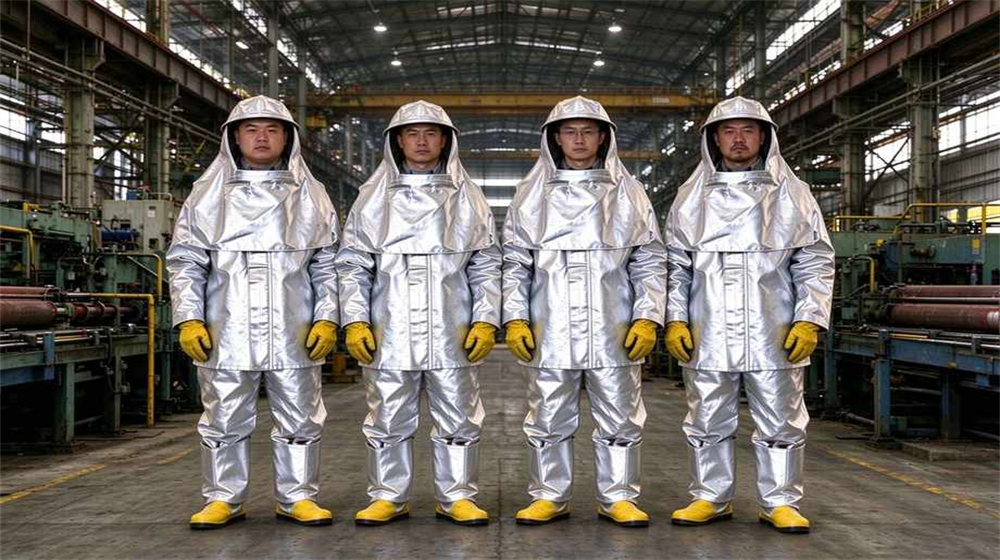
Heat stress management is the operational side of the same decision. In hot environments, crews work in shorter rotations and use relief periods between exposures, and the suit choice affects how long a rotation can safely run. A reflective heavy duty suit keeps the microclimate cooler for a longer working window than a non-reflective alternative, which is why plant supervisors treat the suit specification as part of the heat-stress control plan rather than a separate purchase decision.
Procurement for this category usually runs as a system decision rather than a single-item purchase. The plant safety team defines the exposure profile, the purchasing team compares EN certified suppliers, and the warehouse team checks that the full set arrives with matching documentation. Because the suit ships as a complete configuration, a wholesale order simplifies that chain: one supplier, one compliance file, one size split, and accessories that are guaranteed to match the suit rather than sourced from separate vendors.
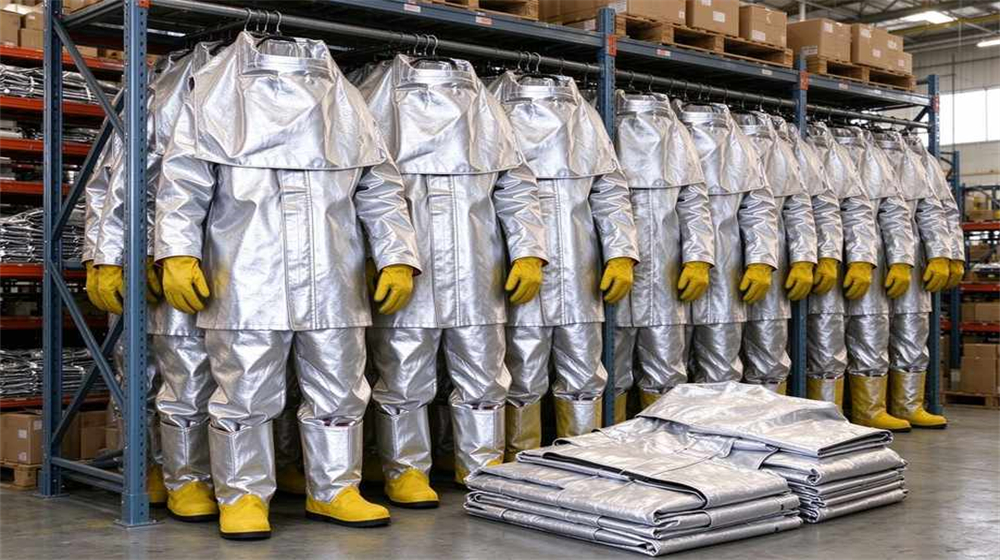
For distributors, the same configuration decision drives reorder behaviour. Plants that standardise on one model reorder the same suit, the same spare hoods and the same gloves, which is why suppliers keep the configuration stable across batches. Ask the supplier how long the current configuration has been in production; a stable model means the next reorder matches the suits already issued to the crew.
Export packing follows the same discipline as the suit itself. Each set is folded with the hood and gloves positioned to avoid creasing the reflective face, and the carry bag keeps the complete kit together inside the carton. For overseas orders, the packing list shows the size split per carton, so the receiving warehouse can verify the delivery against the order without opening every box.
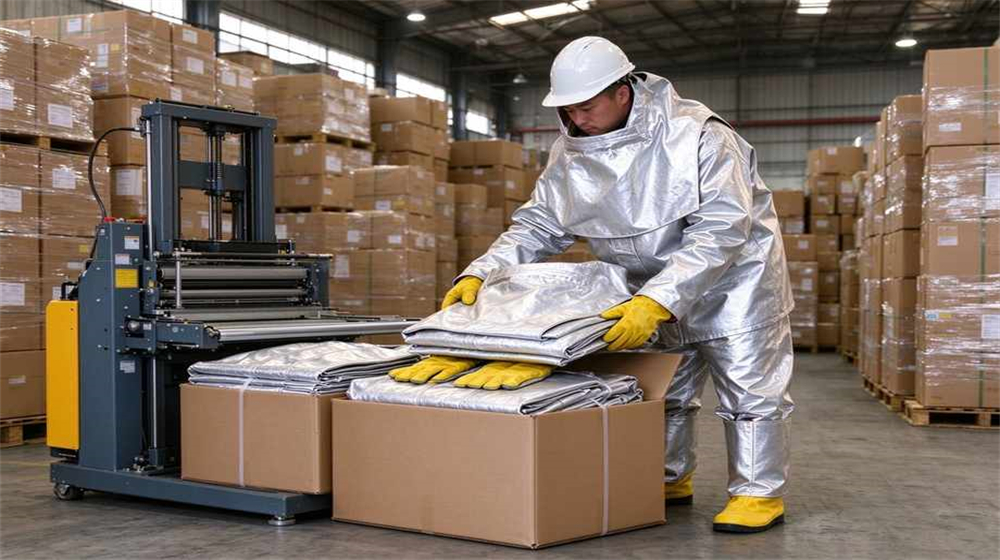
Protection only works if the suit fits, and a heavy duty suit has its own fitting logic because of the backpack panel and the extra insulation at the shoulders. The size range runs from L to XXXL, and the fitting rule is the same as for any layered heat suit: measure over the workwear the crew actually wears.
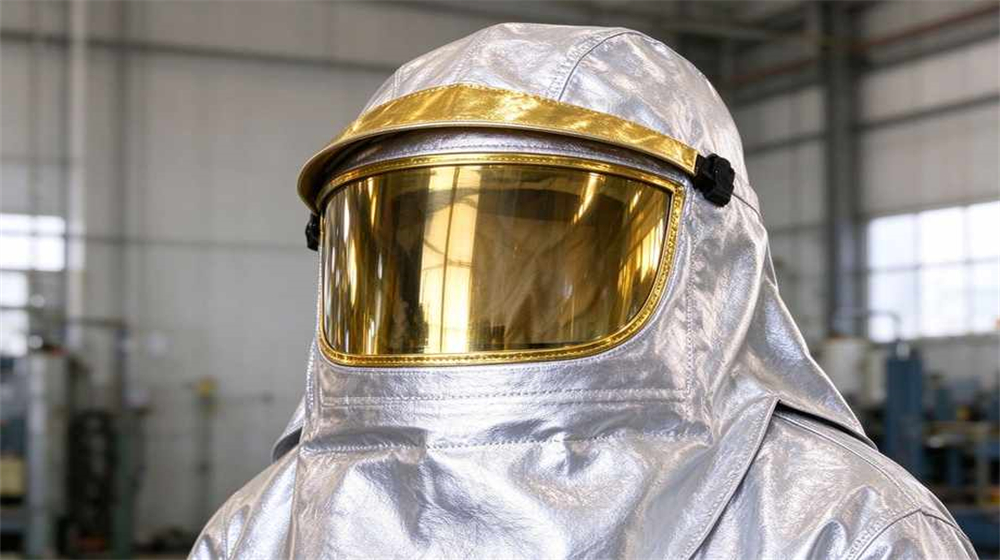
Measure chest, waist and height with the normal under-layer included, because the suit goes over existing clothing. A suit sized without that layer fits tight at the shoulders, restricts the reach, and puts stress on the seams at the wrong time. When a worker sits between two sizes, the larger size is the safer choice for movement and for the backpack panel to sit correctly.
Custom sizing is available through the OEM route. If your team includes a wider range of body types, the supplier can adjust sleeve length and rise on the bib pants while keeping the backpack panel geometry unchanged, because the panel position is tied to the protective performance, not just the fit.
Size
Chest cm
Height cm
SCBA Backpack
Approx. Weight kg
L
104-110
170-178
Fits 6.8L / 9L cylinder
Confirmed per order
XL
110-118
175-183
Fits 6.8L / 9L cylinder
Confirmed per order
XXL
118-126
180-188
Fits 6.8L / 9L cylinder
Confirmed per order
XXXL
126-134
185-193
Fits 6.8L / 9L cylinder
Confirmed per order
Send the actual crew measurements with the enquiry rather than just a quantity, and the supplier confirms the size split before production. That step is cheap and it prevents the most common reason a wholesale order gets re-cut.
The suit ships as a complete system. The hood carries the imported polycarbonate aluminized visor, which rejects radiant heat at the face while staying clear enough for the worker to see the work; the visor is the same material family used in the hood of the EU standard fire proximity suit line, so spare parts are interchangeable across orders.
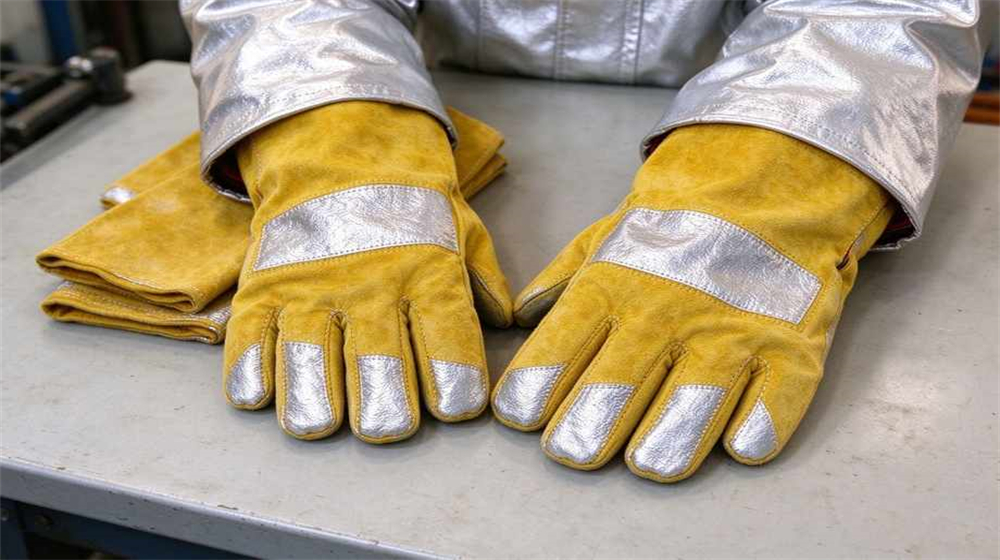
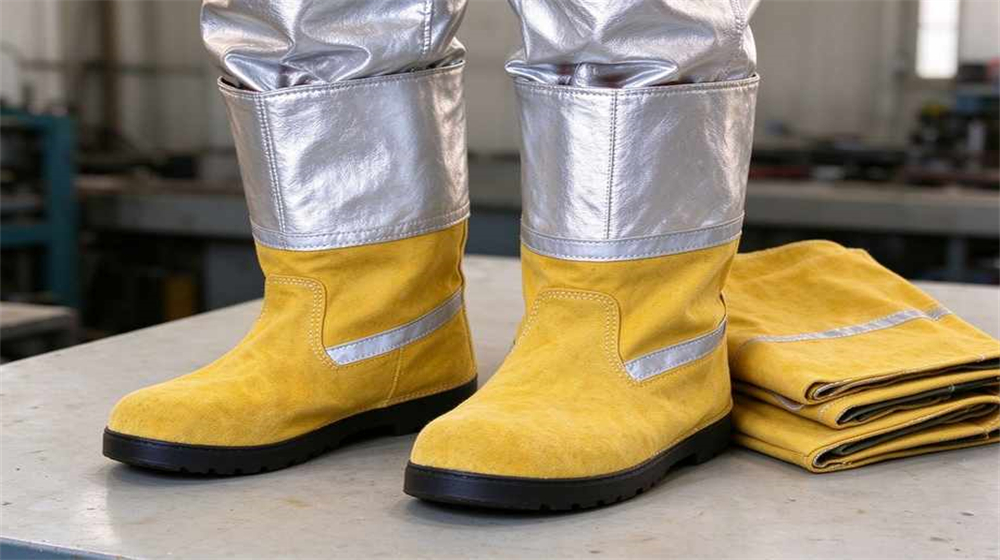
The aluminized gloves extend protection to the hands, where radiant heat is felt first when reaching toward a hot surface. The boot covers seal the lower legs against splash and hot debris, and the carry bag keeps the whole set together for storage and transport, which matters for rescue units that store the kit on a vehicle.
Two sizing mistakes show up in almost every enquiry. The first is measuring without the under-layer, which produces a suit that fits in the fitting room and binds on the job. The second is ordering a single size for a crew with a wide range of body types; splitting the order across sizes costs nothing extra on the unit side and avoids re-cutting the sleeves for the workers at the ends of the range. Both are easy to avoid by sending a simple three-line measurement table with the quantity.
Accessory
Function
Material / Note
Hood with visor
Face and neck protection
Aluminized polycarbonate visor
Aluminized gloves
Hand protection
Matched suit material
Boot covers
Lower leg protection
Aluminized shell
Carry bag
Storage and transport
Holds full kit
Each accessory is confirmed against the same standard documentation as the suit, so the complete system carries one consistent compliance file.
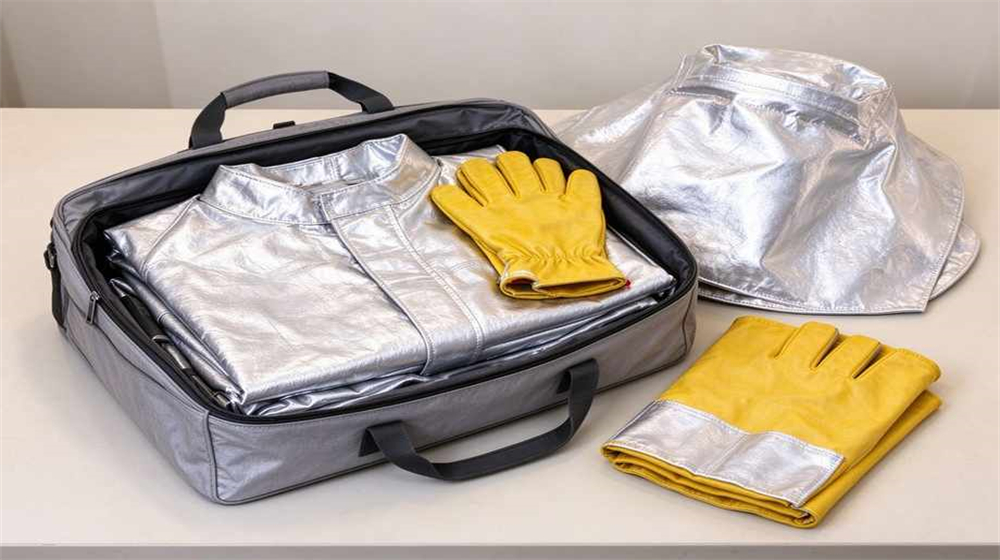
Storage and transport are covered by the carry bag, which holds the full set together. Store the suit fully extended on the hanger rather than folded tight, because creasing stresses the aluminized coating at the fold lines.
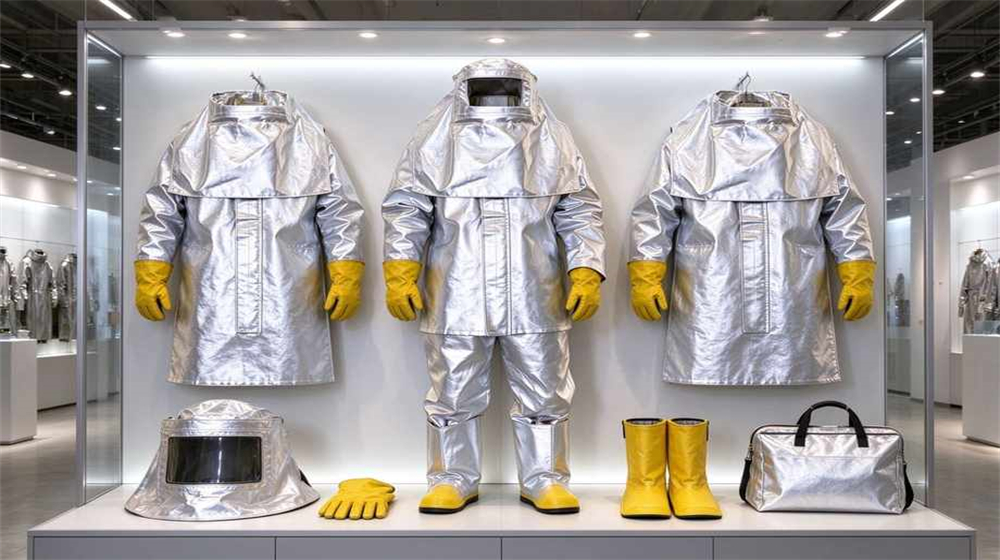
The configuration on this page is what buyers see at the showroom: jacket with backpack, bib pants, hood, gloves, boot covers and carry bag as one system — the same way the supplier ships it.
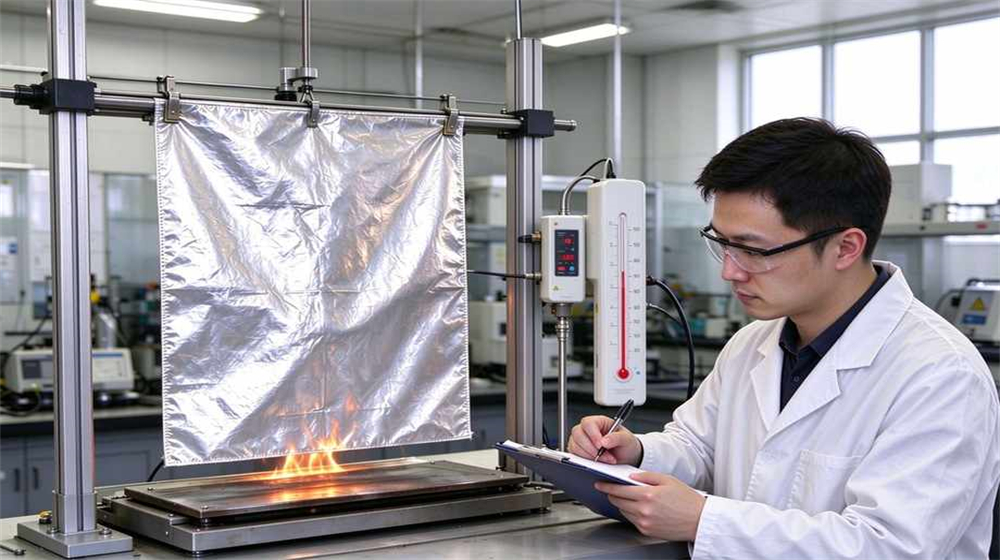
Certification frameworks differ by market; state your target market when enquiring.
A standard heat suit reflects radiant heat with a lighter laminate for short, frequent exposure. An EU grade heavy duty suit adds a thicker insulation core, reinforced shoulders, knees and elbows, and an integrated SCBA backpack for jobs where radiant heat, molten splash and breathing-air needs appear together.
The suit is designed for radiant heat exposure up to 1600°C during short tasks. The rating describes the radiant heat source the reflective face handles, not a contact temperature; actual protection depends on exposure time and distance. Confirm the rating and EN ISO 11612 grade set with the supplier.
What do the EN ISO 11612 grades A1 B1 C3 D3 E3 F3 mean?
Each letter-and-number pair is a tested property: A covers flame spread behaviour, B covers convective heat, C covers radiant heat, D covers molten metal splash, E covers heat transfer in the reverse direction, and F covers limited flame spread. Higher numbers are higher performance levels; C3 and D3 are the grades most relevant to furnace, boiler and casting positions.
Can the SCBA backpack fit our existing breathing apparatus?
The backpack pocket is sized for standard 6.8-litre and 9-litre cylinders with the valve facing down. Before ordering, confirm the cylinder model and valve orientation your team uses, because manufacturers differ. The suit is designed to work with standard industrial and rescue SCBA sets, and the supplier confirms compatibility for your specific model.
Is the SCBA compatible fire suit reusable after exposure?
Yes, it is reusable protective clothing for repeated hot-work shifts and drills. Service life depends on exposure intensity and care: inspect the reflective surface before each use, clean per the supplier's instructions, and store the suit on wide hangers away from heat and sunlight. The backpack frame and webbing are checked on the same schedule.
How is the air cylinder weight supported inside the backpack?
The jacket contains an aluminium backplate that spreads the cylinder load across the shoulder blades and lower back, plus a waist stabiliser that stops the cylinder from swinging during bending or climbing. The reinforced pocket keeps the load fixed, so the suit remains stable on ladders and platforms.
Inspecting the suit between uses is part of the reuse routine: check the reflective surface, the seams, the zipper and the backpack webbing, and keep a per-suit record so retirement decisions are based on condition rather than guesswork.
What applications is the heavy duty heat suit specified for?
Typical positions include power plant boiler doors and inspection hatches, petrochemical furnace and reactor platforms, waste incineration combustion chambers, and industrial rescue deployments. The common profile is short radiant exposure plus frequent movement, often combined with the need for breathing air in the same event.
What sizes are available and how do we measure?
The size range runs from L to XXXL. Measure chest, waist and height over the normal workwear layer, because the suit goes on top of existing clothing. If a worker sits between two sizes, choose the larger size for movement and correct backpack panel positioning. Custom sizing is available through the OEM route.
Can we order the EU grade heat suit with matching accessories?
Yes. The complete configuration includes the jacket with backpack, bib pants, hood with aluminized visor, aluminized gloves, boot covers and a carry bag. Ordering the full set from one supplier keeps the protection level consistent across every part and keeps one compliance file for the whole system.
What is the minimum order quantity for the heavy duty proximity suit wholesale?
MOQ depends on the model and customization level: regular models are more flexible, while customized orders carry higher minimums because of the production setup. Price, lead time and MOQ are confirmed per order and stated in the contract, so the practical step is to send your quantity, target market and end use for a current quotation.
What materials make up the layered construction of the 1600°C suit?
The shell is a composite base fabric of aluminum foil combined with special high-temperature fibers, finished with the Costmir® aluminizing process, and stitched with aramid fire-resistant thread. The inner layer is a permanently flame-retardant lining. The high-reflectivity aluminized outer shell reflects radiant heat at the surface, while the flame-retardant lining adds a second protection layer against conductive heat and hot particles.
Can this EU grade suit protect against molten metal splash?
Yes. The EU1600 configuration is designed to block molten iron and aluminum splash while reflecting radiant heat, and it also guards against metal liquid and light particle splash. That makes it a practical choice for metal smelting, foundry and forging positions where molten metal can splash during tapping, pouring or transport.
What kind of visor is used on the hood?
The hood window uses an imported polycarbonate aluminized visor. The aluminized coating reflects radiant heat away from the face, while the polycarbonate base keeps the window impact-resistant and optically clear, so the wearer keeps a full field of view near furnaces and hot equipment.
Related: Browse EU-standard 1600°C suits – view the full heat suit range for power, petrochemical and rescue applications
Email us anytime for samples, size charts, pricing and current quotations – info@yrftextile.com
EN ISO 11612 standard overview · SCBA system reference · OSHA heat exposure guidance
YIROUFANG TEXTILE (YRF)
Protective clothing manufacturer based in China – serving wholesale, OEM and export orders worldwide.
Email: info@yrftextile.com · MOQ, lead time and price confirmed per order and stated in the contract.
Standards referenced per market: EN ISO 11612, EN and NFPA frameworks – request current test reports and certificate numbers for the ordered model before ordering.
Previous :
Firefighter Proximity Suit | 500°C Near-Fire Heat ProtectionNext :
Firefighter Turnout Gear | 3-Layer TPP 35.8 NFPA 1971 Wholesale Deep Blue Firefighting Suit Set, Forest Fire Fighting Specialized, Full-body Protection
This Deep Blue firefighting suit set is specially designed for forest fire fighting, using special flame-retardant fabric that can withstand 700°C open flames in the wild, with a thermal protection value (TPP) of 25CAL/AM2. The vivid Deep Blue color combined with enhanced reflective strips enables identification from 500 meters away in forest smoke. The lightweight design of only 4.5KG does not affect mountain action speed, with a waterproof rating >40KPA, adapting to camping fire fighting and long-term field operations. The anti-plant puncture design increases wear resistance by 50%, making it professional equipment for forest firefighting, mountain rescue, and outdoor fire fighting actions, providing all-around body protection for forest firefighters.
 High-temperature Resistant Firefighting Suit Set, Emergency Rescue, Quick-wear
This high-temperature resistant firefighting suit set is made of professional-grade flame-retardant materials, capable of withstanding extreme temperatures up to 750°C, with a thermal protection value (TPP) of 26CAL/AM2, providing reliable protection for emergency rescue. The innovative quick-wear design allows complete dressing in 40 seconds during emergencies, with hydrostatic pressure resistance >45KPA and excellent breathability. Designed according to ergonomic principles, weighing only 4.8KG, it effectively reduces the burden on rescue personnel and is suitable for high-risk scenarios such as building fires, tunnel rescues, and industrial firefighting, making it an ideal equipment choice for professional firefighting teams.
 Professional Firefighting Suit Set, Flame-retardant Protection, Rescue Essential, 14-3C Certified
This professional firefighting suit set is made of high-grade flame-retardant cotton fabric, 14-3C certified, capable of withstanding extreme temperatures up to 800°C, with a thermal protection TPP value of not less than 28CAL/AM2. The three-layer composite protection structure, with waterproof static pressure resistance >50KPA and breathability >5000G/M²·24H, ensures comprehensive safety for rescue personnel in complex environments such as building fires, forest fires, and special chemical plant fires. Available in three models: 97/02/14, meeting different rescue scenario requirements.
 02 Firefighting Suit Multi-layer Composite Material Rescue Protection
This Type 02 firefighting suit is made of professional flame-retardant materials with excellent heat resistance, fire protection grade meeting international rescue standards, and waterproof puncture resistance rate of 98%. The deep blue body is equipped with eye-catching yellow reflective strips, increasing night visibility by 85%. The complete six-piece configuration provides comprehensive protection for firefighting, forest firefighting, earthquake rescue, and other scenarios, providing reliable protection for 300+ professional rescue teams.
 Forest Fire Rescue Service with Heat-Resistant Design
This professional forest fire rescue service uses flame-retardant heat-resistant material, achieving GB8624-A2 fire rating standard with heat resistance up to 800°C, and features high-visibility reflective strips visible from 300 meters away. It's suitable for emergency rescue scenarios such as forest fires, mountain rescues, and industrial disasters, providing comprehensive personal safety protection. Each set has undergone 10,000 abrasion tests and proven its reliability and safety in over 1,500 rescue operations nationwide.
 Fire Rescue Cap, Aramid Flame-Resistant Material, Forest Fire Emergency
This professional-grade forest firefighting vest and hat set is made of polyester/cotton blended flame-retardant fabric, with reflective visibility up to 300 meters, capable of resisting short-term flame contact, improving protection efficiency by 85%. The bright orange design with double-layer reflective strips complies with international rescue standards, ensuring 360° visibility in smoke and low light environments. Suitable for forest fire fighting, wilderness emergency rescue, post-earthquake sites, and other emergency disaster relief scenarios, providing comprehensive protection for rescue personnel.
Copyright © Custom Disaster - Relief Bedding: Tents, Sleeping Bags, Blankets All Rights Reserved
the professional team to service !