For a broader overview of how emergency relief blankets fit within the emergency supply system, readers may also consult the companion article on this site, Complete Guide to Complete Guide to Emergency Relief Blankets | Post-Disaster Resettlement · Government Stockpiling · NGO Aid (2026), which provides foundational knowledge behind the selection details covered here.

I. Product Positioning and Scene Adaptation
Post-disaster resettlement emergency relief blankets are purpose-built supplies for distribution at resettlement sites, emergency shelters, and government stockpile programs. The critical difference from household blankets lies not in appearance, but in the hygiene performance, durability, and storage adaptability required under mass-use conditions.
Blankets deployed at resettlement sites must endure damp conditions, overcrowding, repeated disinfection cycles, and frequent handling. These demands taken together already exceed the design parameters of most consumer products.
Different procurement roles prioritize different criteria. Government emergency departments focus first on standards compliance, completeness of quality inspection reports, and convenience of large-scale stockpile rotation management. NGO emergency relief blanket program managers pay more attention to unit cost, cross-border customs support capability, and performance compatibility with destination-country climates. Organizations procuring for UN humanitarian relief blanketprograms additionally need to confirm compliance with United Nations procurement framework requirements on specifications, labeling, and test documentation. Foreign trade distributors tend to evaluate supply continuity and custom packaging support.
II. Emergency Relief Blanket Material Selection: How to Read the Four Core Parameters in a Specification Sheet?
Fill Type
Fill type is the primary variable affecting warmth-to-weight performance. In bulk emergency relief blanket procurement, the most common fill options are:
Pure cotton fill: Good breathability and comfortable skin contact, suitable for short-to-medium-term resettlement in temperate climates. However, cotton absorbs moisture slowly and dries poorly, making it prone to mold in humid environments — particularly relevant for long-term stockpile projects.
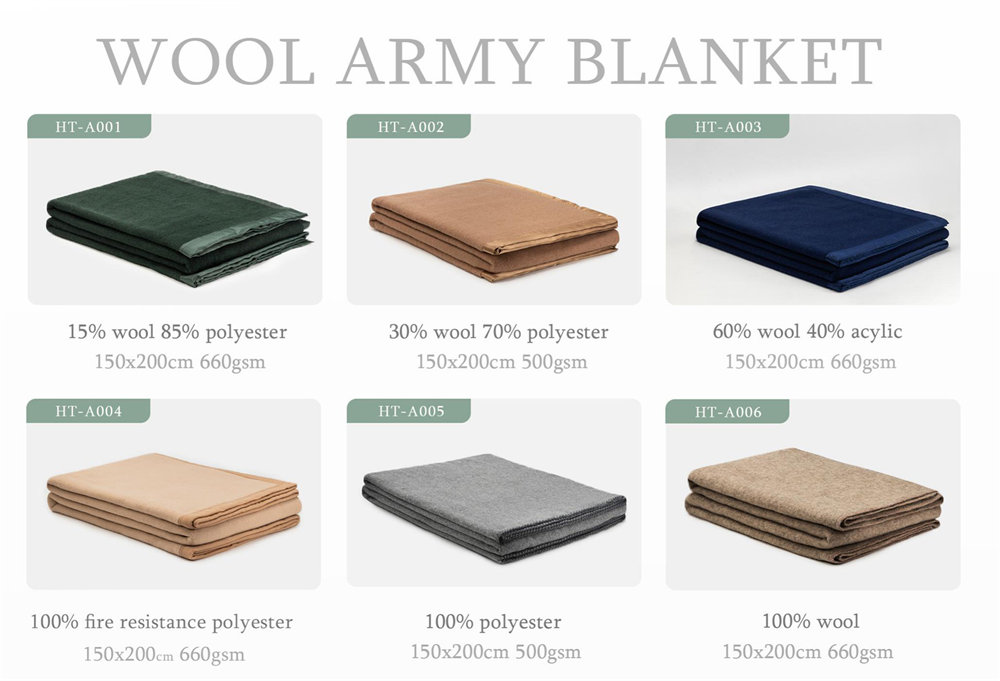
Polyester fill (including hollow-fiber polyester): Lightweight, fast-drying, and significantly more mold-resistant than cotton. Currently the mainstream choice in bulk emergency relief blanket procurement. High gram weight hollow-fiber polyester approaches cotton in warmth performance at relatively lower cost.
Wool or cashmere fill: Excellent natural insulation, moisture-wicking, and comfortable for extended use without excessive heat buildup. Well-suited for cold-climate medium-to-long-term resettlement and commonly specified in higher-standard aid programs or dedicated distributions for elderly persons, children, and injured individuals.
On safety standards: priority should be given to factories with ISO-certified emergency relief blanket production credentials and OEKO-TEX certified products, confirming the absence of substances harmful to human health. For dedicated distributions to children and injured individuals, OEKO-TEX certification should be written into the contract as a mandatory threshold.
III. Scene-Specific Functions and Details
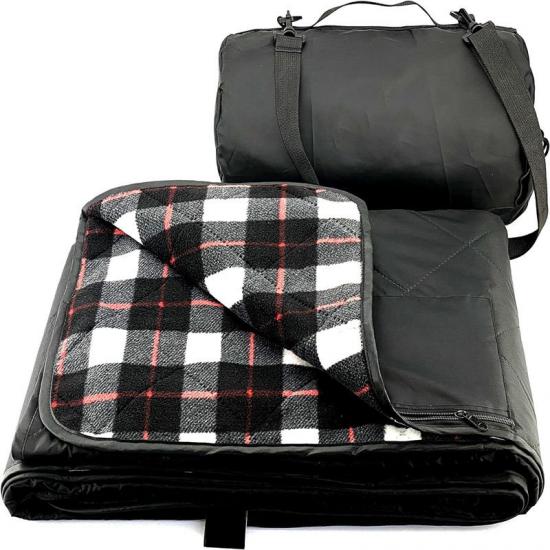
Emergency relief blanket rapid distribution requires standardized folding, clear batch labeling, and controlled single-item weight to facilitate manual handling. Uniform color simplifies on-site counting and collection, while clear batch labels help differentiate multiple arriving shipments. Labels should carry at minimum: batch number, production date, material description, and applicable climate guidance.
Disinfection convenience is the key factor determining actual service life in medium-to-long-term resettlement operations. Fabrics that withstand standard disinfection procedures yield significantly more reuse cycles than single-use thin products. In resettlement sites with high population turnover, anti-mold antibacterial emergency relief blankets that cannot withstand regular disinfection effectively multiply the cost per use cycle.
IV. Specification Categories and Selection Guide: How to Choose Between Basic and Enhanced Configurations?
Dimensions and Emergency Relief Blanket Size Specifications
The standard emergency relief blanket size specification of 150×220 cm accommodates the height range of most adult men and women while facilitating uniform stacking and packaging. When the project includes distribution to elderly persons or children, it is advisable to allocate different size proportions within the order rather than specifying a single universal size.
Two-Tier Configuration Framework
Basic configuration (suitable for temperate and tropical short-term resettlement): medium gram weight, polyester shell, standard mold-resistant treatment, compact folded dimensions, and controlled single-item weight for efficient batch handling and storage.
Enhanced configuration (suitable for cold regions and winter medium-to-long-term projects): high gram weight wool or high-density hollow-fiber polyester fill, TPU waterproof-coated shell, higher tensile strength requirements to support durability in repeated-use and semi-outdoor resettlement conditions.
Both tiers can be combined within a single order — for example, 70% basic configuration plus 30% enhanced configuration — differentiated by color coding for field distribution by population category.
Vacuum Compressed vs. Standard Folded
Vacuum compressed emergency relief blankets reduce folded volume significantly, resulting in meaningfully higher per-pallet load counts compared to standard folded products. The cost difference in international sea freight and long-term warehouse rental can be considerable. Suppliers should be asked to provide compressed per-unit volume figures and per-pallet load quantities for accurate container-loading budget planning. For projects with limited stockpile warehouse space or multiple transshipment requirements, vacuum compressed products typically offer superior logistics cost efficiency.
V. Price and Total Cost Considerations
Unit price is not the sole decision criterion. In government procurement emergency relief blankets and NGO programs, total cost encompasses far more than the purchase order value:
Service life and attrition rate: Properly specified emergency relief blankets typically achieve a design service life of approximately 4 years. Products with poor construction sustain high damage rates during repeated distribution and collection, with replacement costs quickly accumulating well beyond the initial price advantage.
Thermal retention test data: Two products with comparable gram weights may vary meaningfully in thermal retention performance. Requiring suppliers to provide thermal retention efficiency test data produces a more reliable warmth assessment than relying on gram weight alone — particularly important for cold-region projects.
Storage and transport costs: The volume advantage of vacuum compressed emergency relief blankets can produce substantial savings in international freight and long-term warehouse rental, and should be incorporated into the overall budget model at the specification stage.
Acceptance failure risk: A single failed acceptance inspection typically results in an entire project timeline delay, affecting subsequent fund disbursement and partnership assessment. These hidden costs are routinely underestimated at the evaluation stage, yet can generate losses far exceeding the per-unit price difference.
Six-Step Procurement Process
Step 6: Incoming acceptance and archive management — complete acceptance inspection per checklist; archive contracts, communication records, acceptance reports, and payment records for audit and project review purposes.
Incoming Acceptance Checklist
(1)Appearance and workmanship: Inspect a sample quantity for tears, stains, excessive loose threads, or significant color variation.
(2)Gram weight and dimensions: Measure against contracted values (e.g., 150×220 cm, gram weight range); verify deviations remain within allowable tolerance.
(3)Tensile strength verification: For high-frequency distribution projects, review tensile strength test reports against specification requirements.
(4)Waterproof and mold resistance testing: Verify TPU coating performance data or arrange third-party testing as required; confirm that antimicrobial treatment is fiber-integrated rather than surface-applied.
(5)Packaging and labeling: Verify packaging integrity, batch label content, and language labeling compliance against agreed specifications.
(6)Quantity verification: Confirm actual received quantity matches packing list and contract.
Problems identified at the acceptance stage can still be resolved through replenishment or replacement. Once supplies enter the distribution flow after warehouse receipt, the cost of remedy and re-procurement multiplies considerably. Accepting non-conforming goods under time pressure is one of the most consistently cited risk factors in emergency supply project post-mortems.
High-Frequency Commercial Questions
Q: What is the minimum order quantity? Is there flexibility for small-volume projects?
A: Standard bulk MOQ varies by specification configuration. Small-volume trial orders for project verification are supported; per-unit pricing for trial orders is typically higher than bulk pricing, which is standard industry practice. For inquiries with a clearly defined project background, providing the project type and estimated scale upfront helps suppliers assess feasibility and provide a more accurate pricing range.
Q: What is the typical lead time for a mid-scale order? Are expedited delivery arrangements available?
A: The standard production cycle for mid-scale orders is typically approximately 2–4 weeks, depending on specification configuration and current production scheduling. For time-sensitive emergency relief blanket rapid distribution needs, lead times can be compressed to some extent through priority scheduling. The specific capability for each project must be jointly assessed before contract signing, with final delivery dates confirmed in the contract. Earlier communication about capacity reservation consistently improves expedite feasibility.
Q: What is the approximate monthly production capacity? Can supply continuity be guaranteed for large-scale projects?
A: Professional factories typically operate multiple production lines with corresponding equipment, capable of handling mid-scale emergency project volumes. For large-scale projects, it is advisable to discuss capacity reservation and phased production planning in advance, and to specify key milestone delivery quantities in the contract while retaining rolling replenishment flexibility rather than concentrating all requirements into a single batch.
To obtain technical specification template examples or acceptance checklist samples suitable for use in tender documents, contact YRF Emergency Relief Supplies through the site contact form with a brief project background description. YRF will provide generic examples for internal reference and benchmarking purposes, without involving any specific client information. Final terms are subject to the formal contract executed by both parties.
VIII. Common Procurement Pitfalls and Risk Alerts
Error 1: Substituting standard household blankets for professional emergency relief supplies
"Error type: Procuring supermarket household blankets for resettlement site distribution.
Likely consequences: Products without anti-mold antibacterial emergency relief blanket treatment develop mold within days in humid environments; fails project acceptance and creates hygiene risks.
Prevention: Specify ""bulk distribution at post-disaster resettlement sites"" as the explicit use case in technical documents; require corresponding quality inspection reports."
Error 2: Missing or vague gram weight specifications
"Error type: Contract specifies only ""single-person blanket, suitable insulation.""
Likely consequences: Delivered goods deviate from expectations on gram weight, dimensions, and fabric density; contract provisions cannot support legal remedy, resulting in large-scale on-site rejection and timeline delay.
Prevention: Draft a detailed specification document including gram weight range, tolerance, and fabric density requirements; use sample sealing to lock in bulk goods standards."
Error 3: Neglecting tensile strength, resulting in widespread damage in high-frequency distribution
"Error type: Specification focuses only on gram weight and waterproof rating; tensile strength is not included in acceptance criteria.
Likely consequences: Blankets tear extensively during high-frequency distribution, collection, and handling; damage rate far exceeds estimates; replacement costs exceed the original price savings.
Prevention: Include tensile strength requirements in the technical specification document; conduct tensile strength testing during sample sealing before finalizing."
Error 4: Failing to maintain selection documentation during emergency procurement
"Error type: Urgent order placed during a disaster without retaining supplier selection rationale or basic price comparison records.
Likely consequences: Post-project audit disputes arise; decision-makers face accountability questions, placing the entire project review in a defensive position.
Prevention: Even with simplified procedures, retain a one-page requirements brief, supplier selection rationale (covering quality, lead time, and relevant project experience), and a basic price reasonableness statement."
IX. Advantages of Sourcing Emergency Relief Blankets from China
In most projects, emergency relief blankets are procured alongside emergency tents, first aid kits, folding beds, and rescue clothing rather than in isolation. Consolidating procurement with a Chinese emergency relief blanket supplier capable of multi-category supply reduces separately managed supplier relationships and lowers logistics coordination costs and customs complexity.
China's supply chain offers the following relative advantages in bulk emergency relief blanket procurement:
Complete industrial chain: From raw cotton and polyester fiber to finished fabric and accessories, coordinated capacity within industrial clusters is well-established, reducing the risk of supply disruption during demand surges by enabling multi-factory collaboration.
Substantial production capacity reserves: Established factories have experience managing mid-to-large-scale and emergency expedited orders; priority scheduling can, to some extent, support urgent post-disaster resettlement emergency relief blanket supply needs — a meaningful advantage when disaster onset compresses response windows.
Mature export service capability: Familiar with customs requirements in common destination countries; able to provide neutral packaging, multilingual labeling, and full-container sea freight arrangements aligned with NGO and government aid project documentation requirements. For UN humanitarian relief blanket programs, certain factories also have experience supporting UN procurement framework documentation requirements.
According to publicly available information, the proportion of international aid projects sourcing emergency shelter and bedding supplies from China has increased in recent years, with comprehensive value and delivery capability cited as primary factors.
XI. Summary and Procurement Recommendations
Selecting qualified emergency relief blankets fundamentally requires defining standards accurately, writing clear specifications, completing thorough sample verification, and locking in critical contract parameters. Completing these four steps during the pre-procurement phase eliminates the majority of on-site complaints and acceptance disputes.
Recommended Next Steps:
(1)Prepare a one-page requirements brief: Document resettlement population size and composition, minimum temperature at the destination, intended use period, budget ceiling, and project acceptance requirements. This forms the foundation for all subsequent communication and inquiries.
(2)Draft a technical specification document: Using the indicator framework from Sections II and IV, include fill type, gram weight range, shell fabric density and thread count, tensile strength requirements, emergency relief blanket waterproof rating (TPU coating requirement if applicable), mold resistance treatment standard, dimensions (recommended 150×220 cm as the baseline specification), and labeling specifications.
(3)Request samples from 2–3 candidate suppliers: Require samples configured to the specification document; upon receipt, verify against the acceptance checklist in Section VII, with emphasis on measured gram weight, tensile strength test data, antimicrobial treatment method, and the actual compressed volume and per-pallet load count of vacuum compressed emergency relief blankets.
(4)Verify destination-country customs documentation requirements: Confirm with candidate suppliers the required certificates of origin, quality inspection reports (ISO-certified emergency relief blanket credentials, OEKO-TEX certificates), and emergency relief blanket size specification labeling standards. Identifying documentation gaps before goods ship prevents clearance delays on arrival.
(5)Lock in core parameters and non-conformity handling procedures in the contract: Including gram weight tolerance range, tensile strength requirements, sampling and inspection ratios, phased delivery milestones, and breach-of-contract provisions — committing all pre-negotiated standards to written form ensures acceptance has a reliable basis.
For mid-to-large-scale bulk emergency relief blanket procurement projects requiring integrated supply and technical specification support, project overviews may be submitted to YRF Emergency Relief Supplies via the website contact form. YRF will provide a supply configuration reference and key considerations to help reduce internal planning uncertainty during pre-tender preparation. Final terms are subject to the formal contract executed by both parties.
Primary Keyword: Emergency Relief Blankets
Long-Tail Keywords: post-disaster resettlement emergency relief blankets, bulk emergency relief blanket procurement, emergency relief blanket material selection, anti-mold antibacterial emergency relief blankets, high gram weight insulating emergency relief blankets, emergency relief blanket waterproof rating, government procurement emergency relief blankets, NGO emergency relief blankets, UN humanitarian relief blankets, Chinese emergency relief blanket supplier, emergency relief blanket rapid distribution, vacuum compressed emergency relief blankets, ISO-certified emergency relief blankets, emergency relief blanket size specifications, emergency relief blanket storage rotation
Friendly Links :
Copyright © Custom Disaster - Relief Bedding: Tents, Sleeping Bags, Blankets All Rights Reserved
the professional team to service !