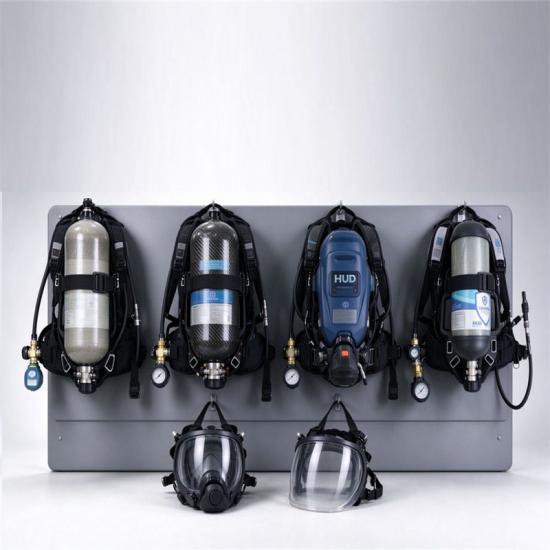
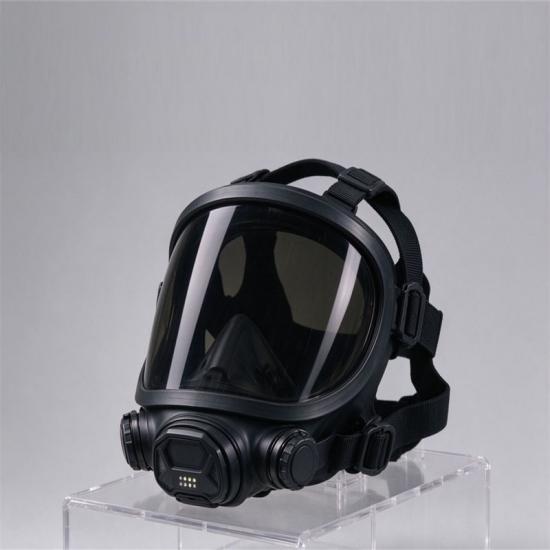
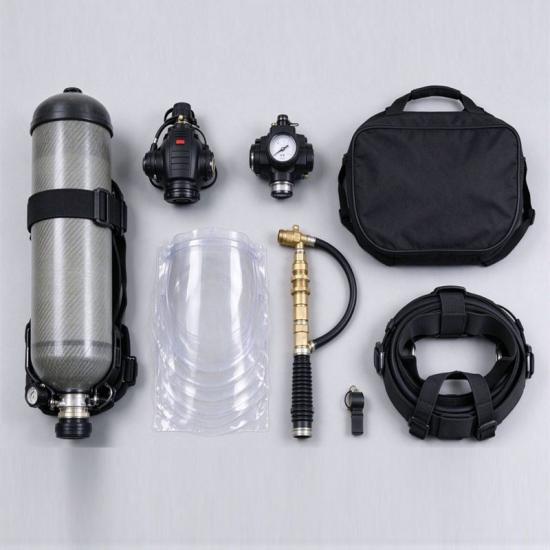
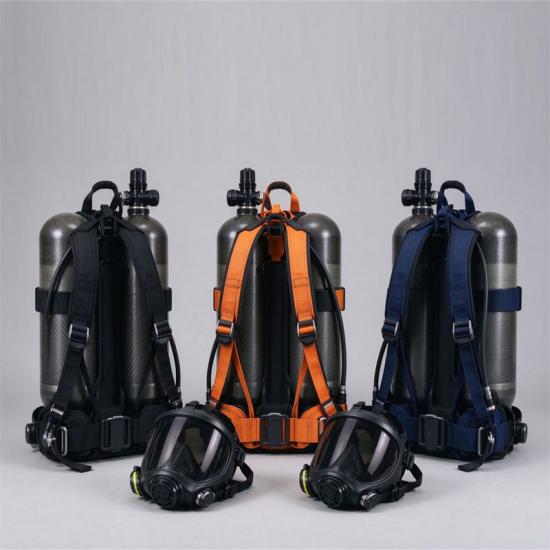
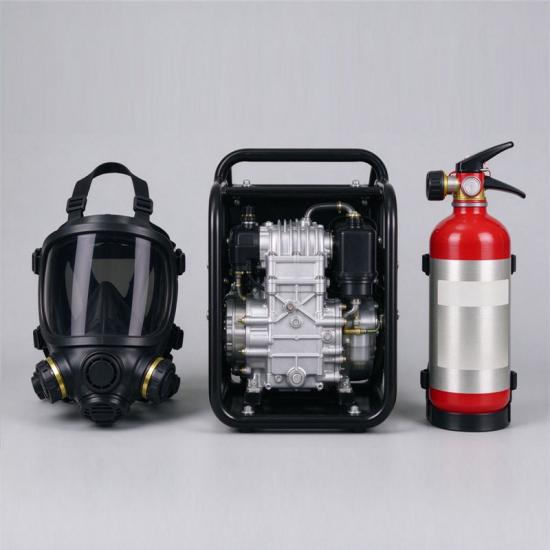
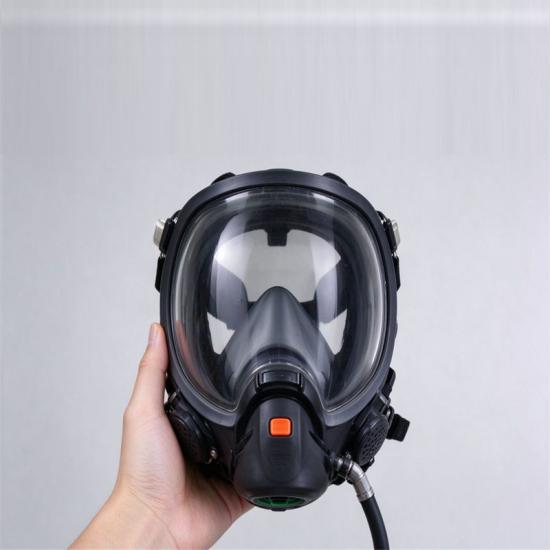
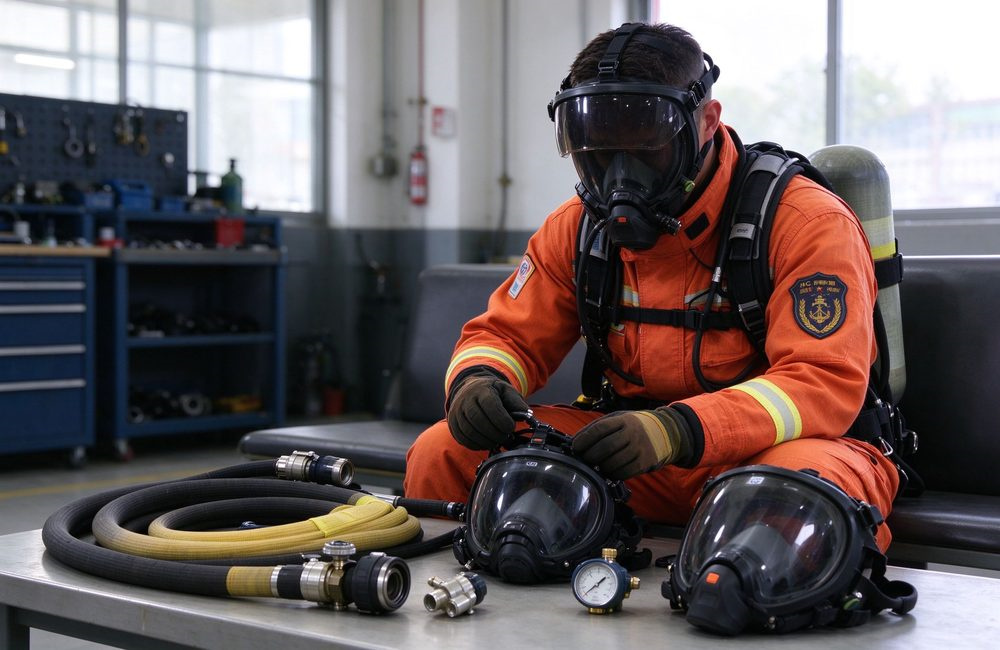
Apositive pressure SCBA is the breathing gear for smoke-filled, oxygen-deficient buildings and confined spaces. It pairs a 6.8L carbon fiber cylinder at 30 MPa working pressure with a full facepiece, a 5.5MPa low-air alarm, SCBA customization, wholesale bulk pricing, fire department procurement and government procurement.
Note: Price for reference only. Exact price based on quantity, size, weight and custom details.
model no. :
SQ-02market price :
$200.9sale price :
$100.9price range :
30-100/$100.9Color :
Multiple Colorsport of dispatch :
Guangdong/GuangzhouPayment :
TT, Paypal, Western Unionmin order :
30original region :
Made in ChinaLead Time :
5-15daysSize :
Customizable sizes |
 |

|
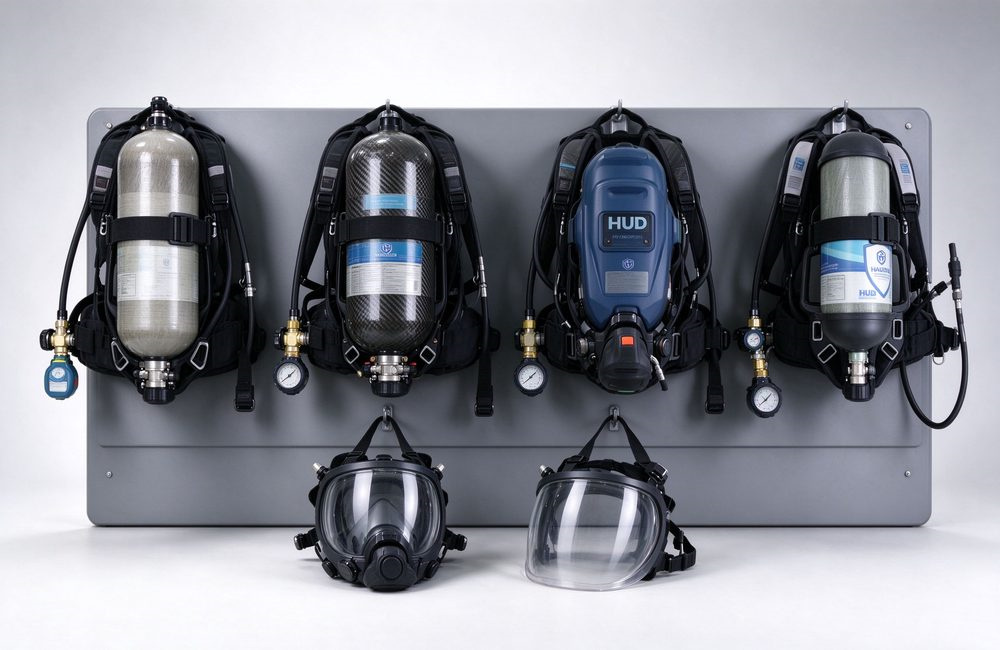
Our positive pressure SCBA lineup covers four air cylinder configurations in one unified backplate system. Steel air cylinder models serve training academies and budget-conscious municipal fleets, while 6.8-liter carbon fiber units are the standard choice for structural firefighting and industrial entry.
Every assembly shares the same first-stage regulator, second-stage demand valve, pressure gauge, and quick-connect harness, so spare parts and training transfer directly across models. Wholesale buyers can mix cylinder sizes within a single order to match different station roles without stocking separate harness systems.
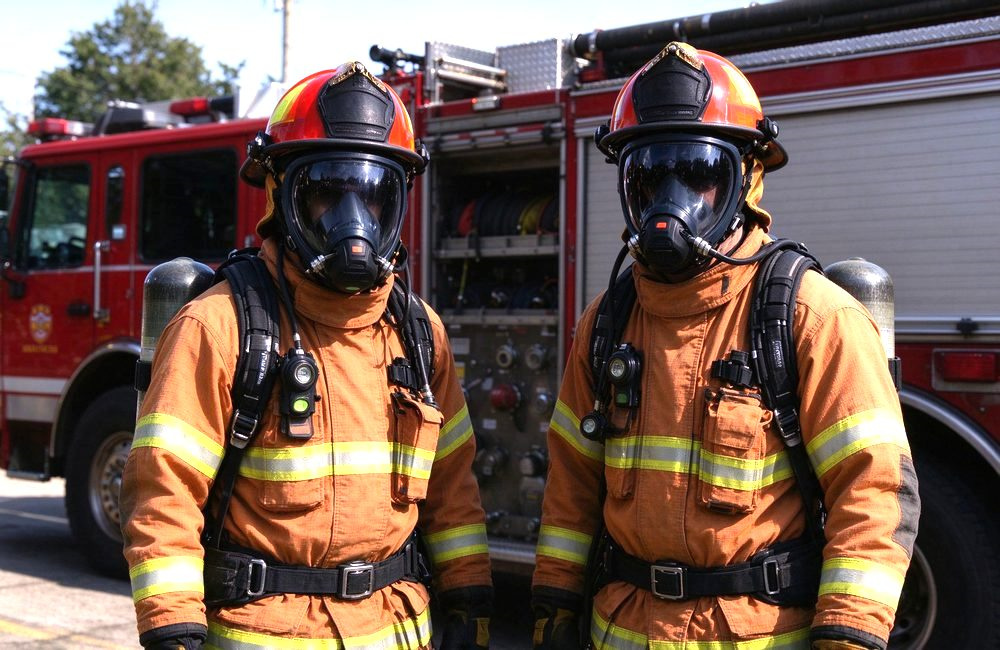
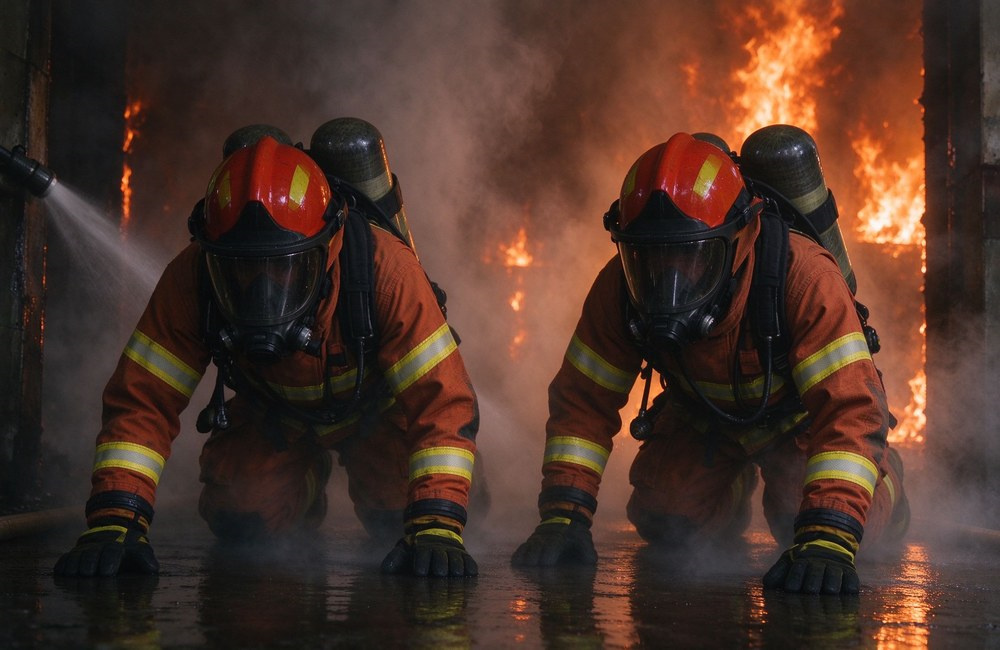
Inside a burning structure, visibility can drop to zero in seconds and the air temperature can exceed 200 degrees Celsius at ceiling level. A positive pressure SCBA keeps clean air flowing to the facepiece even when the surrounding atmosphere is thick with smoke, carbon monoxide, hydrogen cyanide, and superheated particles.
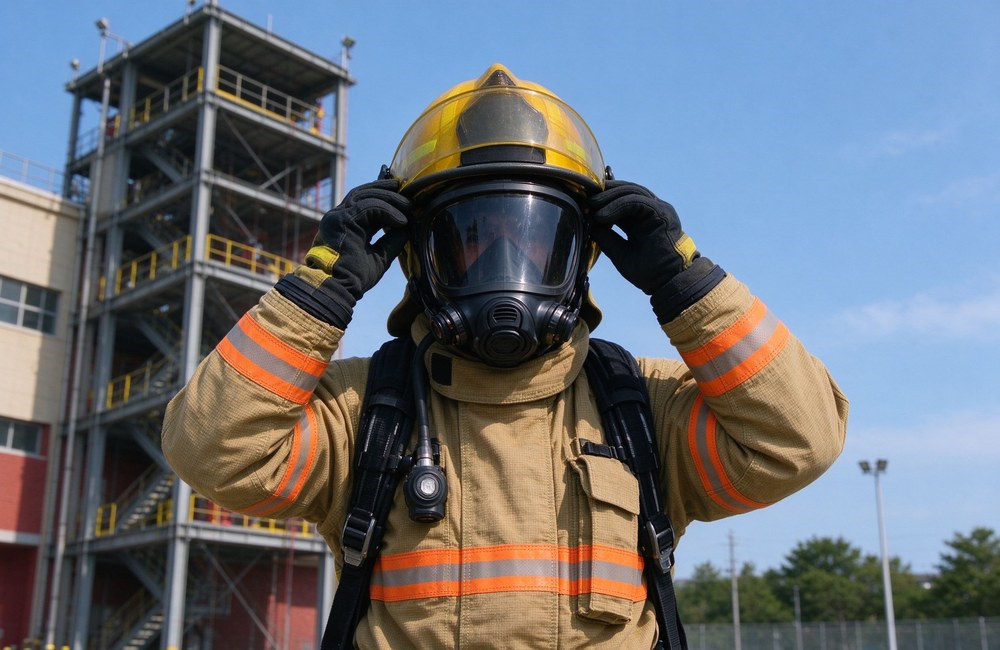
Firefighters train repeatedly in smoke-filled towers because muscle memory for donning, reading the pressure gauge, and managing air supply directly affects survival time on the fireground. Every second saved on a seal check or a pressure reading translates directly into working time inside the building.
An open-circuit positive pressure SCBA is not a single piece of equipment—it is a complete breathing system. Compressed air stored in the air cylinder passes through a first-stage regulator that drops pressure from 30 MPa to an intermediate level, then through a second-stage demand valve that delivers air only when the wearer inhales.
The harness, aluminum backplate, and padded straps distribute the 8-kilogram load across the hips and shoulders rather than the spine. A low-air alarm whistle and pressure gauge give two independent warnings before the air cylinder reaches empty, so no firefighter runs out without audible and visual notice.
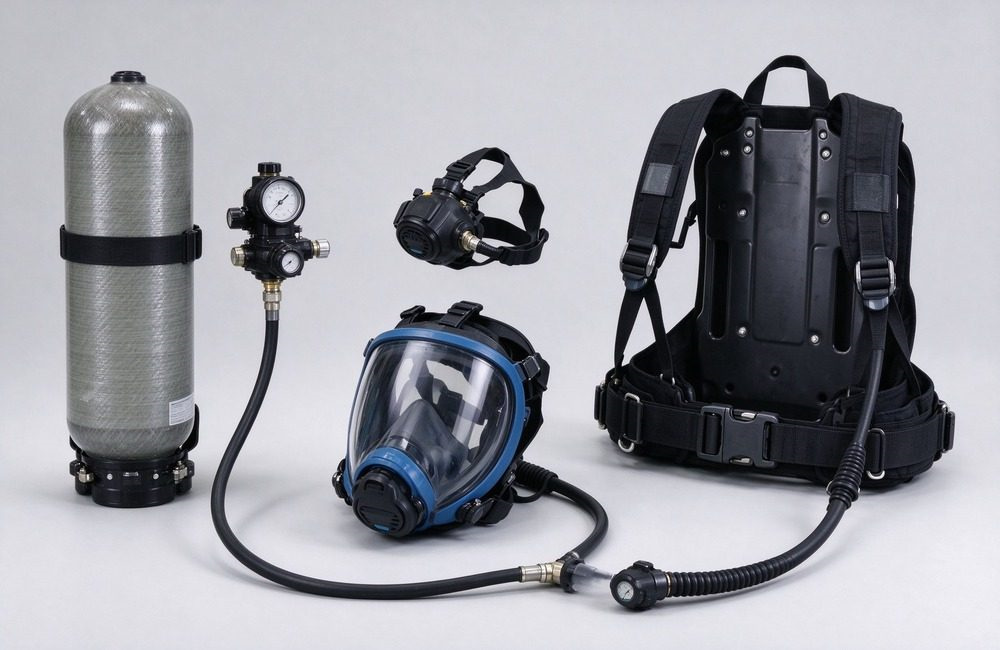
The choice between carbon fiber and steel air cylinders comes down to weight versus cost. A 6.8-liter carbon fiber cylinder weighs roughly 4.5 kilograms full and resists internal corrosion, making it preferred for long interior attacks and high-rise operations where every kilogram matters on the stairs.
A steel air cylinder costs less and tolerates rough handling in training academies, but adds 2 to 3 kilograms felt after 30 minutes on air. Both types pass the same hydrostatic testing, refill to 30 MPa, and fit the same backplate, so a wholesale fleet can mix both types by station assignment.
We supply open-circuit positive pressure SCBA tested to GA124, built around a 6.8L carbon fiber air cylinder rated for 65-minute duration with an integrated pressure gauge and low-air alarm.
Six models span steel training sets to HUD and communication units, available from 10 units at 20–30 day stock delivery with wholesale pricing that scales with order volume.
Municipal fire departments, industrial brigades, and government tender groups buy these because the unified backplate means one training program and one spare parts inventory across the entire fleet.
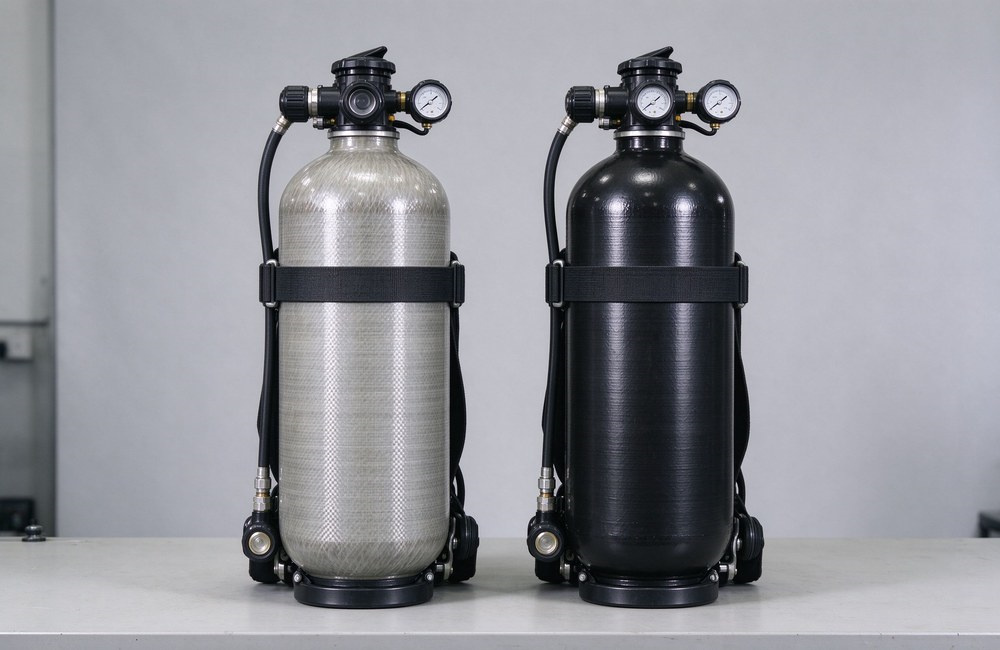
What does a complete positive pressure SCBA lineup look like? We offer six models that cover every breathing task from academy drill to interior fire attack. Every unit is an open-circuit positive pressure self-contained breathing apparatus. What changes between them is the cylinder material, the electronics, and the price tier.
Two models run on steel cylinders for budget training. Three run on carbon fiber cylinder sets for real fire and industrial entry. The sixth is a four-cylinder trolley for long confined-space work. All share the same regulator block, alarm whistle, and quick-release backplate.
Table T1: SCBA Model Matrix
|
Model |
Cylinder |
Standard |
Duration |
Reference Price (USD) |
|
RHZKF6/30 Steel Base |
6L steel |
— |
~30 min |
$180–250 |
|
RHZKF6.8/30 Carbon Economy |
6.8L carbon fiber |
GA124-2004 |
~65 min |
$250–400 |
|
RHZK6.8 3C Standard |
6.8L carbon fiber |
GA124-2013 |
~65 min |
$400–600 |
|
HG HUD Model |
6.8L carbon fiber |
GA124-2013 + HUD |
~65 min |
$600–750 |
|
HG Communication Model |
6.8L carbon fiber |
GA124-2013 + comm |
~65 min |
$700–900 |
|
4-Cylinder Trolley Unit |
4×6.8L carbon fiber |
— |
Mobile supply |
$9,000–12,000 |
*Reference price range only; actual quote depends on configuration, order volume, and Incoterms.*
A full carbon fiber 6.8L set weighs about 8.0–8.6 kg on the back, while the steel base set reaches about 14 kg. The RHZK6.8 3C Standard is the workhorse: it meets GA124-2013 core requirements without the HUD electronics premium.
The steel base model fits academies that cycle gear hard on a tight budget, and suits academy drills and training. For teams that talk constantly inside a building, step up to the communication model, aimed at urban engines and RIT teams.
Between the economy and the standard 3C sits the RHZK6.8/A, a mid-tier carbon fiber unit that already meets GA124-2013 but skips the premium trim. It fits departments that need the newer standard on a tighter budget. Ask us to quote all three carbon tiers side by side so you see exactly where the price gap buys you.
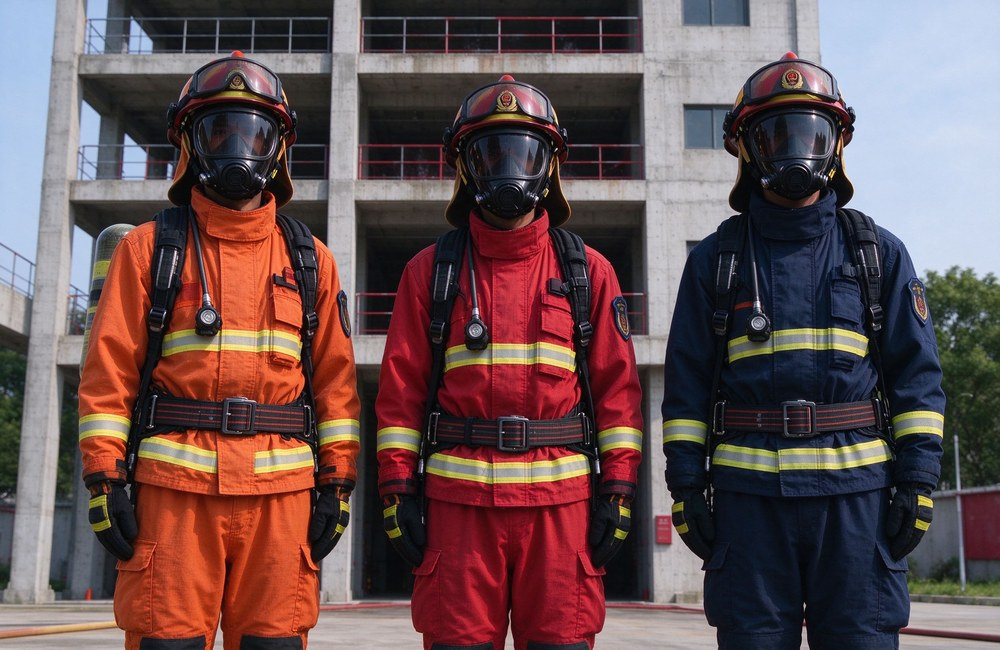
Why does a positive pressure SCBA matter so much? Fire rooms, fertilizer plants, mine shafts, and ship holds often hold air you cannot smell or see. Carbon monoxide, hydrogen sulfide, or low oxygen can knock a worker down in three to five breaths. This is what OSHA calls an IDLH environment — immediately dangerous to life and health.
A filter gas mask cannot save you here. Filter cartridges only work against known gases in the right concentration range, and they do nothing when oxygen drops below 19.5%. In a smoke-filled room there is simply no oxygen to filter. You need a self-contained supply.
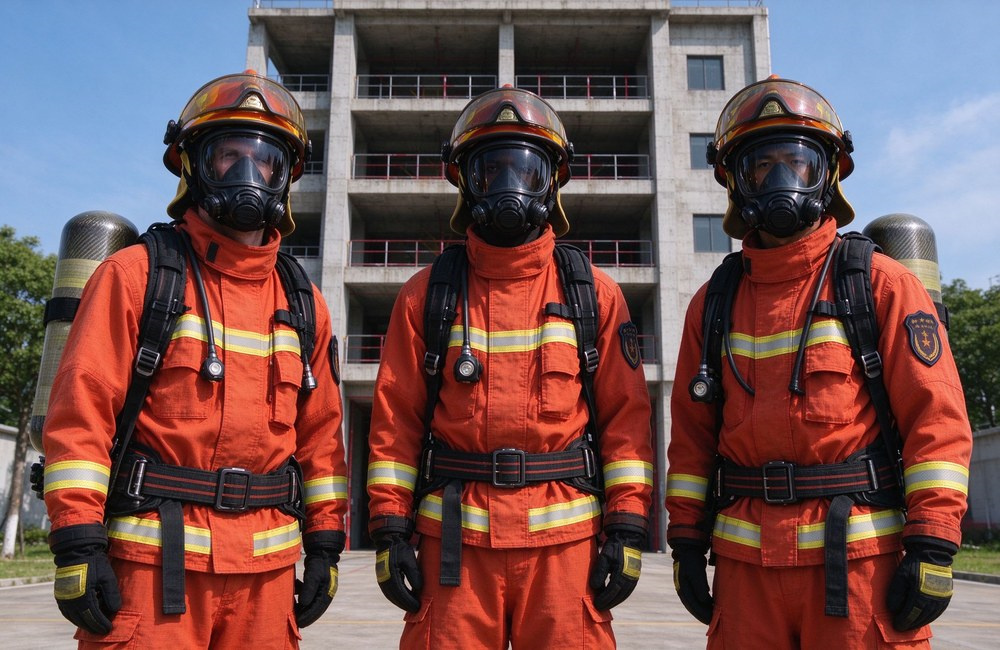
Who actually walks into these rooms? Interior firefighters make up the biggest group. Refinery entry teams, confined-space rescue crews, mining rescue brigades, and ship tank inspectors face the same problem. They all breathe from a tank on their back, not from the room.
The math is unforgiving. A working firefighter breathes 40—60 liters of air per minute under exertion. If the room air is toxic or thin, every breath shortens your time on scene. The SCBA turns 6.8 liters of stored compressed air into a breathable atmosphere you carry with you. That is the whole point of the gear.
How bad do these rooms get? Carbon monoxide at 1,200 ppm can drop a worker in three breaths. Hydrogen sulfide smells at low levels, then deadens your nose so you never sense the lethal rise. Oxygen below 16% brings fast dizziness; below 10% you collapse without warning. There is no wait-and-see option.
So when does a filter mask pass? Only when the air is breathable but irritating: nuisance dust, low organic vapor, normal oxygen. The moment oxygen drops or the gas is unknown, skip the filter and reach for the SCBA on the truck. When in doubt, carry the tank. You cannot guess your way out of an IDLH room.
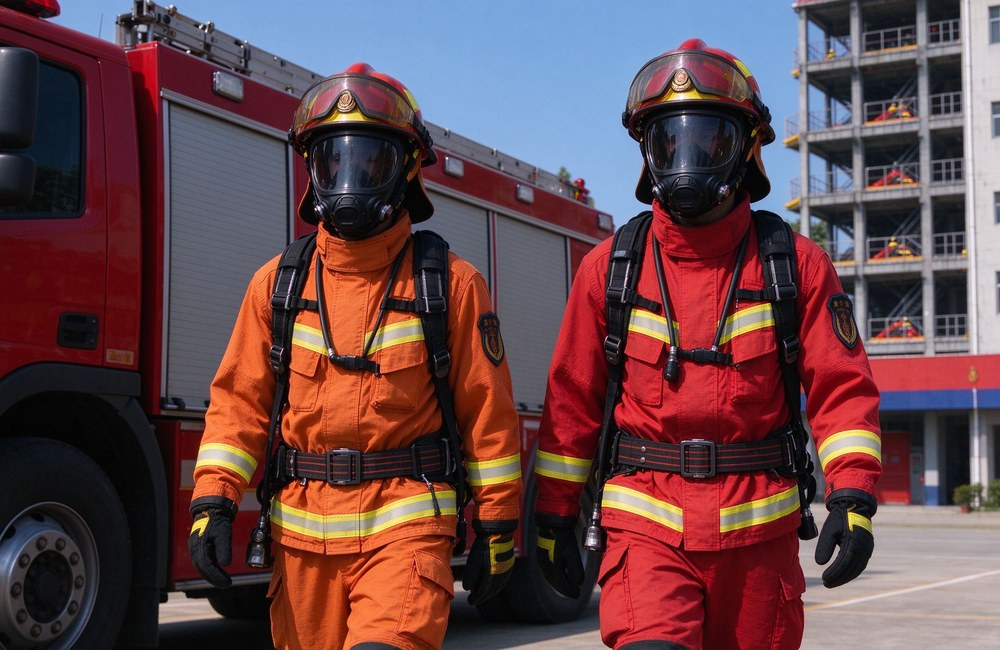
What makes an SCBA "positive pressure"? Inside the full facepiece, the air pressure always stays a little higher than the air outside. If the facepiece has a tiny leak —a gap at the seal, a cracked visor — air flows out, not in.
Toxic smoke pushes against a wall of out-flowing air and cannot slip in. That margin is the whole safety logic.
How does air actually reach your lungs? The gas path runs in four steps. First, high-pressure air leaves the cylinder at 30 MPa. Second, the first-stage regulator drops that to around 0.7—0.9 MPa intermediate pressure. Third, the demand valve on the facepiece delivers only the air you inhale, on demand. Fourth, exhaled air exits through a one-way exhalation valve.
What triggers the alarm? As you breathe down the tank, pressure falls. When it reaches 5.5MPa alarm level, an alarm whistle inside the backplate starts blowing loud and continuous. It is designed so the wearer hears it above fire noise. At that moment you have roughly 8—10 minutes of working air left to exit, depending on your breathing rate.
Why not just open the valve and breathe from a hose? Because demand valves match flow to inhalation. At rest you sip air; under exertion you gulp. The valve delivers exactly what your lungs pull. Positive pressure is maintained during both inhale and exhale. You never suck a vacuum inside the facepiece.
That is what separates a real SCBA from a cheap airline set.
Two small parts do the quiet work. The demand valve opens only when your lungs pull, so you never fight a constant flow. The exhalation valve closes tight on inhale and opens on exhale, keeping the face at a few millibar of positive pressure the whole time. Clean these two parts after every fire; they fail first.
The alarm whistle sits inside the backplate on purpose. It transmits through the harness to your ear, so you hear it even if the comm radio is muted. On the communication model the warning also reaches command at the pump panel. You never have to look at the gauge to know your tank is running low.
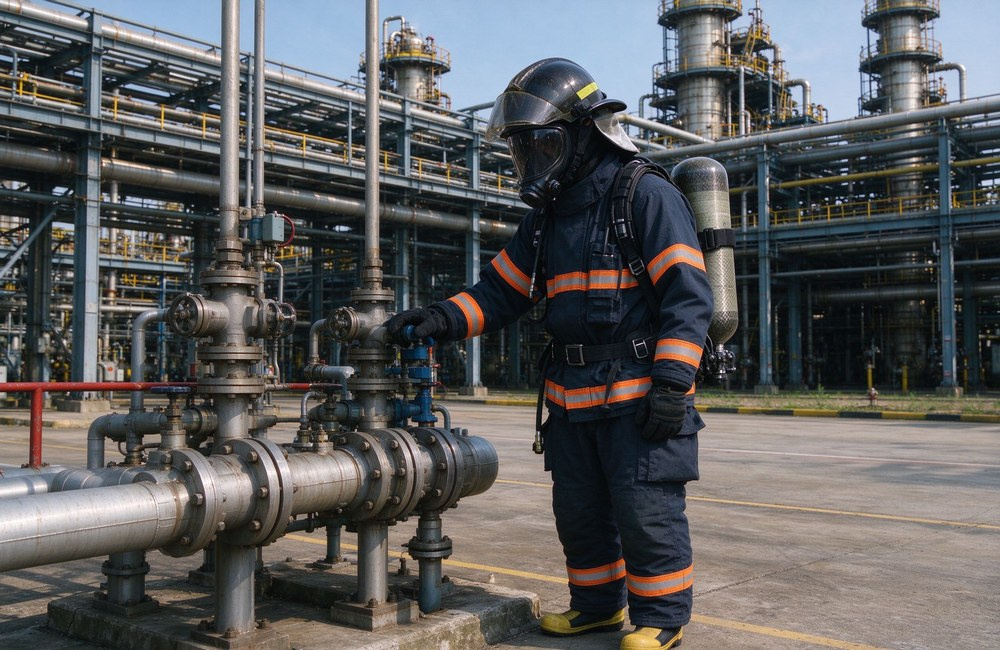
Which air cylinder should you pick? You have two shell materials and four volumes: 3L, 6.8L, 9L, and 12L. The volume sets your duration. The shell material sets your weight and your budget. Most municipal firefighters run a 6.8L cylinder. It is the sweet spot between duration and pack weight.
A carbon fiber cylinder wraps an aluminum liner in composite overwrap. It weighs roughly 4.5 kg full versus about 11 kg for the same-rated steel tank. On a 30-minute interior run, that saved 6.5 kg shows up in your shoulders and your heart rate. Carbon fiber also resists internal corrosion, which steel cannot.
Table T2: Carbon Fiber vs Steel Cylinder
Item
Carbon Fiber Cylinder
Steel Cylinder
Weight (6.8L / 6L, full)
~4.5 kg
~11 kg
Working pressure
30 MPa
30 MPa
Service life
15 years
30 years with tests
Hydrostatic retest
Every 5 years
Every 3 years
Corrosion resistance
Excellent
Needs external SCBA inspection
Relative cost
Higher
Lower
Best fit
Mobile firefighting, entry
Training, stationary, budget
*Values are typical for the 6.8L / 6L class; exact figures vary by production lot.*
There is one tradeoff to know. Carbon fiber cylinders cost more up front and retire at 15 years. Steel is cheaper to buy but heavier, and every 3 years it needs a hydrostatic test at an accredited station. For a mobile crew that climbs stairs and crawls, the weight saving wins.
For a fixed training yard that never moves the tanks, steel is fine.
Volume and duration move together. A 9L cylinder buys roughly 30% more working time than 6.8L, but adds about 1.5 kg. A 12L unit extends that further but starts to feel unbalanced on a smaller firefighter. Match the volume to your average entry time, and keep a few 6.8L packs as the agile spare for fast interior jobs.
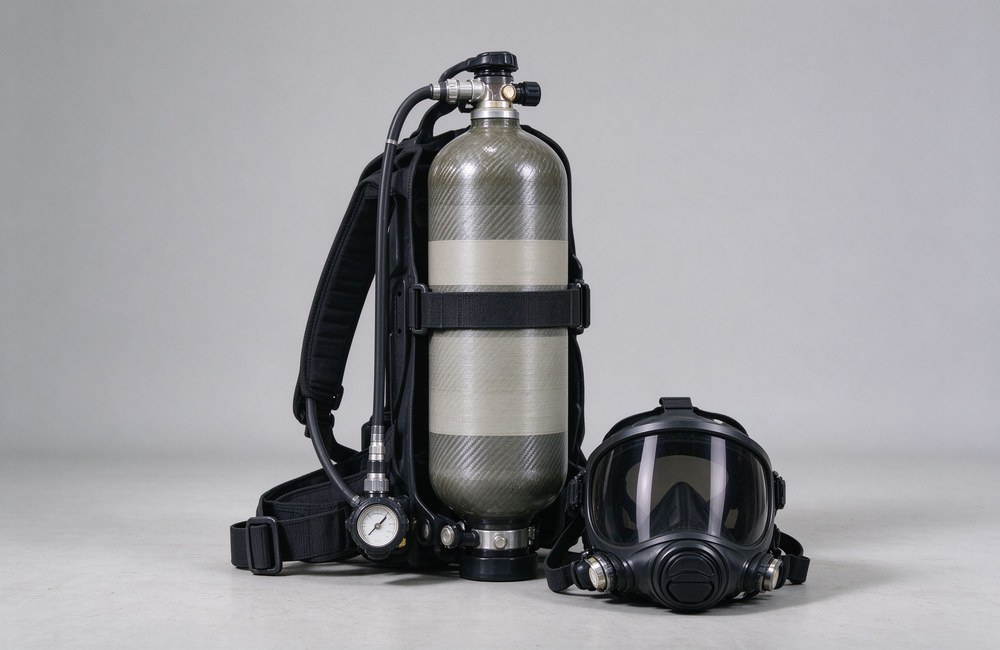
The mask is where breathing meets vision. Our full facepiece uses a food-grade silicone face seal that stays soft in cold and resists heat. The five-point head harness pulls the seal evenly from all sides, so one tight strap does not pinch your forehead while the opposite side leaks.
The visor is polycarbonate, wide-field, and scratch-coated. It gives you roughly a 180-degree view so you can read floor markings and the gauge without turning your head. On HUD units, a small HUD display sits at the bottom of your field of view.
It shows tank pressure as three lights: green full, yellow warning, red low. You glance down without lowering your hood.
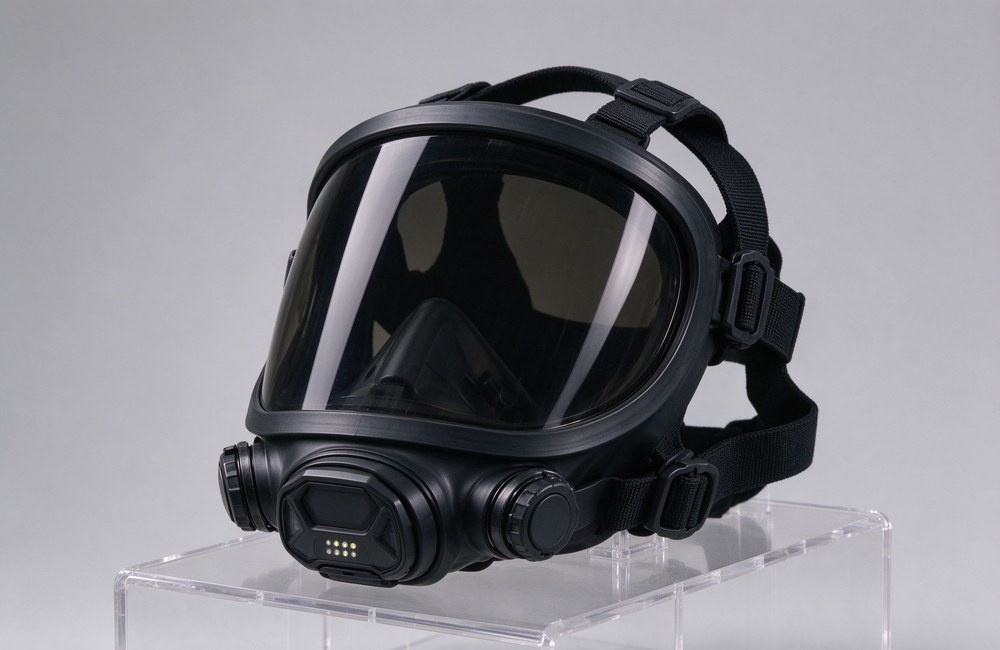
The communication model adds a second layer. A built-in voice amplifier inside the facepiece makes your voice carry through the seal, and an external radio port lets you clip on a standard handheld radio. On this model the alarm whistle reaches at least 90 dB, so command staff hear the low-air warning even inside a noisy pump panel.
Why silicone and not rubber? Silicone keeps its memory after hundreds of donnings. Natural rubber hardens and cracks after a few seasons in a gear room. It also rinses clean between users, which matters when one mask is shared across a four-platoon shift. The visor accepts anti-fog inserts and replacement protective films.
Speech through the facepiece works on two levels. On the base model, a voice port lets command hear you close up. On the comm model, the built-in microphone picks up your voice inside the seal and sends it to the radio, so a normal speaking voice reaches the pump panel fifty meters away. No shouting, no lost instructions.
Fog is the other fight. Moist breath condenses on a cold visor and blinds you on the way in. Anti-fog inserts or a thin coat of anti-fog gel on the inside keeps the view clear for the whole entry. Never treat the visor with an abrasive cloth; one fine scratch cuts your usable sightline in half.
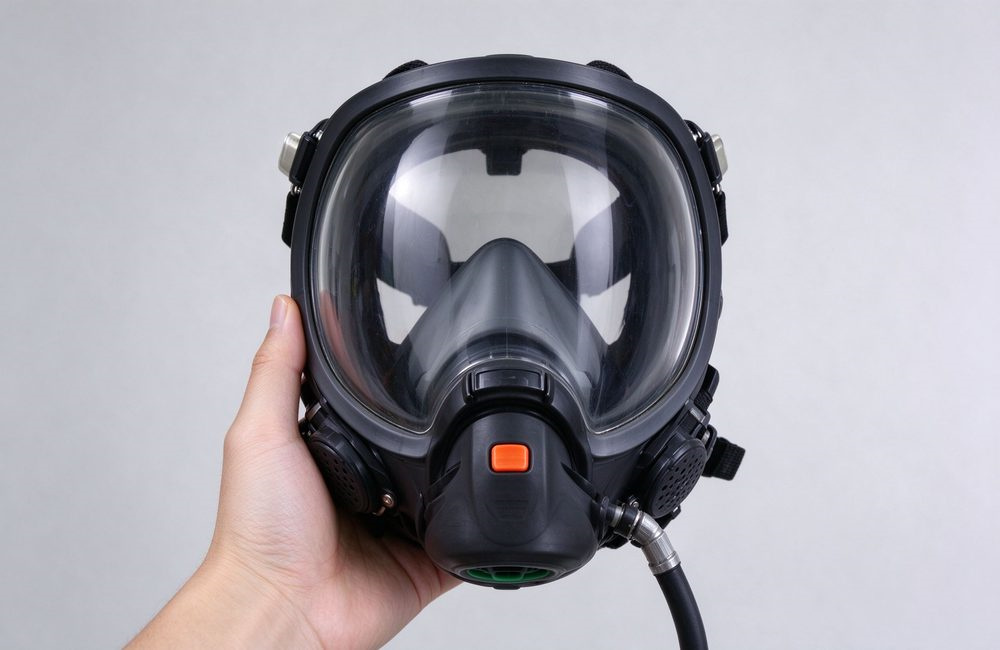
A tank on your back is only as good as the harness that carries it. The backplate is aluminum, rigid, and shaped to follow the spine. It does not flex and twist like a soft nylon strap system. Shoulder straps and a wide waist belt move the load onto your hips, which is the strongest place to carry weight.
Why does that matter? On a 20-minute crawl through debris, a poorly hung tank swings and yanks your shoulders. A well-fit harness locks the cylinder close to your center of gravity. Every strap is adjustable with one gloved hand. A quick-release buckle dumps the whole unit in one motion if you need to shed weight fast.
Balance is tuned per size range. Taller crews get a longer backplate and lower cylinder saddle. Shorter operators get the saddle raised so the tank does not hit their hips. The waist belt pads are removable for washing.
During long overhaul work on the surface, crews loosen the belt, crack the valve, and keep the facepiece off but the pack ready.
We do not overclaim comfort. An 8 kg SCBA is still 8 kg. What the harness does is stop that weight from working against you. It centers the load, lets your hips carry it, and keeps your arms free for a nozzle or a handline. Try the donning drill before you buy a hundred.
The backplate itself carries the data tag. Every serial, test date, and cylinder spec is printed there so a firefighter reads it without opening the harness. Buckles are over-center, not friction, so they hold under load instead of sliding. That matters when you are hanging from a ladder rung.
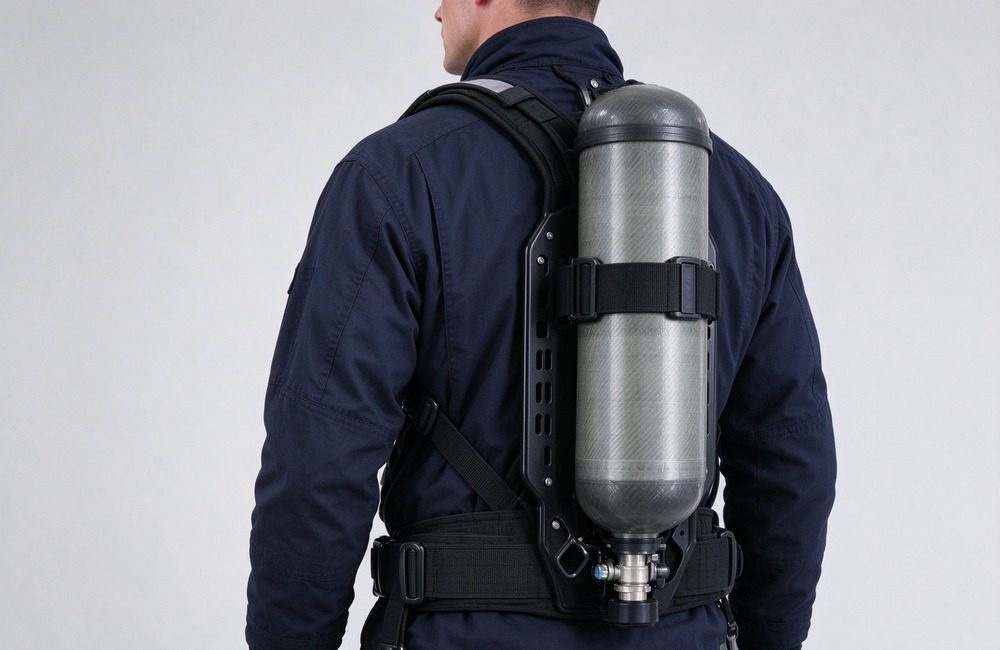
Which SCBA should you actually buy? Start from the job, not the price tag. Interior fire attack, industrial inspection, long-duration entry, and academy training each point to a different model. Buy the cheapest that clears your mission, not the cheapest on the shelf.
Walk the decision tree. If you enter burning buildings indoors, pick the RHZK6.8 3C Standard with carbon fiber. If you patrol refineries and plants where air may be bad, the Carbon Economy model covers it at lower cost. If you run long confined-space entries, move up to 9L or 12L, or use the four-cylinder trolley.
What about the electronics? Only add HUD and comm if your crew actually uses them. HUD pays off in zero-visibility interiors where nobody can read a shoulder gauge. Comm pays off in large structures where command needs constant radio traffic. For a small rural station, the standard 6.8L unit is the right buy.
Let budget finish the math. Steel base fits a training academy that cycles gear hard. Carbon Economy fits an industrial HSE budget. The 3C Standard fits a municipal tender. HUD and Comm fit urban engine companies and specialized teams.
Match the cylinder to your average task duration — 65 minutes at rest is closer to 25—30 minutes under heavy exertion. Plan for the hard work, not the easy walk.
Do not forget the team layer. A two-person entry rule means buying in pairs, plus one spare per four units for RIT. If your brigade runs 20 firefighters on a shift, budget for about 28 units: 20 in service, 4 being inspected, 4 spare. That keeps a broken mask from benching a whole crew.
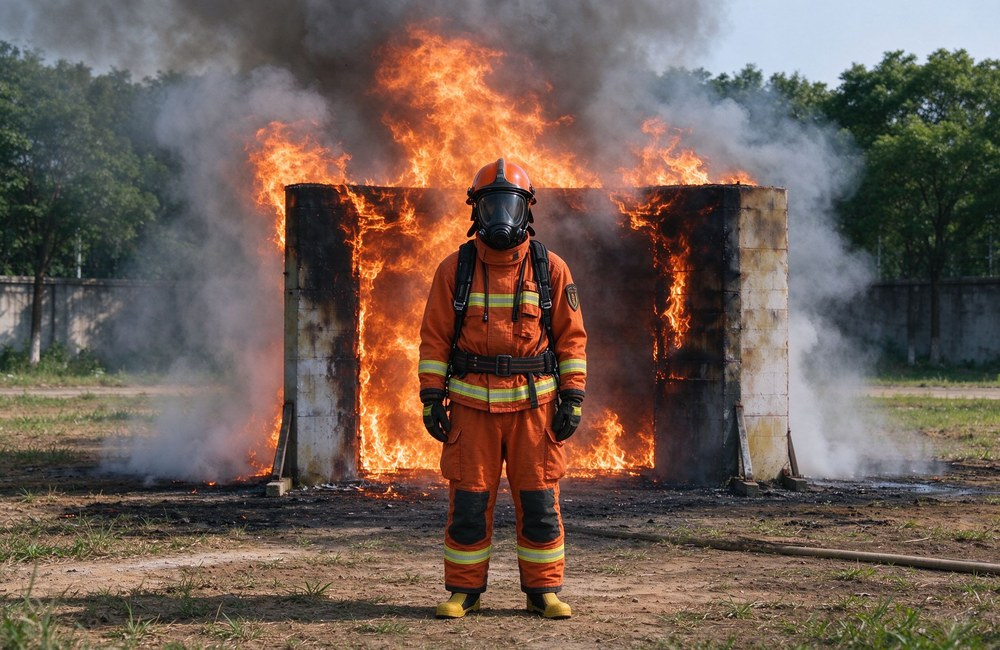
What keeps an SCBA fleet running for ten years? It is not the tank. It is the small wear parts. Every crew needs a spare cylinder or two on the shelf, a refill adapter, and a mask bag. When a demand valve seal perishes after a season, you replace the seal kit - not the whole mask.
We stock the common wear items as separate line items: demand valve assemblies, first-stage regulators, alarm whistles, exhalation valve discs, head harness replacements, and visor protective films. You order by model number, and the part numbers are printed on the data tag. No need to guess which O-ring fits.
What about the support gear? A high-pressure breathing air compressor fills cylinders from 0 to 30 MPa. A spare cylinder rack lets one crew refill while another works. The four-cylinder trolley is itself an accessory-grade unit: it feeds two masks through an air line for teams that work one long shift inside a tank.
Do not wait for a part to fail to discover it is unavailable. We hold spare parts for at least five years after a model is discontinued. Tell us your fleet model when you order, and we can quote a recommended spares kit sized to your unit count. It is cheaper than a dead mask sitting in a locker.
A few consumables vanish fast on a busy fleet. Visor protective films scratch and need swapping. Head harness straps stretch after a season. Exhalation valve discs stiffen. We sell these as low-cost kits so your stores room always has a drawer of them. Reorder when you hit a three-month supply, not when the last one breaks.
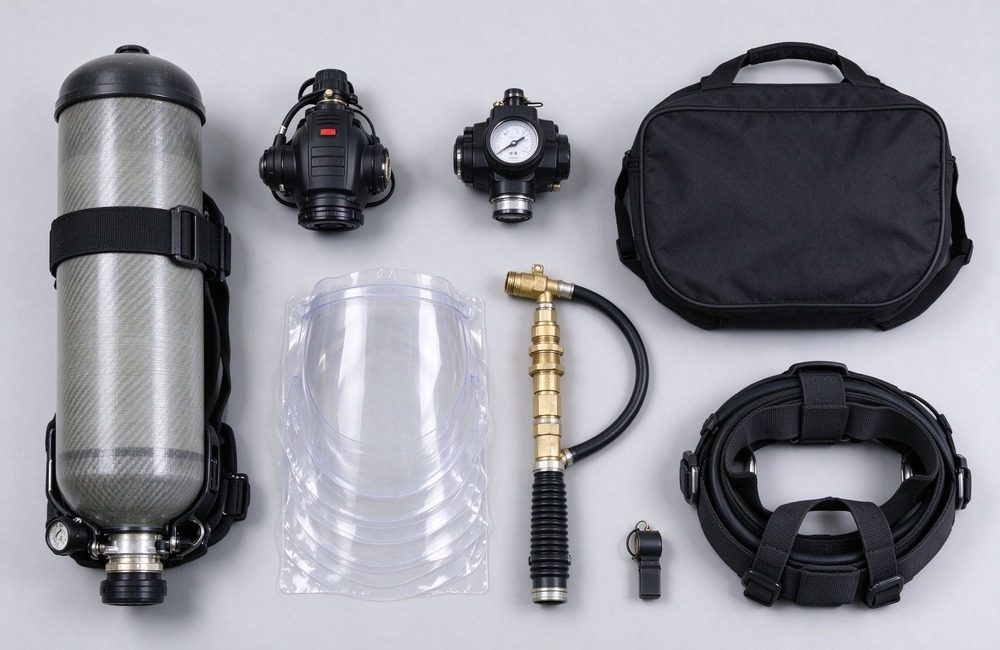
Which standard should your SCBA meet? It depends where you operate. Chinese municipal tenders usually call out GA124 tested positive-pressure fire SCBA. North American departments reference NFPA 1981. European buyers work to EN 137. We describe all units as "tested to" these standards and supply third-party test reports.
What do these standards actually check? Leak tightness of the whole set. Inhalation and exhalation resistance. That the alarm whistle fires at the right pressure. That the facepiece stays clear under heat and flame exposure. That the visibility through the visor is adequate. Each region weights these tests a little differently.
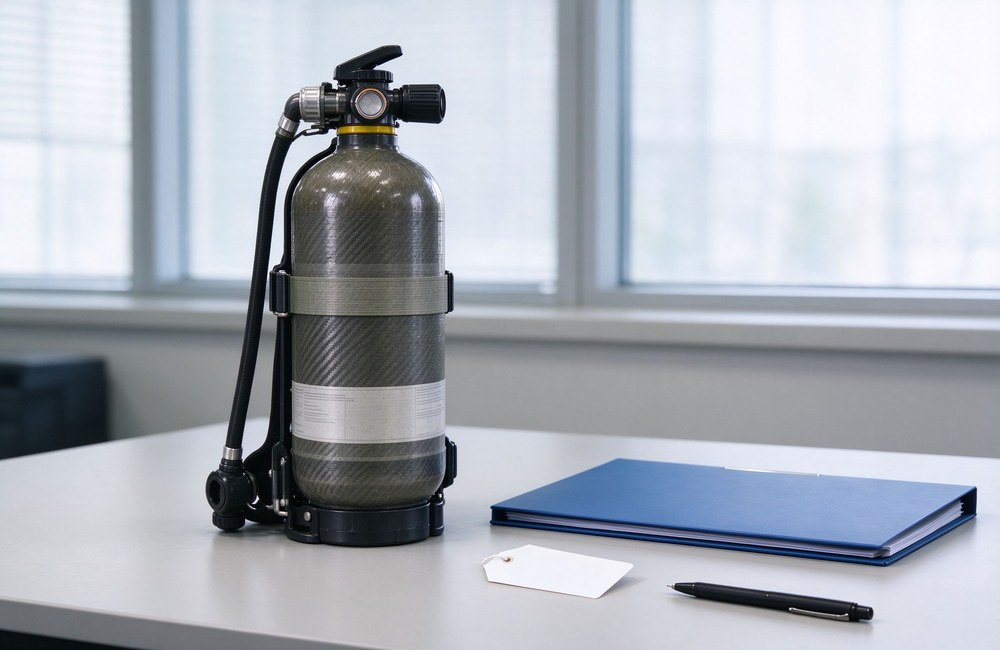
Table T3: GA124-2013 vs NFPA 1981 vs EN 137
|
Item |
GA124-2013 (China) |
NFPA 1981 (USA) |
EN 137 (Europe) |
|
Region |
China |
North America |
European Union |
|
Scope |
Positive-pressure fire SCBA |
Open-circuit emergency SCBA |
Open-circuit breathing apparatus |
|
Cylinder pressure |
30 MPa |
~2216 psi class |
200 / 300 bar |
|
Alarm pressure |
5.5卤0.5 MPa |
Residual ~25% |
Residual pressure indicator |
|
Key tests |
Leak, alarm, inhalation resistance |
Heat, flame, comms, thermal |
Leak tightness, resistance, visibility |
|
Evidence we supply |
GA124 test report |
NFPA 1981 test report |
EN 137 test report |
*We state units are "tested to" these standards; full third-party certification marks are quoted separately if your tender requires them.*
Read your tender line by line. Some documents demand a specific lab report number. Others only require that the unit meets the stated class. If your tender names a specific mark, send us the clause before you order. We map each tender requirement to our product fields so you can fill the response table without guesswork.
Why do we say "tested to" and not "certified"? Full certification to a specific mark involves a notified body holding a factory audit every year. We supply the third-party test report and describe the unit honestly. If your tender requires a named certificate holder, we discuss that as a separate project before you order.
The three standards overlap more than they differ. All three demand a positive-pressure mask, a low-air alarm, and a tested cylinder. Pick the standard your market writes into the tender. If you export to several regions, we can quote one platform unit with the test reports each destination expects.
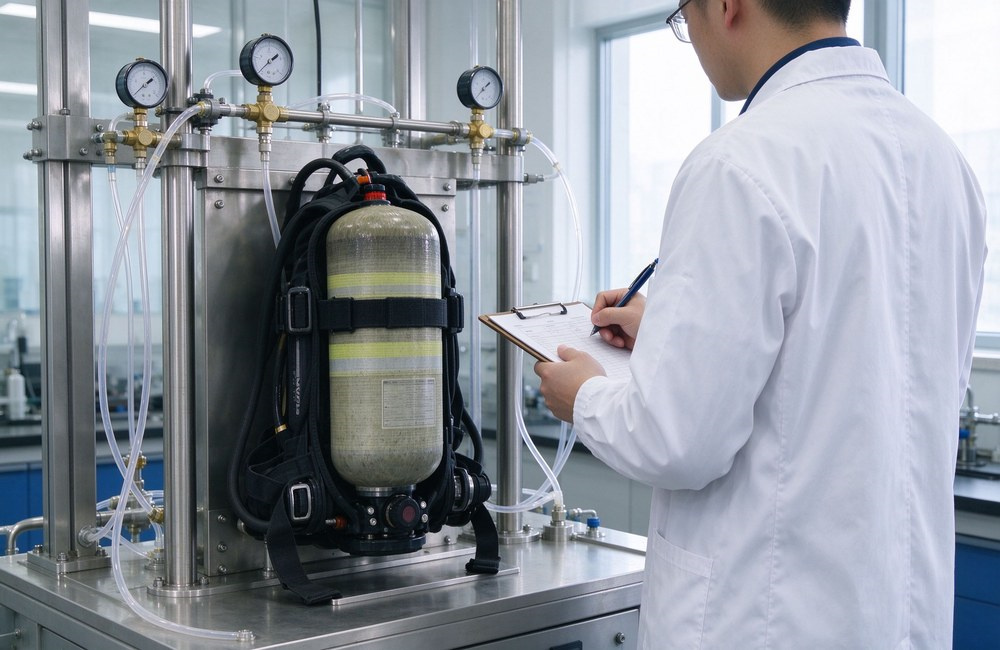
How long your SCBA survives comes down to inspection discipline. A mask sitting in a locker gets zero wear until someone pulls it on smoke. That is why a fixed monthly check matters more than a yearly overhaul. Ten minutes per unit, once a month, catches 90% of failures before they matter.
What goes on the list? Every month: look the facepiece over for cracks, read the pressure gauge on the cylinder, pull the straps for fraying. Every year: run an airtightness leak test, bleed the tank to confirm the alarm whistle fires at 5.5±0.5 MPa.
Every three years for steel, every five for carbon fiber: send the cylinder for a hydrostatic test at an accredited station.
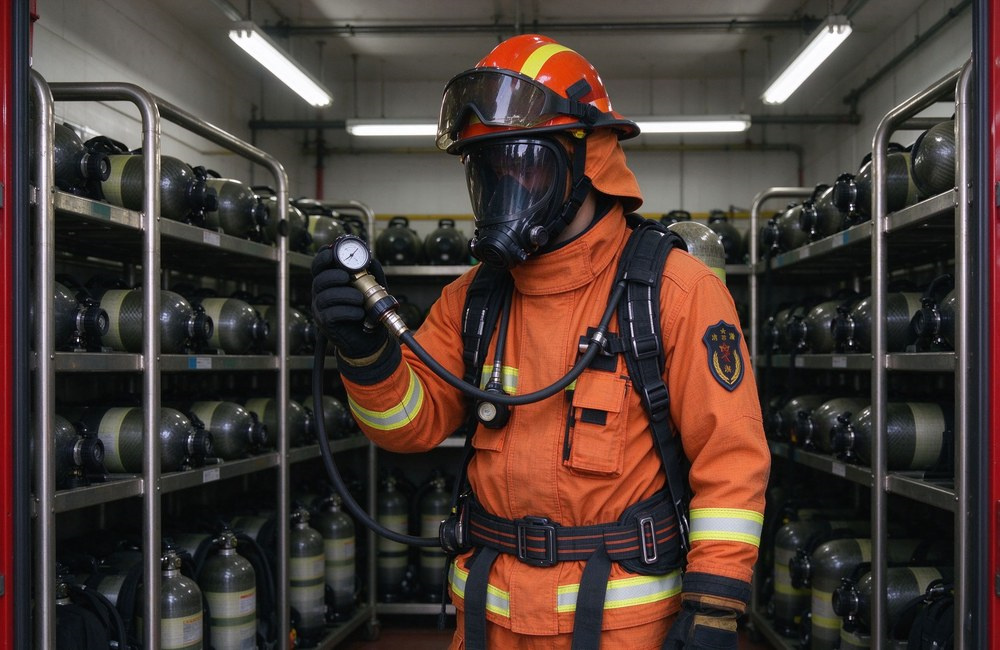
Table T4: Monthly / Annual Inspection Checklist
Item
Frequency
Method
Pass Standard
Full face mask seal
Monthly
Visual + user seal check
No cracks, seal elastic
Cylinder pressure
Monthly
Read gauge
≥28 MPa when full
Harness straps & buckles
Monthly
Visual + pull
No fraying, buckle holds
Alarm whistle
Annually
Bleed-down test
Sounds at 5.5±0.5 MPa
Set air tightness
Annually
Positive-pressure leak test
No pressure drop over 1 min
Cylinder hydro test
Every 3 yr steel / 5 yr carbon
Authorized test station
Pass stamp on cylinder neck
Regulator & valve
Annually
Functional flow test
Smooth flow, no leaks
*Keep a written log per unit; logbooks are required in most tender audits.*
Do not skip the logbook. A SCBA maintenance record is what turns a used SCBA into a defensible piece of equipment during an audit. If the alarm whistle ever sounds late or weak, pull the unit from service. A low-air warning that fails is how crews run out of air inside a building.
Wipe the facepiece between every user with a mild disinfectant, not solvent. Solvent cracks the silicone seal. Never store a charged cylinder in direct sun or near a heater; heat raises pressure and ages the composite faster. A cool, dry gear rack is where the pack lives between calls.
Never borrow parts between two different models. A regulator from one line may thread onto another mask but seal wrong. Mixing parts voids the test record. Keep each unit's parts on its own shelf, tagged by serial, so a repair never becomes an accidental cross-install.
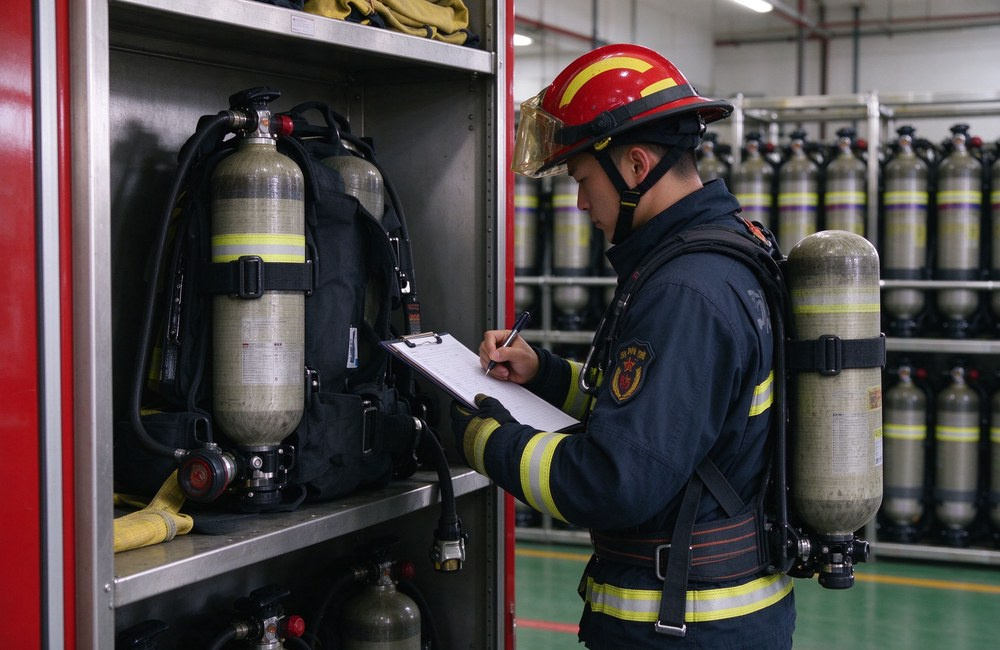
A perfect SCBA is useless if it goes on wrong. The drill has four moves. First, lay the pack on the ground, cylinder away, check the pressure gauge reads full, and step into the shoulder straps. Second, stand up and tighten the waist belt before the shoulder straps.
Third, put on the facepiece first, tighten the five-point harness, then connect the breathing hose. Fourth, crack the valve fully open.
Now prove the seal. Do a user seal check: cover the inlet with your palm and inhale gently. The mask should pull tight against your face and hold the vacuum for a second. If you feel air leaking at the cheeks or temples, reset the harness. Never trust a mask that passes visually but leaks under suction.
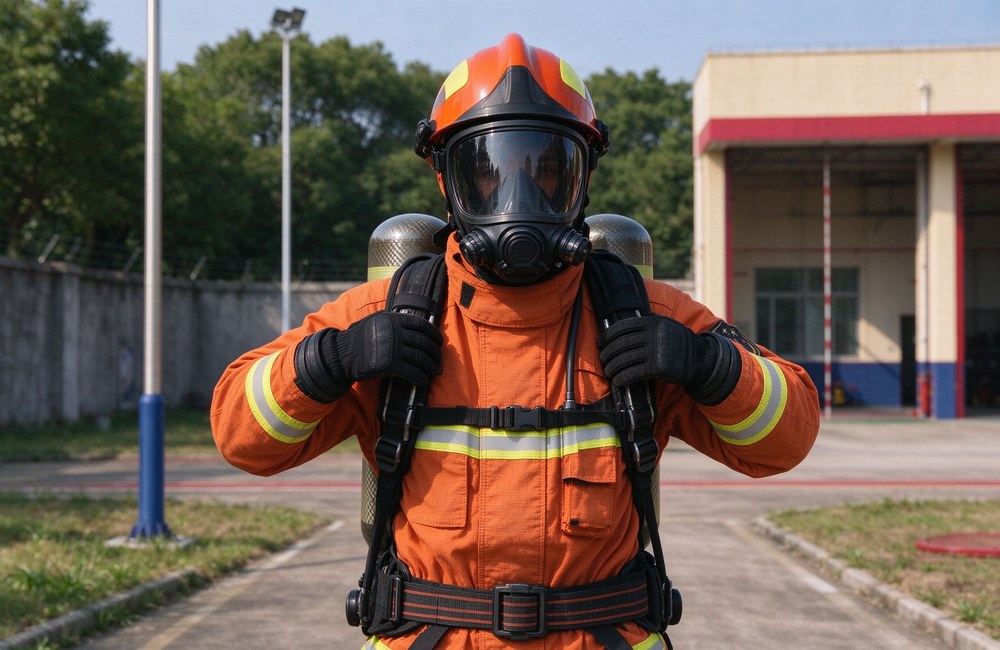
What do you do when the alarm whistle sounds? Stop and plan the exit, not keep pushing in. At 5.5 MPa you have roughly 8-10 minutes of working air, and that window shrinks as your heart rate climbs. Maintain contact with your partner. Use the RIT line if visibility is gone.
Do not remove the facepiece until you are outside and told the air is safe.
Speed comes from repetition, not from skipping the seal check. A trained crew dons a full set in under 60 seconds. Rookies start around 90 seconds. Run the drill monthly so the moves are muscle memory by the time you need them for real. The 10 seconds you spend on the seal check can save your life.
Always pair up inside. One firefighter cannot safely self-rescue from a zero-visibility room. Stay within arm's reach or on a shared line. If a partner's alarm fires first, you exit together. The two-up rule is not paperwork; it is the plan that gets both of you out when one tank runs low.
After every use, purge the facepiece and dump the exhalation valve clean of soot. Loosen the straps so the silicone seal rests relaxed, not stretched on the hook. Leave the gauge valve half-open, not slammed shut or wide open for weeks. Small habits like these keep the seal soft for a decade.
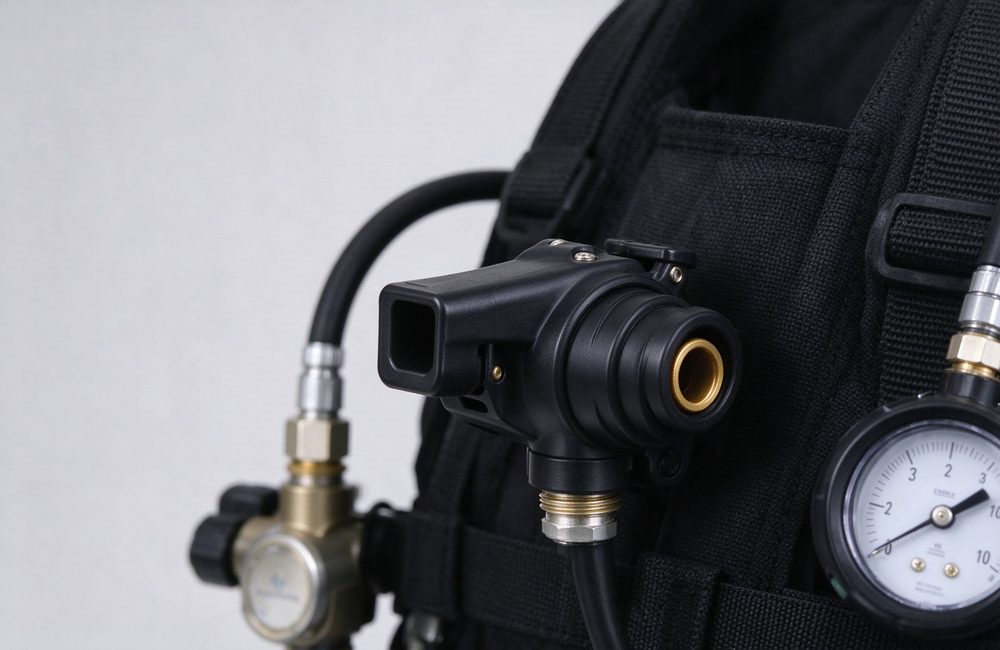
The low-air alarm is the last audible warning before a firefighter must turn and exit. It sounds at roughly 25 percent of remaining cylinder pressure, when the pressure gauge enters the red zone, which usually means 10 to 15 minutes of working air left.
Firefighters train to treat the alarm as a mandatory exit signal, not a suggestion, because interior conditions can deteriorate faster than the remaining air can support.
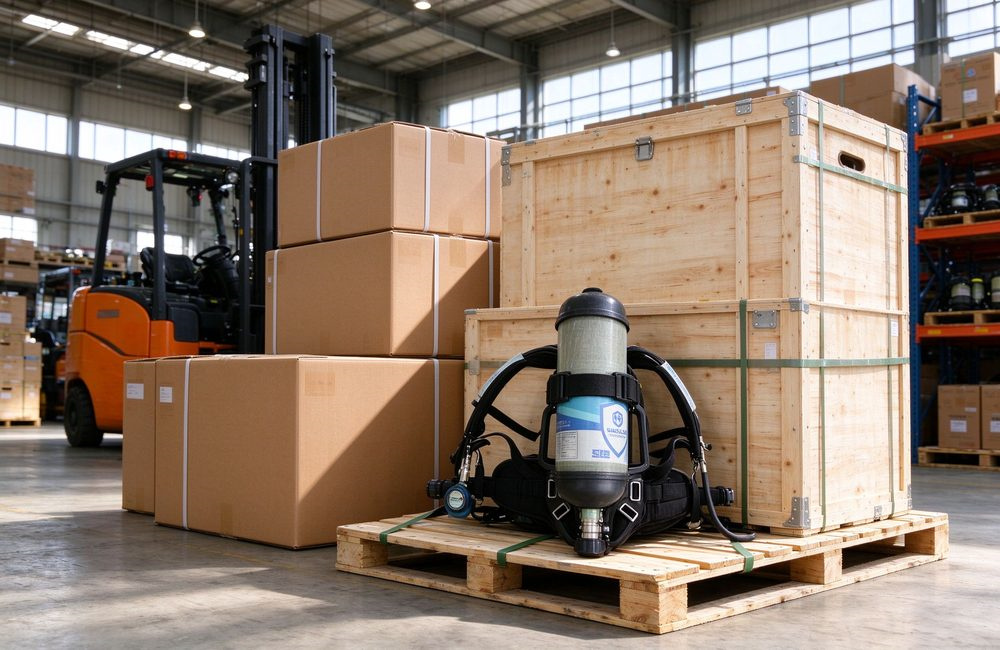
How does an SCBA arrive at your dock? Each unit goes into its own export carton with foam cutouts that hold the air cylinder, regulator, and mask in separate cradles. The mask ships in a soft bag inside the carton so the visor does not rub against metal during ocean transit.
We do not stack loose units on a pallet and wrap them in film.
What are the order terms? Wholesale minimum order is 10 units for stock models. Sample orders of 1-2 units are available for evaluation, at a sample price plus freight. Stock units ship in 20-30 days after deposit. Custom builds - logo, special cylinder, comm module - run 45-60 days.
FOB China is standard; CIF to your port can be quoted on request.
Can you consolidate mixed models in one shipment? Yes. A tender often wants 30 standard units, 5 HUD units, and one trolley. We pack all of it into one container and give you a single packing list. Each carton carries a model number and serial number so receiving can count units against the delivery note.
We protect the visor and the facepiece seal in transit on purpose. A cracked visor that survives the sea crossing is the most common claims reason. If anything arrives damaged, photograph the carton and the unit within 7 days and we arrange replacement parts. Bulk orders can also ship by air for urgent projects, at the buyer's cost.
What comes in the box? One SCBA unit with a charged 30 MPa cylinder, the full facepiece, a pair of spare O-rings, the user manual, and the test report copy. We do not ship loose accessories you have to chase later.
If you want a refill hose or a wall bracket added, say so on the order and it goes in the same carton.
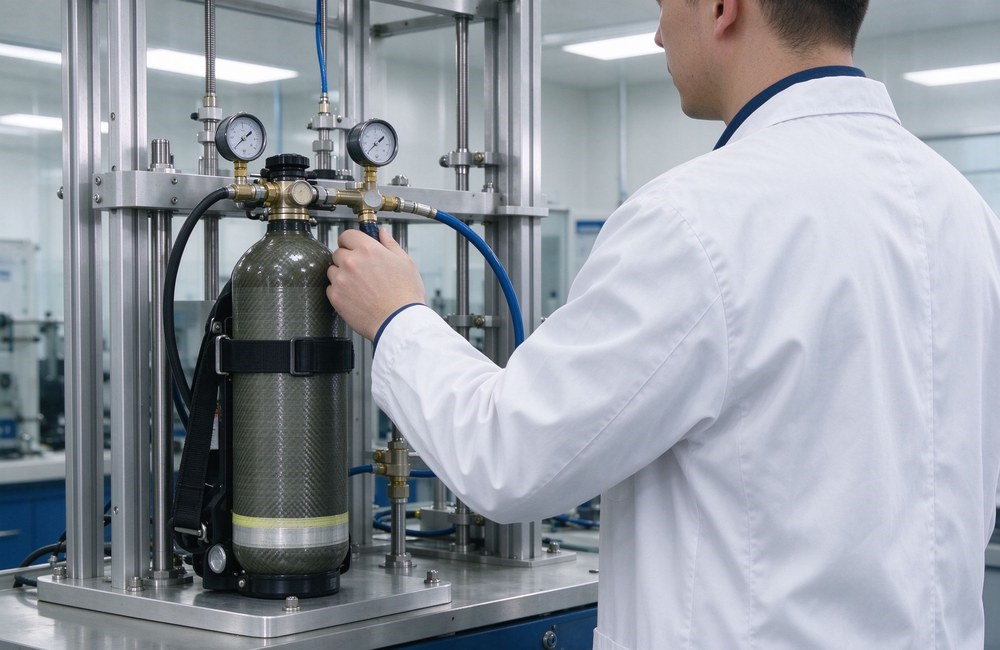
What happens before an SCBA leaves the line? Every single unit goes through 100% outgoing air-tightness testing, not a sampling rate. We pressurize the set, close the valve, and watch for pressure drop over a set hold time. Any unit that bleeds down fails and is reworked before it moves on.
Air cylinders are checked on their own bench. Each one gets a pressure test and a serial trace. The alarm whistle is calibrated to fire at 5.5±0.5 MPa. The mask undergoes a fit test on a form to confirm the silicone seal seats evenly. Only units that clear every station get packed.
How is the quality system run? Production runs under an ISO 9001-style quality flow, with a written QC checklist per unit. The checklist records the test readings so a manager can sign off each carton before it closes. You receive a copy of that checklist with your shipment.
We do not claim zero defects. No supplier does. What we offer is traceability: every unit has a serial, every test has a number, every claim has a paper trail. If a unit ever fails in service, we trace its test record back to the bench day.
That is the difference between QC theatre and QC that actually backs the gear in the field.
Batch-level random audits run alongside the 100% test. Each batch, we pull a few units for a deeper check: alarm whistle decibel level, visor light transmission, and the cylinder burst margin. The batch only ships if those samples pass too. That second gate catches drift the bench test might miss.
Each cylinder leaves our bench with a traceable serial. The number links back to its pressure test reading and its hydro retest date. When your auditor asks "when was this tank last tested?", you read the stamp, not guess. That paper trail is what survives a real incident review.
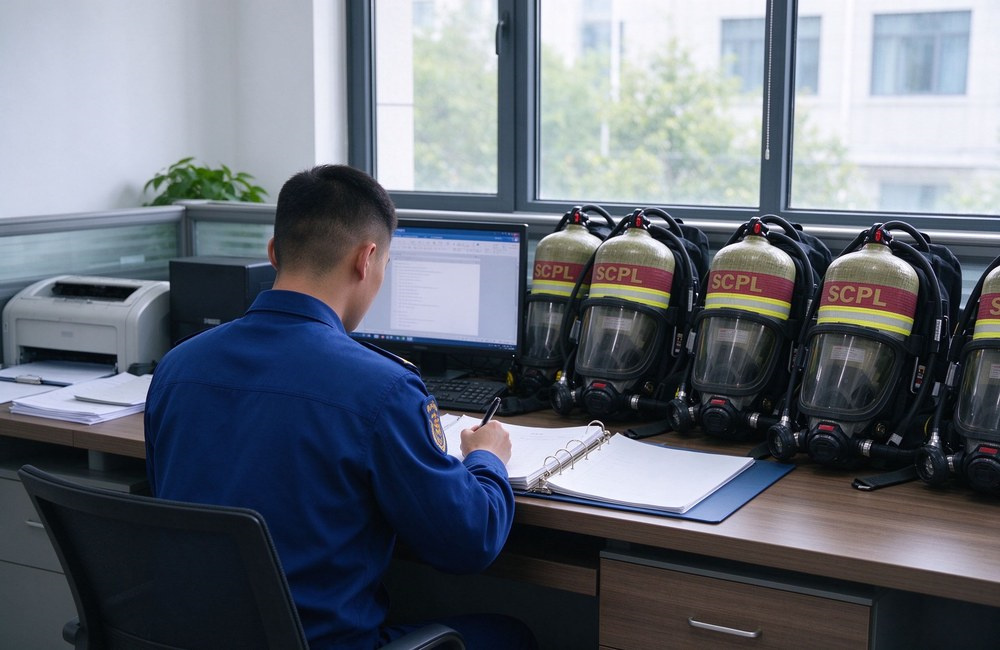
Buying SCBA through a government tender is a paperwork marathon. The department needs an authorized bidder, test reports that match the spec table, and delivery on a fixed date. We support all three. If you are the local distributor or the brigade itself, we supply the documents your evaluator will ask for.
What documents do we hand over? A tender authorization letter naming your organization as our bid partner. Third-party test reports showing GA124, NFPA 1981, or EN 137 test results. An ISO 9001 certificate. And a spec-response table that maps each clause in your tender to the corresponding field on our product sheet, so you fill it in directly.
Can we supply a physical sample for evaluation? Yes, for volume tenders we can ship one demo unit to your training ground. Your instructors can don it, run the alarm bleed test, and compare it against competing units before you commit to a bulk order. That sample price is usually credited against the later order.
Large tender volumes are normal for us. A municipal brigade may order 100 to 300 units at once for a full fleet refresh. We plan production slots around your required delivery date and stage the shipment so it clears customs and arrives before your drill window. Send us the tender PDF and we will come back with a clause-by-clause response.
Payment and delivery fit the tender cycle. We stage production around your budget approval date and can split the shipment into phases if your funding arrives in tranches. For a multi-year fleet refresh, we lock unit prices for the whole contract term so later orders do not float on market price.
Can you tailor an SCBA to our department? Yes, on the standard models. The most common custom mark is a silk-screened logo on the facepiece shell or the backplate. Your department name or crest goes on one side of the backplate, sized to fit without covering the data label.
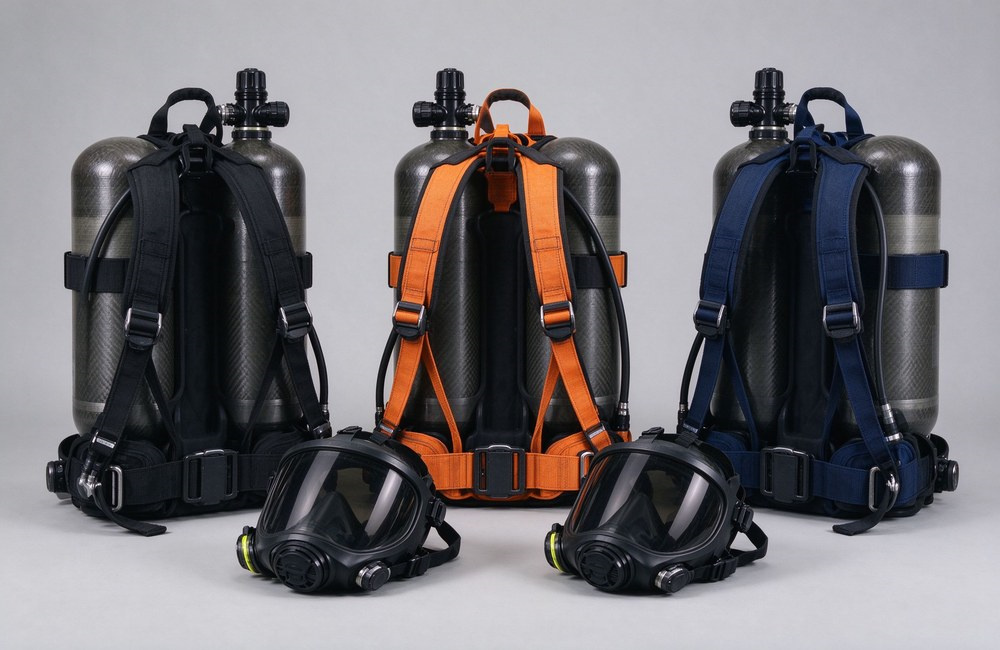
Beyond logo, you choose the cylinder. Pick 3L for short rescue bursts, 6.8L as the standard, 9L or 12L for long industrial entries. You also choose the electronics package: base unit, HUD display, or full communication module. Cylinder shell color can be black, yellow, or orange to match your fleet paint scheme.
What does customization add to lead time? A plain stock unit ships in 20-30 days. Any custom work - silk-screen logo, a non-standard cylinder, or adding a comm module - moves the build to 45-60 days. We lock your artwork proof by email before production, so you approve the logo size and position before the first unit is made.
Minimum order for custom decoration is still 10 units. Sample units 1-2 are available for layout approval at sample price. Tell us your department name, your preferred cylinder, and whether you want HUD or comm. We will quote one all-in number with the custom line item broken out separately.
You can also mix the trim. A black carbon fiber cylinder with a yellow harness, for example, so your units are instantly recognizable on a mutual-aid scene. The comm module adds about 0.6 kg; HUD adds about 0.3 kg. Tell us which options are mandatory and which are optional, and we price the mandatory baseline first.
How much does a positive pressure SCBA actually cost? Current wholesale pricing for a complete set lands in four bands, driven mostly by the cylinder shell and the electronics. The cheapest unit that still works in smoke is not the cheapest on the shelf. Here is the honest breakdown so you can budget without a surprise.
Steel base sets start around $180-250. Carbon fiber economy sets run $250-400. The 3C standard carbon fiber set runs $400-600. HUD and communication models top out around $600-900. The four-cylinder trolley is quoted separately because it is a different product class.
Table T5: Four Price Tiers (2026 Reference)
|
Tier |
Model |
Configuration |
Reference Price (USD) |
Best Fit |
|
Entry |
RHZKF6/30 Steel Base |
6L steel cylinder, no electronics |
$180-250 |
Training academies, budget drills |
|
Economy |
RHZKF6.8/30 Carbon |
6.8L carbon fiber, GA124-2004 |
$250-400 |
Industrial inspection teams |
|
Standard |
RHZK6.8 3C |
6.8L carbon fiber, GA124-2013 |
$400-600 |
Municipal fire departments |
|
Premium |
HG HUD / Comm |
6.8L carbon + HUD or comm module |
$600-900 |
Urban engine, command, hazmat |
*Prices are indicative wholesale FOB China per unit; MOQ and production timeline are subject to contract. Large orders and Incoterms shift the final number.*
The gap between tiers is real. The $180 steel unit saves you money at purchase but adds 6.5 kg to every crawl and needs a hydro test every 3 years. The $500 carbon fiber unit costs more now but saves your crew's shoulders for a decade. Buy for the body that wears it, not the spreadsheet that signs it.
Look past the sticker price over ten years. Add hydro tests, spare seals, visor films, and the shoulder cost of a heavy steel pack on every shift. When you total it, the cheaper steel unit often costs more in fatigue and inspection hours. Ask for a line-by-line ten-year quote, not just the unit price.
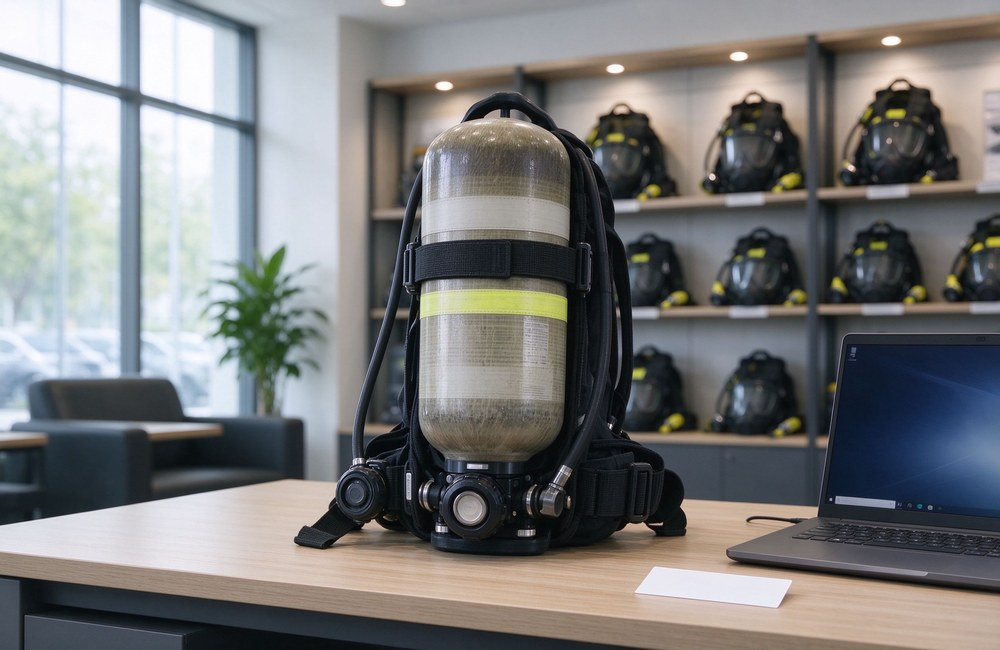
Complement your SCBA with full firefighter turnout gear and a structural fire helmet for a complete PPE ensemble. As an industrial SCBA supplier, we also support buyers looking for SCBA for sale outside municipal tenders.
An SCBA does not run alone. Four related items complete the breathing-safety corner of your storeroom. Filter gas masks cover non-IDLH workplaces where the gas is known and oxygen is normal. A high-pressure breathing air compressor keeps your cylinders full between calls. An emergency escape set (EEBD) gives a 10-15 minute exit when something goes wrong on the surface.
The four-cylinder trolley extends the SCBA concept into long confined-space work, feeding two masks from a rolling cart. Buy these together and your kit covers entry, refill, and escape the three moments where breathing gear matters most.
The EEBD is not a work SCBA. It is a 10-15 minute bailout pack you clip on when a fixed breathing line fails inside a tank. It buys you the walk out, not the work in. Keep it mounted near the entry point so a team member grabs it without suiting up again.
Filter gas masks for non-IDLH workplaces • Breathing air compressors to keep cylinders charged 路 Emergency escape sets (EEBD) for a 10-15 minute exit.
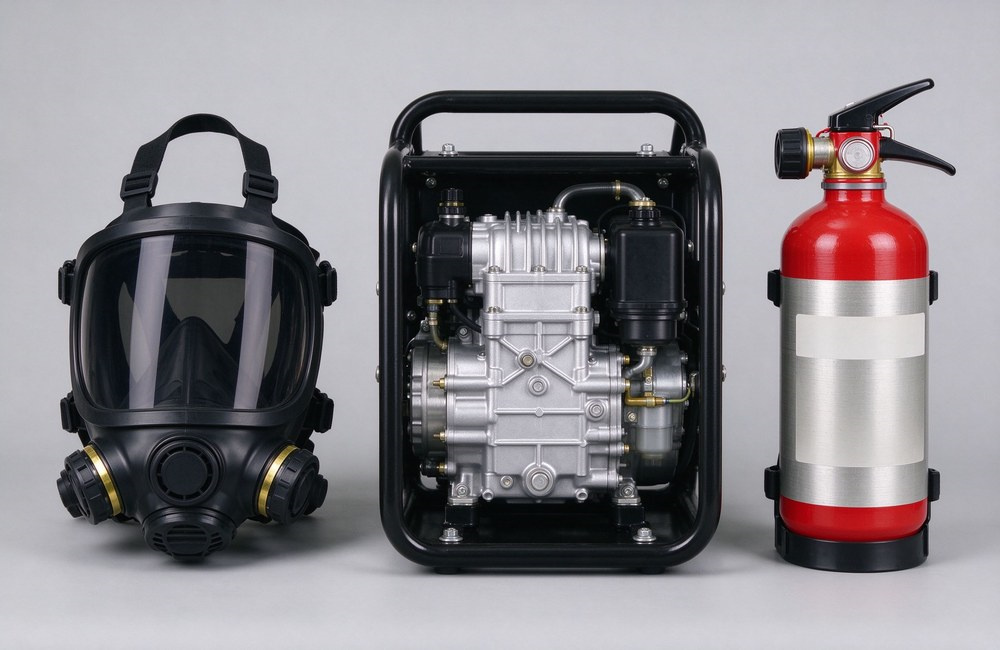
Below are the questions wholesale buyers, fire training officers, and procurement managers ask most often about positive pressure SCBA. Each answer covers specification, ordering, maintenance, and compatibility so you can compare configurations before requesting a formal quote. If your question is not listed here, send the cylinder size and backplate you are considering, and we will reply with a spec sheet and current lead time.
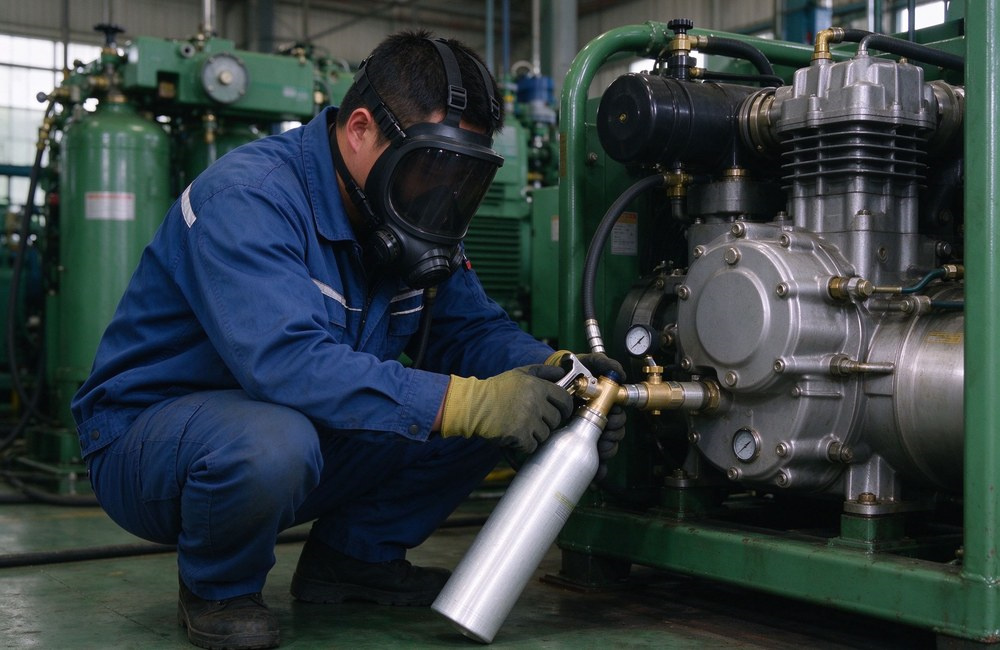
It is a self-contained breathing apparatus where the air inside the full face mask always stays slightly higher than the outside air pressure. If the mask leaks, air flows out instead of drawing smoke in. It is the standard for firefighting and IDLH entry, unlike filter masks that only clean ambient air.
The rated 65-minute duration is measured at rest. In real interior firefighting your breathing rate hits 40-60 liters per minute, so practical working time drops to about 25-30 minutes. Plan the assignment around that working number, not the bench number.
Carbon fiber is about 4.5 kg versus 11 kg for steel, so it wins for mobile crews. It costs more and retires at 15 years. Steel is cheaper, heavier, and needs a hydrostatic test every 3 years. Pick carbon for climbing and crawling; steel for stationary training yards.
When the tank pressure drops to 5.5±0.5 MPa, the whistle starts blowing loudly and continuously. It tells you roughly 8-10 minutes of working air remain. At that point you should stop advancing and plan the exit with your partner, not keep working.
Do a quick visual check every month: mask cracks, cylinder gauge reading, strap fraying. Once a year run an airtightness test and confirm the alarm fires at 5.5 MPa. Steel cylinders need a hydro test every 3 years, carbon fiber every 5 years at an accredited station.
GA124-2013 is the Chinese fire-industry standard for positive-pressure firefighting air breathing apparatus. It covers leak tightness, inhalation resistance, alarm pressure, and mask performance. We supply third-party test reports and describe units as "tested to GA124."
Yes, that is exactly what SCBA is for. It carries its own breathing gas, so it works in rooms with oxygen below 19.5%, where a filter mask fails completely. Never rely on a filter respirator in confined spaces or smoke. Always carry the tank.
Put on the mask and tighten the five-point harness. Cover the breathing inlet with your palm and inhale gently. The mask should pull tight to your face and hold suction for a second. If you feel air leaking at the cheeks or temples, reset the straps and repeat before entry.
A carbon fiber 6.8L set weighs about 8.0-8.6 kg on the back, depending on HUD or comm options. A steel-cylinder base set reaches about 14 kg. That extra 6 kg shows up fast on a 30-minute interior run in heat stress and shoulder load.
A filter gas mask cleans the surrounding air, so it needs normal oxygen and known gases. An SCBA carries its own compressed air, so it works in smoke, toxic spills, and oxygen-deficient rooms. If the air you breathe is unbreathable, you need an SCBA, not a mask.
A carbon fiber composite cylinder has a 15-year service life from manufacture date, with a hydrostatic retest every 5 years. After 15 years it must be retired from breathing service even if it still holds pressure. Check the date stamp on the cylinder neck before each fleet purchase.
Yes. We offer 3L, 6.8L, 9L, and 12L cylinders. Larger volume extends duration but adds weight and cost. 6.8L is the standard fire size. 9L or 12L suits long industrial entries and mining rescue where you stay down longer and move less.
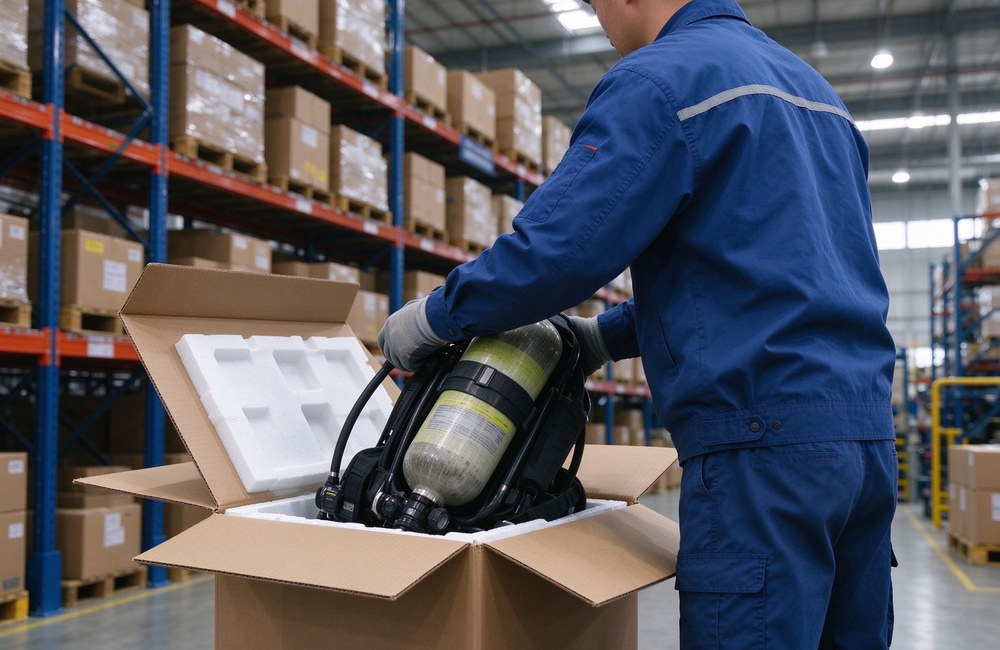
HUD stands for heads-up display. It is a small three-color light at the bottom of your mask visor: green means full tank, yellow means warning, red means low. You glance down to read pressure without lifting your shoulder gauge in zero-visibility interiors.
Yes. Demand valves, regulators, alarm whistles, exhalation valve discs, head harnesses, and visor films are separate line items. Order by the part number on your data tag. We hold spares for at least 5 years after a model is discontinued so your fleet stays repairable.
Use an accredited high-pressure breathing air compressor rated to 30 MPa. Never fill from a workshop compressor meant for tools, since the air carries oil and moisture. Fill slowly, let the cylinder cool between stages, and check the final gauge. Breathing air quality matters as much as pressure.
Current reference ranges are: steel base $180-250, carbon fiber economy $250-400, 3C standard $400-600, and HUD or comm models $600-900. The four-cylinder trolley is quoted separately. Final price depends on cylinder size, order volume, and Incoterms.
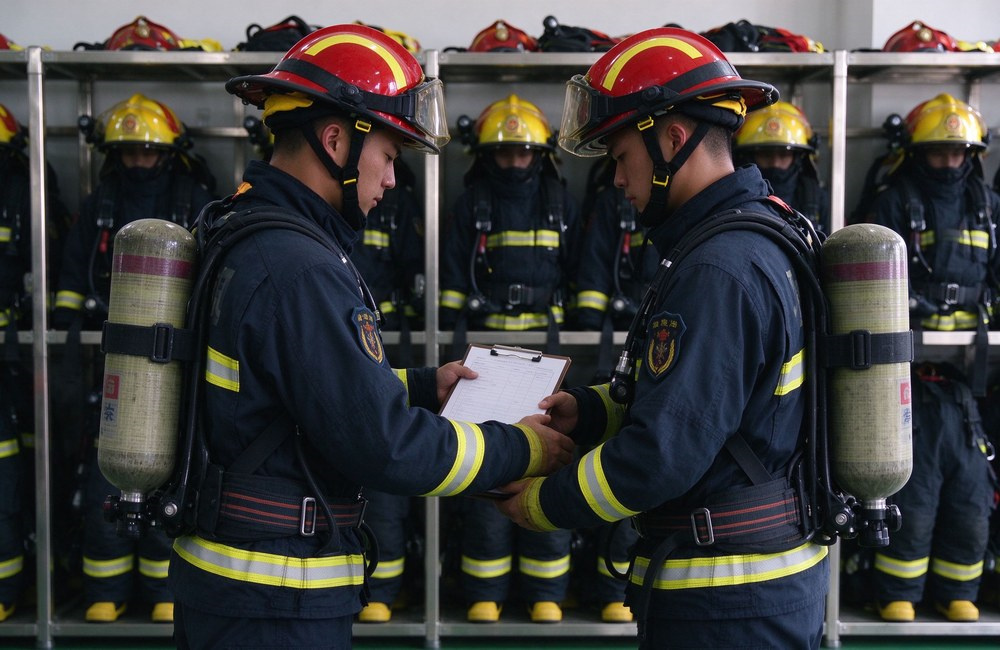
Stock models start at 10 units. Sample orders of 1-2 units are available at sample price plus freight, to let you evaluate fit and function before a bulk order. Custom decoration still starts at 10 units after the artwork proof is approved.
Stock units ship in 20-30 days after deposit. Custom orders logo, non-standard cylinder, or comm module run 45-60 days. The final lead time is locked in your signed sales contract, and we plan production slots around your required delivery window.
Yes. We silk-screen your department name or crest onto the mask shell or backplate, sized to avoid covering the data label. We send an artwork proof by email for approval before production. The minimum for custom decoration is 10 units.
Yes. We supply third-party test reports showing GA124, NFPA 1981, or EN 137 test results, plus an ISO 9001 certificate. We describe units as "tested to" these standards. If your tender requires a specific certificate mark, tell us before ordering so we can quote it.
Standard terms are 30% T/T deposit and 70% against copy of the bill of lading. Confirmed government tenders can accept an irrevocable L/C at sight. We do not offer open-account terms for first orders. Final terms are confirmed on the proforma invoice.
Yes. We supply a tender authorization letter naming your organization, test reports, the ISO 9001 certificate, and a spec-response table mapping each tender clause to our product fields. For volume tenders we can also send a demo unit to your training ground.
Ready to spec your next SCBA order? Start with a 1-2 unit sample, compare the test report against your tender, and lock the 20-30 day delivery window before fire season. Filter gas masks, breathing air compressors, and emergency escape sets complete the same breathing-safety corner.
© 2026 YRF Textile. All rights reserved.
info@yrftextile.com
Previous :
Yellow Splash Resistant Suit | HDPE+PP Fabric for Acid AlkaliNext :
Disposable Type 5/6 Coverall | Lightweight SMS Chemical Wholesale Deep Blue Firefighting Suit Set, Forest Fire Fighting Specialized, Full-body Protection
This Deep Blue firefighting suit set is specially designed for forest fire fighting, using special flame-retardant fabric that can withstand 700°C open flames in the wild, with a thermal protection value (TPP) of 25CAL/AM2. The vivid Deep Blue color combined with enhanced reflective strips enables identification from 500 meters away in forest smoke. The lightweight design of only 4.5KG does not affect mountain action speed, with a waterproof rating >40KPA, adapting to camping fire fighting and long-term field operations. The anti-plant puncture design increases wear resistance by 50%, making it professional equipment for forest firefighting, mountain rescue, and outdoor fire fighting actions, providing all-around body protection for forest firefighters.
 High-temperature Resistant Firefighting Suit Set, Emergency Rescue, Quick-wear
This high-temperature resistant firefighting suit set is made of professional-grade flame-retardant materials, capable of withstanding extreme temperatures up to 750°C, with a thermal protection value (TPP) of 26CAL/AM2, providing reliable protection for emergency rescue. The innovative quick-wear design allows complete dressing in 40 seconds during emergencies, with hydrostatic pressure resistance >45KPA and excellent breathability. Designed according to ergonomic principles, weighing only 4.8KG, it effectively reduces the burden on rescue personnel and is suitable for high-risk scenarios such as building fires, tunnel rescues, and industrial firefighting, making it an ideal equipment choice for professional firefighting teams.
 Professional Firefighting Suit Set, Flame-retardant Protection, Rescue Essential, 14-3C Certified
This professional firefighting suit set is made of high-grade flame-retardant cotton fabric, 14-3C certified, capable of withstanding extreme temperatures up to 800°C, with a thermal protection TPP value of not less than 28CAL/AM2. The three-layer composite protection structure, with waterproof static pressure resistance >50KPA and breathability >5000G/M²·24H, ensures comprehensive safety for rescue personnel in complex environments such as building fires, forest fires, and special chemical plant fires. Available in three models: 97/02/14, meeting different rescue scenario requirements.
 02 Firefighting Suit Multi-layer Composite Material Rescue Protection
This Type 02 firefighting suit is made of professional flame-retardant materials with excellent heat resistance, fire protection grade meeting international rescue standards, and waterproof puncture resistance rate of 98%. The deep blue body is equipped with eye-catching yellow reflective strips, increasing night visibility by 85%. The complete six-piece configuration provides comprehensive protection for firefighting, forest firefighting, earthquake rescue, and other scenarios, providing reliable protection for 300+ professional rescue teams.
 Forest Fire Rescue Service with Heat-Resistant Design
This professional forest fire rescue service uses flame-retardant heat-resistant material, achieving GB8624-A2 fire rating standard with heat resistance up to 800°C, and features high-visibility reflective strips visible from 300 meters away. It's suitable for emergency rescue scenarios such as forest fires, mountain rescues, and industrial disasters, providing comprehensive personal safety protection. Each set has undergone 10,000 abrasion tests and proven its reliability and safety in over 1,500 rescue operations nationwide.
 Fire Rescue Cap, Aramid Flame-Resistant Material, Forest Fire Emergency
This professional-grade forest firefighting vest and hat set is made of polyester/cotton blended flame-retardant fabric, with reflective visibility up to 300 meters, capable of resisting short-term flame contact, improving protection efficiency by 85%. The bright orange design with double-layer reflective strips complies with international rescue standards, ensuring 360° visibility in smoke and low light environments. Suitable for forest fire fighting, wilderness emergency rescue, post-earthquake sites, and other emergency disaster relief scenarios, providing comprehensive protection for rescue personnel.
Copyright © Custom Disaster - Relief Bedding: Tents, Sleeping Bags, Blankets All Rights Reserved
the professional team to service !