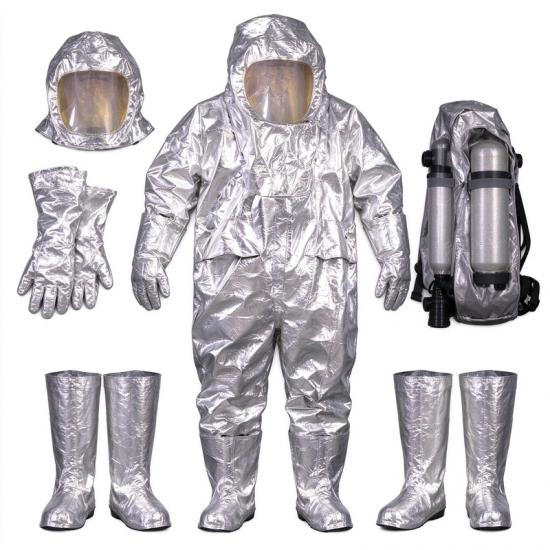
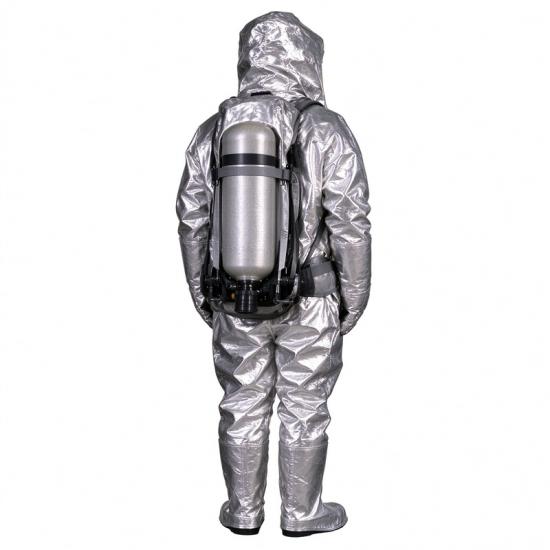
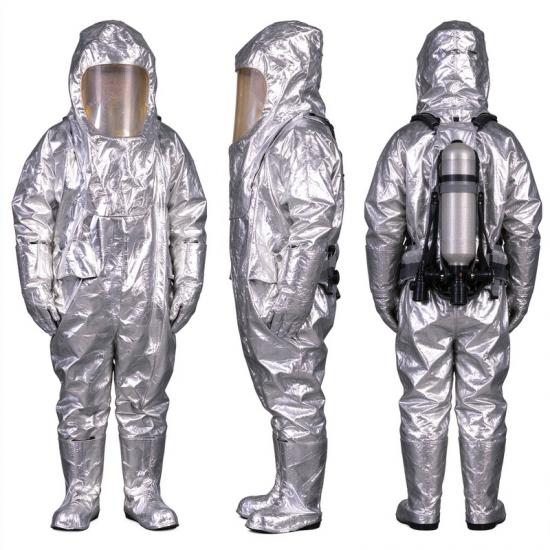
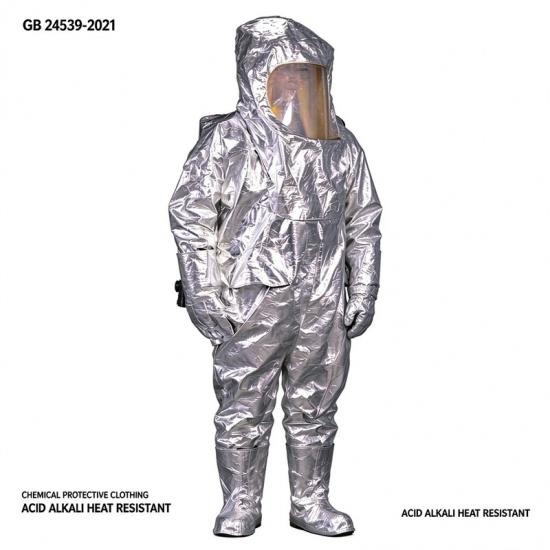
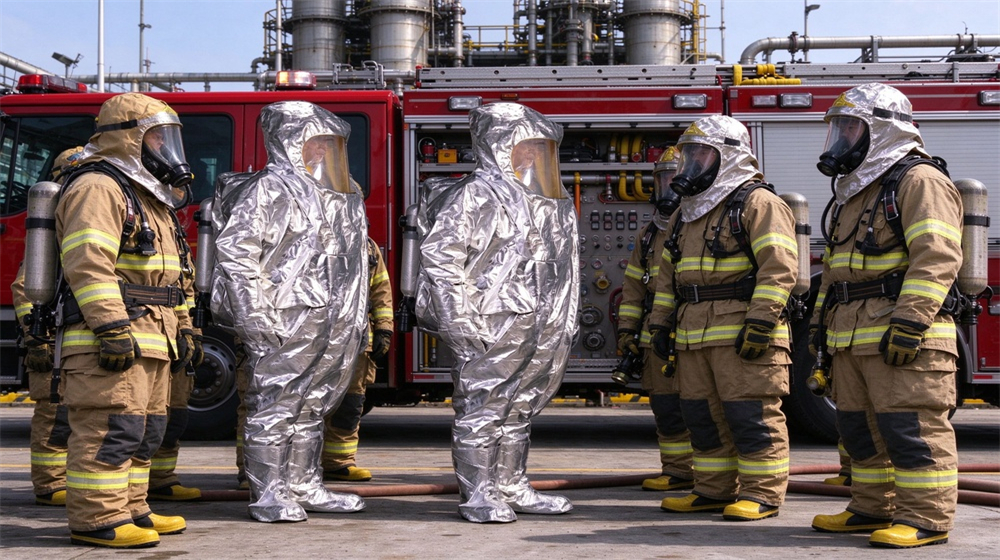
Our thermal chemical composite suit adopts aluminum foil outer shell and multi-layer chemical resistant lining. It provides dual protection against radiant heat, flame, acid, alkali and hydrocarbons. One-piece design with hood, face shield, SCBA backpack and overpressure exhaust system. Sizes M-L-XL, ideal for chemical plant hazmat emergency, available for bulk procurement.
Note: Price for reference only. Exact price based on quantity, size, weight and custom details.
model no. :
XFF-06Brand:
YRFmarket price :
$119.8sale price :
$59.9price range :
30-100/$59.9Color :
Multiple Colorsport of dispatch :
Guangdong/GuangzhouPayment :
TT, Paypal, Western Unionmin order :
30original region :
Made in ChinaLead Time :
5-15daysThermal Chemical Suit | Dual Fire and Chemical Barrier
Protection
Industrial fires and chemical leaks happen together in 40% of plant emergencies, but most response teams carry two separate protective suits. A thermal-chemical composite suit with aluminized outer layer and chemical barrier membrane handles both fire heat and hazardous liquid splash in one garment. Full specs, certification details, sizing charts, and wholesale pricing below for industrial safety procurement.
 |

|
1. What Is Fire-Chemical Protective Clothing?
2. The Dual Build: Aluminum Foil + Chemical Barrier
3. Fire-Chemical vs Chemical-Only vs Thermal Suits
4. Performance Data Behind the Spec Sheet
5. Configuration: Hood, Backpack and Overpressure System
6. Who Needs Fire-Chemical Protection
7. Sizing, Inspection and Maintenance
8. Buying Bulk Chemical PPE from a China Supplier
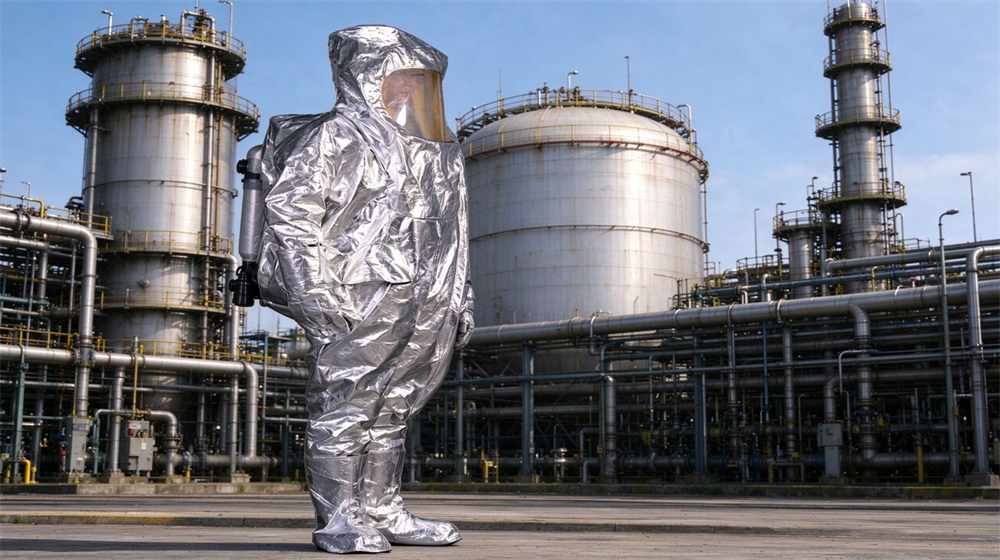
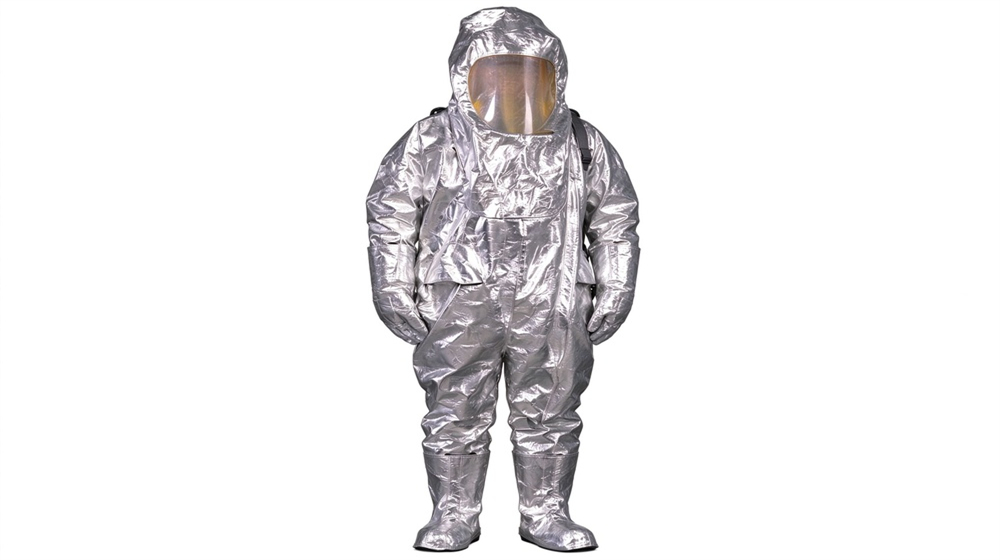
If a spill site can also burn, a suit that only stops chemicals is half a suit. The RHF-IOF closes both sides: an aluminum foil outer shell that reflects radiant heat and resists flame, and a multi-layer chemical-resistant flame-retardant lining that stops acids, alkalis and hydrocarbons. As a chemical protective clothing supplier, we build it one-piece with hood, breathing-apparatus backpack, sealed zipper and overpressure exhaust — for plants, industrial teams and emergency responders who need heat and chemical protection in one order.
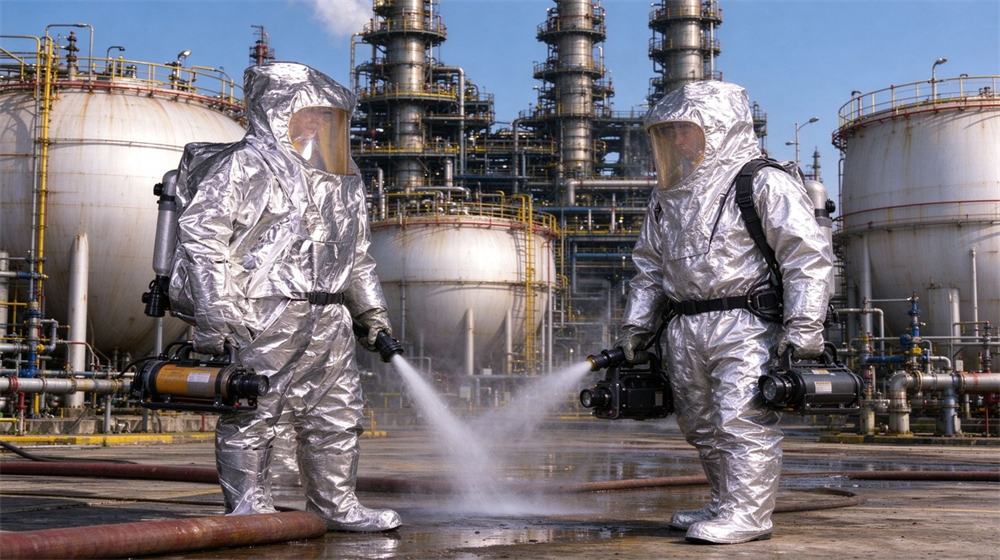
One-piece build with hood and face shield, inspected before every batch leaves the plant.
Flame, acid, alkali, hydrocarbons — one garment, rated for each.
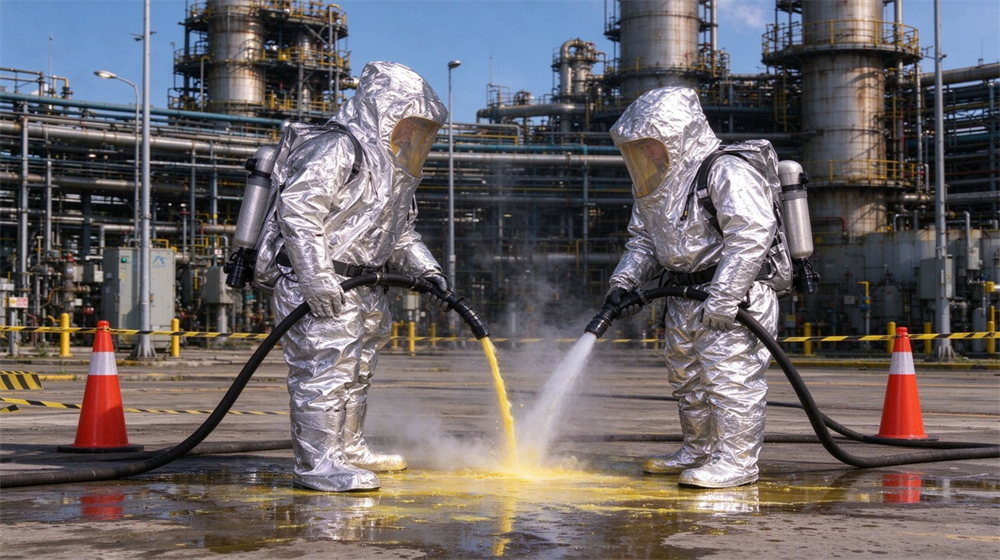
Fire-chemical protective clothing is the crossover class between thermal and chemical suits: one garment for worksites where radiant heat or flame and chemical exposure share the same task — a leaking valve near a furnace, a line break beside hot piping, a response inside a chemical plant. The RHF-IOF answers that crossover with two protection systems in one garment.
The outer shell is aluminum foil fire-proof fabric — the reflector thermal suits rely on, and an impermeable surface chemicals cannot soak into. The lining is a multi-layer chemical-resistant flame-retardant material that stops liquids reaching the body and backs up flame resistance.
The garment is one piece — top and trousers together — because seams are where chemical suits fail. Head, hands, feet and the front closure are each closed or sealed.
Ordering bulk chemical ppe puts the whole team on one standard — one shell, one lining, one inspection routine, with the batch report with the order.
Chemical-only suits stop liquids and vapors but are not built for radiant heat. The RHF-IOF closes that gap: char ≤10cm, afterflame ≤2s, hydrostatic ≥17KPa.
Thermal suits reflect heat but are not chemical barriers. The RHF-IOF sits the foil shell over the chemical lining, so both answers work in one garment.
Heat first, chemicals second, seams sealed — one line for the crossover class.
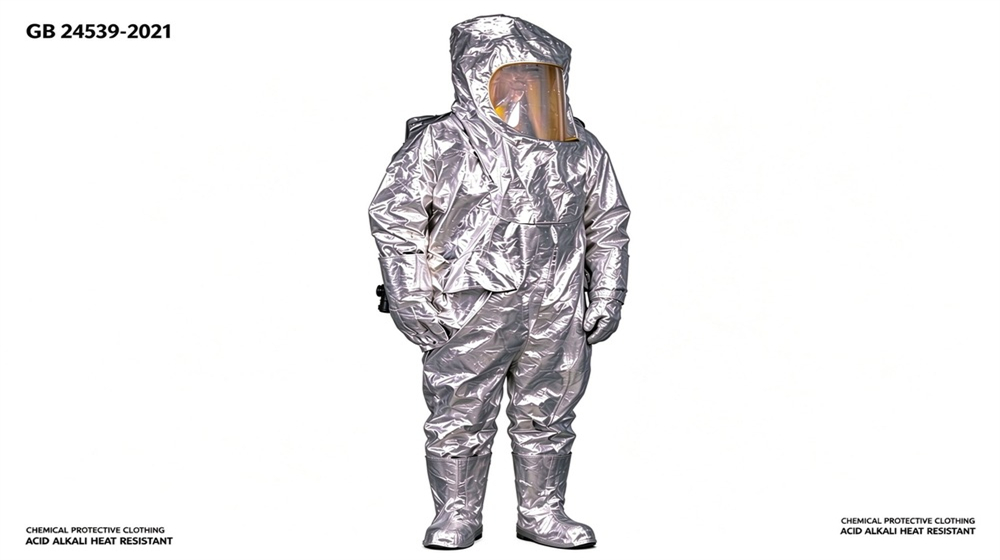
The protection story is a layer story: the outer aluminum foil shell handles heat and sheds liquids, the inner multi-layer chemical-resistant flame-retardant material stops what gets past it. Heat crosses the reflective shell first; chemicals cross the barrier before anything touches the wearer.
Layer Role
In the Fire-Chemical Suit
Aluminum foil shell
Reflects radiant heat, resists flame, sheds liquid chemicals
Chemical-resistant flame-retardant lining
Barrier against acids, alkalis, hydrocarbons; backs up flame resistance
Sealed construction
One-piece top and trousers, sealed zipper, double front flap — seams minimized and sealed.
Overpressure exhaust system
Vents internal pressure outward so vapors do not pull inward.
Hood, gloves, boots
Wide-vision hood with face shield, chemical gloves, chemical rubber boots — full closure.
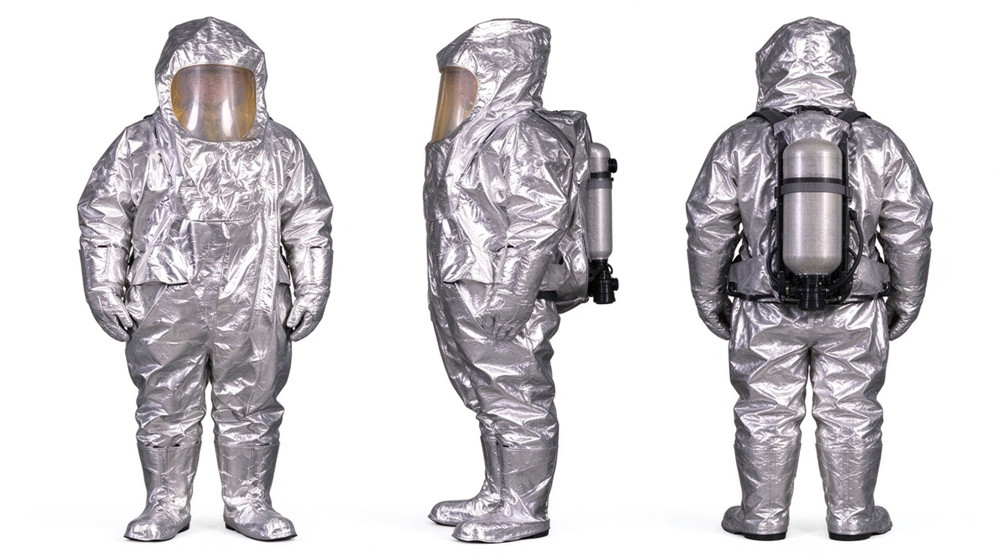
Aluminum foil is the oldest reliable radiant-heat reflector in protective clothing — polished foil reflects heat instead of absorbing it. On the RHF-IOF it has a second job: as the outermost surface it sheds chemical liquids, so a spill runs off the shell instead of soaking into the lining.
Flame resistance is measured, not assumed: char ≤10cm, afterflame ≤2s, afterglow ≤2s — the standard language of flame-resistant clothing, and the numbers sit in the RHF-IOF test report.
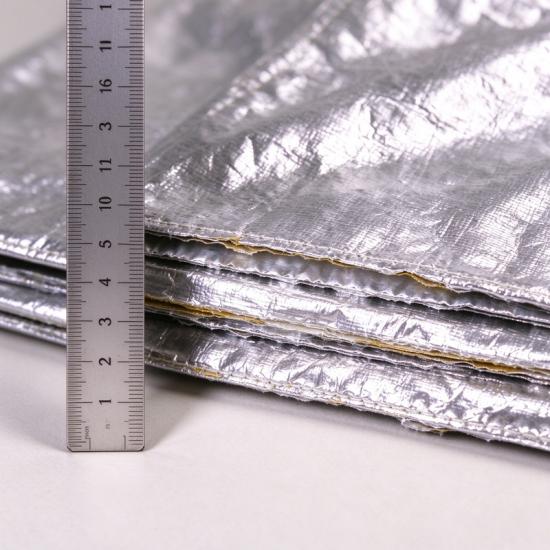
Thickness is verifiable. The multi-layer build — aluminum foil shell over the chemical-resistant flame-retardant lining — is measured, not described.
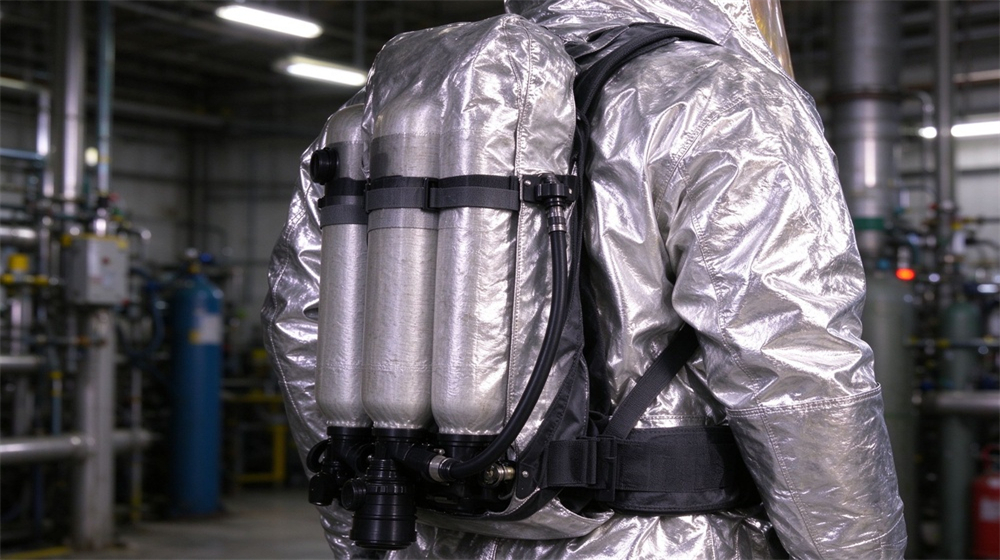
Behind the shell, the lining does the chemical work. It is a multi-layer composite of chemical-resistant and flame-retardant materials — layers arranged so a chemical has to cross more than one barrier. The measured results are the ones buyers should compare: tear strength ≥50N, breaking strength ≥500N, peel ≥9N, hydrostatic pressure ≥17KPa, and acid and alkali hold times measured in a liquid-column test.
Compare samples with the ruler and the test sheet together — the sample shows thickness, the sheet shows the numbers.
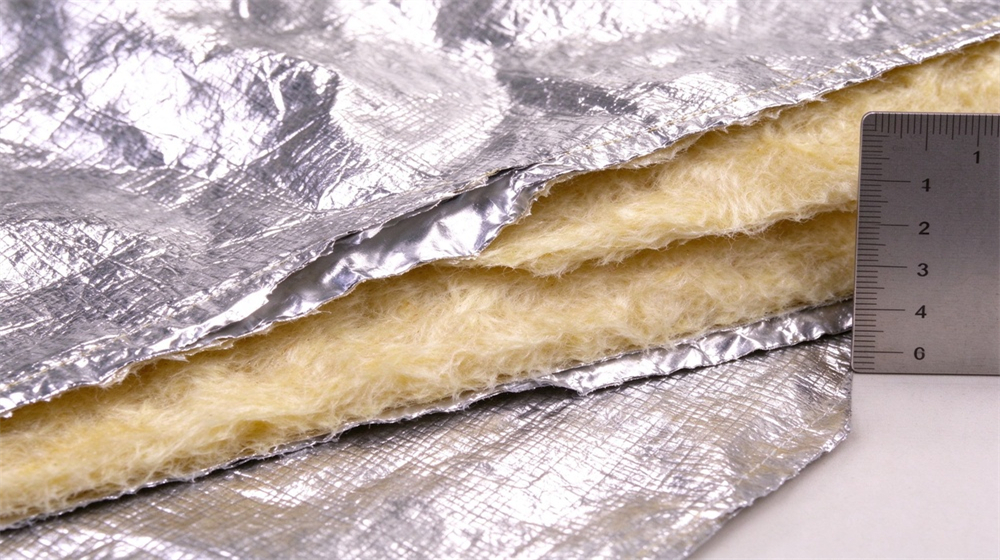
A two-piece suit has a waist seam — a horizontal path for liquid. The RHF-IOF is one garment, so that path does not exist. The hood, gloves, boots and front zipper are each closed or sealed.
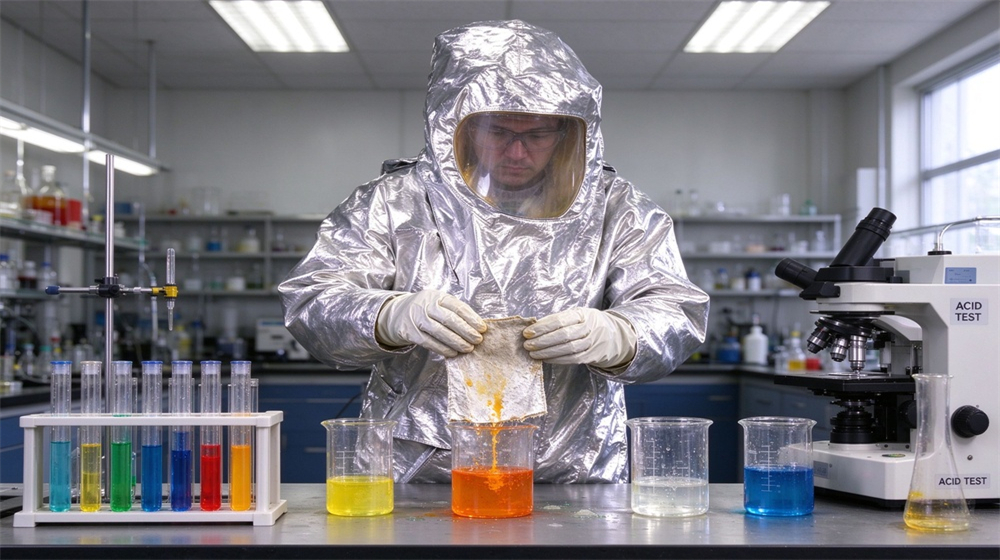
Three garment classes cover most plant and emergency tasks. The decision starts with the worksite, not the catalog: name the threats, then match the garment.
Decision Point
Fire-Chemical (RHF-IOF)
Chemical-Only Suit
Thermal Suit
Core task
Heat + chemical exposure at one worksite
Chemical liquids, splashes, vapors
Radiant heat, flame proximity
Radiant heat
Aluminum foil shell reflects it
Not built for radiant heat
Built for it
Acid / alkali
Liquid-column hold times measured
Core strength
Not a chemical barrier
Flame resistance
Char ≤10cm, afterflame ≤2s
Varies by fabric
Core strength
Construction
One-piece, sealed zipper, overpressure system
Sealed by design class
Open or closed by task
Name the hazards first. A valve repair beside a hot line needs fire-chemical; an acid laboratory needs chemical-only; a furnace crew needs a thermal suit. The RHF-IOF sits where heat and chemicals overlap — most of a chemical plant.
Stocking more than one class is normal for plants that cover both routine chemical work and hot-zone maintenance. The rule that keeps crews safe: every crew member wears the lightest garment that fully protects the actual task — and for tasks where both threats are present, the lightest adequate garment is the fire-chemical suit.
Emergency drills are the proof of the decision matrix: crews rehearse which garment the task demands before the real call comes in.
This is also a bulk chemical ppe buying decision: when the worksite profile is consistent, the plant orders one class in quantity and one inspection routine, instead of mixing classes across the same crews.
The RHF-IOF numbers come from the product file and the batch test report. Buyers should compare methods before comparing figures — the table below lists the values in the standard test language for flame, tear, break, pressure and chemical hold.
The garment is produced to meet GB 24539-2021 for chemical protective clothing and XF 770-2008 for firefighter chemical protective clothing — the standard reference buyers check first.
The acid and alkali tests use a liquid column — a measured column of liquid standing on the fabric — and record how long before penetration. 98% sulfuric acid, 60% nitric acid and 30% hydrochloric acid held for one hour without penetration is a strong result for plant work; 6.1 mol/L caustic soda held ≥60 minutes is the alkali side of the same proof. These are the numbers a plant engineer checks first, and they are the values that separate a fire-chemical garment from a generic coverall on the same worksite. The test method matters as much as the figure — a liquid-column hold is a different proof than a splash test, and the RHF-IOF report states the method on every line.
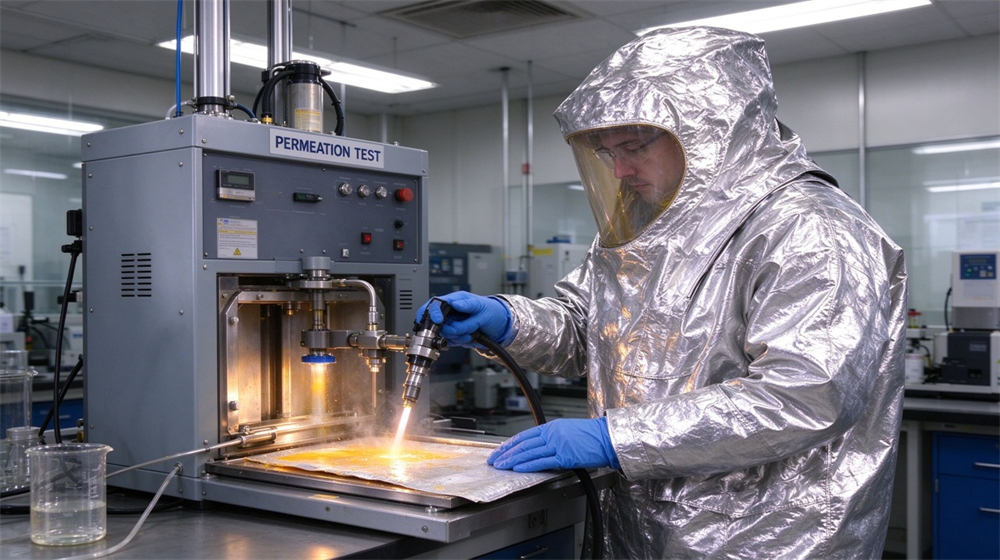
In the lab, the fabric stands under a measured liquid column and the clock runs until penetration — the result is a number, not a promise.
Every claim on this page traces back to the product file and the batch test report: request the report with your sample and compare the method before you compare the number. Flame, tear, break, pressure and chemical hold are all measured values, not marketing language.
Permeation tests record when the chemical crosses the barrier — the hold time on the spec sheet comes from runs like this one.
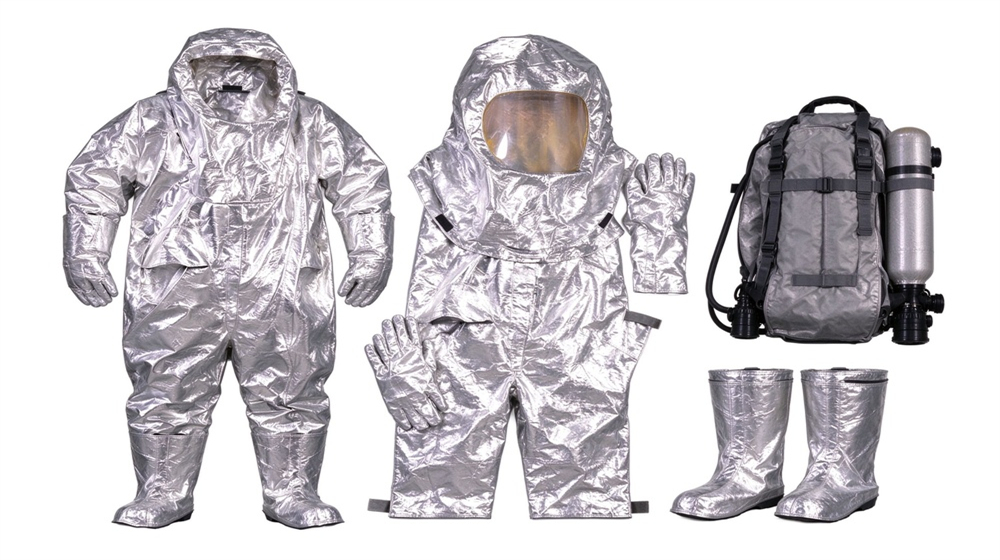
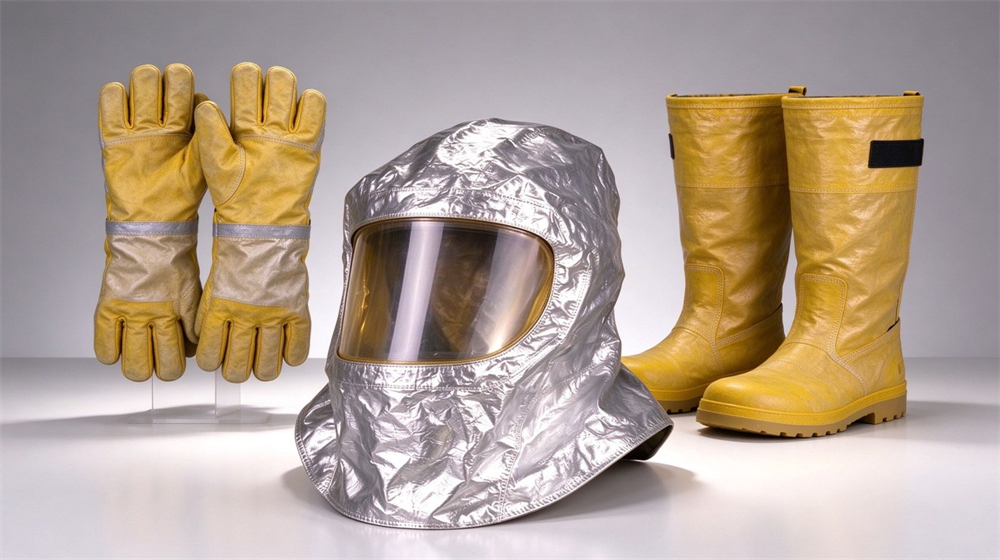
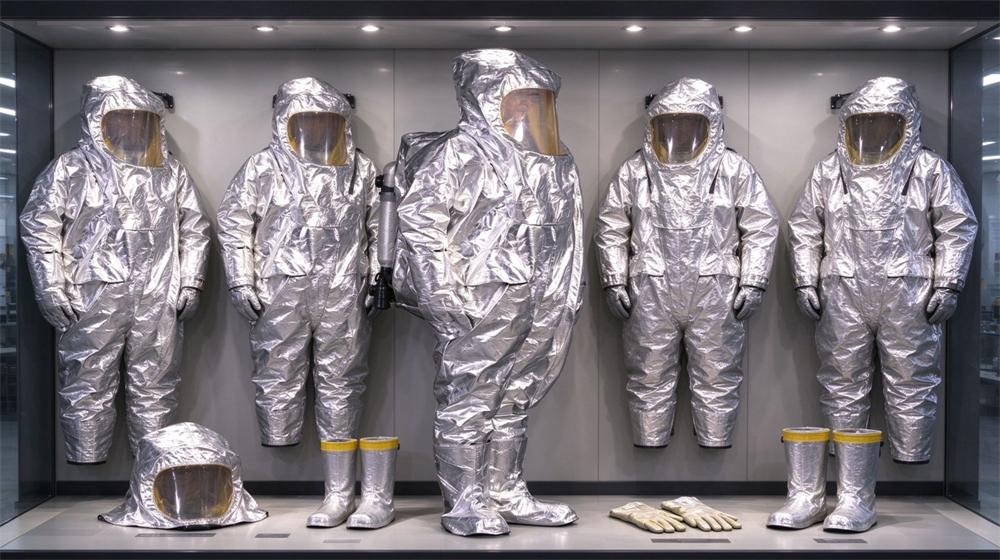
The RHF-IOF ships as a complete system: one-piece coverall, wide-vision hood with face shield, breathing-apparatus backpack, chemical gloves, chemical rubber boots, sealed zipper with double front flap, and an overpressure exhaust system. Ordering the full system from one supplier keeps every component matched to the same standard — gloves, boots and hood are part of the barrier, not afterthoughts.
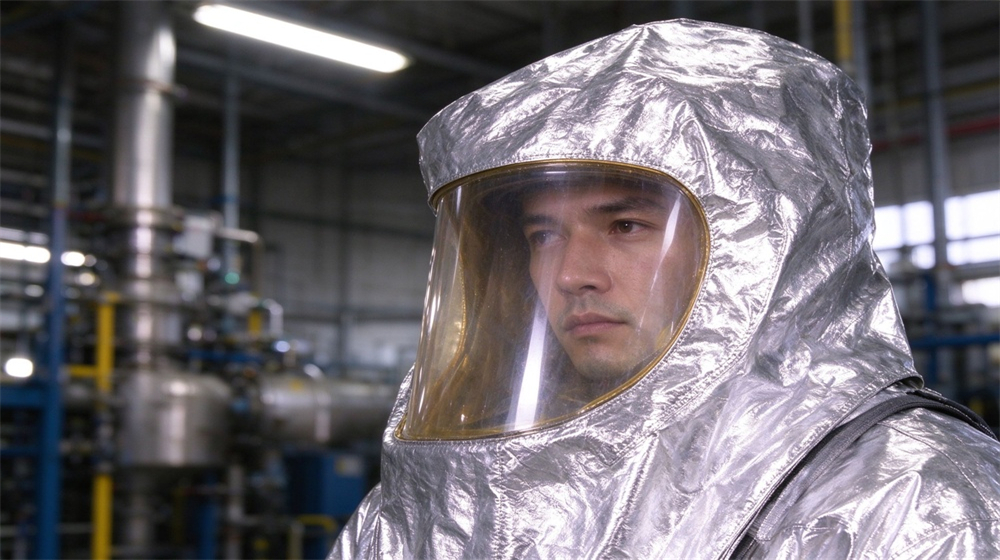
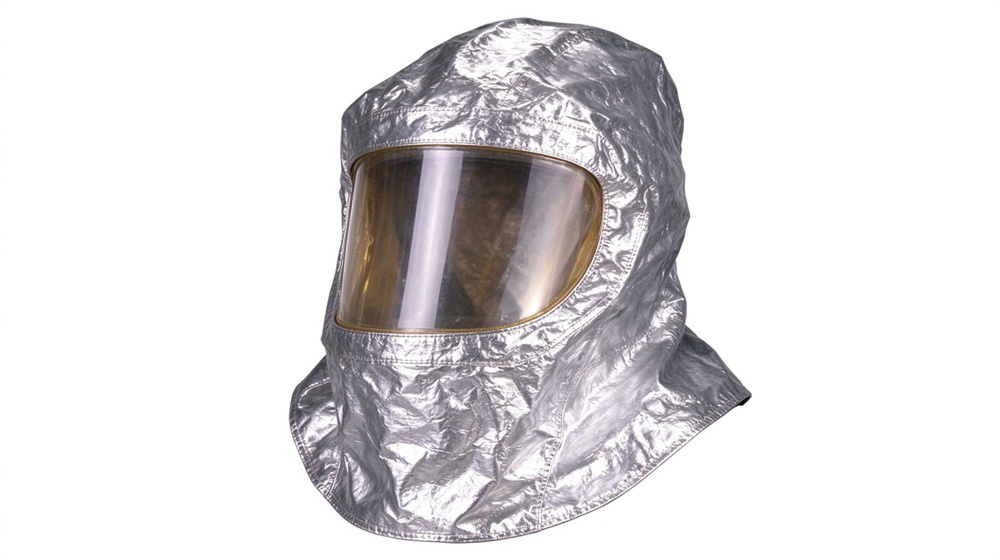
The hood closes the head opening with a wide-vision clear face shield. Wide vision matters in chemical work — the wearer reads gauges, valves and moving equipment through the shield, and a shield that narrows the field forces risky head movement. The face shield is part of the sealed system, checked for clarity in every inspection. Around a chemical plant the wearer is reading instruments every few seconds, so shield clarity is a work tool, not a comfort feature — a fogged or scratched shield slows the task and raises risk.
Close-up of the hood and face shield — the wide field keeps the wearer reading the worksite, not the shield.
The hood is part of the sealed system: clear shield, tight closure, checked every inspection.
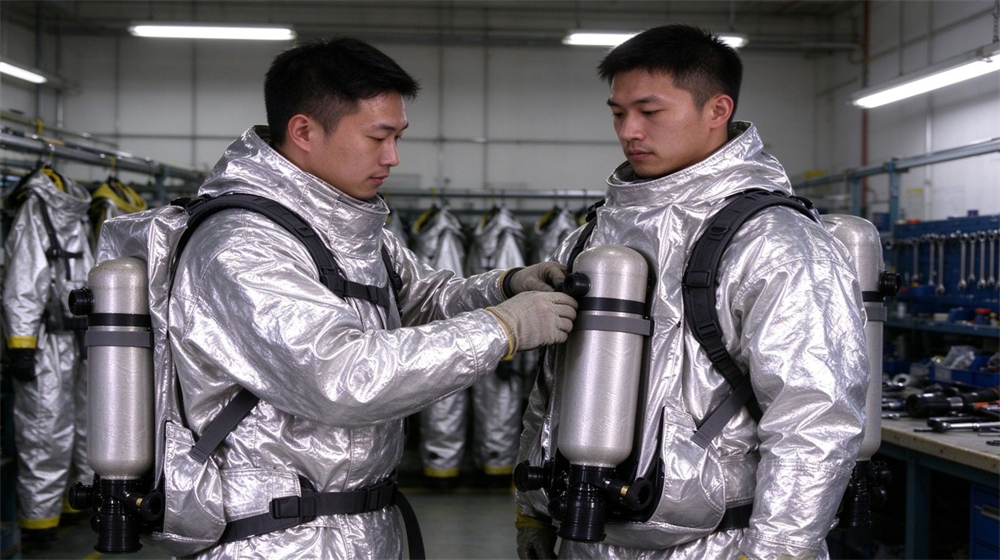
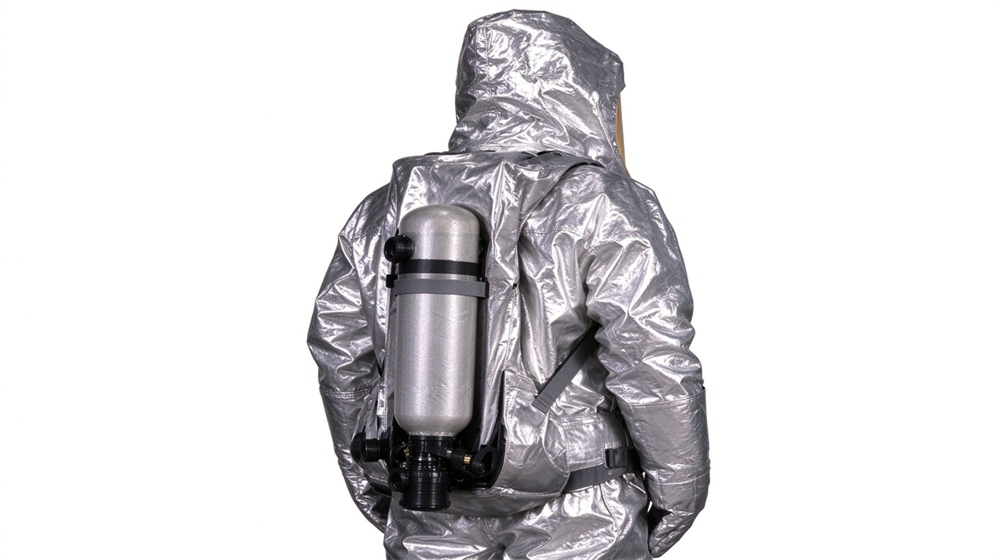
The backpack is built to carry breathing apparatus, so the suit works with respiratory protection instead of against it. The overpressure exhaust system vents internal pressure outward — as the wearer moves and the suit warms, pressure escapes through the exhaust instead of pulling vapors in through openings. Together they make the garment usable for real response work, not just a shell. In a long operation — a pump fire, a slow valve failure, a tank overflow near ignition — the crew works in the suit for minutes at a time, and the exhaust system is what keeps the garment workable through that whole window.
The backpack mounts the breathing apparatus inside the suit envelope, so the protection moves with the crew.
Detail of the overpressure exhaust valve — a small part that decides how the garment behaves in a long operation.
The backpack is part of the one-piece build, so the apparatus mount is never an afterthought.
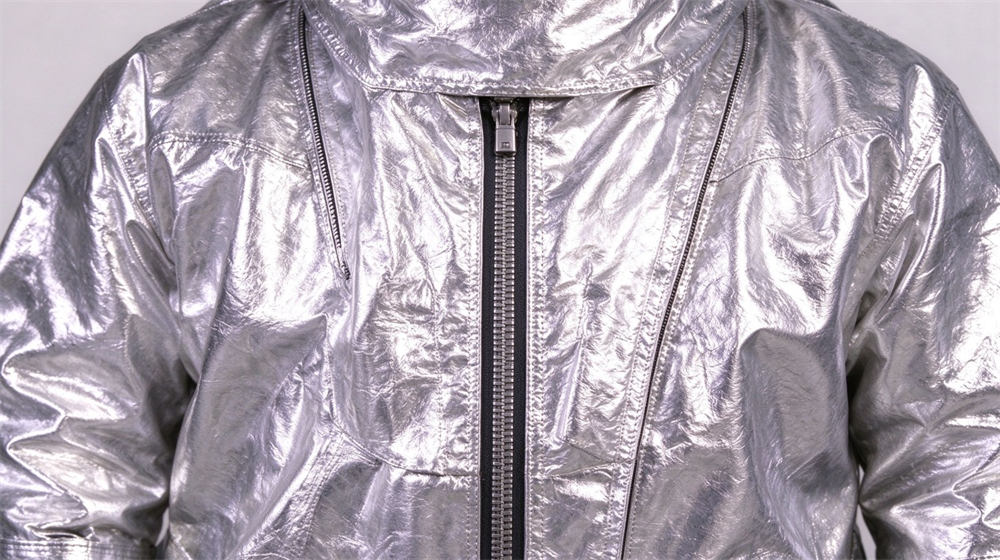
The front closure is a sealed zipper covered by a double flap. The flap is the second line behind the zipper — liquid has to cross the zipper and then the flap, and the flap also protects the zipper from splash damage. Seam and closure inspection is part of the routine check, because a closure that fails mid-task is not a comfort issue — it is a hole in the barrier. Crews check the zipper run every time the garment is donned, and the weekly inspection adds the flap condition to the same check.
The front closure is where chemical suits either work or fail — sealed zipper, double flap, inspected every time.
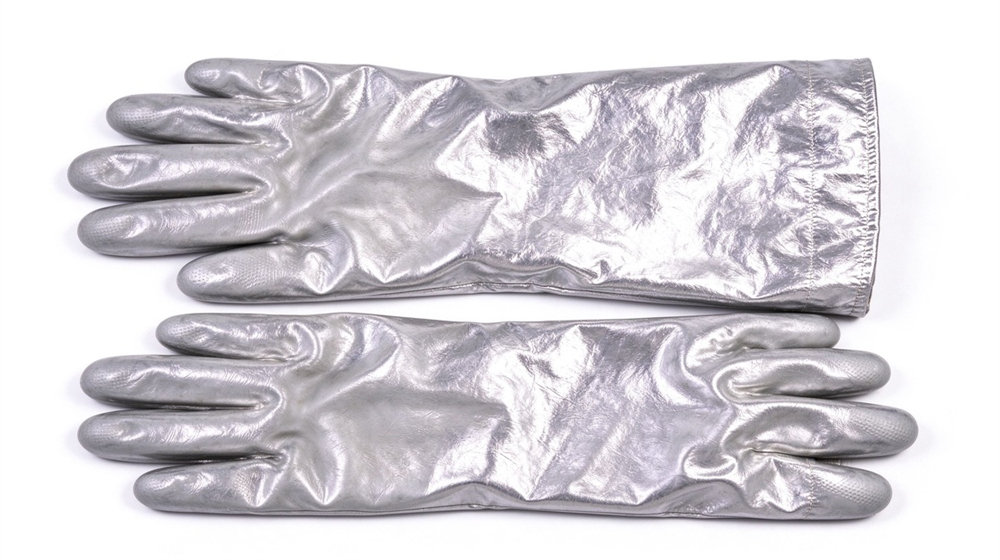
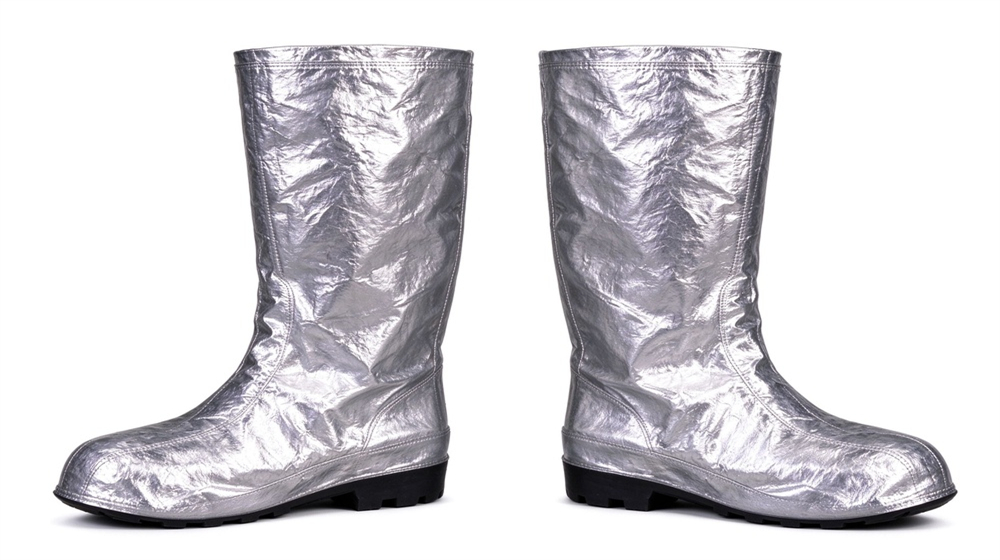
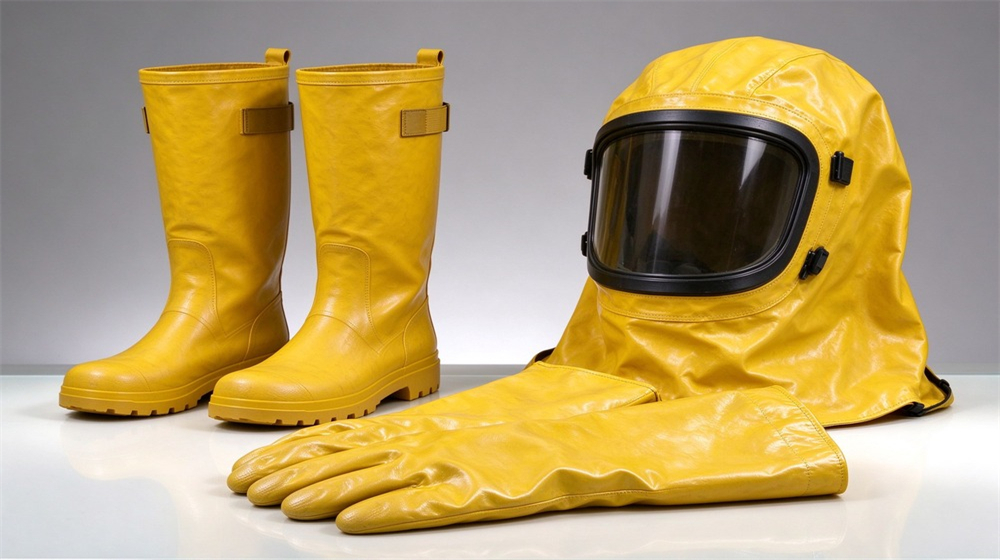
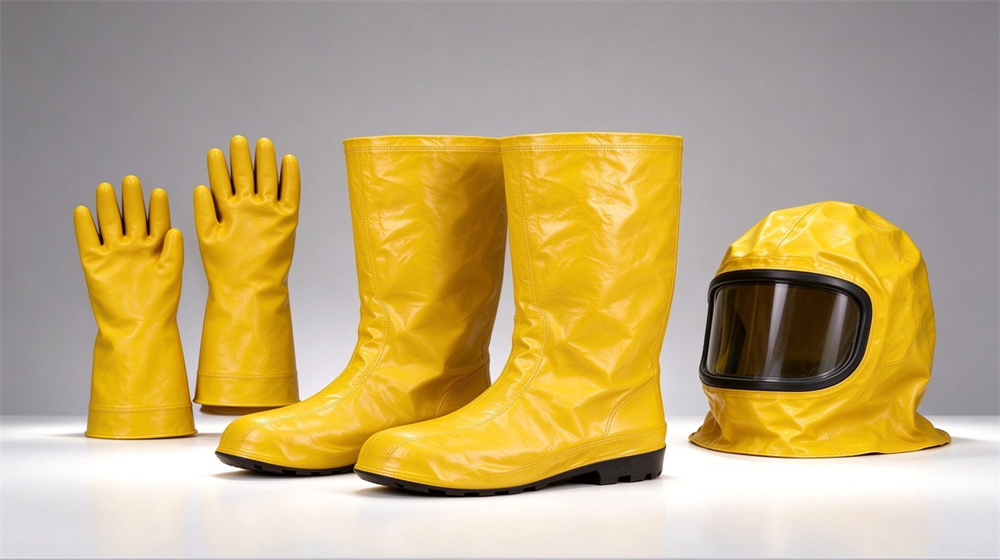
Chemical gloves close the wrist opening, chemical rubber boots close the ankle opening. Both are matched to the suit's chemical class, and both are ordered as part of the system so there is no gap between what the spec sheet describes and what the crew wears.
Gloves close the wrist path — matched to the same chemical class as the suit.
Boots close the ankle path, with the same chemical rating as the rest of the system.
One-piece construction removes the waist seam — the horizontal leak path that two-piece suits carry.
Two industries carry the core of fire-chemical work: chemical plants and emergency response. Both face the same overlap — a worksite where heat and chemicals coexist — and both use the RHF-IOF the same way: one-piece, hood closed, breathing apparatus carried, task executed at the shortest exposure.
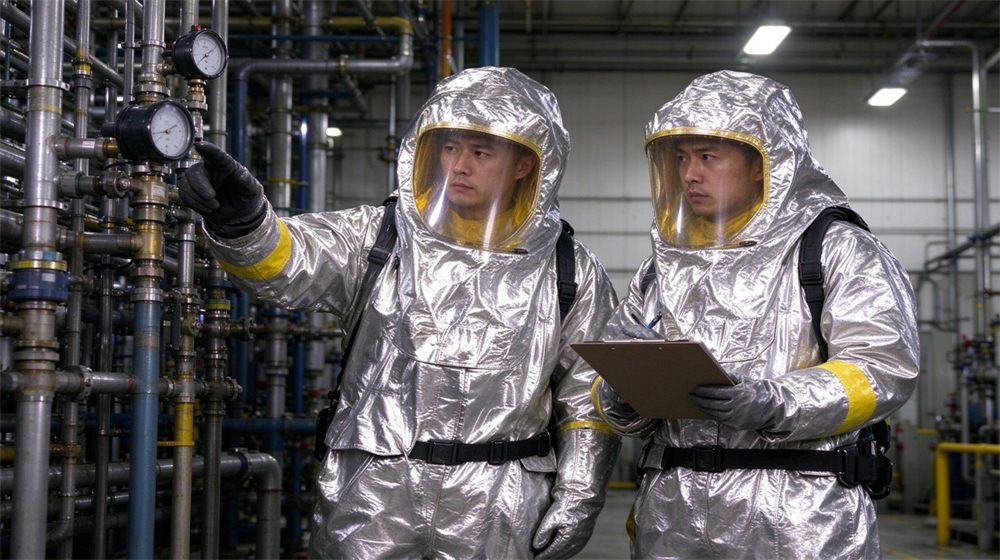
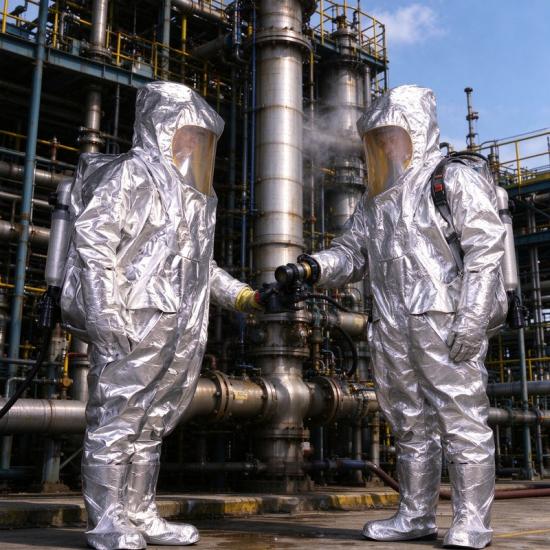
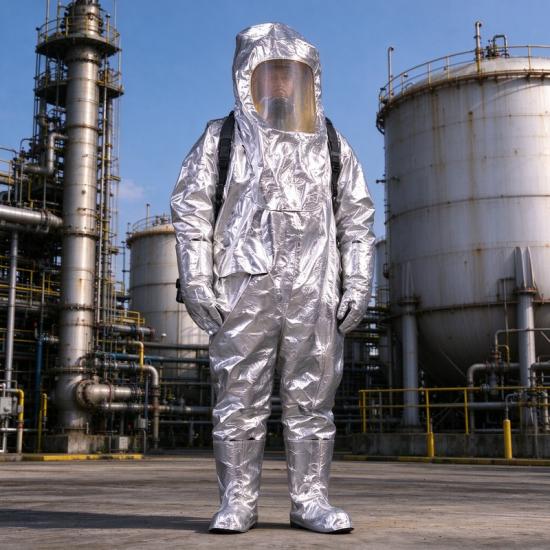
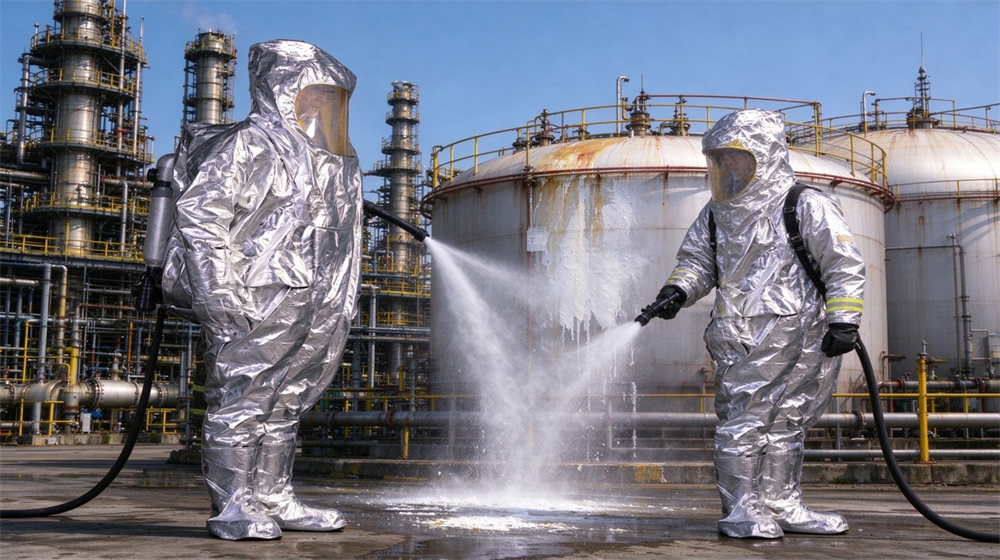
Tank farms, unit lines and pump stations are the everyday fire-chemical worksites. A leaking valve beside hot piping, a line break near a furnace, a flange repair over an acid stream — each task puts a worker where radiant heat and chemical liquid share the same square meter. The RHF-IOF is specified for those tasks, and plants order it in bulk so every crew member on the hot side wears the same standard.
Neutralization work at the tank line sits inside the heat-and-chemical overlap — the exact profile the RHF-IOF is specified for.
Hazmat teams face the worst version of the overlap: a burning or hot area with released chemicals, where the response crew must get close enough to neutralize or contain. The fire-chemical suit lets the team move in with both protections — heat answered by the foil shell, chemicals answered by the lining — and the overpressure system keeps the garment workable through a longer operation.
Spill rescue is the hardest profile — released chemicals, possible ignition — and it is exactly where the dual build earns its place.
Industrial fire brigades carry fire-chemical suits for plant incidents where flame and chemicals meet — pump fires, valve failures, tank overflows near ignition sources. The garment sits beside their thermal and proximity suits, covering the tasks where neither of those alone is adequate. Brigade crews train in the garment the same way they train in any PPE: the crossing is rehearsed, the breathing apparatus is checked with the suit, and the drill is recorded. After a response, the suit goes through the after-use check — shield, zipper, seams — before it returns to the rack, so the next call starts from a verified garment.
Plants and brigades buy bulk chemical ppe for the same reason they buy any PPE in quantity: one standard, one inspection routine, one fit logic across the crew. Batch orders keep the whole team on the same garment — same shell, same lining, same closures — and the batch test report travels with the order.
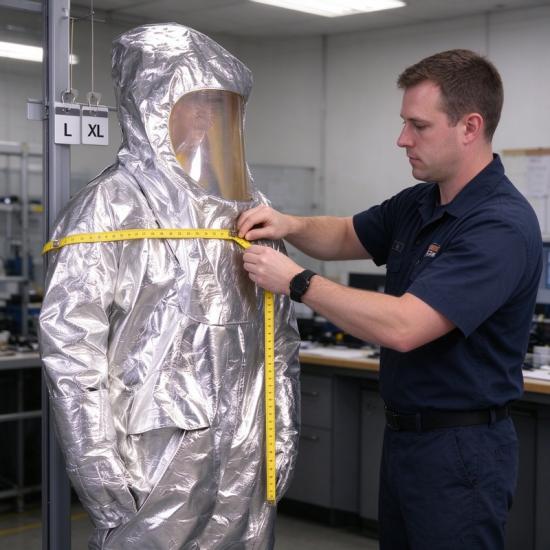
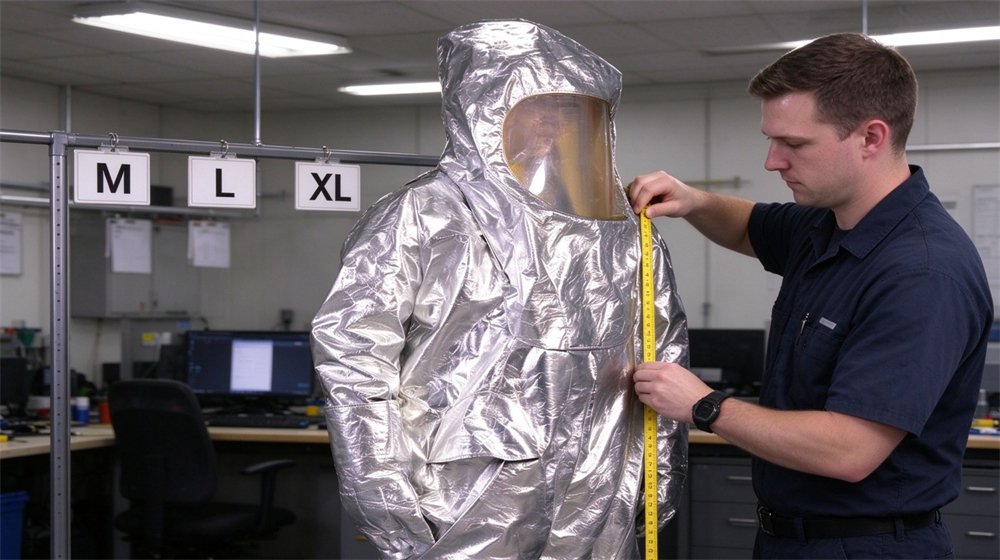
The RHF-IOF is produced in M, L and XL with consistent proportions across the range, so protection stays the same when the wearer changes. Sizing starts from the actual crew: measure over the intended under-layer, check the size chart, then order the mix your team really needs instead of reordering the old quantities.
Measure over the under-layer, compare against the chart, order the distribution that fits the real crew.
After every use: check the face shield for clarity and the sealed zipper for smooth closure. Weekly: check seams, the double flap, the glove and boot connections. Monthly: run a full functional check including the overpressure exhaust valve. Record each check; the record supports the next deployment decision.
Seams and closures are checked on a schedule, and the record follows the garment.
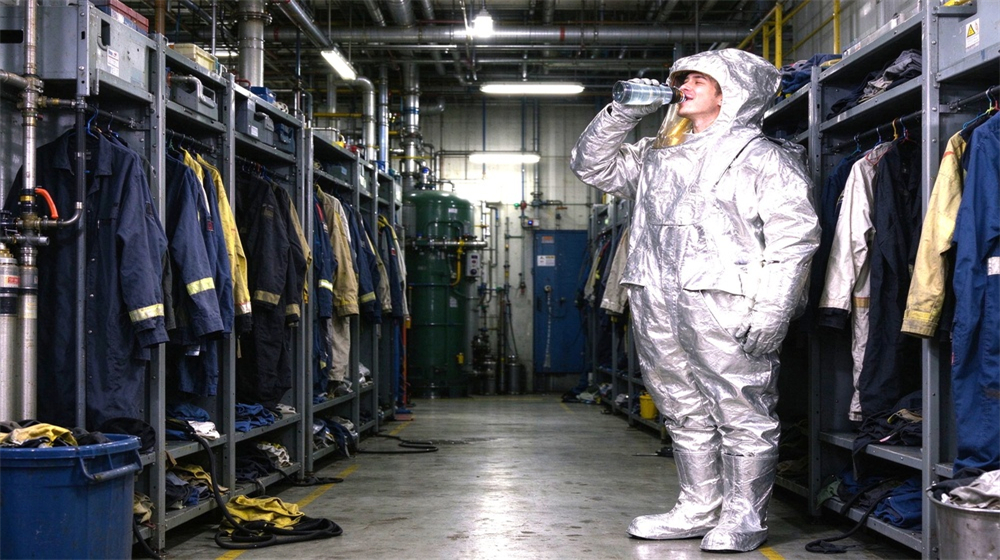
Hydration and rest keep the crew effective — the garment protects the body, the routine protects the crew.
Clean per the care instructions that ship with the garment, store in a dry gear room out of direct sun, and keep the face shield protected. Sunlight and heat age chemical garments; storage is part of the protection plan.
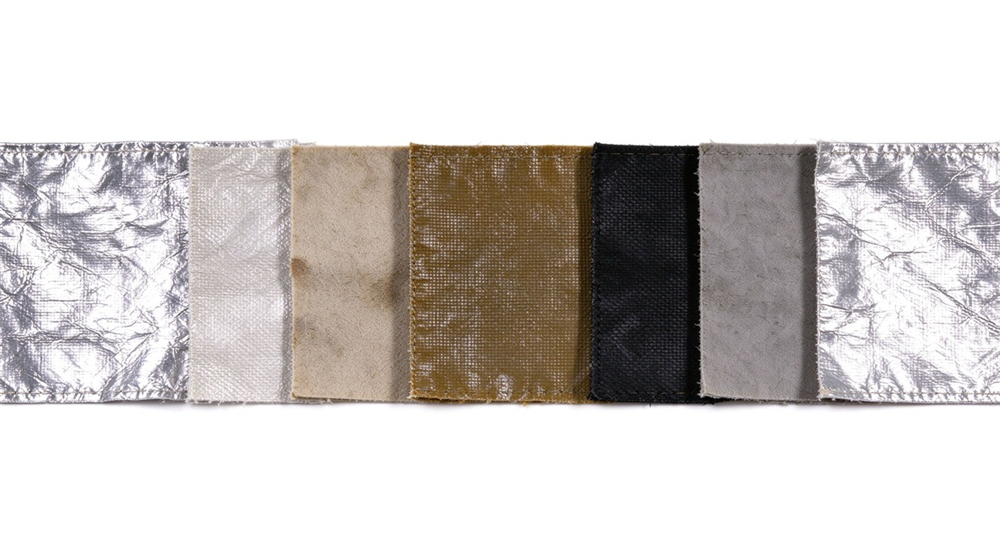
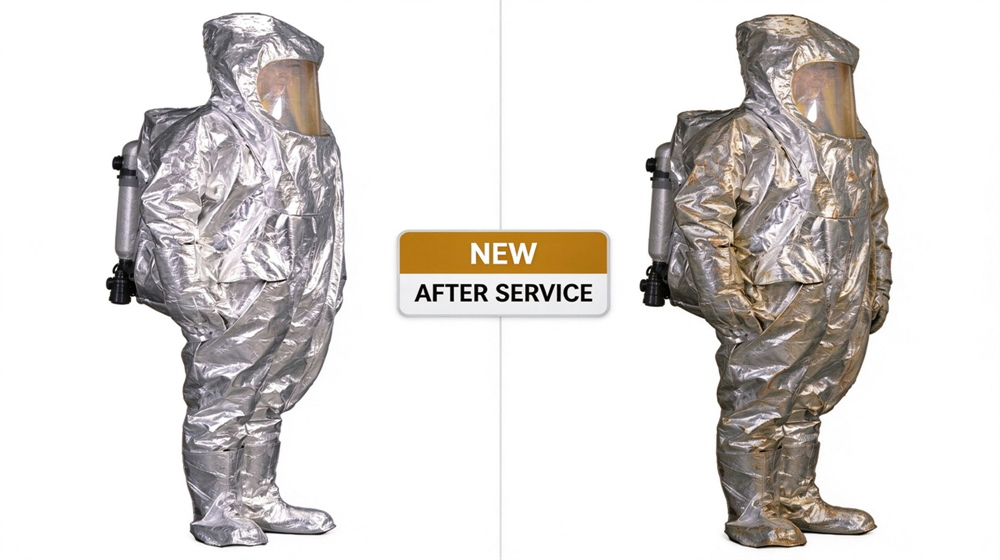
Keep a reference: a new suit and a service-aged suit compared side by side shows what use does to the shell and lining. When the inspection finds damage — shield cracks, seam weakening, shell wear — the garment is replaced on the record, not on a guess. Service life is a record decision rather than a calendar decision: a suit that has seen acid splash and hot work has a history, and the record tells the crew whether it goes back on the rack or into replacement.
Side-by-side comparison turns service life from a claim into evidence.
Buying the RHF-IOF in bulk starts with configuration. Send the worksite profile, crew sizes and expected quantity; we confirm the style, sizes, quantity and delivery terms in the contract before production starts. MOQ varies by configuration, confirmed at quotation; production timeline is confirmed per order.
The order rests on three points: configuration, certification evidence and delivery. Confirm the size breakdown, ask for the batch test report against the standard, and agree packing, lead time and payment terms in writing. Everything beyond that — MOQ, timeline, packing — is confirmed at quotation and written into the contract.
A first order is worth the sample step: one garment for the crew that will wear it, reviewed for fit, movement, shield clarity and breathing-apparatus interface — the same criteria as the bulk order. Sample review feeds the specification, the specification feeds the contract, and the bulk order starts from a confirmed configuration instead of a guess.
The wholesale rack is where bulk chemical ppe orders are staged — one standard across the batch.
Export packing follows the same logic as the suit: no weak points. Each garment is protected in its carton, the face shield is covered, and cartons are staged for inspection before dispatch. Carton contents and packing list are confirmed in the contract.
Cartons staged for inspection before dispatch — the receiving team knows exactly what arrived.
Buying the complete kit — garment, hood, gloves, boots — from one supplier keeps every component at the same standard. Mixing suppliers means mixing protection levels; the full-system order closes that gap before it reaches the plant floor.
An import order is a scheduling decision, not just a price one. The production timeline follows the confirmed order, each batch carries its own test report, and export packing is part of the agreement. The specification stays on file between orders, which is why repeat batches come out identical.
Visiting buyers see the complete system in one place — and the showroom display matches the contract spec. For remote buyers the same information travels in the product sheet: configuration, materials, sizes and the test-report request all in one file, so the first conversation starts from the same page.
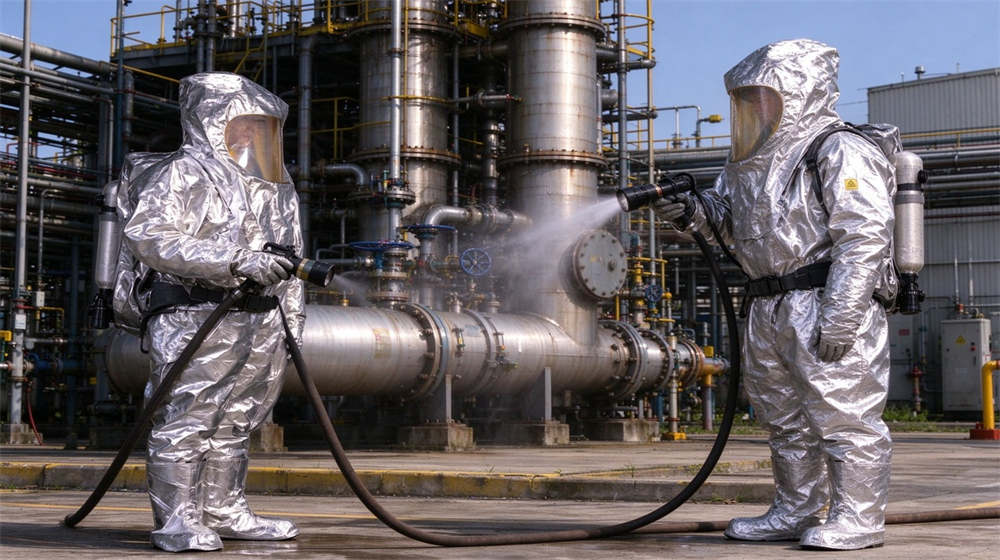
Yes. The heat-and-chemical suit is designed as a protective outer layer, so it fits over standard cotton workwear and gives the crew one complete barrier for radiant heat, splash and vapour. Leave the thermal liner and boots as a matched kit from the same order so sizing, seams and closures stay consistent across the whole set.
Buyers ask the same questions in different words — here they are answered directly.
Q1. What is a fire-chemical protective suit used for?
It is the crossover class between thermal and chemical suits: one garment for tasks where radiant heat or flame and chemical exposure share a worksite — tank-farm valve repairs near hot piping, spill response inside a plant, industrial fire brigade work where fire and chemicals meet. The RHF-IOF answers both threats in one build, so the crew does not choose between heat protection and chemical protection when the worksite refuses to separate them. Buying one crossover garment also simplifies the inventory: one spec sheet, one inspection routine and one spare-parts list instead of two separate garment programs, and the crew trains in one suit rather than two.
Q2. How is it different from a chemical-only suit?
A chemical-only suit stops liquids and vapors but is not built for radiant heat. The RHF-IOF adds an aluminum foil fire-proof shell that reflects radiant heat and resists flame — char ≤10cm, afterflame ≤2s — while the chemical lining handles acids, alkalis and hydrocarbons. For a plant that runs both hot lines and chemical lines, that single garment replaces two separate purchases and one crew decision: the same suit follows the worker from the hot line to the chemical line without a change-over.
Q3. How is it different from a thermal suit?
A thermal suit reflects heat but is not a chemical barrier. The RHF-IOF puts the aluminum foil shell over a multi-layer chemical-resistant flame-retardant lining, so the heat answer and the chemical answer work in one garment — which is the difference between buying one crossover suit and managing two separate garment classes on the same crew.
Q4. What chemicals does it protect against?
The measured results: 98% H₂SO₄, 60% HNO₃ and 30% HCl held for 1 hour without penetration in a 1mm liquid-column test, and 6.1 mol/L NaOH held ≥60 minutes in a 10mm column. Gasoline splash (120# soak 30s) does not degrade the fabric. These are liquid-column tests with a measured column standing on the fabric — the hold time is a recorded value, not a marketing claim. When comparing suppliers, ask for the test method on the report: a splash test and a liquid-column test are different proofs, and the RHF-IOF report states which one was run on every line.
Q5. How much heat and flame can it take?
Flame resistance: char ≤10cm, afterflame ≤2s, afterglow ≤2s. Thermal stability: 260°C / 5 min with change ≤10%. The aluminum foil shell reflects radiant heat; the lining backs up flame resistance if the shell is breached. The design intent is a short, deliberate exposure — enough time to finish the valve work or contain the release and get out. For continuous radiant-heat work the crew pairs the suit with the right work plan; the suit is rated for the crossing, and the plan controls the duration.
Q6. What is the layer structure?
Outer aluminum foil fire-proof fabric, multi-layer chemical-resistant flame-retardant lining, sealed one-piece construction with sealed zipper and double front flap, overpressure exhaust system, plus hood, gloves and boots. The full layer list ships with the sample, and each layer’s role — reflect heat, stop liquid, seal openings, vent pressure — is documented in the product sheet so the buyer can compare the build before ordering. A buyer comparing two suppliers should lay the two layer lists side by side: the garment with the sealed openings and the documented barrier usually answers the worksite better than the one with the longer feature list.
Q7. What does the complete kit include?
One-piece coverall, wide-vision hood with face shield, breathing-apparatus backpack, chemical gloves, chemical rubber boots, sealed zipper and overpressure exhaust system. Ordering the full kit from one supplier keeps every component matched to the same standard — gloves, boots and hood are part of the barrier, not separate purchases that may not seal together.
Q8. What sizes are available?
M, L and XL with consistent proportions across the range, so protection stays the same when the wearer changes. Include the crew size distribution in your enquiry; the breakdown is confirmed with the order; if the crew includes unusual body types, send measurements and we confirm options together with the order details. Sizing is confirmed against the wearer’s work layers: the suit is worn over plant clothing or a thermal underlayer, and the size should sit over that layer without binding at the shoulders or knees.
Q9. Must it be used with breathing apparatus?
Yes. The garment is built with a breathing-apparatus backpack and is used with respiratory protection — the backpack carries the apparatus so the suit works with it instead of against it. The overpressure exhaust system complements the respiratory setup: internal pressure vents outward, so vapors do not pull inward as the wearer moves and warms up. When the order includes respiratory protection, confirm the apparatus model with the order details so the backpack and the mask set match the crew’s existing equipment.
Q10. What standard does it meet?
The garment is produced to meet GB 24539-2021, the Chinese standard for chemical protective clothing, and XF 770-2008 for firefighter chemical protective clothing, with GB/T 33536-2017 flame-retardant clothing referenced in the build. The batch test report travels with the order, so procurement can file the standard number, the report and the batch traceability together.
Q11. What is the overpressure exhaust system?
It vents internal pressure outward as the wearer moves and the suit warms, so vapors and gases do not pull inward through openings. In a long operation — a pump fire, a slow valve failure, a tank overflow near ignition — the crew works in the suit for minutes at a time, and the exhaust system is what keeps the garment workable through that whole window. It is part of the monthly functional check; crews learn the sound of a working exhaust valve during training so a blocked valve is noticed before it becomes a problem.
Q12. Can it be used for chemical spill emergency response?
Yes. Spill and hazmat response is a core application: the crew gets close enough to neutralize or contain while both protections — heat and chemicals — are in place, with breathing apparatus carried in the backpack. A burning or hot area with released chemicals is the worst overlap a responder can face, and it is exactly the profile the dual build was designed for. Teams that use the suit for response usually train in it once per quarter — donning, breathing-apparatus fit, and the crossing drill — so the first real call is not the first time the suit is worn.
Q13. Do you supply bulk chemical ppe to plants and brigades?
Yes. We supply fire-chemical suits in bulk to chemical plants, industrial teams and emergency response organizations, with the whole order on one size and configuration standard, and the batch test report produced with the batch. MOQ varies by configuration, confirmed at quotation; production timeline is confirmed per order. For a first order we recommend starting with a sample garment — the sample verifies the build, the fit and the documentation before the full quantity is produced.
Q14. How do I inspect and maintain the suit?
After every use: check the face shield clarity and the sealed zipper. Weekly: seams, double flap, glove and boot connections. Monthly: full functional check including the overpressure valve. Store dry, out of direct sun, with the face shield protected. Record each check — the record supports the next deployment decision and tells the crew which garment has seen service. A simple log sheet with date, inspector and finding is enough; the value is in the habit, not the form. Garments with a recorded repair or a doubtful shield should be flagged in the log until they are re-verified or replaced.
YIROUFANG TEXTILE · Fire-Chemical Protective Suit RHF-IOF · info@yrftextile.com
High-Temperature & Chemical Protection Series: Fire Proximity Suit · Carbon Fiber Fire Entry Suit · Fire-Chemical Protective Suit
View the Full Protective Clothing Series
Previous :
Disposable Type 5/6 Coverall | Lightweight SMS Chemical WholesaleNext :
Fire Entry Suits – for Crossing Flame Zones Wholesale Carbon Fiber Fire Entry Suits Deep Blue Firefighting Suit Set, Forest Fire Fighting Specialized, Full-body Protection
This Deep Blue firefighting suit set is specially designed for forest fire fighting, using special flame-retardant fabric that can withstand 700°C open flames in the wild, with a thermal protection value (TPP) of 25CAL/AM2. The vivid Deep Blue color combined with enhanced reflective strips enables identification from 500 meters away in forest smoke. The lightweight design of only 4.5KG does not affect mountain action speed, with a waterproof rating >40KPA, adapting to camping fire fighting and long-term field operations. The anti-plant puncture design increases wear resistance by 50%, making it professional equipment for forest firefighting, mountain rescue, and outdoor fire fighting actions, providing all-around body protection for forest firefighters.
 High-temperature Resistant Firefighting Suit Set, Emergency Rescue, Quick-wear
This high-temperature resistant firefighting suit set is made of professional-grade flame-retardant materials, capable of withstanding extreme temperatures up to 750°C, with a thermal protection value (TPP) of 26CAL/AM2, providing reliable protection for emergency rescue. The innovative quick-wear design allows complete dressing in 40 seconds during emergencies, with hydrostatic pressure resistance >45KPA and excellent breathability. Designed according to ergonomic principles, weighing only 4.8KG, it effectively reduces the burden on rescue personnel and is suitable for high-risk scenarios such as building fires, tunnel rescues, and industrial firefighting, making it an ideal equipment choice for professional firefighting teams.
 Professional Firefighting Suit Set, Flame-retardant Protection, Rescue Essential, 14-3C Certified
This professional firefighting suit set is made of high-grade flame-retardant cotton fabric, 14-3C certified, capable of withstanding extreme temperatures up to 800°C, with a thermal protection TPP value of not less than 28CAL/AM2. The three-layer composite protection structure, with waterproof static pressure resistance >50KPA and breathability >5000G/M²·24H, ensures comprehensive safety for rescue personnel in complex environments such as building fires, forest fires, and special chemical plant fires. Available in three models: 97/02/14, meeting different rescue scenario requirements.
 02 Firefighting Suit Multi-layer Composite Material Rescue Protection
This Type 02 firefighting suit is made of professional flame-retardant materials with excellent heat resistance, fire protection grade meeting international rescue standards, and waterproof puncture resistance rate of 98%. The deep blue body is equipped with eye-catching yellow reflective strips, increasing night visibility by 85%. The complete six-piece configuration provides comprehensive protection for firefighting, forest firefighting, earthquake rescue, and other scenarios, providing reliable protection for 300+ professional rescue teams.
 Forest Fire Rescue Service with Heat-Resistant Design
This professional forest fire rescue service uses flame-retardant heat-resistant material, achieving GB8624-A2 fire rating standard with heat resistance up to 800°C, and features high-visibility reflective strips visible from 300 meters away. It's suitable for emergency rescue scenarios such as forest fires, mountain rescues, and industrial disasters, providing comprehensive personal safety protection. Each set has undergone 10,000 abrasion tests and proven its reliability and safety in over 1,500 rescue operations nationwide.
 Fire Rescue Cap, Aramid Flame-Resistant Material, Forest Fire Emergency
This professional-grade forest firefighting vest and hat set is made of polyester/cotton blended flame-retardant fabric, with reflective visibility up to 300 meters, capable of resisting short-term flame contact, improving protection efficiency by 85%. The bright orange design with double-layer reflective strips complies with international rescue standards, ensuring 360° visibility in smoke and low light environments. Suitable for forest fire fighting, wilderness emergency rescue, post-earthquake sites, and other emergency disaster relief scenarios, providing comprehensive protection for rescue personnel.
Copyright © Custom Disaster - Relief Bedding: Tents, Sleeping Bags, Blankets All Rights Reserved
the professional team to service !