Categories
latest blog
Last updated: 22 November 2026
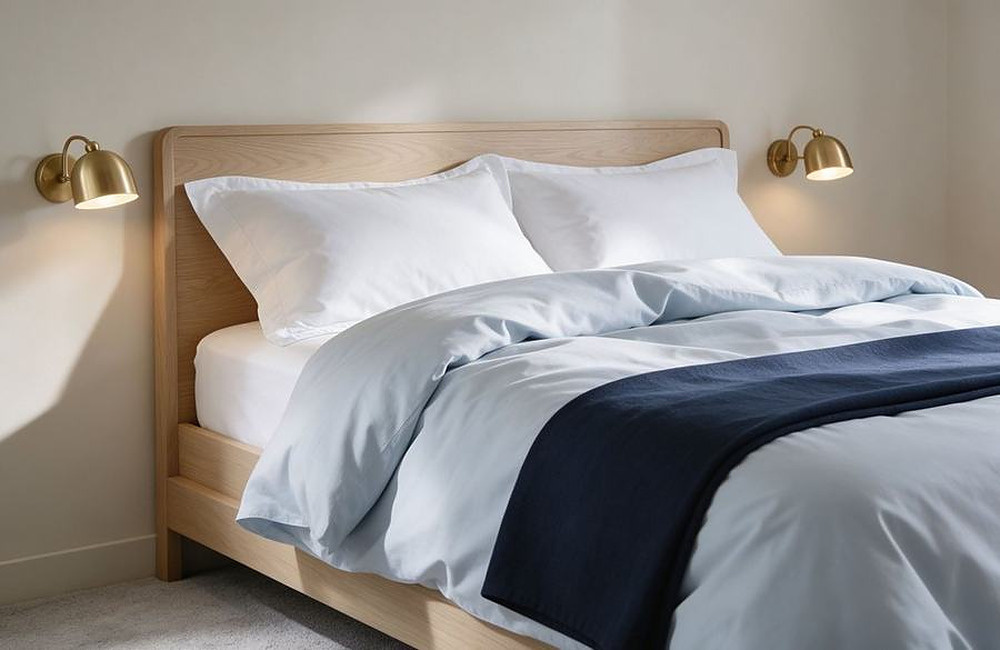
A four star room at the level guests actually judge: the first thing touched after the door opens is the bed.
|
|

|
On this page
Each section below prices the same room at a different star level, then shows where the extra money stops buying anything a guest can feel. Limits for harmful substances in textiles, including bedding and towelling, are published by OEKO-TEX.
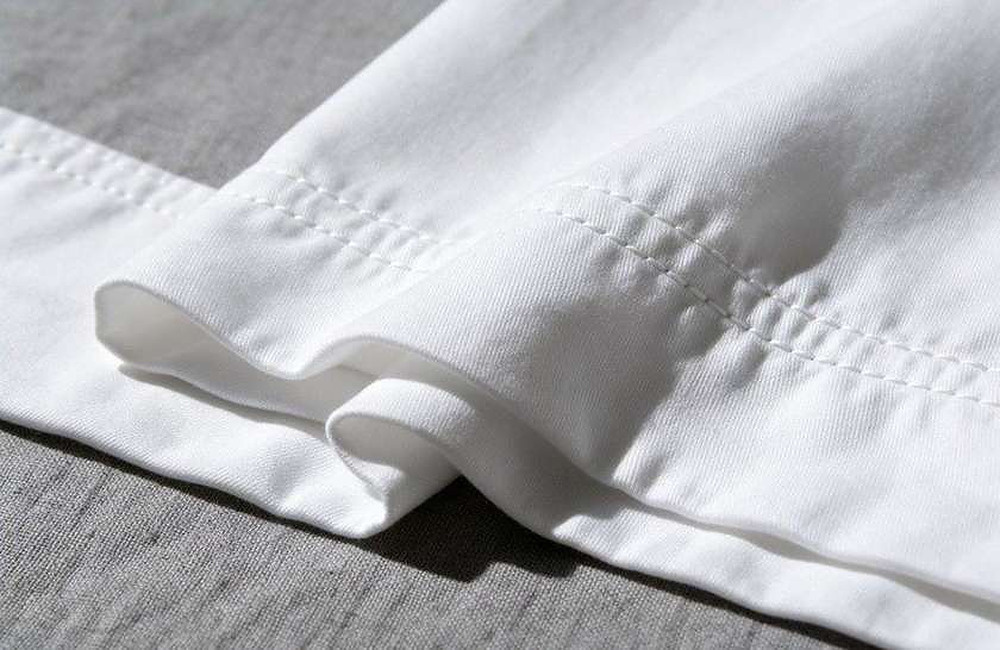
The hem is where a four star set announces itself: double-stitched, straight, and still straight after eighty washes.
Four star hotel bedding is separated from three star by three measurable specs: yarn count, weave and GSM. Those three decide how the linen feels on the first night and how it holds up after repeated industrial washing. The usual line is 60s percale at 180 gsm against 40s at 150 gsm, with a 550 gsm towel in the bathroom.
This page shows what changes at each star level, and where properties over-spec or under-spec.
So where exactly does the extra money go between three star and four star? Our production is based in Foshan, Guangdong, China, where cutting, sewing and packing are handled in-house.
Key takeaways
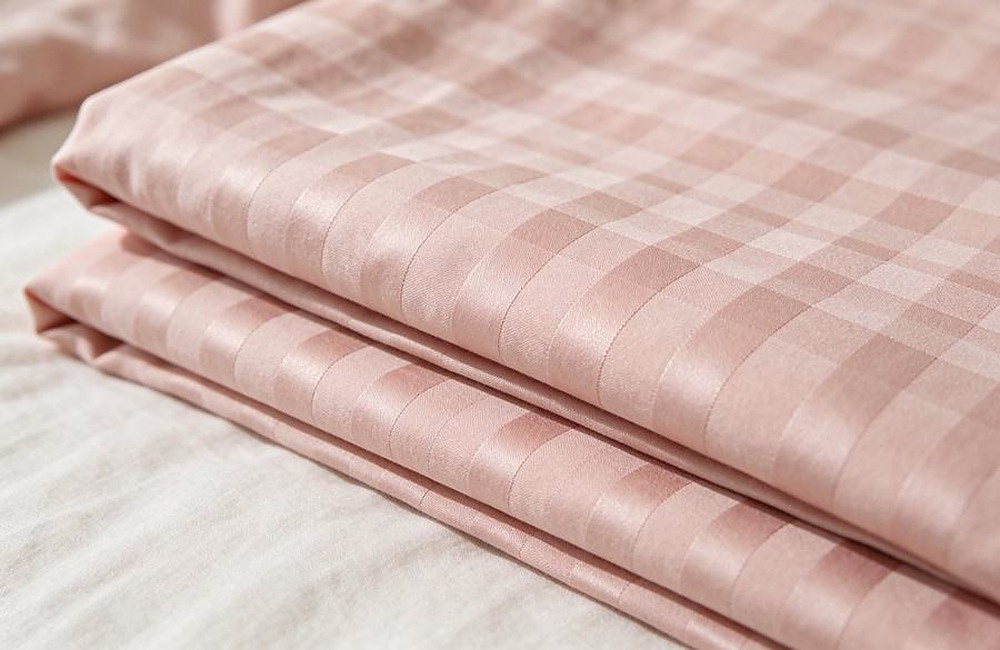
Soft pink satin stripe, folded to a squared edge — the colour tier above plain white.
Quick answer: A star rating does not mean softer linen; it means four fields move up together — yarn count, weight per square metre, pocket depth and hem construction. Upgrading one without the other is how a property pays a four-star price for a three-star bed, and the spec sheet shows it before a guest does.
Star rating does not change the colour, the pattern, or the brand on the label.
It changes three numbers that a buyer can write into a purchase order: the yarn count, the weave structure, and the fabric weight per square metre.
Everything else that guests describe as "quality" follows from those three. Yarn count is the number of 840-yard hanks per pound of cotton, written as 40s or 60s.
A higher count means finer yarn, which means a smoother surface and a lighter fabric at the same weight. Weave decides how the threads interlace: plain, twill, or sateen.
GSM decides how much cotton is in a square metre, and therefore how the sheet drapes, how it feels against skin, and how many washes it survives.
Most procurement mistakes happen because a property changes one of the three and expects the other two to follow. A hotel that moves from 40s plain to 60s plain at the same GSM gets a smoother sheet that is no more durable.
A hotel that moves to sateen at the same yarn count gets shine and drape but a fabric that shows wear faster because the float yarns sit proud of the surface.
GSM moves cost most directly, because it is cotton. Yarn count moves cost next, because fine yarn requires better raw cotton and slower spinning.
Weave moves cost least, though sateen needs more weft coverage and therefore slightly more yarn.
A property that wants to look more expensive on a fixed budget usually gains most from raising GSM one step and leaving yarn count alone.
It does not change the bed size, the pillow count, the housekeeping standard, or the laundry chemistry.
A four star hotel with a badly specified 60s sheet will feel worse on the first night than a three star hotel with a well-specified 40s sheet, because hand feel is a product of fibre, density and finish rather than of the number on the certificate.
Inspectors assessing a property against a star framework look at the bed as presented: whether linen is clean, taut, free of pills, matched across rooms, and consistent with the room rate. They do not read a yarn count.
The spec exists to deliver that consistency night after night, which is why the four star standard settled where it did rather than somewhere more expensive.
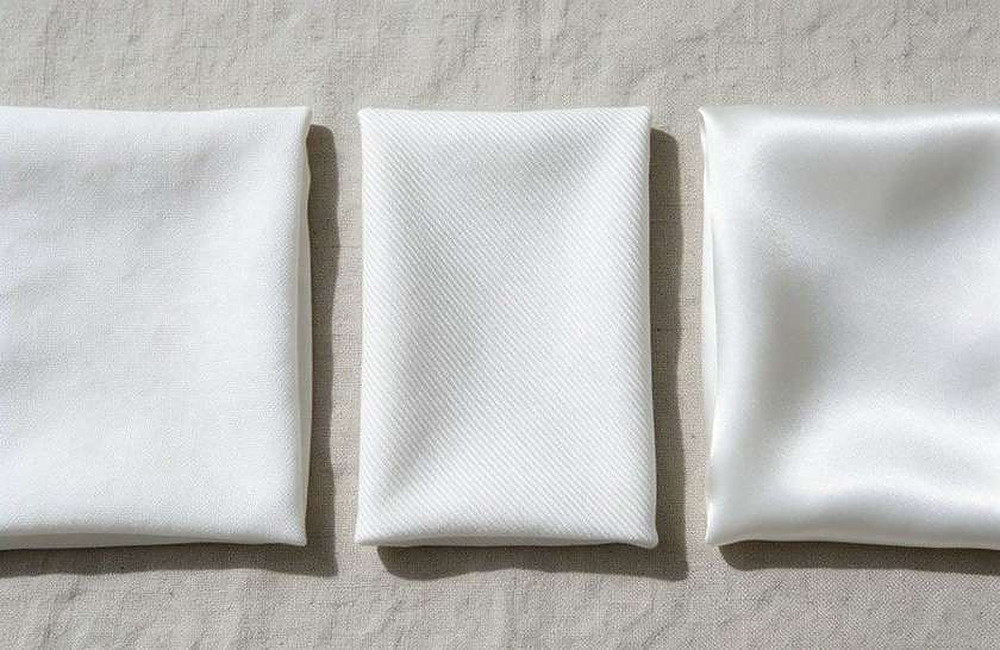
Plain, twill and sateen under the same light. The three surfaces read differently before anyone touches them.
Quick answer: The three star baseline that sits behind any four star property runs from 130 GSM upward in a plain or twill weave on a 40s yarn, with a single-stitched hem. It is serviceable and it washes hard; what it lacks is the hand and the drape that a guest reads as quality on the first night.
The three star baseline is 40s×40s cotton in a plain weave at 120–130 GSM. It is a working specification, not a cheap one: it survives industrial washing, holds its whiteness, and feels acceptable for the first two years of service.
Most hotels that skip it and jump straight to a four star spec end up replacing stock early, because the fabric was never given a stable base.
At 40s, the yarn is coarse enough to be forgiving. Plain weave gives a flat, matte surface with a tight structure, so the sheet resists abrasion and rarely pills.
At 120–130 GSM the fabric is light enough to dry quickly in a tunnel finisher and heavy enough not to feel like paper.
This is the specification that most institutional buyers should treat as their floor.
Three star rooms, backpacker and hostel beds, staff accommodation, and any property where the linen will see more than 120 industrial washes before replacement. The lower yarn count tolerates rougher handling and shorter wash cycles, and the lighter GSM reduces energy cost per kilo dried.
Any room sold above a certain rate, and any bed photographed for a booking site. At 40s plain, the fabric photographs slightly flat and shows crease lines under direct light.
Guests do not complain, but the room reads as functional rather than comfortable in the listing image, which is where the decision is actually made.
A three star spec in a four star room is the most common under-spec in mid-market refurbishments, because the difference is invisible on a spec sheet and obvious on a bed. The correction usually arrives as a full replacement two years early, which costs more than the original upgrade would have.

The three star room that still works: 40s plain at 120–130 GSM, correctly sized and correctly washed.
Quick answer: The four star standard is 60s warp over 40s weft in twill or sateen at 135 to 150 GSM, double-stitched hems, pillowcases at 40s, and towels at 500 to 550 GSM on a 32s/2 pile. Add a 5 per cent shrinkage ceiling read under ISO 6330 with ISO 5077, and a 5 to 8 cm duvet cover allowance.
The four star standard is 60s warp over 40s weft in twill or sateen, at 135–150 GSM, with double-stitched hems. The mix matters: the 60s warp gives surface smoothness where skin contacts the sheet, while the 40s weft gives structure and durability where the fabric takes load.
Using 60s in both directions raises cost without adding much feel.
Twill and sateen both read as more expensive than plain, for different reasons. Twill's diagonal structure catches light in a soft directional way and drapes with weight. Sateen's float yarns produce a sheen and a smoother hand, at the cost of slightly faster surface wear.
Neither is more durable than plain; both are more photogenic and more tactile, and that is what the star level is buying.
The visible difference between a good four star set and a mediocre one is usually the hem. Double stitching with a folded return holds shape through washing; single stitching curls after forty cycles.
The duvet cover should also run 5–8 cm larger than the duvet insert in both dimensions, so the fill stays lofted instead of being compressed into a tight bag.
Pillowcases take the most abrasion of any piece in the set, because they are handled, turned and washed at the highest frequency.
Specifying them at 40s in the same weave as the sheet gives a longer service life at a lower cost, and guests do not notice the difference against the face.
Pillowcases at 60s are a five star detail, not a four star requirement.
Residual shrinkage of 3–5% is normal in cotton; anything above 6% means the fabric will not fit the bed after ten washes.
A four star order should state the maximum shrinkage and the test method, because a supplier that does not control it delivers sets that fit on delivery and no longer fit by the second quarter.
Star level
Yarn count
Weave
GSM
Hem
Pillowcase / Towel GSM
Three star
40s×40s
Plain
120–130
Single stitch
40s plain / 400–450
Four star
60s×40s
Twill or sateen
135–150
Double stitch
40s twill / 500–550
Five star
60s×60s
Sateen
150–180
Double stitch, mitred
60s sateen / 600–700
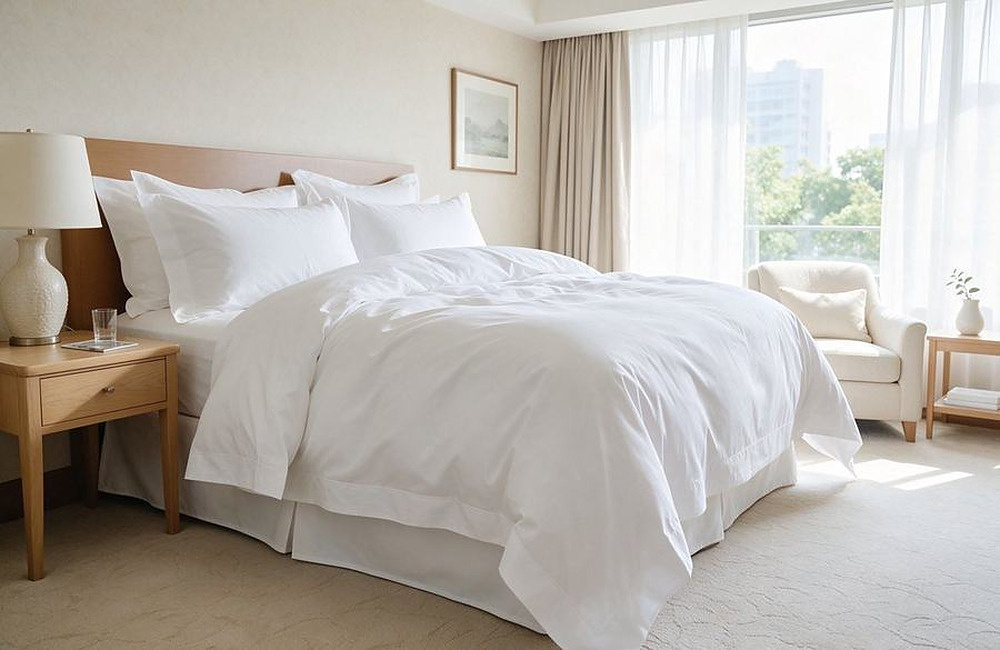
The four star difference, visible at the corner: heavier fabric, double-stitched hem, and a duvet cover with room for the fill.
Quick answer: Five star and above moves to 60s×60s sateen at 150 to 180 GSM, with a heavier hand and a longer drape. The trap is buying the construction and not the weight: 140 GSM in a 60s sateen reads thin on a made bed, and the guest reads thin as cheap regardless of the yarn count.
Five star moves to 60s in both directions and sateen throughout, at 150–180 GSM, usually with a mitred hem and a woven or embroidered logo on the pillowcase.
The step from four to five is smaller in feel than the step from three to four, and considerably more expensive, because fine yarn in both directions raises the raw cotton grade required.
At this level the fabric becomes heavy enough to drape rather than lie on the mattress, which is the actual sensory difference guests notice.
A 170 GSM sateen duvet cover falls into folds and holds them; a 140 GSM twill cover sits flat. Both look clean; only one photographs like a hotel brochure.
Drape, sheen, and a heavier hand. It also buys a shorter service life unless the wash chemistry is controlled, because sateen at high GSM pills faster at the fold lines.
Five star properties usually run softer water, lower alkalinity, and a slower wash cycle to protect the surface, and that cost belongs in the model before the linen is ordered.
For the adjacent buying decision, see bulk hotel bedding sourcing guide.
Rooms let as suites but serviced at a mid-market standard, and properties whose laundry cannot deliver a flat, pill-free finish.
A 180 GSM sateen sheet that comes back with a hard crease reads worse than a 140 GSM twill that comes back flat.
The specification is only half the product; the wash is the other half.
Custom embroidery on pillowcases is a genuine five star marker and a genuine operational problem: it must be specified with thread count, placement, size and colour-fastness, and it adds a lead time.
Properties that add embroidery without specifying colour-fastness discover the logo fades before the pillowcase does.

Five star drape: sateen at 150–180 GSM falls into folds rather than lying flat.
Quick answer: The over-specified items are usually the ones nobody sleeps on: bed skirts, decorative pillows and a heavy runner. They absorb budget that would have fixed the pillow and the towel, which are the two items a guest touches every night.
Over-specification is where a refurbishment budget quietly leaves the room. Three items absorb money that guests do not value in proportion to the cost: bed skirts, decorative pillows, and robes.
All three are visible, all three are photographed, and all three are frequently the first thing a guest moves out of the way.
A bed skirt hides the base of the bed and adds visual weight to the room. It also collects dust, needs pressing, and is replaced when its colour drifts from the sheets after twenty washes.
A decorative pillow set adds a styling moment and, in most properties, three extra pieces per room to wash, count and lose. Robes are the largest per-piece cost of the three and the most frequently taken.
If a property wants a bed skirt, specify it in a cheaper construction than the sheets, accept that it will be replaced more often, and plan for the colour drift.
A bed skirt made from the same 60s sateen as the duvet cover is an expensive way to hide a bed base.
Every decorative pillow is a piece to wash, a cover to replace, and an item to inventory. A room with five pillows across three sizes looks styled in a photograph and costs roughly a third more in linen and laundry than a room with two.
Properties that have to choose should choose the bed.
Robes disappear at a materially higher rate than any other linen item, and a five star robe in a four star room is the classic mis-allocation.
A four star property that wants the gesture should specify a mid-weight waffle robe in a washable blend, price replacement into the budget, and accept that a percentage leaves with guests.
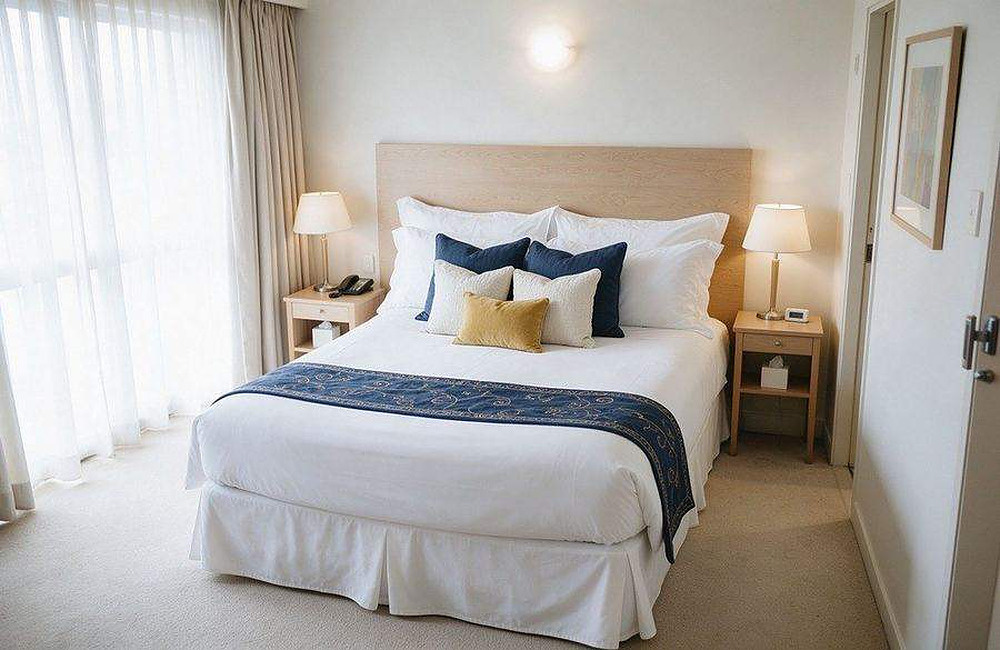
Quick answer: The under-specified items are the pillow and the towel, not the sheet. A pillow losing 40 to 70 per cent of its loft, and a 550 GSM towel falling to 500 then 440 GSM across 50 washes, are the commonest four star failures. A deep mattress also needs 33 to 43 cm of pocket.
Under-specification is harder to see than over-specification, because nothing looks wrong on delivery. Three items account for most guest complaints at the four star level: a pillow that has lost its loft, a towel that has thinned below its stated weight, and a duvet cover that no longer fits its insert.
Pillow loft is a function of fill weight and fill resilience. A 700-gram microfibre pillow at 40% hollow-fibre content collapses within a year of industrial washing; the same weight at 70% hollow content holds shape for three.
Buyers who specify only the weight get the collapse, because weight alone does not describe resilience. Test methods for abrasion, pilling, tearing and colour fastness are issued by ASTM International.
A four star pillow is usually 800–900 grams of hollow-fibre or a 50/50 down-feather blend, with a stated minimum resilience.
Specify both numbers, and specify the cover construction: a down-proof cotton cover at 233T prevents fibre migration through the shell, which is what makes a pillow look thin at the end of its life.
A four star towel at 500–550 GSM feels substantial on the first wash and noticeably lighter after thirty, because loop pile compresses.
Specify GSM at delivery and a minimum after 50 washes, and specify the yarn: 32s/2 combed cotton pile over a 21s ground gives a towel that keeps its hand after repeated industrial cycles.
A towel specified only at 500 GSM with no yarn detail will be a 440 GSM towel by year two.
A duvet cover cut to the exact insert size compresses the fill and reads as a flat, mean bed.
The allowance should be 5–8 cm in both dimensions, and the order should state residual shrinkage so that the allowance survives the first ten washes.
This is the single most common four star failure that guests describe as "the duvet feels thin".
|
Item |
Common shortcut |
What goes wrong |
What to specify instead |
|
Pillow |
Weight only, no resilience figure |
Loft collapses within 12 months |
Fill weight plus hollow content plus down-proof cover |
|
Towel |
500 GSM at delivery, no yarn detail |
440 GSM by year two |
GSM floor after 50 washes, 32s/2 pile over 21s ground |
|
Duvet cover |
Cut to insert size |
Fill compressed, bed reads flat |
5–8 cm allowance plus shrinkage ceiling |
|
Fitted sheet |
Pocket depth not stated |
Corners lift on a deep mattress |
Pocket depth 33–43 cm for deep mattresses |

Quick answer: Guests read three physical facts, not a specification: weight at 150 GSM reads standard, 180 GSM reads heavy, and 130 GSM reads thin. Hand feel comes from yarn diameter and finish, drape comes from weight, and coolness comes from the weave — three separate numbers behind one impression.
Guests describe linen as soft, crisp, cool, heavy or cheap.
None of those words is a specification, and all of them trace back to three physical properties: surface friction, fabric density, and moisture behaviour.
A buyer who understands the mapping can predict what a guest will say before the first set is washed. Surface friction comes from yarn count and weave. Fine yarn at 60s presents more fibres per inch and a shorter pile, so the surface feels smooth rather than textured.
Sateen reduces friction further because the float yarns lie flat across the surface. Twill sits between plain and sateen, which is why it reads as "crisp" rather than "silky".
Density comes from GSM. Heavier fabric holds more air between the bed and the body, so it feels warmer in winter and heavier in summer.
That is the physical reason a 150 GSM duvet cover reads as luxurious in a cool climate and as oppressive in a tropical one, and why the same specification cannot be sold into both markets without complaint.
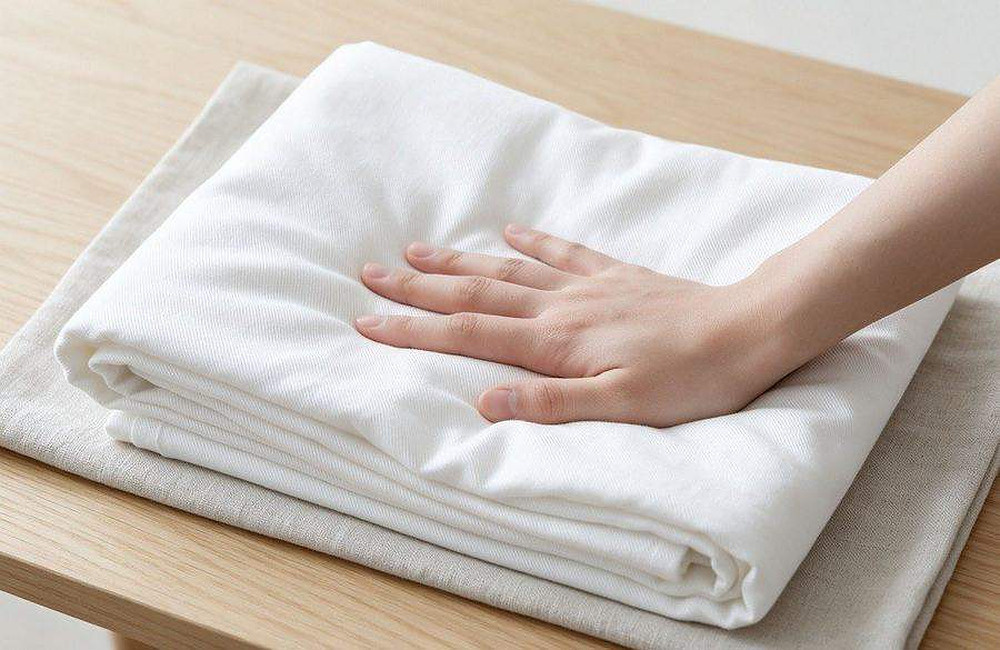
Hand feel photographed: the surface is what changes, and the surface is yarn count plus weave.
Softness on first touch is a function of fibre diameter and yarn twist. Combed cotton at 60s with a low twist reads soft immediately; carded cotton at 40s reads slightly rough until ten washes soften it.
Hotels that want a soft first impression should specify combed yarn, which costs more per kilo but removes the need for a break-in period.
Weight per square metre, and the ratio of warp to weft. A 150 GSM sheet with a 60s warp and 40s weft feels heavier than a 150 GSM sheet built from 40s in both directions, because the finer warp packs more fibres into the same area.
Buyers comparing GSM alone are comparing the wrong number.
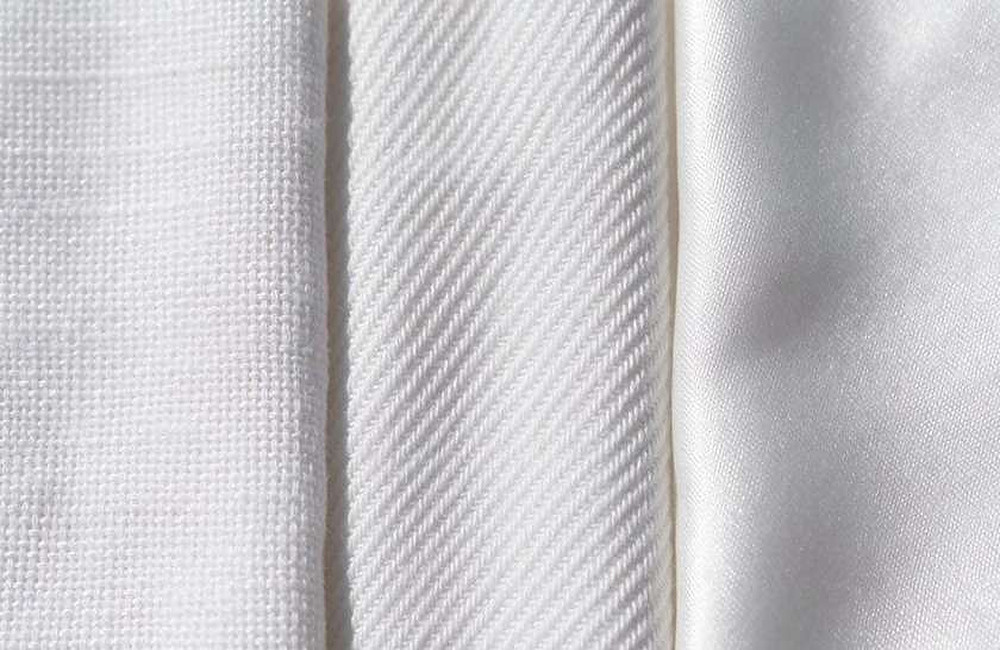
Three weaves, same light, same camera. Plain reads flat, twill reads crisp, sateen reads smooth.
Absorbency and dry rate. Cotton absorbs well but dries slowly; a heavy sateen at 180 GSM holds moisture longer than a 130 GSM plain weave, which is why heavy linen in humid markets can feel damp by the second night.
The fix is not a lighter specification but better humidity control in the room, and properties that cannot control humidity should not spec 180 GSM. For the adjacent buying decision, see sheet set specification template.
Thread count beyond 300, brand of cotton, and the presence of a logo on a hem. They notice creases, pills, colour drift, and a duvet that has gone flat.
This is why money spent on visible construction details returns more than money spent on fibre grade beyond the four star threshold.

Where the budget goes: the largest uninterrupted white surface in the room is the bed, and that is what gets remembered.
Quick answer: Budget allocation by star level is a ratio, not a list: the sheet takes the largest share because it covers the most area, the pillow and towel take the next, and the decorative layer takes the least. Spending on the decorative layer first is the most common four star mistake.
Linen is a minority of the room's capital cost and a majority of the guest's first impression. Most operators allocate 6–10% of the per-room refurbishment budget to bedding, and the split within that allocation decides whether the room reads as three, four or five star.
The useful way to allocate is by function rather than by item count. Sheets and duvet covers carry the visual impression, because they are the largest uninterrupted white surface in the room. Pillows carry comfort.
Towels carry the daily tactile impression and are touched more often than any other item. Bed skirts, runners and decorative pillows carry styling only.
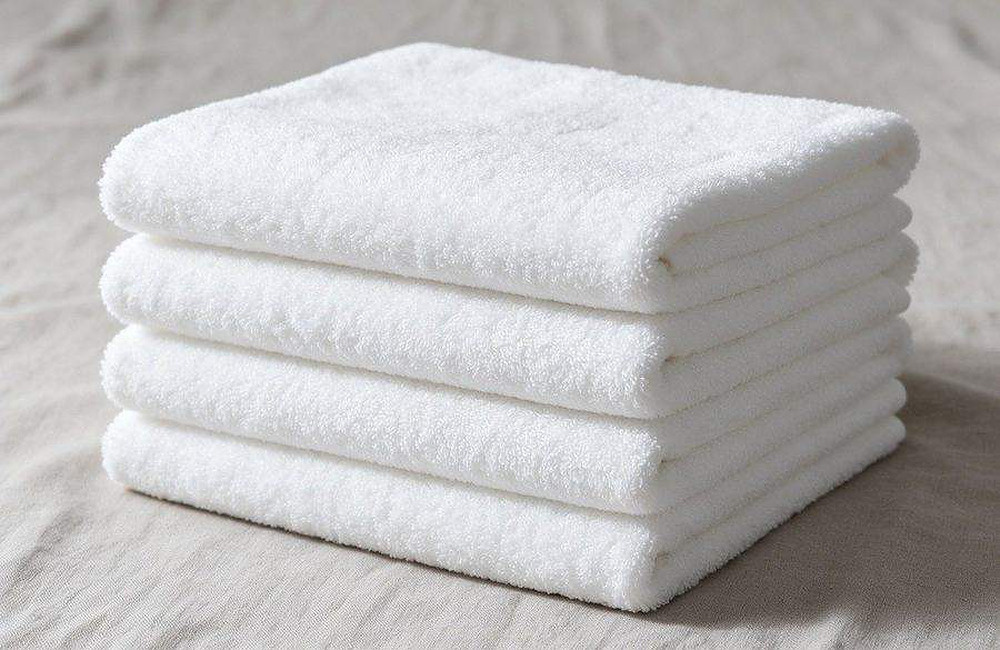
Towels carry the most daily contact. Twenty-five percent of the allocation is the right order of magnitude, not fifteen.
A workable four star split is roughly 60% to bed linen (sheets, duvet covers, pillowcases), 25% to towels, and 15% to pillows and protectors.
Properties that invert this and spend on towels first get a room that feels good in the bathroom and unconvincing at the bed, which is the wrong order for how a guest enters a room.
Three to five par of bedding is a capital cost that most refurbishment budgets under-provide. A 120-room property at three par is buying roughly 2,500 pieces before any replacement stock, and that figure belongs in the same allocation as the visible linen.
Linen at four star grade loses 15–25% of stock a year under industrial washing. A budget that buys the initial order and no reserve will be replacing stock out of operating expense within eighteen months, which is where most star-level drift actually begins.
|
Star level |
Bed linen share |
Towels share |
Pillows and protectors |
Priority when budget is tight |
|
Three star |
55% |
30% |
15% |
Durable sheets, adequate par stock |
|
Four star |
60% |
25% |
15% |
Duvet covers and hems first |
|
Five star |
65% |
20% |
15% |
Sateen quality and embroidery |
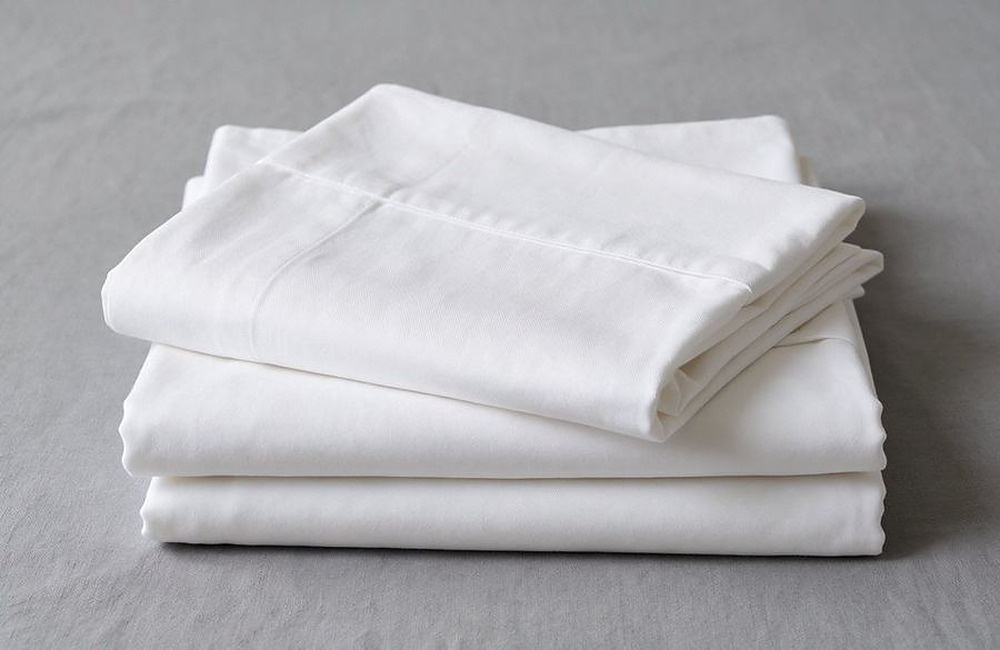
Stage one: pillowcases and pillows. The highest perceived return per unit of spend.
Quick answer: The partial upgrade path is to change the two items the guest touches first: pillow and towel to 550 GSM at 32s/2, before touching the sheet. A property that upgrades the sheet and leaves a flat pillow still reads as a tired room.
Most properties cannot re-spec the whole room in one budget year, and most do not need to.
A staged upgrade can move a room from three star impression to four star impression by changing the items guests touch most, in the order that produces the largest perceived gain per unit of spend.
The order is not intuitive. Operators usually start with the sheets because they are the largest surface, but the sheets are also the most expensive change and the least likely to be noticed on arrival.
The items that move perception fastest are pillowcases, pillows, and towels, because they are handled directly and compared immediately against the guest's memory of other hotels.
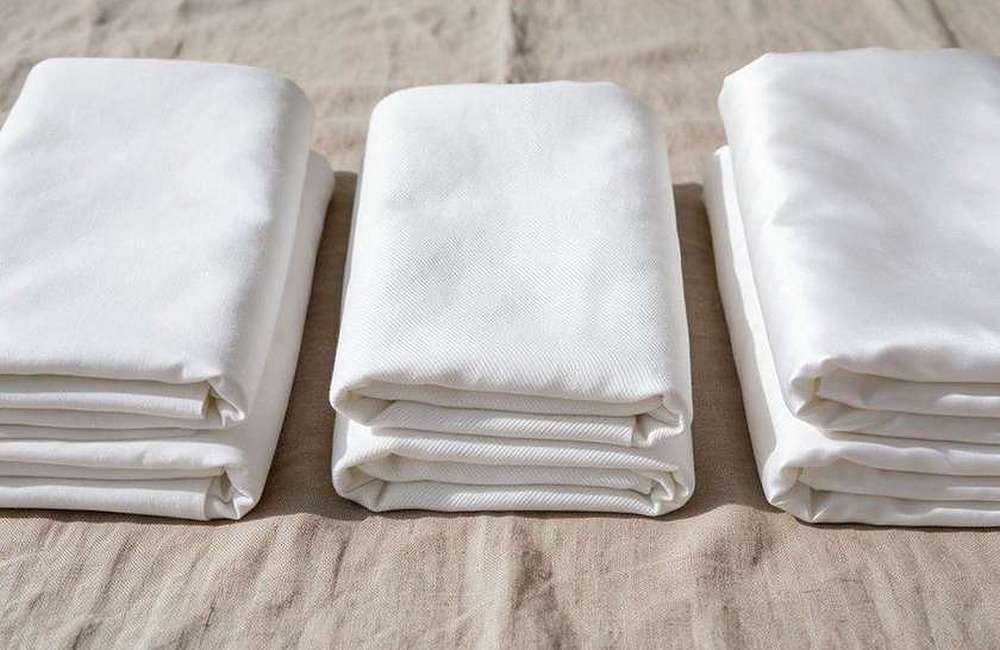
Stage two: towels. Cheaper than re-sheeting and noticed every day in every bathroom.
Changing pillowcases from 40s plain to 40s twill, and pillows from an unstated fill to 800–900 grams of stated hollow content, changes the first five minutes of the stay for a fraction of a full re-spec. It is the highest-return single change available to a three star property.
Towels to 500–550 GSM with a specified 32s/2 pile. This is the change guests comment on most often, because a thin towel is the most frequently reported disappointment in mid-market reviews. It costs less than sheet replacement and lands in every bathroom, every day.
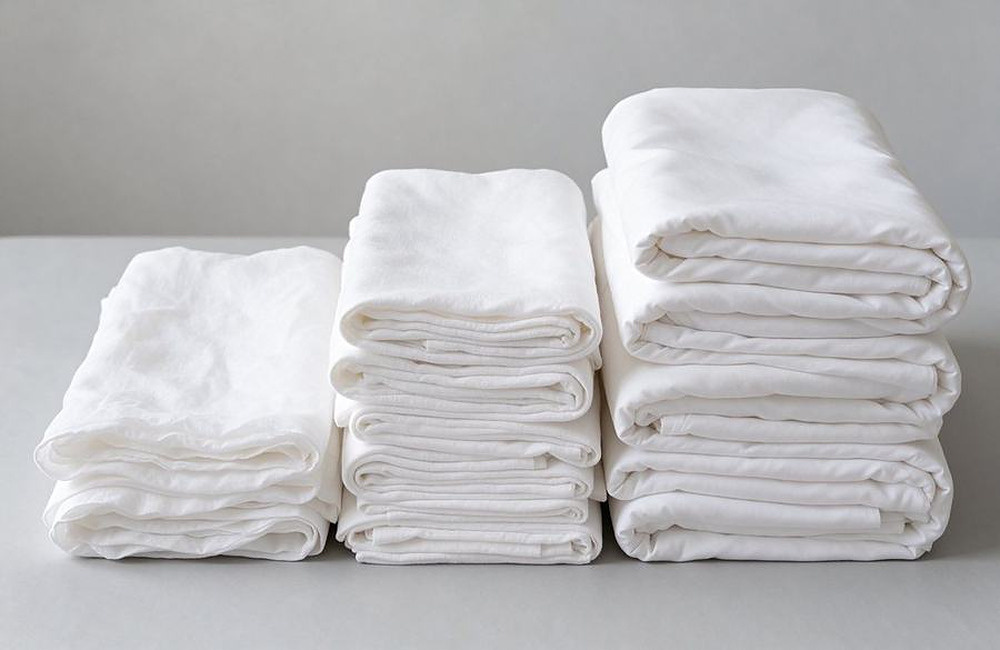
Three tiers laid out together: the same white cloth, three different weights and three different surfaces.
Duvet covers next, because they are the largest single visual element and can be changed without changing the sheet set. Sheets last, because a sheet upgrade requires changing the whole par and the whole replacement cycle at once.
Do not mix star levels within one room. A 60s sateen duvet cover over a 40s plain sheet reads as inconsistent and draws attention to the lower-grade item.
Stage by function across all rooms rather than by room, so that every room is internally consistent at each stage.
The purchasing version of the comparison: seven columns, three rows, and numbers that survive a tender.
Quick answer: The three tier table fixes the whole specification at once: three star at 130 GSM 40s plain, four star at 135 to 150 GSM 60s×40s, five star at 150 to 180 GSM 60s×60s sateen. Every line item then follows the tier rather than being bought separately.
The table below is the purchasing version of this page: three tiers, seven columns, and the numbers to put into a purchase order. It assumes cotton, a white base cloth, and industrial washing at 60–80°C with a standard detergent regime.
Read the table as a floor and a ceiling, not as a menu.
A property can move one column without moving the others, but moving yarn count without moving GSM produces a sheet that is smoother and no stronger, and moving GSM without moving yarn count produces a heavier sheet that photographs better and pills faster at the fold.
Quote the row that matches the star level, add the shrinkage ceiling, add the hem construction, and add the test method for each number.
A tender that lists only GSM invites suppliers to compete on the one number that is easiest to fake, because GSM can be raised with lower-grade cotton.
For the adjacent buying decision, see hotel towel programme.

Consistency is the actual product. Every room matching every other room is what a star rating registers.
It stops at five star because above that the differentiation moves to embroidery, hand-stitched hem detail, and bespoke sizing, none of which can be specified in a seven-column table. Properties selling above five star usually work from a bespoke sample rather than a specification sheet.
The specification in this table pairs with the size logic in sheet set specification template, and the towel side of it is developed further in hotel towel programme. For a whole-property view that spans bedding, towels and soft furnishings, see bulk hotel bedding sourcing guide.

White linen after a hundred washes: still white, but only if the wash chemistry was specified along with the cloth.
Figure ranges are quoted from the published standard; the binding clause is the standard text itself, not this summary.
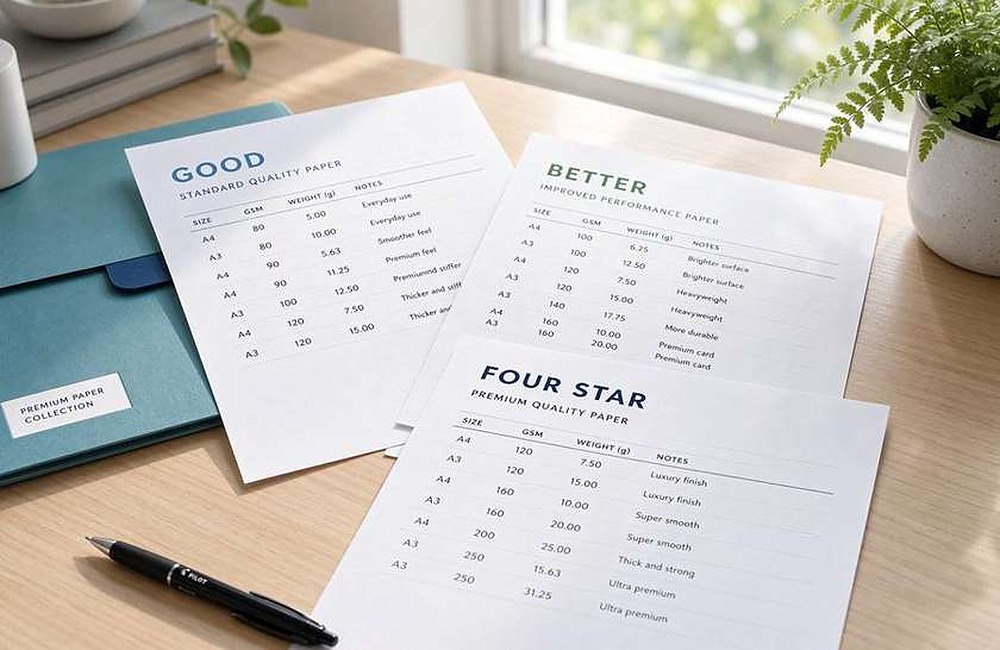
The specification is written at three tiers so a bidder prices the same scope, not a guessed one.
What linen spec does a 4 star hotel actually need?
60s warp over 40s weft, twill or sateen, 135–150 GSM, double-stitched hems, pillowcases at 40s in the same weave, and towels at 500–550 GSM with a 32s/2 pile. Add a shrinkage ceiling of 5% and a 5–8 cm duvet cover allowance. Those numbers are what separates a four star bed from a three star bed on a spec sheet, before anyone touches it.
Is 60s worth the price over 40s?
In the warp, yes; in both directions, usually not at four star. A 60s warp gives surface smoothness where skin contacts the sheet, and that is the change guests feel. Moving to 60s×60s raises cost materially and shortens service life unless the wash chemistry is controlled, which is a five star trade rather than a four star one.
How many sets per room should we budget?
Three par is the working minimum, four is standard, five is what high-occupancy properties with slow laundry cycles need. A 120-room hotel at three par is buying roughly 2,500 pieces, and the par stock is capital that belongs in the refurbishment budget rather than in operating expense. Under-providing par stock is the reason hotels run out of linen on a full weekend.
Can we upgrade towels without changing sheets?
Yes, and it is the highest-return single change available to a three star property. Towels from 400–450 GSM to 500–550 GSM with a specified 32s/2 pile cost less than re-sheeting and are noticed in every bathroom every day. A thin towel is the most frequently reported disappointment in mid-market reviews.
What GSM is expected at each star level?
Bed linen: 120–130 GSM at three star, 135–150 at four, 150–180 at five. Towels: 400–450, 500–550, and 600–700 respectively. GSM is a floor rather than a target, because loop pile compresses: a 500 GSM towel with no yarn specification is a 440 GSM towel by year two, which is why the order should state a minimum after 50 washes.
How do you keep white linen white after 100 washes?
Four things, in order of effect: control iron in the water supply, keep alkalinity within the detergent supplier's range, avoid overloading the washer so that soil redeposits, and specify an optical brightener regime that the laundry can actually dose. A 60s sateen washed in hard water goes grey before it goes thin, and the greying is what guests report as "tired" linen.
What pocket depth does a four star mattress need?
33 to 43 cm covers a deep mattress; below 33 cm the fitted sheet lifts at the corner after the first wash. Measure the mattress, not the bed frame, and add the topper thickness if a topper is used.
How much does a 550 GSM towel lose across 50 washes?
A 550 GSM towel typically falls to about 500 GSM by 25 washes and about 440 GSM by 50. Buy the GSM that still reads substantial after 50 washes, not the number printed on the sample card.
Whether to own this specification or rent it is worked through in our rental versus purchase comparison. Foshan Yiroufang Textile Manufacture Co., Ltd | Four star hotel bedding and linen | Foshan, Guangdong, China

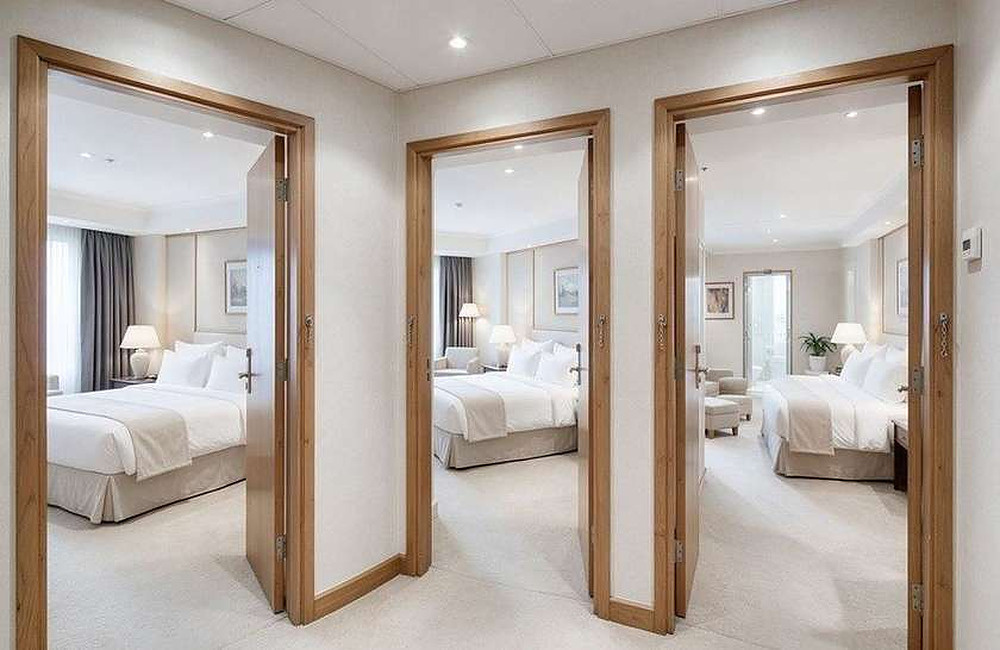
A written specification is measured against the room it will fill, and this is the room.
Write to lisa@yrftextile.com with the room count and the specification sheet; the reply comes back with finished sizes and the report references.
Tell us the star level, room count and bed sizes, and we return a purchasing specification with yarn count, weave, GSM, hem construction, pillow and towel figures, par stock quantity and a shrinkage ceiling — formatted to drop into a tender document.

Previous :
Hospital Bed Linen Wholesale: 21s and 32s Yarn Counts, 140 to 180 GSM, 100 Wash Life, ISO 15797 and GB 18401 Testing for Ward, Theatre and Maternity Departments, Colour MatchingNext :
Hotel Bedding Wholesale for Institutional Buyers: 40s and 60s Yarn Counts, 180 to 300 GSM Percale, ISO 15797 Wash Testing and Container Supply for Hotels, Hospitals and Care HomesCopyright © Custom Disaster - Relief Bedding: Tents, Sleeping Bags, Blankets All Rights Reserved
the professional team to service !