Categories
latest blog
Last updated: 25 November 2026
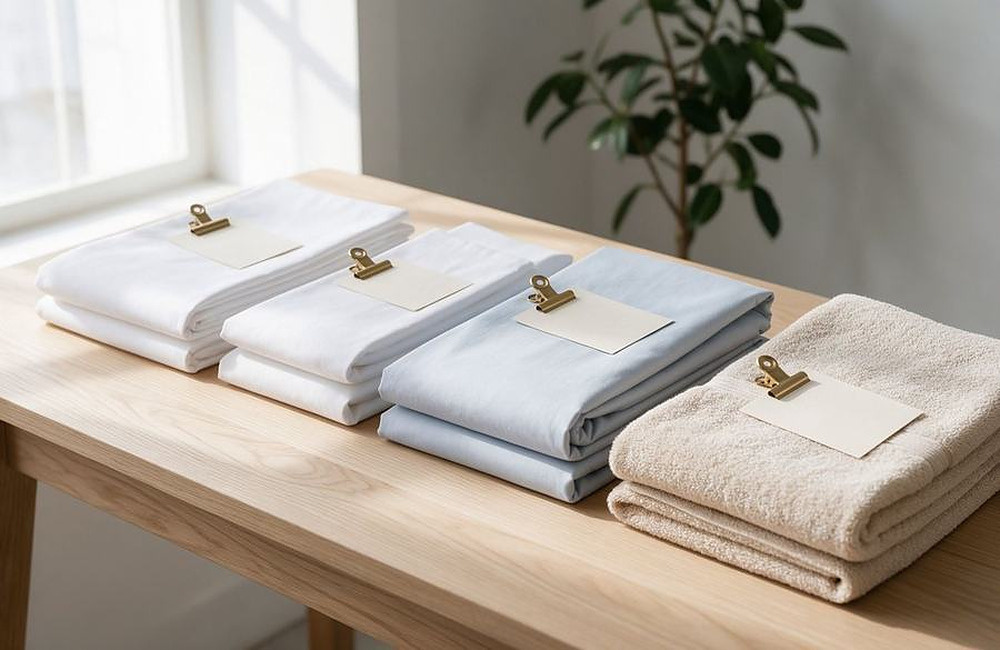
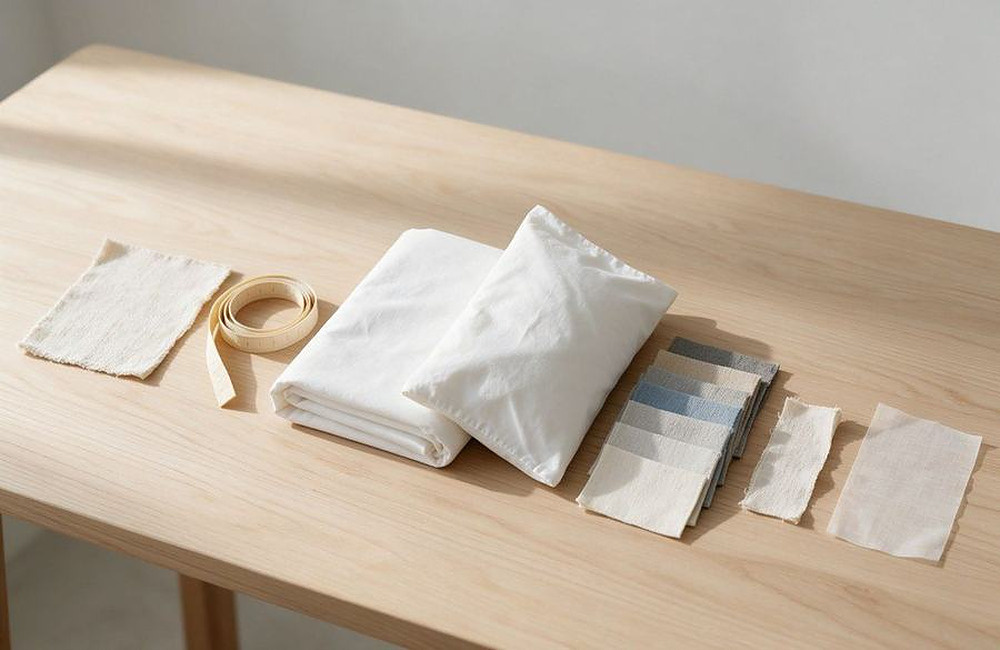
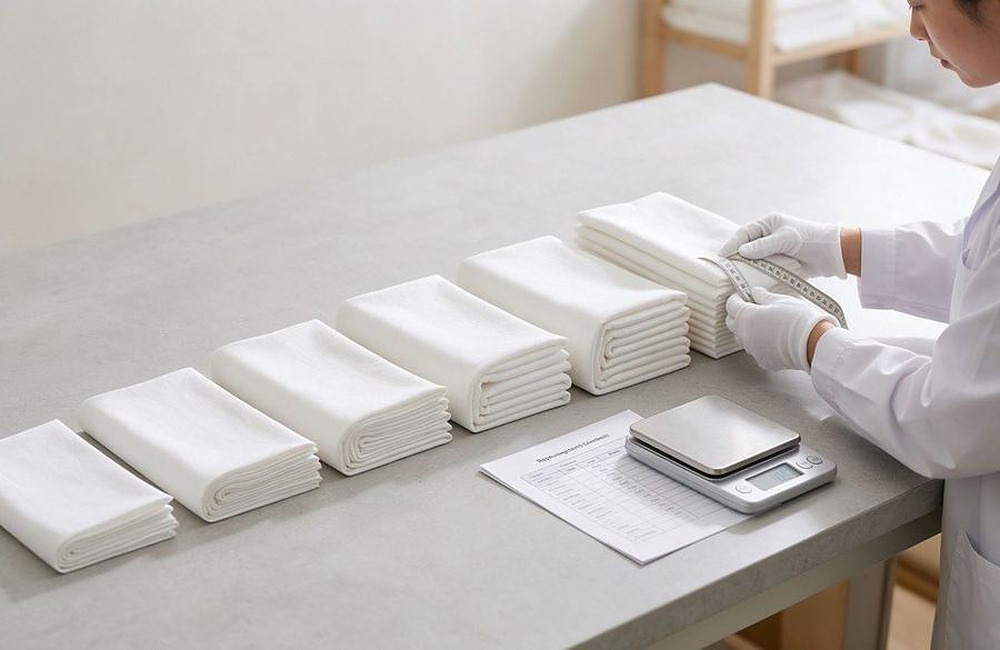
White cotton sheets, duvet covers and pillowcases laid out for a line-by-line spec comparison.
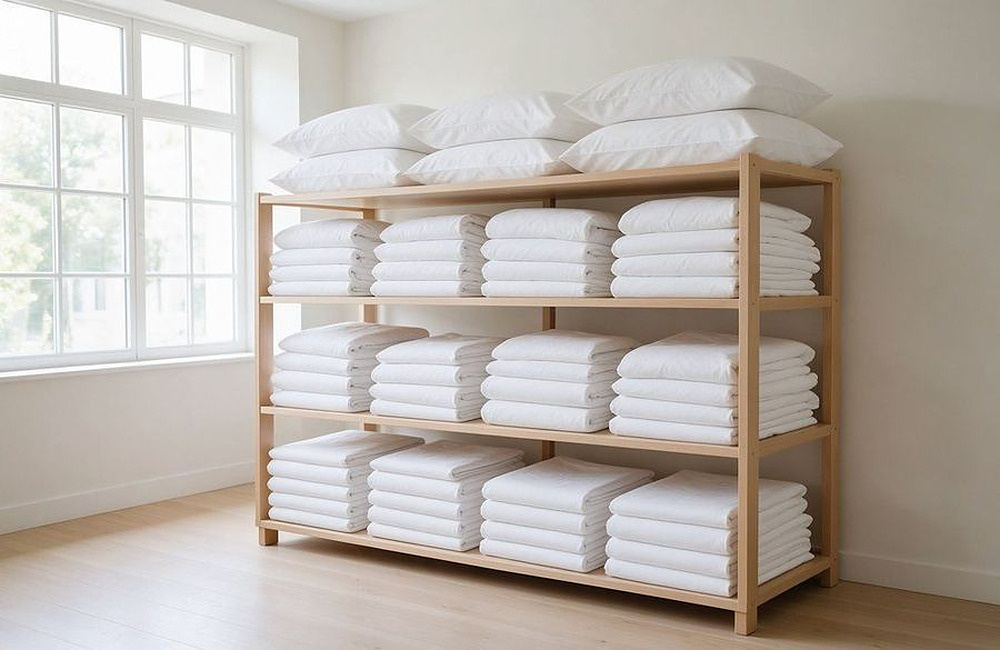
The linen room is where a spec either holds or fails, because that is where counting, issuing and washing meet.
Hotel bedding wholesale orders usually fail on one document: the spec sheet. A buyer who cannot state yarn count, GSM, pocket depth and shrinkage will receive samples that look right and wash wrong. Write 40s over 180 gsm, an 8 cm pocket and a 5% shrink tolerance, and the sample matches the bulk.
This guide sets out the seven fields every line item needs, and how to compare quotes written in different units.
So which seven fields does a spec sheet actually need, and in what order?
Key takeaways
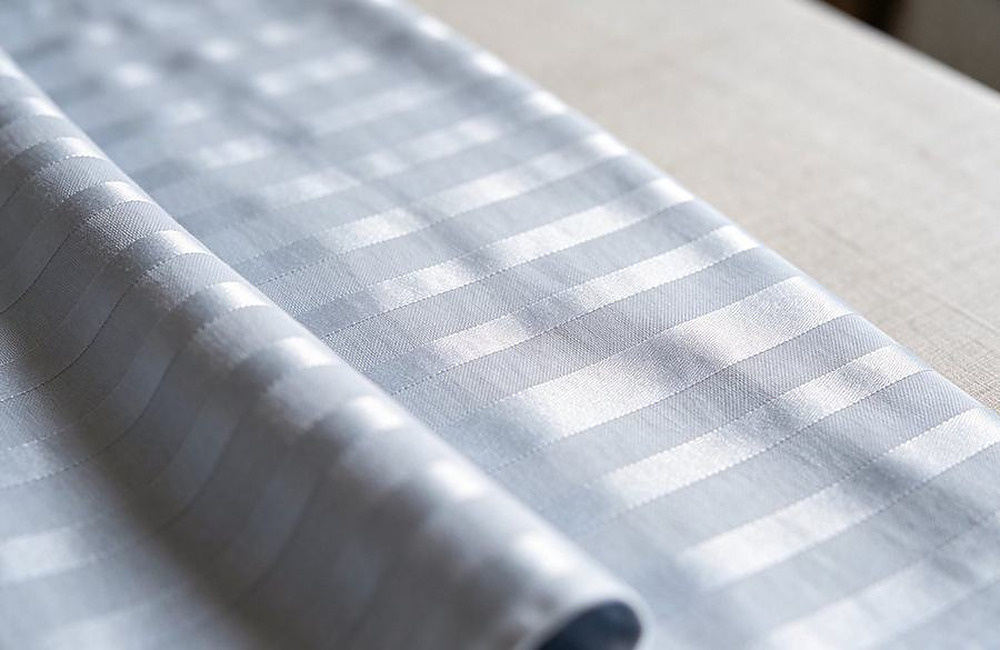
Satin stripe, grey-blue — the default hotel and ward colourway in this range.
Procurement managers, project contractors and public buyers all approach this category from different angles. A hotel group compares hand feel and wash life.
A hospital compares barrier performance and colour coding. A school compares the contents of a dorm pack.
The purchasing logic differs, but the document that decides the outcome is the same. That document is the spec sheet, and it is the same for a hotel and a hospital.
Limits for harmful substances in textiles, including bedding and towelling, are published by OEKO-TEX. Our production is based in Foshan, Guangdong, China, where cutting, sewing and packing are handled in-house.

Measuring pocket depth before ordering — the field most quotations leave out, and the one that decides whether the sheet fits at all.
Quick answer: A hotel guest room uses about eight bedding line items — flat sheet, fitted sheet, duvet cover, pillowcase, pillow, duvet, mattress protector and bed skirt — each with its own size and weight logic. Buying them as one bundle is why sizes mismatch after washing.
Hotel bedding is not one product. A single guest room typically carries eight distinct line items, and each has its own spec logic. Buyers who treat them as a bundle end up with mismatched sizes and mismatched wash life.
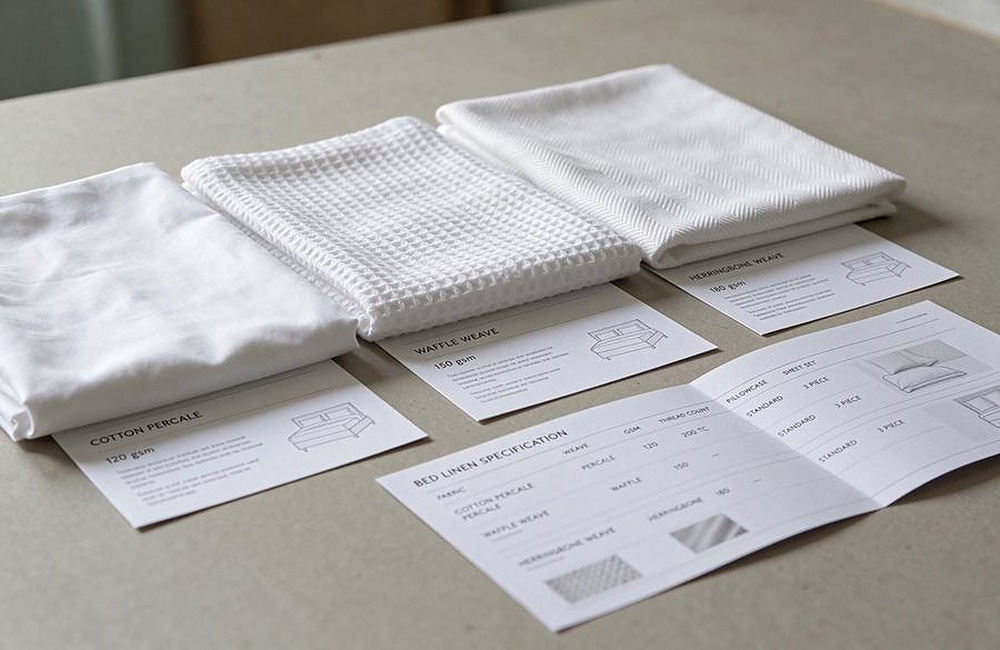
Three weights, three weaves, one spec sheet — comparing on paper before approving samples.
|
Line item |
Typical specification |
Replacement cycle |
Share of linen budget |
|
Flat sheet |
40s×40s plain or 60s×40s twill, 120–150 gsm |
18–24 months |
Highest volume item |
|
Fitted sheet |
Same base cloth, 30–35 cm pocket |
18–24 months |
Similar to flat |
|
Duvet cover |
130–160 gsm, corner loops or ties |
18–30 months |
Second largest |
|
Pillowcase |
40s, envelope or housewife closure |
12–18 months |
High rotation, low unit cost |
|
Pillow |
Down, feather or down-alternative; 600–800 g fill |
18–24 months |
Capital item |
|
Duvet inner |
Down or microfibre, 200×230 and above |
24–36 months |
Capital item |
|
Mattress protector |
Quilted or laminated, 100–120 gsm face |
12–18 months |
Consumable |
|
Line item |
Typical specification |
Replacement cycle |
Share of linen budget |
|
Bed skirt or runner |
100–120 gsm, colour matched |
24 months |
Optional |

The same room carries eight spec decisions, not one, from sheet size to pillow fill to towel weight.
The budget split matters more than the piece list.
In most institutional projects the linen itself is a minority of the cost, and laundry labour, replacement and freight take the rest.
A buyer who prices only the piece and ignores the cycle cost will pick the cheaper line and pay more over five years. Ask for the cycle cost per piece inside the quotation itself.
A set is a contract term before it is a product.
In a hotel tender it usually means a sheet, a duvet cover and two pillowcases; in a hospital tender it may add a draw sheet and a mattress protector; in a dormitory pack it may mean eight pieces including a mat.
Write the piece list into the specification, not the word set.
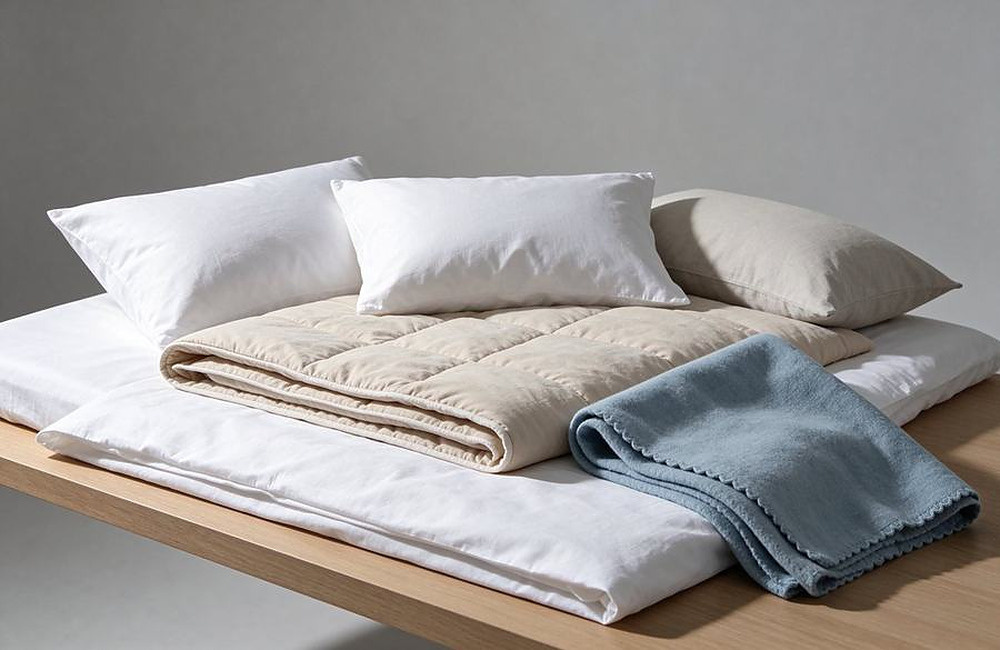
A set is a contract term before it is a product: the piece list has to be written down.
The word set causes more disputes than any other term in this category. It can mean three things:
Loose set: a flat sheet, a duvet cover and one pillowcase. No fitted sheet, no inner. Common in European contracts.
Four-piece set: flat sheet, fitted sheet, duvet cover, two pillowcases. Standard in most hotel projects. Full pack: the four-piece set plus pillow, duvet inner and protector. Common in dormitory and camp procurement.
A quote that says "USD per set" without this definition cannot be compared to another quote. This is the single most common reason two bids look 40 percent apart when they are actually priced for different contents.
Practical rule: write the set definition into the purchase order, not just the quotation. A three-line definition prevents a six-week dispute at handover.
In a typical 200-room hotel project, sheets and duvet covers take roughly half the bedding budget by value. Pillows and duvet inners take the next largest share because they are capital items replaced less often but at higher unit cost. Protectors and pillowcases are small in value and high in rotation.
This matters for sequencing. When a property replaces linen in stages, the highest-value items should be specified first, because they lock the size system the rest must match. A pillow bought before the pillowcase size is fixed will usually be the wrong size.
Size definition is covered in full on the hotel bed sheet set sizes and pocket depth page. The rest of this guide treats sizes as an input rather than a sub-topic.
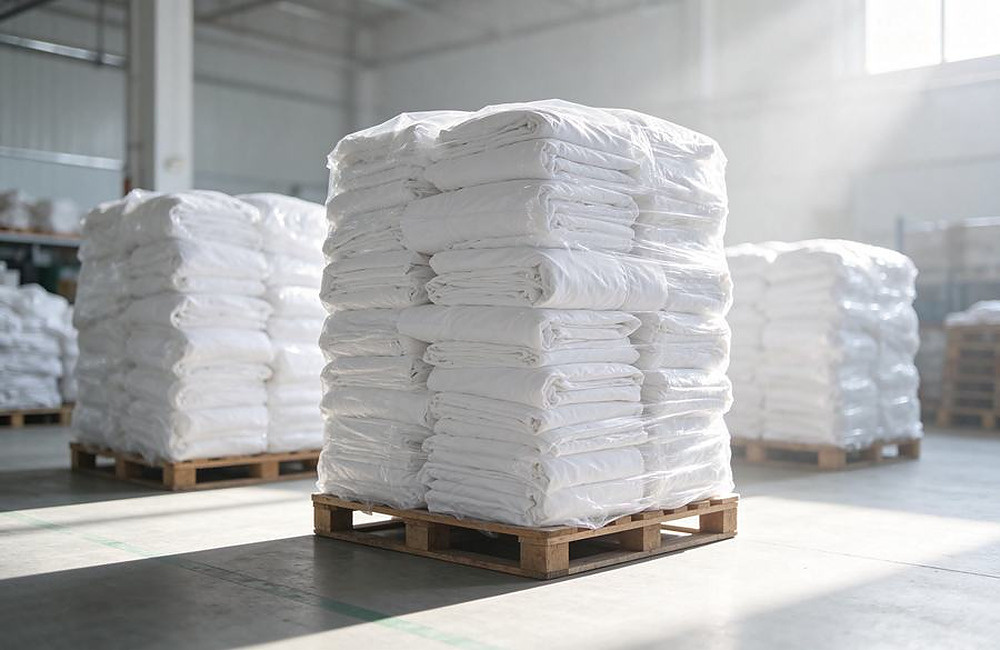
Project batches leave the line as matched sets, not as single items.
Quick answer: Institutional bedding reaches a property through five channels: direct factory, trading company, wholesale market, platform seller and project agent. The differences that matter are minimum order — a five-set sample versus a 300-set single-style run — plus who holds spec control and who carries the claim if the goods fail.
Institutional bedding reaches a property through one of five channels. Each channel carries a different cost structure, a different minimum order and a different level of spec control. Choosing the channel before choosing the product is the usual sequence, and it is usually the wrong one.
|
Channel |
Typical minimum |
Spec control |
Unit cost level |
Suits |
|
Factory direct |
Per style, often 300–1,000 sets |
Full, buyer writes the spec |
Lowest |
Projects with a fixed spec and a known volume |
|
Export trader |
Lower, can mix styles |
Partial, buyer accepts catalogue |
Mid |
Small properties, mixed orders, first-time importers |
|
Local distributor |
Per pack, no container needed |
Low, stock items only |
Highest |
Urgent replacement, single-property top-ups |
|
Linen rental service |
Contract term, not unit count |
Service provider owns the spec |
Per-use pricing |
High-occupancy city hotels without laundry capacity |
|
Public procurement |
Tender lot size |
Full, but locked by the tender document |
Competitive |
Schools, hospitals, institutions, government housing |

Channel choice fixes cost structure before product choice fixes quality, so the route decides the price band.
Seven fields are the minimum, and they are the seven a mill can quote against without asking questions. Finished size, fibre, yarn count, density, weight, shrinkage and colour fastness.
Anything less and the quotation becomes a guess that both sides will interpret differently. A quotation that answers all seven can be compared line by line without a meeting.
Every field must carry a unit and a tolerance.
The buyer writes the specification and the factory produces to it. Unit cost is lowest because no distribution layer sits in between.
The trade-off is volume: a factory line runs best when one style runs for a stretch, so small mixed orders cost more per unit than the price list suggests.
Spec control is the real advantage here. A buyer who needs a 35 cm pocket, a specific corner loop and a 4-grade colour fastness cannot get all three from a catalogue. Factory direct is the only channel where the buyer owns every field on the sheet.
Traders aggregate styles from several factories and ship mixed containers. This suits a property that needs sheets, towels and protectors in one shipment without meeting three separate minimums. Unit cost sits above factory direct and below local distribution.
The risk is spec drift. When a trader substitutes a mill mid-order, the GSM can move by 10 to 15 g and the buyer may not notice until the first wash. Ask for the mill name and the lot number on the packing list.
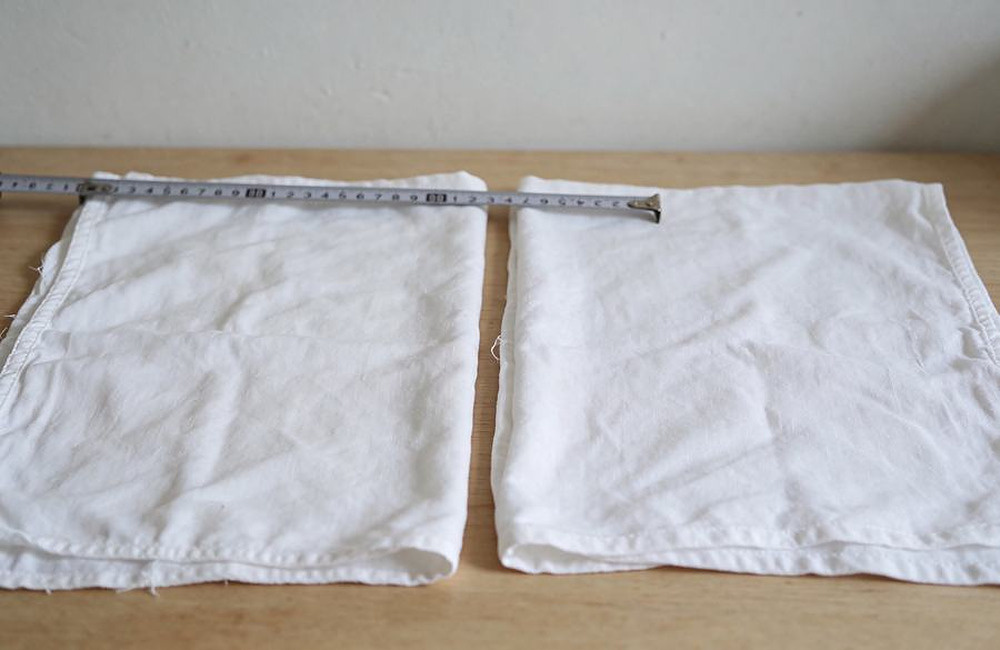
Shrinkage is measured, not assumed: the same cut before and after ten washes.
Fastest and most expensive. Stock items sit in a warehouse, so a property can replace twelve torn sheets on Thursday. There is no spec negotiation, because the distributor only holds what it holds.
Use this channel for emergencies, not for a project. The unit cost premium is usually large enough to fund a full re-spec within a year.
The property never owns the linen. The service provider supplies, launders and replaces it for a per-use or per-room fee. This removes capital cost and laundry labour from the property balance sheet.
The cost model is covered in full on the linen rental versus purchase page. The short version: rental wins at high occupancy, ownership wins at low occupancy with spare laundry capacity.
The tender document defines the spec, the volume, the delivery window and the penalty terms. The buyer cannot negotiate the technical clauses after publication.
Suppliers who can fill a spec sheet accurately and provide the required test reports have a structural advantage over those who bid on price alone.
The tender mechanics, mandatory clauses and the fill-in template are on the institutional bedding tender page.
Before choosing a channel, answer five questions. What is the fixed volume? How many sizes and colours? Who owns the specification? Is there laundry capacity on site? What is the delivery window?
If the volume is fixed and the spec must be owned by the buyer, factory direct is the default answer.
If the volume is small and mixed, a trader removes the minimum order problem.
If the delivery window is days rather than weeks, local distribution is the only option that works, whatever the premium.
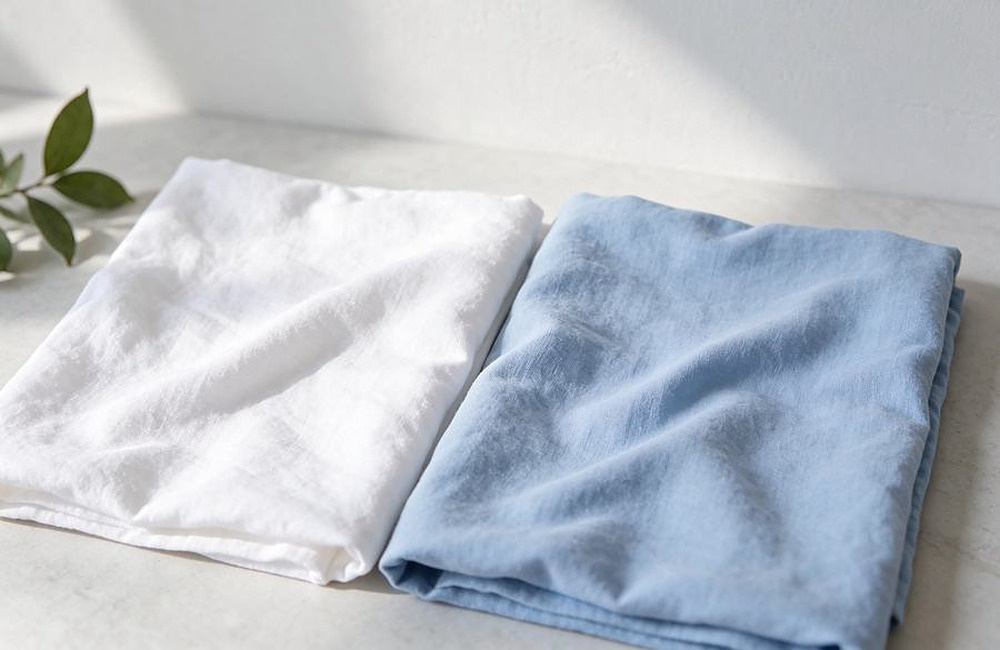
Colour fastness decides whether white stays white and colour stays colour after fifty industrial cycles.
Quick answer: Seven fields make a line item comparable: finished size after washing, weight in gsm, yarn count, construction, colour or dye lot, shrinkage percentage with its test method, and packing. Miss any one and two quotes stop being comparable even when both are technically correct.
A specification is only useful if it can be compared. Seven fields make a line item comparable. Miss any one and two quotes become incomparable, even when both are technically correct.
|
# |
Field |
Why it decides the comparison |
Example entry |
|
1 |
Finished size |
Two suppliers can quote the same "queen" and differ by 8 cm |
245×280 cm, tolerance ±2 cm |
|
2 |
Fibre composition |
100% cotton and 60/40 poly-cotton look alike in a photo |
100% cotton, combed |
|
3 |
Yarn count |
Sets hand feel and wash life more than any other field |
Warp 40s, weft 40s |
|
4 |
Fabric density |
Combined with yarn count, it fixes the thread count |
133×72 per inch |
|
5 |
Weight (GSM) |
Determines body, drape and how long the cloth lasts |
135 g/m² |
|
6 |
Shrinkage |
Explains why a 245 cm sheet becomes 238 cm after ten washes |
≤3% after 3 washes |
|
7 |
Colour fastness |
Decides whether white stays white and colour stays colour |
Wash 4–5, rub 4 |
Yarn count is the field that predicts life, and it is the field most often written as a range.
A 21s sheet and a 40s sheet at the same weight behave differently in industrial washing, because the coarser yarn loses strength more slowly at the seam.
Write the count, not a category. A supplier who quotes a category is quoting a range, and a range is not a specification. Ask for the spinning count per ply in writing.
Finished size means the size after washing and finishing, not the greige size on the loom. A supplier who quotes greige size will deliver a sheet 5 to 8 cm short after the first industrial wash.
Always ask whether the stated size is cut size or finished size, and write the tolerance into the order.
Composition drives hand feel, absorbency, shrinkage and price. Blends are legitimate and common, but the ratio must be stated. A 60/40 poly-cotton sheet lasts longer under harsh washing and feels drier on the skin. A 100% cotton sheet feels softer and shrinks more.
Do not accept "cotton rich" or "cotton blend" as a composition. Those phrases have no fixed meaning and cannot be tested against a standard.
Yarn count is the thickness of the yarn, written as 40s or 60s. Higher count means finer yarn, softer hand, and lower resistance to abrasion. It is the field most often missing from quotations, and the field that most changes what the guest feels.
The relationship between yarn count and thread count is covered in section 4. The relationship between yarn count and price is simple: finer yarn costs more per metre because it spins slower and breaks more often.
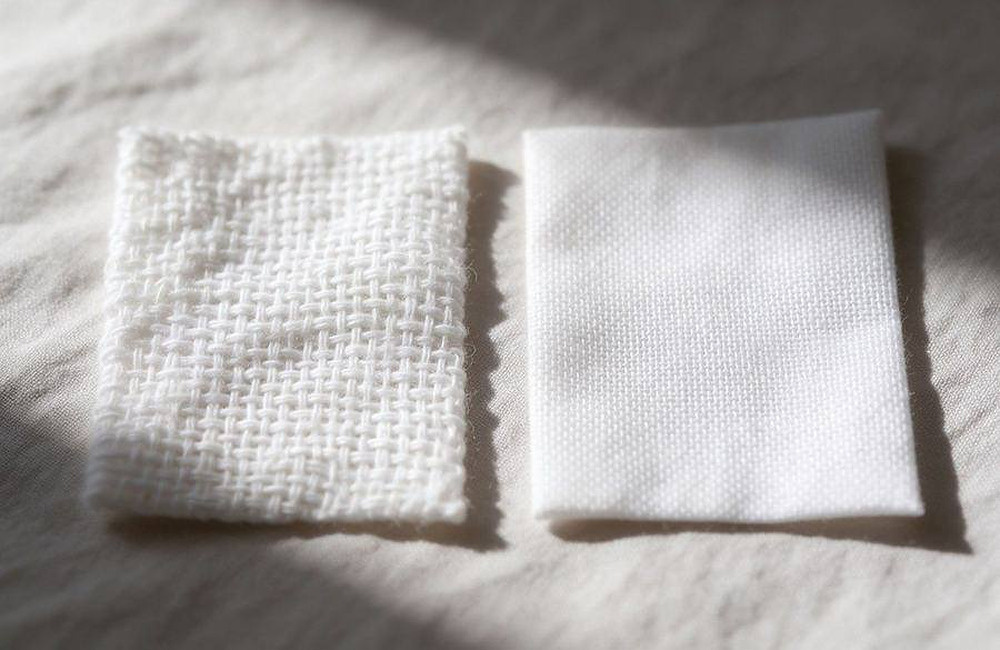
Density is the count of warp and weft threads per inch, and it is the field that decides how a sheet feels at equal yarn count.
A 133 by 72 body is the standard hotel cloth; 173 by 120 gives a smoother surface and a longer life at higher cost.
Ask for both numbers, never a single thread count figure. Both numbers belong in the specification line. The two numbers together decide the hand feel. A 40s sheet at 133 by 72 and a 40s at 173 by 120 are different products.
Density is the number of warp and weft threads per inch. It sets how tight the cloth is and how much it weighs at a given yarn count. Two cloths at 40s can differ by 30 g/m² purely on density.
GSM, or grams per square metre, is the field most buyers already track. It is a good proxy for body and durability, and a poor proxy for softness. A heavy cloth in coarse yarn feels rougher than a lighter cloth in fine yarn.
Weight ranges by product type are in section 5.
Shrinkage is the field that causes the most post-delivery complaints. Cotton shrinks. The only question is how much, and whether the supplier has pre-shrunk the cloth or sized it generously to compensate. For the adjacent buying decision, see hotel bed sheet set sizes and pocket depth.
A stated shrinkage of 3 percent or less after three washes is the common industry benchmark. Ask for the test method, because a number without a method is an opinion.
Fastness decides how the product looks in month eighteen, not month one. Four sub-tests matter: washing, rubbing, light and perspiration. For white goods, the relevant risk is greying and yellowing rather than colour loss.
Standard references and the exact sub-test codes are listed in section 8 and expanded on the tender testing page.
Most common omission: quotations that list size, composition and GSM but omit yarn count and shrinkage. Those two fields are where the real cost difference hides, and where the post-delivery dispute starts.
Quick answer: Thread count counts threads per square inch; yarn count measures how thick each thread is. A 40s cloth at 133×72 measures around 200TC, while 60s×40s at 173×120 measures around 300TC. Higher thread count on finer yarn is softer, not more durable — it needs a gentler wash regime.
These two numbers are routinely confused, and confusing them leads buyers to pay for the wrong thing. Thread count measures how many threads sit in one square inch. Yarn count measures how thick each thread is.
|
Yarn count |
Typical density |
Approximate thread count |
Hand feel |
Wash life |
|
40s |
133×72 |
≈200 |
Crisp, light |
Standard hotel grade |
|
40s |
133×100 |
≈230 |
Denser, smoother |
Good |
|
60s×40s |
173×120 |
≈300 |
Soft, silky |
Upper hotel grade |
|
60s×60s |
200×120 |
≈320 |
Very soft, fine |
Premium, needs gentle wash |
|
Coarse 21s (towels) |
— |
Not applicable |
Thick loop, firm |
Long under industrial wash |
Weight buys three things: opacity, drape and hand feel, in that order. Below the transparency threshold the sheet reads cheap on the bed whatever the fibre.
Above the upper band the property pays for weight the guest cannot distinguish, and the dryer runs longer for nothing.
Match the weight to the wash regime first, then to guest expectation, not the reverse.
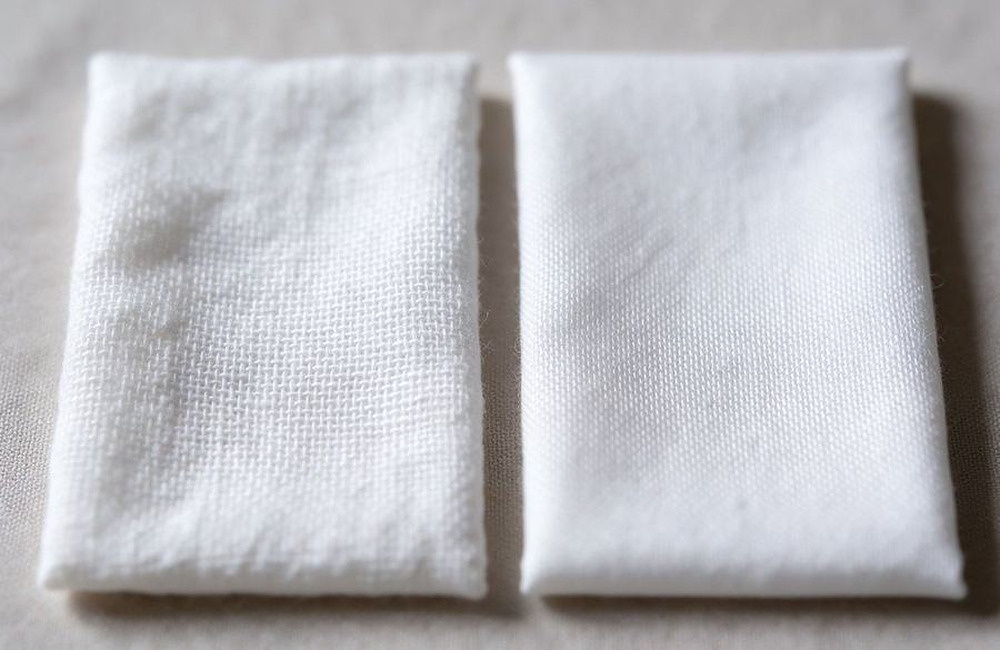
Fine yarn and high thread count are two different purchases, and a spec sheet can show one while hiding the other.
A 40s cloth can be woven at a high density and advertised as 400 thread count. It is technically accurate and practically misleading, because the yarn is coarse.
The cloth will feel firm rather than soft, and it will last well. A 60s cloth at 300 thread count feels softer and costs more to make.
When a quotation leads with thread count and omits yarn count, ask for the yarn count. That one question separates a genuine premium cloth from a densely woven standard cloth.
Write threads per inch, not "TC" alone. Buyers in different markets read TC differently: some mean threads per square inch, some mean threads per ten square centimetres. A figure of 200 means one thing in one market and something else elsewhere.
A safe export line reads: yarn 40s×40s, density 133×72 per inch, approximately 200 threads per square inch.
For a hotel that replaces linen every two years and washes industrially, 40s at 133×72 is the working standard. For a property selling a premium sleep experience, 60s×40s at 173×120 is the normal upgrade.
A buyer who wants both softness and long life has to accept a trade-off. No cloth delivers both at the same price point.
The practical answer is to split the order: finer cloth for the rooms guests remember, coarser cloth for the rooms that run high turnover.
Weave types and finishing options are on the bed linen fabric reference page.
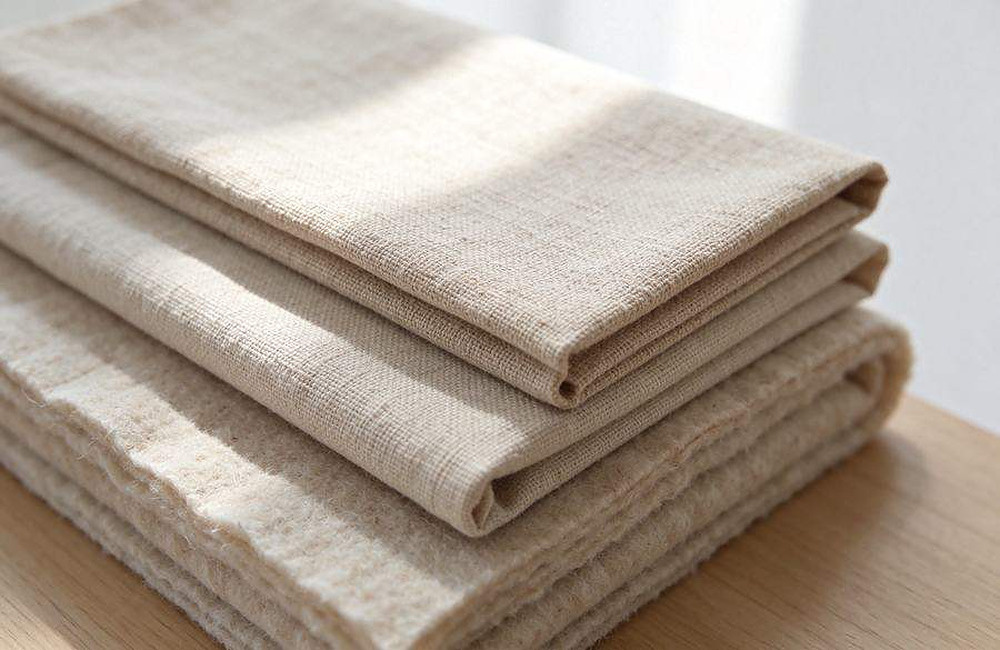
Weight sets the job: the same fibre at three weights behaves as three products.
Quick answer: GSM is weight per square metre, not a quality grade. For sheets the working band is 115 to 180 gsm: 115 to 130 gsm for economy properties with high turnover, 150 to 160 gsm for standard hotel, 170 to 180 gsm for upper tier. Two cloths at 160 gsm feel different if the yarn differs.
GSM is a weight, not a quality grade. Two cloths at the same weight can feel entirely different if the yarn differs. Still, weight ranges by product type are a reliable starting point, because below a certain weight the cloth stops doing its job.
|
Product |
Plain weave |
Twill |
Sateen |
Notes |
|
Bed sheet |
120–130 gsm |
135–150 gsm |
150–180 gsm |
Below 115 gsm the cloth turns transparent under tension |
|
Duvet cover |
130–150 gsm |
150–170 gsm |
160–180 gsm |
Premium covers sit at the top of the range |
|
Pillowcase |
120–130 gsm |
135–145 gsm |
145–160 gsm |
Face fabric matters more than body weight |
|
Mattress protector face |
100–120 gsm |
— |
— |
Barrier performance matters more than weight |
|
Bed skirt or runner |
100–120 gsm |
— |
— |
Drape and colour match drive the choice |
|
Table cloth |
180–220 gsm |
— |
— |
Weight drives stain resistance and drape |
Sizes across four institution types do not share one table.
A hospital bed at 90 by 200 is not a hotel double at 140 by 200, and a camp bunk is shorter again.
Fix one table per institution type, and check pocket depth against the actual mattress, which is where most deliveries fail. A five centimetre error in pocket depth is enough to lift a sheet off a deep mattress.
Three things change as weight rises: body, drape and abrasion resistance. A 135 gsm twill sheet stays flat on the mattress and hides the mattress pattern. A 120 gsm plain sheet is lighter, cooler and more transparent. Both are legitimate; they serve different rooms.
What weight does not buy is softness. Softness comes from yarn count and finishing. A heavy coarse cloth can feel rough, and a light fine cloth can feel silky.
Buyers who equate weight with luxury usually overpay for the wrong attribute. Test methods for abrasion, pilling, tearing and colour fastness are issued by ASTM International.
Hold a sheet against a window and the transparency threshold becomes visible: below roughly 120 gsm the light passes through and the sheet reads thin on the bed.
Above 150 gsm at the same size it drapes and stays opaque.
Grams per square metre is the cheapest proxy for that threshold, which is why the field is quoted in every tender.
Below roughly 115 gsm in white cotton, a sheet becomes visibly transparent when pulled across a mattress, especially under a reading lamp. This is the practical floor for guest-facing rooms. Back-of-house and camp use can go lower, because the expectation is different.
Heavier cloth survives more industrial cycles, but only up to a point. Beyond about 180 gsm, the added weight slows drying and increases laundry cost more than it extends life.
For high-turnover properties, the economics usually favour 130 to 150 gsm replaced on schedule over 180 gsm replaced less often.
Towel weight ranges follow a different logic, because loop structure matters more than flat-cloth weight. The three yarn tiers and their weight bands are on the hotel towel wholesale page.
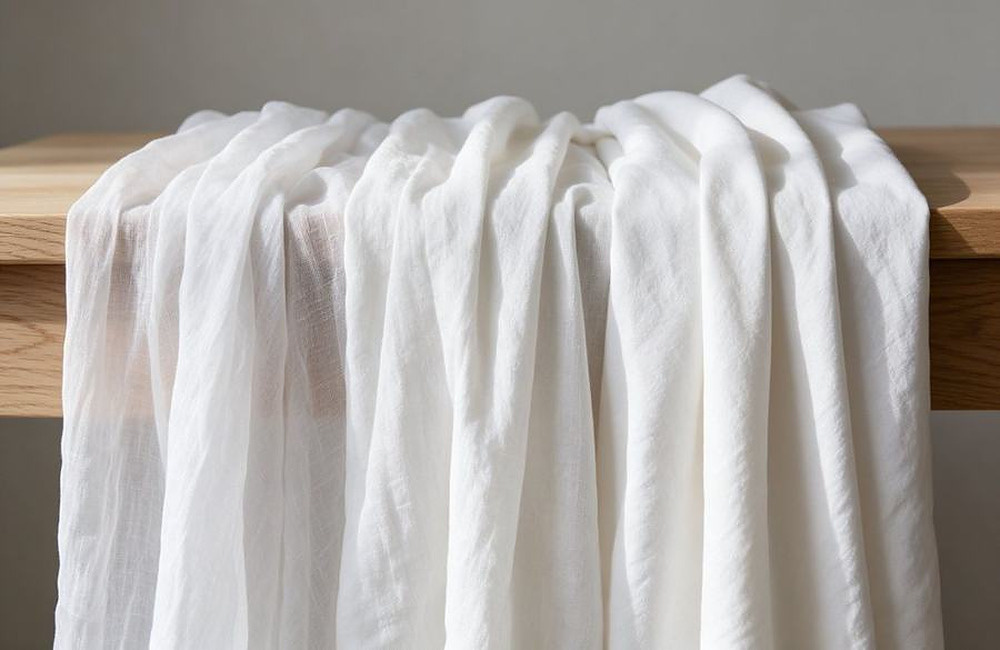
Hold a sheet against a window and the transparency threshold becomes visible.
Quick answer: Four bed populations mean four size systems: hotel fitted sheets run a 30 to 35 cm pocket, hospital beds need 20 to 25 cm with a waterproof base, dormitory singles sit at 90×190 cm, and camp beds run 200 to 210 cm. Five centimetres of pocket depth separates a tight fit from an exposed edge.
Four bed populations, four size systems. Specifying a hotel sheet for a hospital bed produces a short drape and an exposed mattress edge. The size table below is the working reference for all four.
Industrial laundering removes strength from the seam before it removes appearance from the surface.
That is why a sheet can look acceptable on the bed and still fail a tear test at the corner.
Buy on the washed sample, not the new one, and ask which cycle count the number refers to. The tear test is the one that decides whether a sheet survives a hundred cycles.
|
Bed type |
Mattress (cm) |
Flat sheet (cm) |
Fitted sheet (cm) |
Duvet cover (cm) |
Pocket depth |
|
Single |
90×190 |
180×280 |
90×190+30 |
150×220 |
30 cm |
|
Single wide |
100×200 |
190×290 |
100×200+30 |
160×220 |
30 cm |
|
Double |
140×200 |
230×290 |
140×200+30 |
200×220 |
30 cm |
|
Double wide |
150×200 |
240×290 |
150×200+30 |
210×220 |
30 cm |
|
Queen |
160×200 |
250×290 |
160×200+35 |
220×240 |
35 cm |
|
King |
180×200 |
270×290 |
180×200+35 |
220×240 |
35 cm |
|
Super king |
200×200 |
290×300 |
200×200+35 |
240×240 |
35 cm |
|
Bed type |
Mattress (cm) |
Flat sheet (cm) |
Fitted sheet (cm) |
Duvet cover (cm) |
Pocket depth |
|
Hospital standard |
90×200 |
180×290 |
90×200+25 |
150×230 |
25 cm |
|
Hospital long |
100×210 |
190×300 |
100×210+25 |
160×240 |
25 cm |
|
Dormitory bunk |
90×190 |
160×250 |
90×190+25 |
150×210 |
25 cm |
|
Kindergarten |
70×140 |
130×200 |
70×140+20 |
110×150 |
20 cm |
|
Camp single bunk |
80×190 |
150×250 |
80×190+25 |
140×210 |
25 cm |
|
SPA massage bed |
70×180 |
— |
70×180+20 |
— |
20 cm |

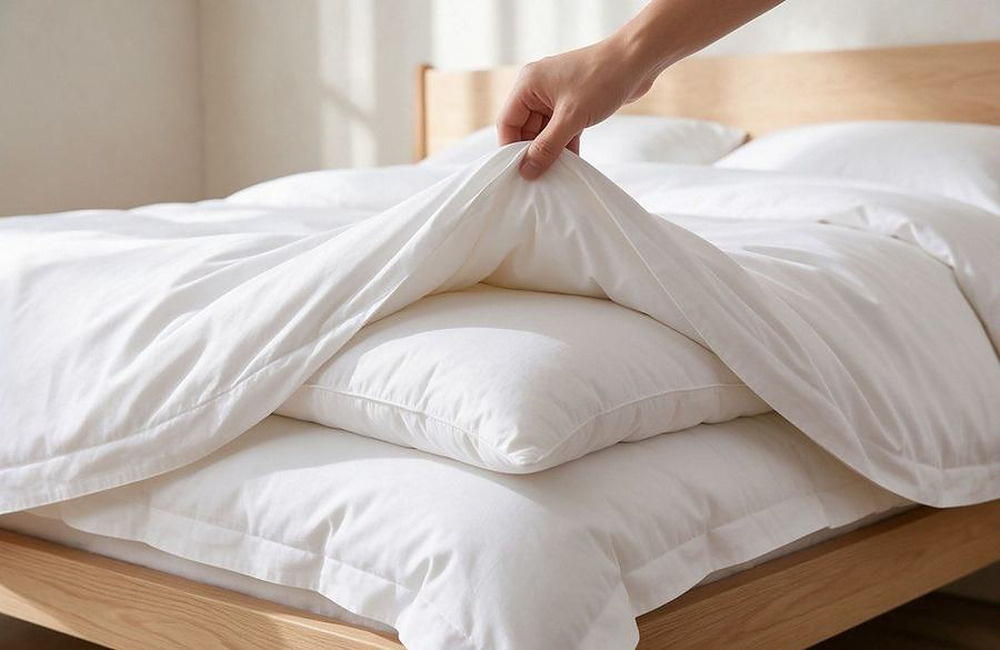
A fitted sheet is specified by mattress footprint plus pocket depth. A 30 cm pocket on a 32 cm mattress will pop off at the corner within a week. Institutional mattresses are often thicker than domestic ones, especially hospital and care beds with pressure-relief tops.
Measure the mattress, not the frame. Add 2 cm for a mattress protector. If the property uses a topper, add its thickness as well.
A duvet cover should be five to eight centimetres larger than the inner on each side, so the inner does not shift and the corners stay filled. Smaller and the cover pulls at the seams; larger and the duvet folds inside.
Give both dimensions in the specification, or the mill will size the cover to the bed rather than to the inner.
The cover should be 5 to 8 cm larger than the inner on each dimension. Too small and the inner bunches at the corners. Too large and the inner migrates, leaving cold spots. Corner loops or ties hold the position without relying on size alone.
European inners often run to 220×240, while UK and US inners cluster around 220×230 and 218×218. A cover bought before the inner is chosen is a cover that may not fit.
Standard hotel pillowcases run 48×74 and 50×75. King cases run 51×91. A 50×75 case on a 48×74 pillow leaves slack that looks untidy after housekeeping, so specify both together rather than separately.
Full size conversion tables in metric, inches and EU, US and UK formats are on the hotel bed sheet set page, along with the tender-ready specification template.
Quick answer: Hotel linen wears out in the wash, not in the bed. A tunnel washer runs hotter, longer and with more mechanical action than any domestic machine, and every cycle removes fibre, weight and tensile strength. Plan acceptance at 50 cycles for economy stock and 100 cycles for upper-tier stock.
Hotel linen does not wear out from sleeping on it. It wears out from washing. An industrial tunnel washer runs hotter, longer and harsher than any domestic machine, and each cycle removes a measurable amount of fibre, weight and strength.
The reference method is ISO 15797, which defines industrial laundering test procedures. Method 4 covers 50 cycles and method 6 covers 100 cycles. A supplier who says "industrial wash tested" without naming the method has told the buyer nothing comparable.
|
What degrades |
Typical change after 50 cycles |
What buyers notice |
|
Fabric weight |
Loses a few percent of mass through fibre loss |
Cloth feels thinner and drapes differently |
|
Tensile strength |
Falls measurably, faster at high temperature |
Tears start at the hem and along creases |
|
Colour |
White greys, colour fades unevenly |
Mixed batches look mismatched |
|
Surface |
Pilling appears on sateen and twill |
Cloth looks worn before it is worn out |
|
Shrinkage |
Most shrinkage happens in the first 5 to 10 cycles |
Sizes drift and sheets stop fitting |
Compliance is a document question, not a product question. A textile sold into a European institutional project needs the right test report for the market it enters, and a supplier who cannot name the standard behind the certificate has not been tested to it.
Ask for the report number and the issuing laboratory. A certificate without a laboratory name is a marketing document, not evidence. For the adjacent buying decision, see hotel towel yarn count guide.

Coarser yarn has more fibres in the cross-section, so it resists abrasion longer. This is why 21s cotton is common in healthcare sheeting and in towel ground cloth, where the priority is surviving repeated washing rather than feeling silky.
Finer yarn, 40s and 60s, gives the softer hand that guest rooms expect and loses strength faster under the same wash regime. Both choices are correct for their setting. A hospital that specifies 60s for patient sheeting usually replaces it sooner than expected.
The purchase price is a small part of the lifetime cost. Laundry, replacement labour and premature withdrawal dominate. A sheet bought at a higher unit price that survives twenty more cycles is often the cheaper sheet, and that is the calculation worth running.
The full testing set for healthcare linen, including barrier limits and the standards buyers actually ask for, is on the hospital bed linen page.
Cost per piece is the number a buyer can see; cost per wash is the number the budget feels. Divide the purchase price by the cycles the item survives, then add the laundry cost per cycle.
A sheet at twice the price that lasts three times as long is the cheaper line, and the arithmetic takes about two minutes on a calculator.
A useful way to compare two sheeting options is to divide the unit price by the number of industrial cycles each survives. A cloth that costs more per piece but survives twenty extra cycles can come out cheaper per wash.
This calculation needs three inputs: the unit price, the tested cycle count, and the replacement labour cost. The third input is usually the one buyers forget, and it is the one that decides whether a cheap sheet is actually cheap.
Run the comparison against your own washer, not against a supplier's laboratory figure. A tunnel washer running at a higher temperature will shorten life for every cloth, and it will shorten the life of fine yarn faster than coarse yarn.
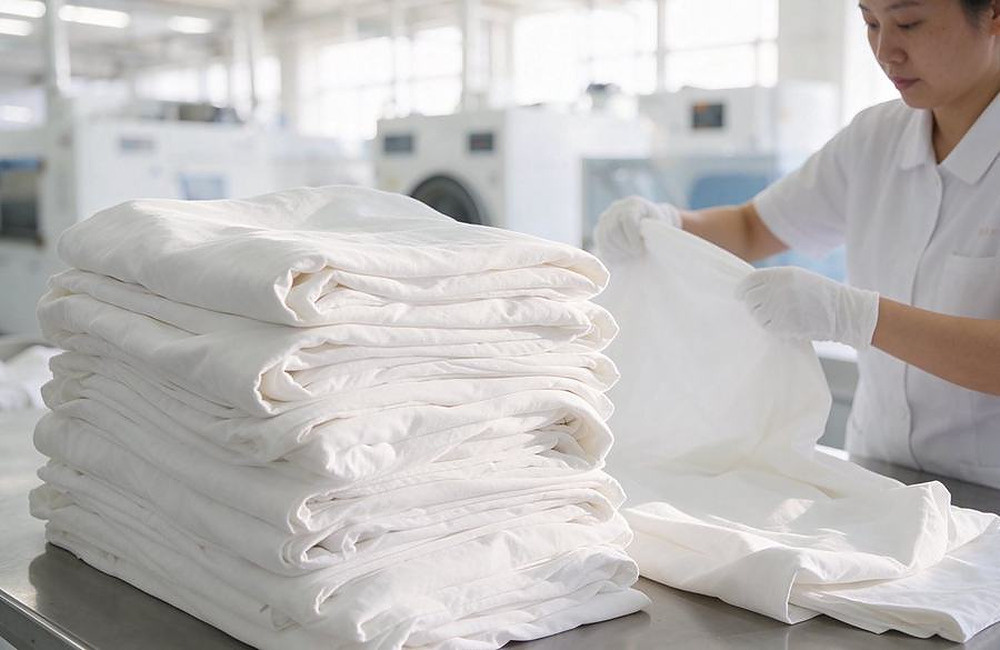
Cost per piece is the number a buyer can see; cost per wash is the number the budget feels.
Quick answer: A market requirement can eliminate a specification outright, so it belongs in the first conversation. China works to GB 18401 class B for skin contact; the European Union to REACH plus OEKO-TEX Standard 100 with a certificate number; the Gulf to SASO or ESMA conformity documents checked at port; the EAEU to TR CU 017/2011 declaration.
Compliance questions usually arrive late, after the price is agreed. They should arrive first, because a market requirement can eliminate a specification entirely.
|
Market |
Baseline requirement |
Commonly requested by buyers |
Notes |
|
China |
GB 18401, class B for skin contact |
Formaldehyde, pH, decomposable aromatic amines |
Class A is infant use, class C is non-contact |
|
European Union |
REACH restrictions |
OEKO-TEX Standard 100 with certificate number |
OEKO-TEX covers harmful substances, not durability |
|
Gulf states |
SASO, ESMA depending on destination |
Conformity certificate at clearance |
Documentation is checked at port, not at order |
|
EAEU |
TR CU 017/2011 |
Declaration of conformity |
Applies to textile products for skin contact |
|
Africa, selected |
KEBS or PVoC depending on country |
Pre-shipment inspection certificate |
Inspection must be arranged before shipment |
Order structure protects both sides.
A deposit against the material, a balance against the shipping documents, and a final payment after arrival inspection is the common pattern for a first order.
Anything that puts all the money on one side before production leaves the other side without a remedy. On repeat orders the structure simplifies, because inspection history replaces the deposit.
Important: CE marking does not apply to ordinary bedding and sheeting. CE is tied to specific EU product directives such as medical devices, PPE, toys or construction products. A supplier who puts CE marking on ordinary bedding is either misinformed or misrepresenting. Ask instead for OEKO-TEX, REACH compliance documentation, or a test report against the standard the buyer actually needs.
Two documents are routinely mislabelled in this trade. ISO 9001 certifies a factory's quality management system, not a product. EN 14065 certifies a laundry's RABC process control, not a textile.
Both are legitimate and useful. Neither should appear as a product claim on a bedding page.
Curtains are tested as finished products, not as fabric rolls. The relevant references are BS 5867-2:2008 and NFPA 701. Bedding flammability requirements differ by market and by product class, and a supplier should state which test was run on which item.
The clause-by-clause list buyers score against, with the fill-in sheet, is on the institutional bedding tender page.

Certificates are checked at the border, long after the price is agreed.
Quick answer: Minimum order is set by dye-lot batch size and line time, not by a warehouse rule. A single custom colour at 300 sets costs less per unit than 50 sets, because the dye lot runs the same either way. Lead time splits into dyeing and finishing, sewing, and inspection — three blocks that do not overlap.
Minimum order quantity in this category is set by dye lot and by line time, not by a warehouse rule. A factory dyes in fixed batch sizes, so a small order in a custom colour costs more per unit than the same order in white.
|
Order type |
Typical volume band |
What drives the price |
Suits |
|
Sample set |
1–5 sets |
Cutting and shipping, not production |
Spec verification before commitment |
|
Trial order |
100–300 sets |
One dye lot, one style run |
First order with a new supplier |
|
Project order |
300–2,000 sets |
Line time and dye lot count |
Single hotel or campus project |
|
Programme order |
2,000+ sets, repeated |
Scheduled capacity and raw material booking |
Hotel group, rental service, institutional framework |
A trial order is the cheapest test a buyer will ever run.
It costs one purchase order and answers the questions a specification cannot: how the cloth behaves in that property's own laundry, how the sizes fit the actual beds, and how the supplier handles a short shipment.
One carton, one room type and one wash cycle answer more than a year of samples.
A single sample set carries courier cost and cutting time. A 100-set trial carries one dye lot and one line changeover. A 2,000-set programme carries scheduled capacity and pre-booked yarn. The unit price moves for structural reasons, not negotiation tactics.
Buyers who ask for a price before defining volume get an answer that cannot be compared to anything. Define the tier first, then ask for a quotation.
Production time is only one part of the timeline. The full sequence runs: spec confirmation, sample approval, raw material booking, dyeing, cutting and sewing, inspection, packing and shipping.
Skipping the sample approval step is the usual reason a project runs late, because the rework happens after the goods are made.
Current production capacity and confirmed lead times are confirmed on a per-order basis. Ask for the schedule in writing against your delivery window rather than relying on a general figure.
A standard structure splits the order into a trial quantity and a balance. The trial verifies the spec under real washing. The balance runs on the approved standard. Payment terms are agreed separately and are not published on this page.
For public tenders, the structure is fixed by the tender document rather than by the supplier. Delivery windows, penalty clauses and inspection rights are set before bidding, so the supplier's job is to confirm feasibility before submission.

Each order tier carries a different cost driver, from sample freight to mill minimum to container fill.
Quick answer: A trial order answers three questions only: does the cloth hit the stated weight, does it survive the local wash regime, and does the size still hold after shrinkage. Around 300 sets in one style and one dye lot is the practical size; run at least three local washes and 30 accelerated cycles before fixing the standard.
A trial order exists to answer three questions: does the cloth match the spec, does it survive the local wash regime, and does the size hold after shrinkage. Everything else can be settled on paper.
The result of a trial is three numbers, not an opinion: measured size after one wash, shrinkage percentage, and the count of pieces that failed inspection.
Write them down before the second order, and use them to amend the specification rather than to negotiate the price.
Keep the trial carton label, because it is what the second order gets checked against.

Three questions, one trial, before the balance order runs: absorbency, shrinkage, and colour after wash.
Fill all seven fields for every line item. Write the set definition. Write the finished size and tolerance. Confirm which test reports exist and which are quoted on request.
Approve it on a bed, under the property’s own lighting, with the actual duvet inner inside.
Measure the finished size, the pocket depth and the shrinkage after one wash, and write the approved numbers into the purchase order. A sample approved on a table is not an approved sample.

A production sample is the last point where a specification can still be corrected at no cost.
Approve a sample made on the production line, not a lab sample. Lab samples are made on different equipment and often flatter than production. Sign and date the approved sample, keep one piece, and reference its lot number in the purchase order.
Run 100 to 300 sets through the property's actual wash process, not a laboratory approximation. Measure the sheet after cycle 1, cycle 10 and cycle 30. Record length, width, weight and any pilling. For the adjacent buying decision, see restaurant table linen specifications.
|
Check |
Acceptance |
How to measure |
|
Finished size after wash |
Within stated tolerance |
Tape measure, flat, after line drying |
|
Shrinkage |
≤3% after 3 washes |
Compare to cut size record |
|
Colour fastness |
Grade 4 or above on wash and rub |
Grey scale comparison |
|
Seam integrity |
No open seams after 30 cycles |
Visual and pull test at hem |
|
Pilling |
No visible pilling after 10 cycles |
Visual against a light box |
|
Hand feel retention |
No stiffening or hardening |
Blind comparison with retained sample |
If the trial passes, the balance order runs against the approved sample and its lot number. If it fails on size, the fix is usually cut size rather than cloth.
If it fails on colour, the fix is dye lot control. If it fails on seams, the fix is stitch density and thread type.
Keep the trial records. They become the reference for every future reorder, and they shorten the next project's approval cycle considerably. For the adjacent buying decision, see bed linen fabric and yarn basics.

Folding tolerance is part of the specification, not a housekeeping detail, because it sets the shelf height.
Foshan Yiroufang Textile Manufacture Co., Ltd | Institutional bedding procurement | Foshan, Guangdong, China
Write to lisa@yrftextile.com with the room count and the specification sheet; the reply comes back with finished sizes and the report references.
The pack contains the seven-field specification sheet, the four-market size table, the wash-life test record template and the per-room quantity calculator. Fill it in once and every quotation becomes directly comparable.
Figure ranges are quoted from the published standard; the binding clause is the standard text itself, not this summary.

The wash test is the acceptance test: what survives cycle ten is what ships.
What is the minimum order for hotel bedding?
It depends on the order tier. A sample set can be as small as one set. A trial order usually starts around 100 sets in one style and one dye lot. Below that, cutting and shipping cost dominate the unit price.
Can you mix sizes in one container?
Yes, within limits. Mixed sizes in white goods are straightforward. Mixed sizes in custom colours multiply the dye lot count, which is what pushes the price up.
What is the lead time for 500 sets?
Lead time runs from spec confirmation through sample approval, material booking, dyeing, sewing, inspection and shipping. Confirm the schedule in writing against your delivery window, because the sample approval step is where most projects lose time.
Do you provide a spec sheet I can send to my client?
Yes. The seven-field sheet in this guide is the same format we use for quotations. Fill it in or send it blank to your client and return it completed.
Can you ship to a project site instead of a port?
Site delivery is arranged case by case. Remote sites, multiple delivery points and phased delivery all change the packing and the logistics cost, so they need to be stated before the quote.
What certifications do you actually hold?
Test reports and certificates vary by product and by market. Ask for the specific document you need, and we will confirm what can be arranged for that order. Certification numbers are not quoted on this page, because a number we do not hold is worse than no number.
Is 21s good enough for a hotel?
21s cotton is common in healthcare sheeting and towel ground cloth because coarse yarn resists abrasion. For guest-facing sheets, 40s is the working standard and 60s is the premium upgrade. The yarn choice should follow the room type.
Which is better, 40s or 60s?
60s feels softer and costs more. 40s lasts longer under harsh washing and costs less. For high-turnover rooms, 40s replaced on schedule is usually the better economics. For premium rooms, 60s is the expected standard.
Is higher thread count always better?
No. A coarse yarn woven densely can carry a high thread count and still feel firm. Yarn count tells you more about hand feel than thread count does.
What GSM should a hotel sheet be?
Plain weave usually runs 120–130 gsm, twill 135–150 gsm and sateen 150–180 gsm. Below about 115 gsm in white cotton, the cloth becomes visibly transparent under a reading lamp.
How do you handle custom colours?
Custom colour is a dye lot decision. State the colour reference, the quantity and the number of sizes. Each additional colour adds a dye lot, which is the main cost variable in coloured programmes.
Do you offer OEKO-TEX or ISO certificates?
OEKO-TEX Standard 100 is a product test for harmful substances and is requested by many EU buyers. ISO 9001 is a factory management system certificate, not a product certificate. Tell us which document your buyer requires and we will confirm what is available.
Copyright © Custom Disaster - Relief Bedding: Tents, Sleeping Bags, Blankets All Rights Reserved
the professional team to service !