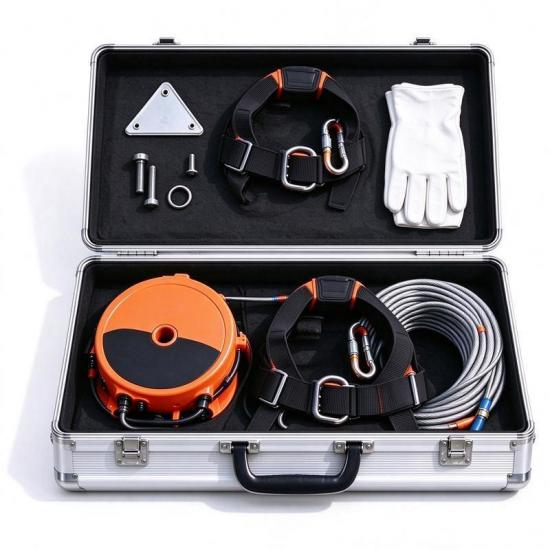
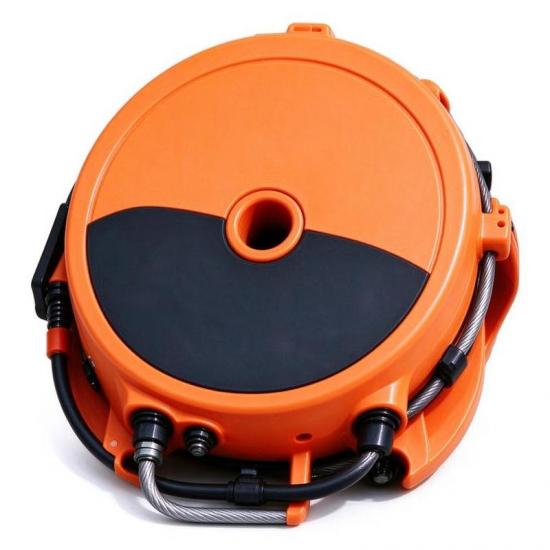
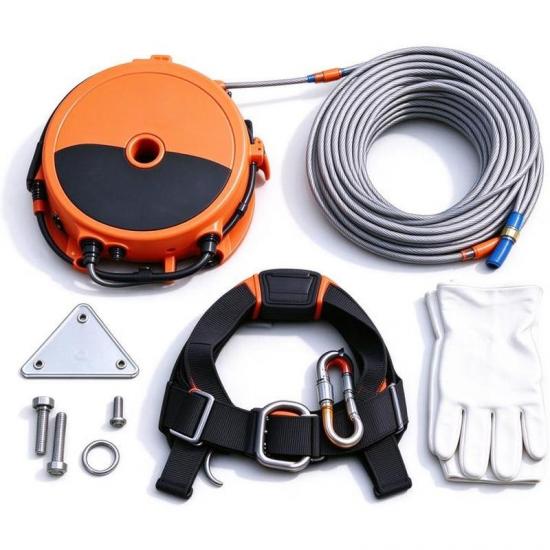
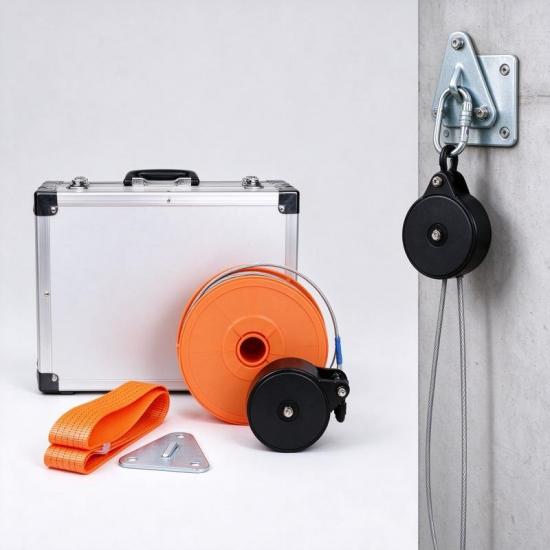
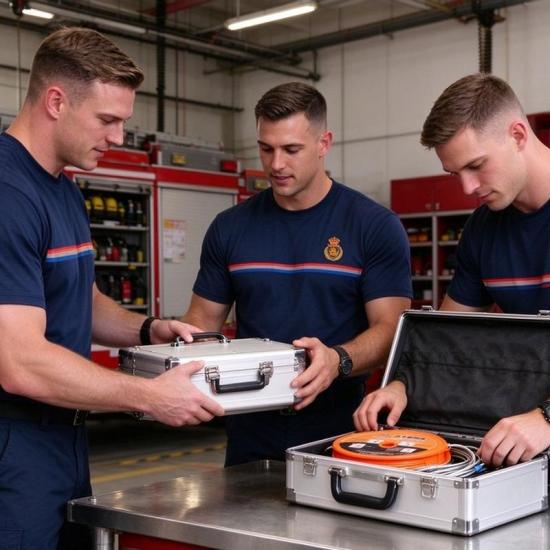
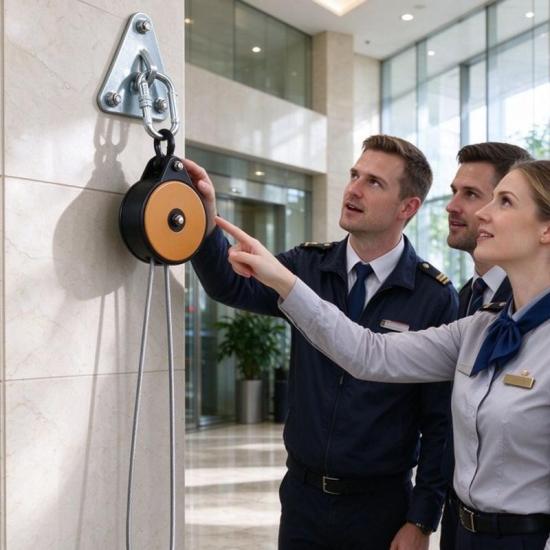
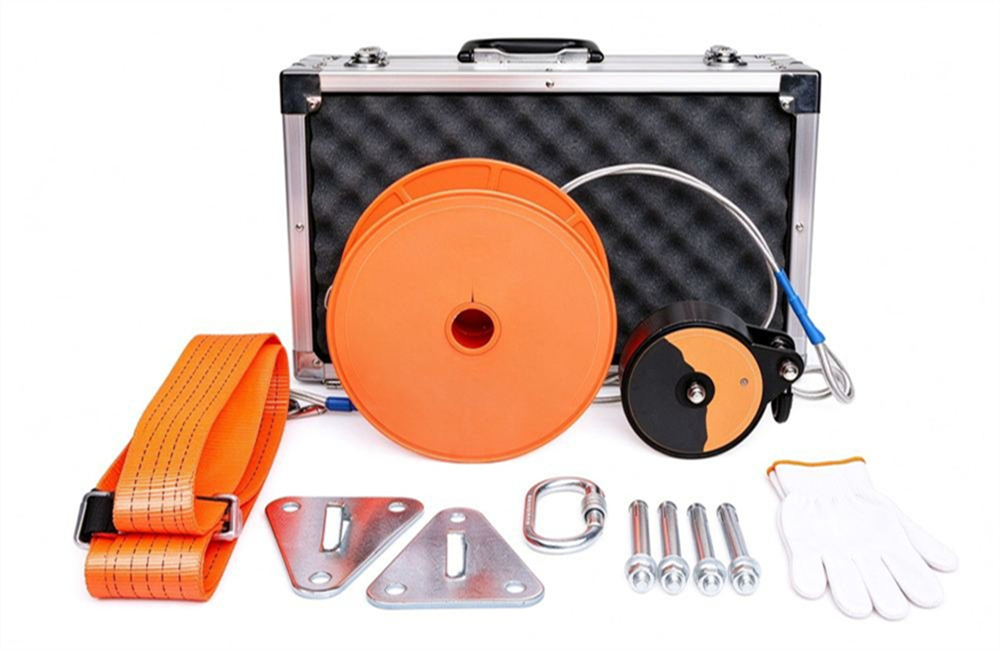
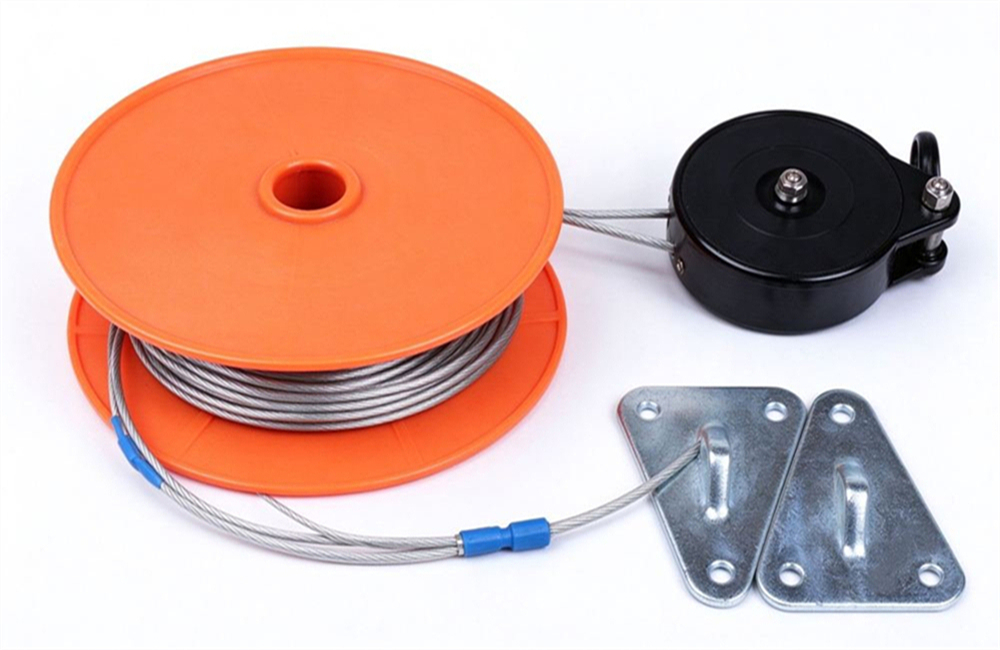
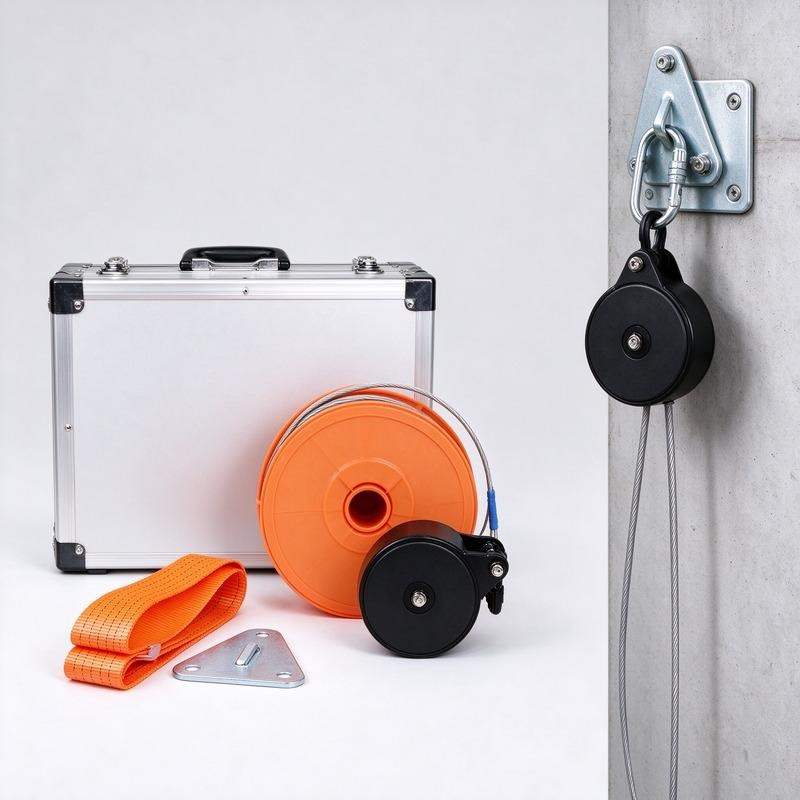
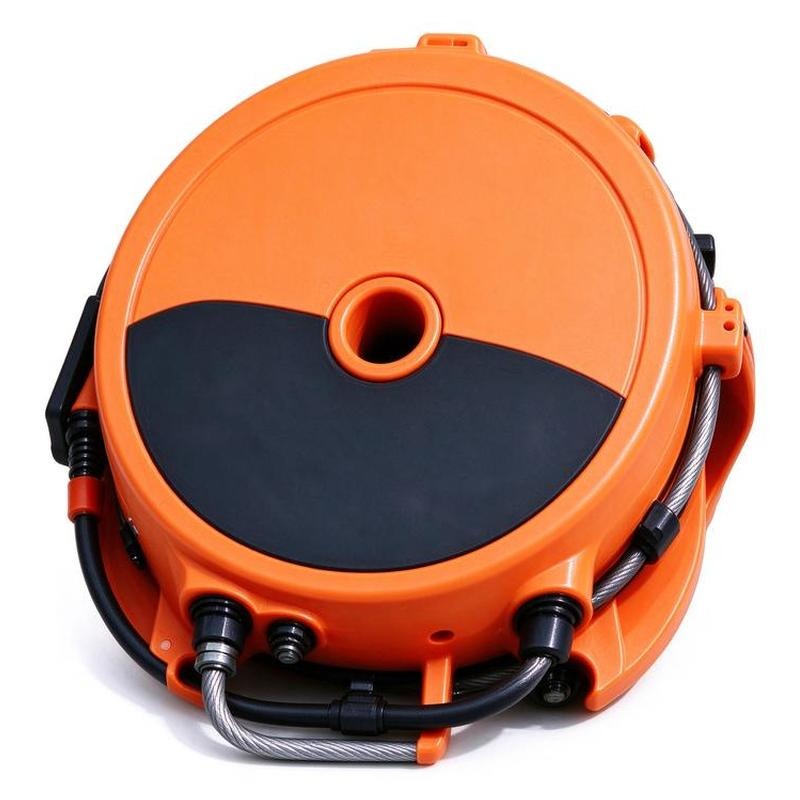
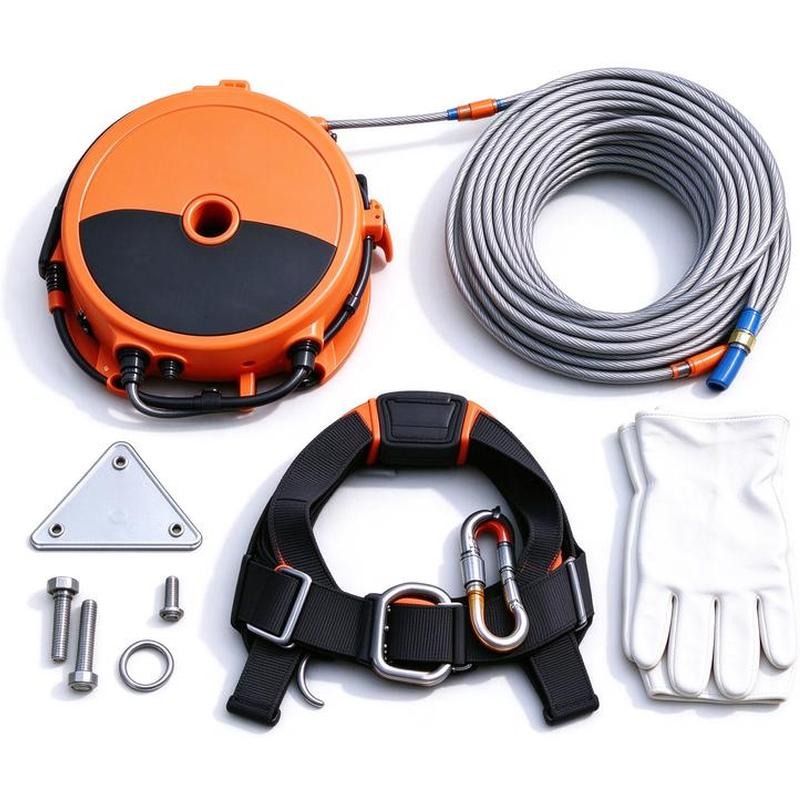
This rescue descent equipment kit adopts centrifugal brake structure for stable descending speed. It comes with descender host, steel cable, safety harness, carabiner, mounting bracket and aluminum case. Suitable for high-rise buildings, wind turbine platforms and industrial sites. Easy to install, reliable for emergency evacuation during fire and high-altitude accidents.
Note: Price for reference only. Exact price based on quantity, size, weight and custom details.
model no. :
E-05Brand:
YRFmarket price :
$150.9sale price :
$74.9price range :
11-100/$74.9 100-500/$74.1Color :
Whiteport of dispatch :
Guangdong/GuangzhouPayment :
TT, Paypal, Western Unionmin order :
30original region :
Made in ChinaLead Time :
5-15days
Portable Rescue Descender for High-Rise Evacuation
for Fire Departments
When firefighters arrive at a high-rise fire, they face a problem. This is where professional rescue descent equipment earns its place. This rescue descender resets automatically between users. Every rescue descender ships with a field service kit.
Fire teams choose it for repeat deployments. Maintain it after every exercise. CE and 3C certification options are available. A single unit serves many users. Check the rope before each use. Store it in its aluminum case.
The stairs fill with smoke. The elevators shut down. People are trapped above the fire floor. They need rescue descent equipment that works without power.
The portable professional is the rescue descent equipment that solves this.
It is mechanical rescue descent equipment that lowers people out windows at a controlled 1.5 meters per second. No electricity. No batteries. Fully mechanical.
Unlike residential units, this rescue descent equipment is built for daily training, repeated use, and field repair. Firefighters carry it on every high-rise call.
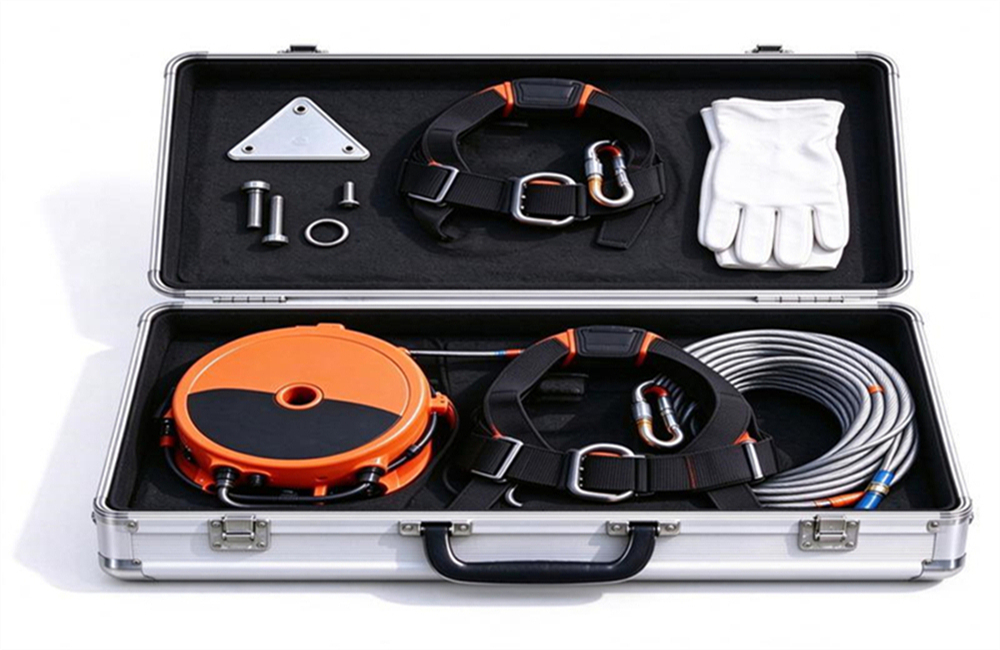


Table of Contents
1.
What Is a Professional Rescue Descender?
10.
Cold Weather and Extreme Environments
2.
How the Centrifugal Brake Works
11.
Training Requirements
3.
Professional vs Residential: Detailed Comparison
11b.
The Procurement Process
4.
Full Specifications
11c.
Sample Training Schedule
5.
A Real Rescue Deployment
12.
What's in the Box
6.
Who Uses This Equipment
13.
Writing a Tender Specification for Rescue Descent Equipment
6b.
Which Model Should You Order?
14.
Brand Comparison
6c.
Deployment Plan for Fire Departments
14b.
Quality and Testing
7.
Setup: Permanent and Portable
15.
Acceptance Testing
8.
Reset and Reuse Between People
16.
Industrial Use Cases
8b.
Deployment for Premium Buildings
17.
Mechanical vs Electronic
8c.
Operating Notes for Rescue Teams
17b.
Portable vs Fixed Systems
9.
Maintenance and Spare Parts
18.
FAQ
9b.
Maintenance Log Template for Rescue Descent Equipment
19.
OEM and Distributor
9c.
Troubleshooting Common Issues
20.
Ordering and Pricing
9d.
Spare Parts and Replacement Schedule
20b.
Export, Packaging, and Lead Time
21.
Related Products
Compare with Our Other Rescue Products
YRF builds a complete high-rise rescue family. Match the right tool to your building and users.
Reciprocating High-Rise Escape Descent Device – fixed unit for multi-person home escape.
Self-Locking Escape Rope Kit – portable rope kit for backup and travel use.
Nylon Wire Escape Ladder – steel-core ladder for 2-3 storey buildings.
Special Needs Rescue Harness Kit – padded harness for elderly, children and wheelchair users.
1. What Is a Professional Rescue Descender?
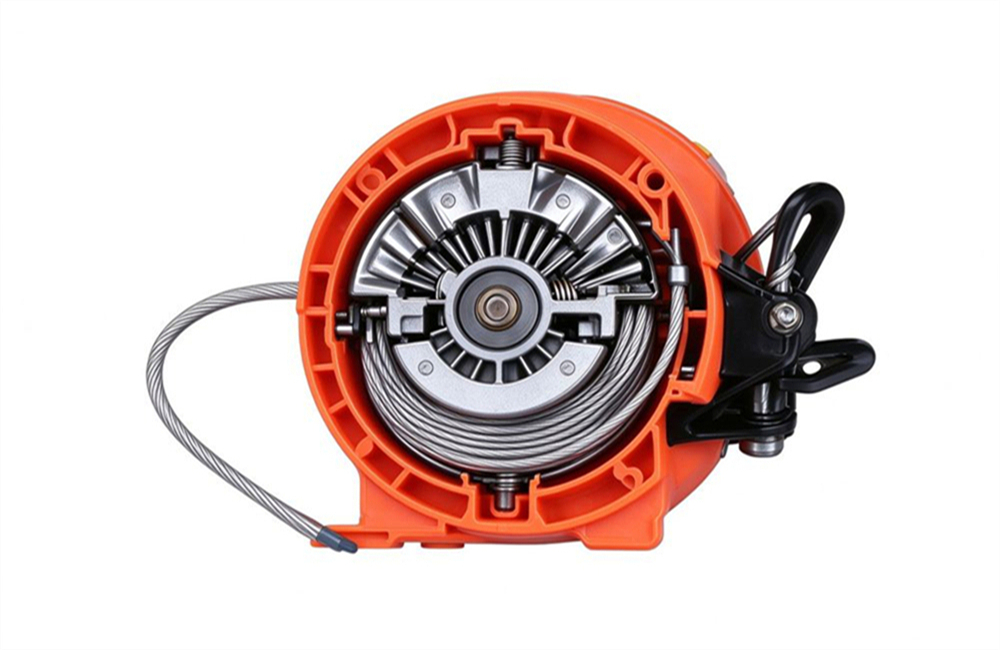
A professional rescue descender controls descent speed automatically. A rescue descender is a piece of rescue descent equipment that lowers a person from a height at a controlled, automatic speed.
It is not a rope. It is not a winch. It is a self-braking device, and it is the most trusted rescue descent equipment in vertical evacuation.
The person clips a rescue harness to the steel cable of the rescue descent equipment. When they step out the window, gravity pulls the cable out. The internal brake engages automatically and keeps the speed constant.
It does not matter if the person weighs 50 kg or 200 kg. The speed stays at 1.5 meters per second. This is the defining feature of quality rescue descent equipment.
The professional version is professional rescue descent equipment built for: firefighters, high-rise building management, hotels, hospitals above 5 floors, offshore platforms, and wind turbine maintenance.
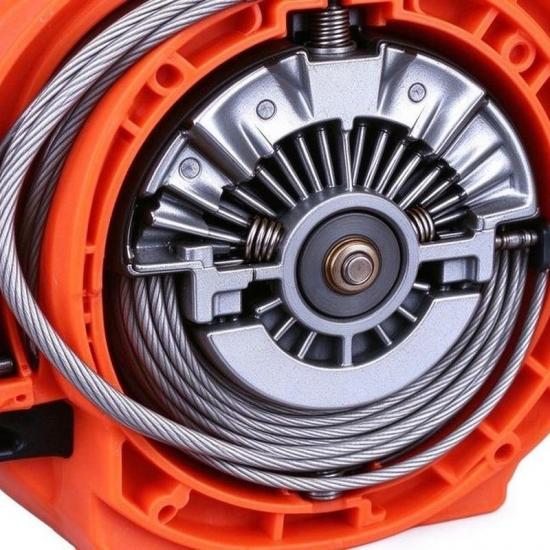
2. How the Centrifugal Brake Works
The centrifugal brake inside the rescue descender reacts to body weight. Understanding the brake helps you understand why this rescue descent equipment is reliable.
The basic idea
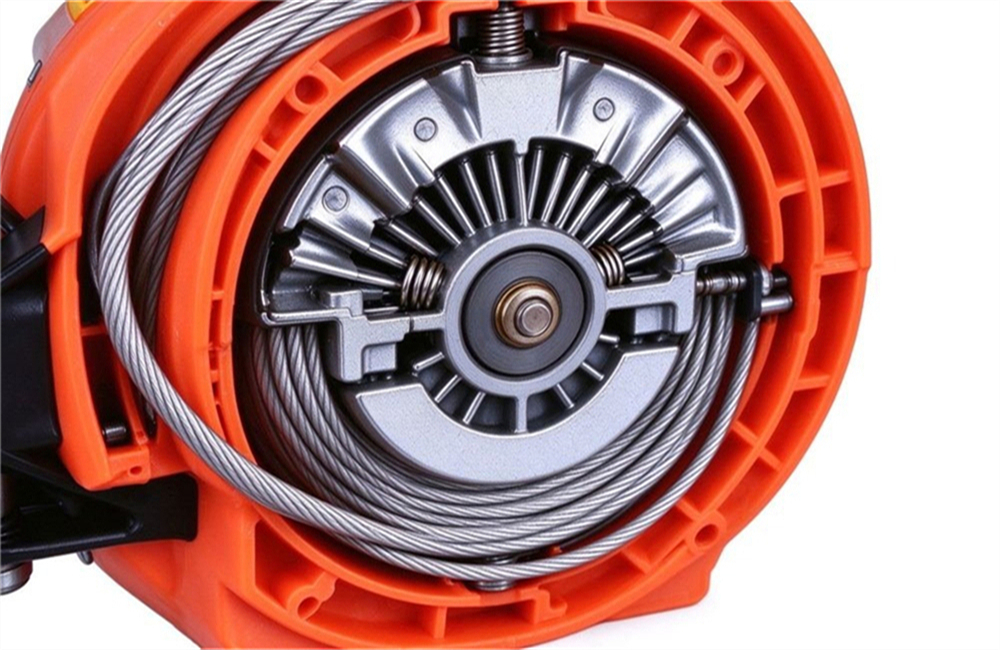
Inside the case is a spool. The cable wraps around this spool. The spool is connected to a set of brake pads. This is the core of the rescue descent equipment.
When the person steps out, the cable pulls the spool. The spool spins.
Centrifugal force
As the spool spins faster, centrifugal force pushes the brake pads outward against the case wall.
The faster it spins, the harder the pads press. The more friction, the slower it spins.
This creates a self-regulating system inside the rescue descent equipment. It finds the speed where the force balances the friction. That speed is about 1.5 m/s.
It does not matter if the person is light or heavy. The system adjusts automatically.
No electronics, no batteries
The brake is purely mechanical. There is nothing to fail electrically. That is why this rescue descent equipment never fails to start.
It works in a blackout. It works underwater. It works at -30°C.
This is why rescue teams trust this rescue descent equipment. The simplest mechanism is the most reliable.
3. Professional vs Residential: Detailed Comparison
A professional rescue descender is built for repeated use. The bottom line: residential units are designed for one family, one emergency. Professional units are designed for a career of training and real rescue.
Feature
Residential (E-01)
Professional (E-05)
Price
$25-$85
$60-$180
Design life
Up to 100 descents
Unlimited, field-serviceable
Speed
1 m/s fixed
1.5 m/s standard, adjustable on request
Max load
150 kg
200 kg (two adults at once)
Cable
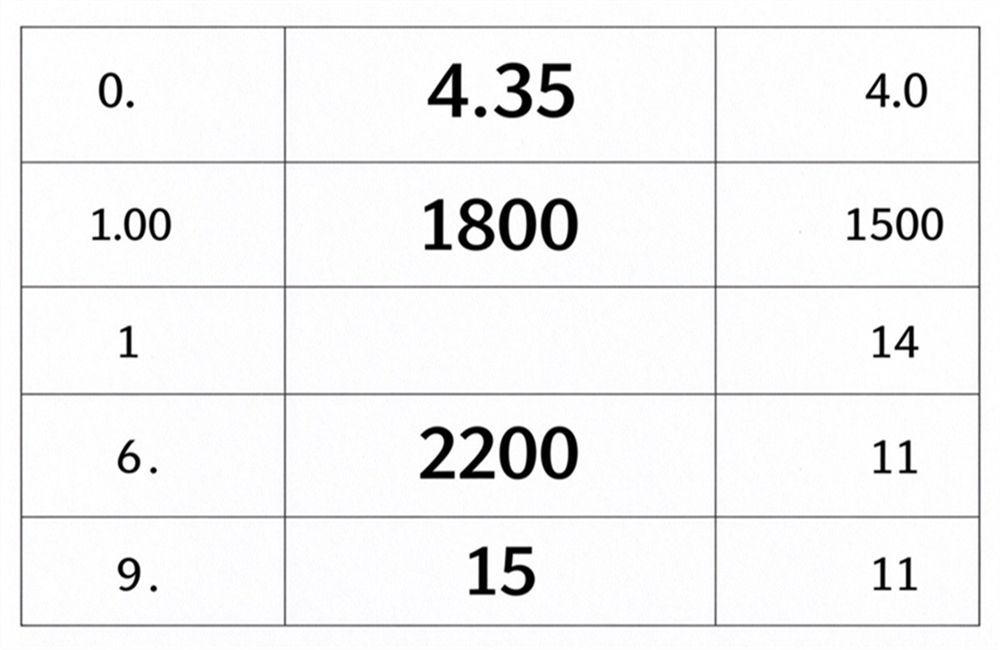
4.35 mm, fixed inside
5 mm, user-replaceable spool
Body
Aluminum
Die-cast aluminum + steel reinforcement
Mount
Permanent wall bracket
Permanent bracket OR portable tripod
Brake pads
Fixed, not replaceable
Field-replaceable, 5-minute job
Temperature
-10 to +50°C
-30 to +60°C
Reset between people
Auto-rewind
Spring-assisted rewind
Weight
2.5 kg
3.5 kg + 2 kg case
4. Full Specifications
Specifications for this rescue descender include rated load and cable length. Body: Die-cast aluminum, orange powder coat, impact-resistant
Cable: 5 mm galvanized steel wire, nylon jacket
Brake: Centrifugal friction, field-replaceable pads
Speed: Factory set 1.5 m/s, adjustable 0.5-2 m/s on request
Working load: 200 kg maximum
Temperature range: -30°C to +60°C
Unit weight: 3.5 kg
Carry case: Aluminum, 40 × 30 × 15 cm, 2 kg
Mounting: Steel wall bracket with expansion bolts
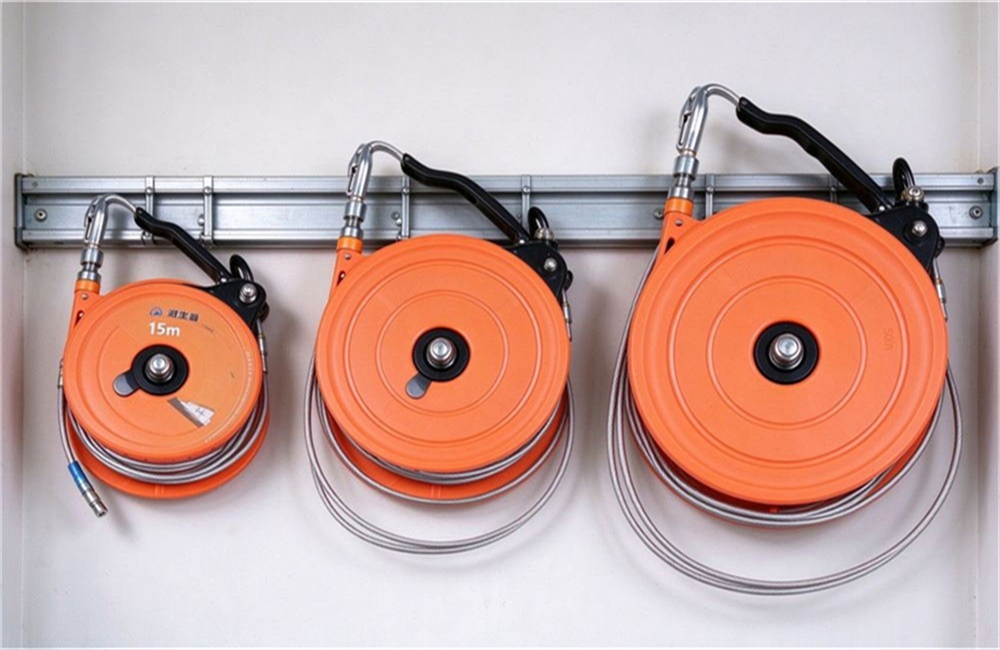
Cable lengths: 15 m, 30 m, 50 m
Model
Cable Length
Building Height
Price Range
PD-15
15 m
5 floors
$60-$90
PD-30
30 m
10 floors
$90-$140
PD-50
50 m
17 floors
$140-$180
5. A Real Rescue Deployment
Fire crews deployed this rescue descender in under two minutes. Here is what a high-rise fire response looks like with this rescue descent equipment.
Minute 1: Arrival
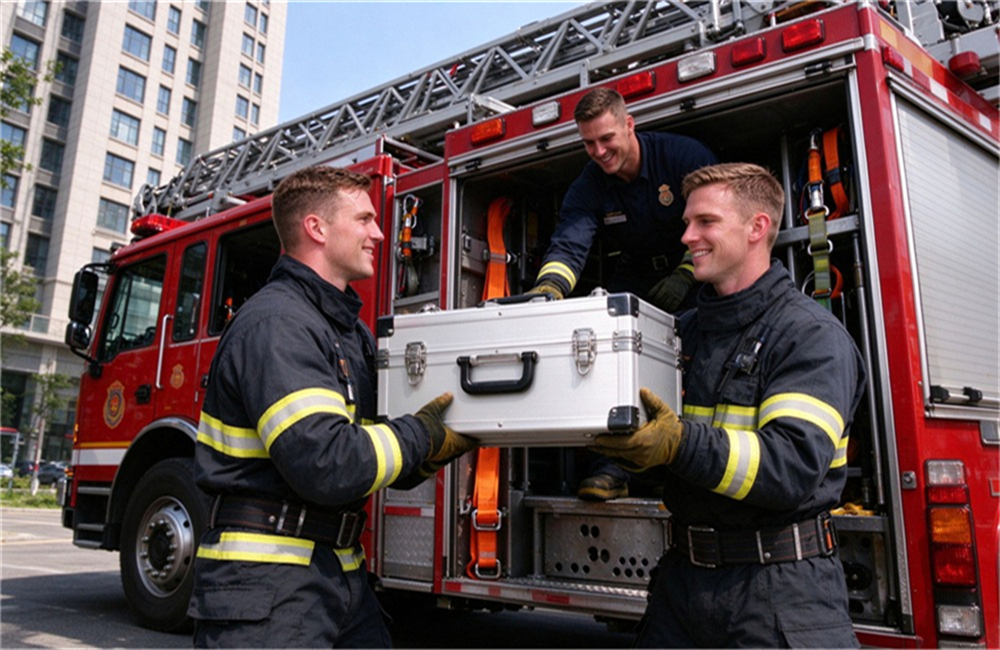
Firefighters arrive. Smoke is visible from several floors. People are trapped above the fire floor. The rescue descent equipment comes off the truck first.
Minute 3: Setup
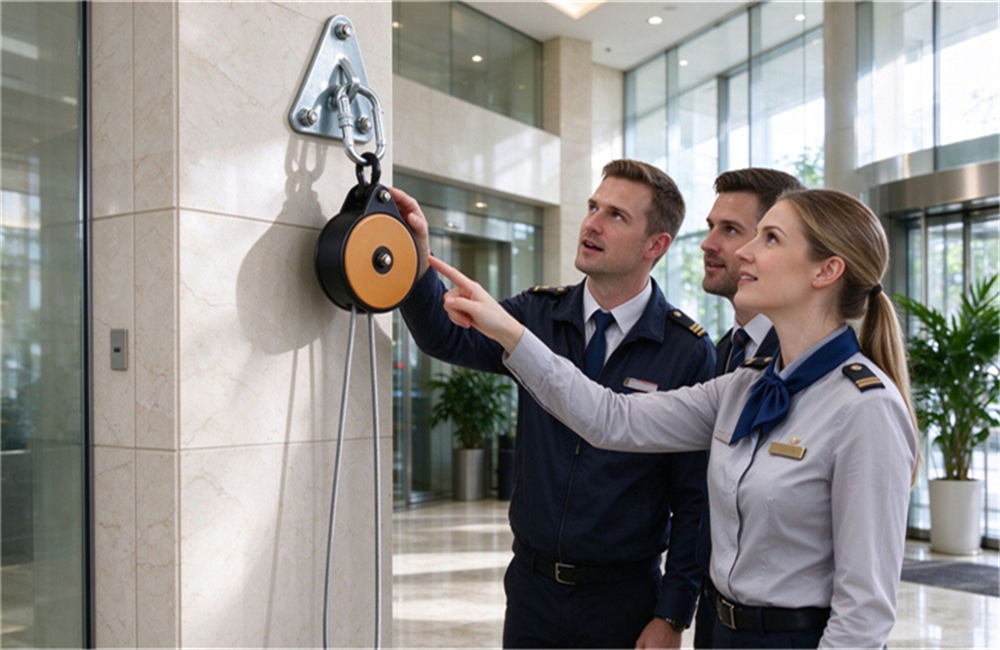
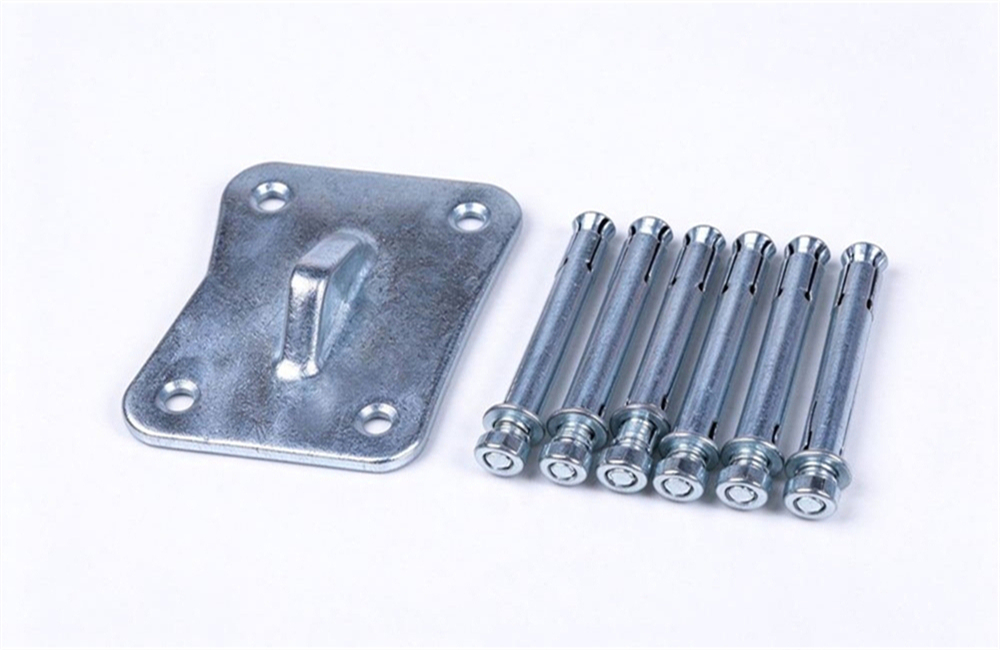
Two firefighters take the rescue descent equipment to the rescue floor. They bolt the bracket to the wall near a window. The bracket uses four expansion bolts into concrete.
Minute 5: First person
They clip special needs rescue harness kit to the cable hook of the rescue descent equipment. They help the trapped resident into the harness. They lower the resident out the window. The brake takes over. The resident descends at 1.5 m/s.
Minute 6: Ground crew
On the ground, EMS catches the resident. Unclips the harness. Helps them stand. The resident is taken to the ambulance.
Minute 7: Reset
The firefighter pulls the cable back up. Spring-assisted rewind makes this easy. Inspects the cable. Ready for the next person.
Minutes 8-20: Repeat
Two firefighters can evacuate 20 people in about 15 minutes. This is faster than carrying everyone down the smoke-filled stairs.
6. Who Uses This Equipment
Fire departments
Fire departments stock the rescue descender on every truck. Urban search and rescue teams. High-rise response units. Training academies. They all standardize on one type of rescue descent equipment.
Building management
Luxury hotels. Premium office towers. High-end residential buildings. Hospitals above 5 floors. Each keeps rescue descent equipment on every floor.
Industrial
Offshore oil rigs. Construction sites above 10 meters. Wind turbine maintenance teams. This rescue descent equipment moves with the crew.
Why building management buys one
Some buildings keep rescue descent equipment on each floor. It is mounted by the window. In an emergency, tenants can use it themselves, or staff can deploy it.
6b. Which Model Should You Order?
Choose the rescue descender model by floor height and load. Three questions will tell you which descender model your team needs.
Question 1: How tall are your buildings?
Up to 5 floors: PD-15 (15 m cable).
5-10 floors: PD-30 (30 m cable). Most common choice.
11+ floors: PD-50 (50 m cable).
Question 2: How will it be used?
Daily training + real calls: Professional model with spare parts.
Standby on one floor: One unit mounted permanently per floor.
Multiple sites: Portable units in aluminum cases, moved by vehicle.
Question 3: What is your budget and order size?
2-20 units: Standard price tiers apply.
20+ units: Project pricing with scheduled delivery.
Tender: We fill out your technical specification sheet.
Send us your building profile. We will recommend the right rescue descent equipment configuration.
6c. Deployment Plan for Fire Departments
Each station keeps one rescue descender per rapid response unit. Here is how modern departments deploy professional rescue descent equipment.
Apparatus configuration
Most departments carry 2-4 units on the ladder truck.
One unit rides on the engine for apartment fires. One spare stays in the station for training.
Response checklist
Confirm building height and fire floor from dispatch.
Choose the right cable length for the rescue floor.
Assign two firefighters to the rescue team.
Take the rescue descent equipment to the floor below the fire.
Establish ground crew at the drop zone.
Training academy integration
New recruits train on the descender in week two of basic training.
Each firefighter completes 20 supervised descents before certification.
Annual recertification includes a timed deployment drill.
Mutual aid and multi-unit response
Departments that carry rescue descent equipment can assist neighboring cities.
Multi-unit responses combine ground ladders, aerial platforms, and descenders for high floors.
This is why many state inventories include this equipment as a standard line item.
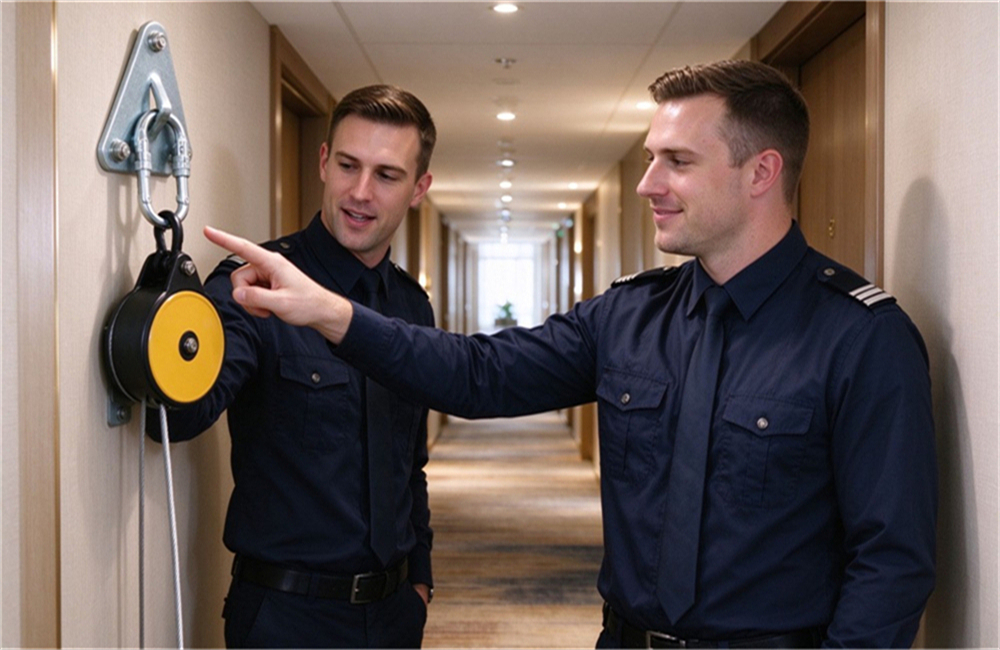
7. Setup: Permanent and Portable
Permanent installation:
Choose a concrete wall near an escape window. Do not mount on drywall or plaster.
Mark four bolt holes with a pencil.
Drill 12 mm holes, 60 mm deep.
Insert expansion bolts.
Bolt the steel bracket to the wall. Tighten to 40 Nm.
Slide the descender onto the bracket. Lock the safety pin.
Pull the cable out 2 meters. It should retract smoothly.
Test with a test weight if possible.
Portable use:
Take the unit out of its aluminum case.
Attach to a tripod, vehicle winch, or permanent anchor point.
Unspool the cable.
Ready for use.
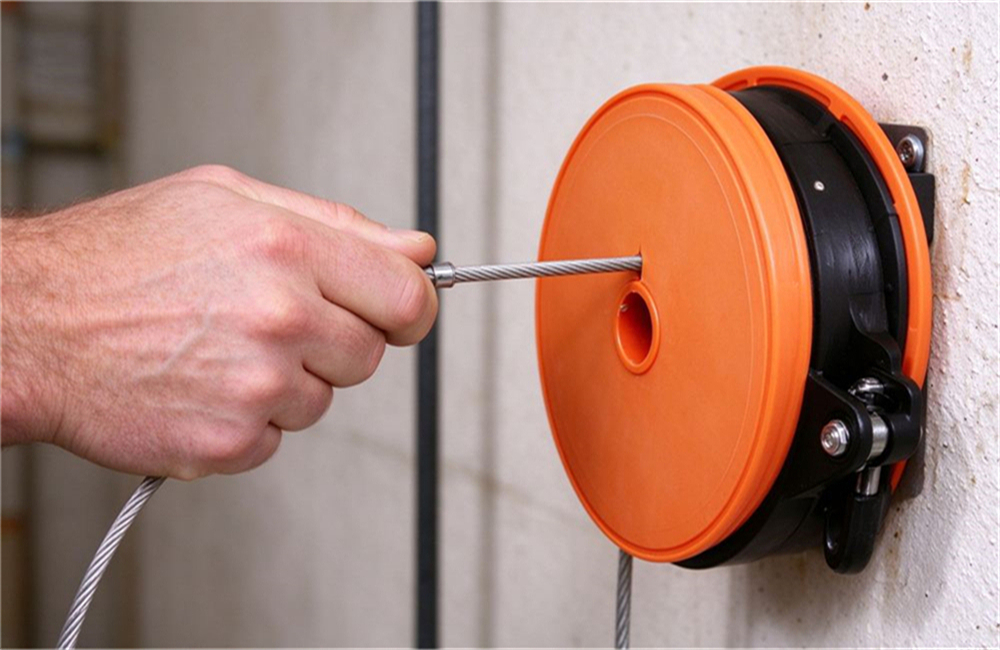
8. Reset and Reuse Between People
Reset the rescue descender in under 30 seconds between users. The rescue descender mounts on a wall bracket or travels in a case. This is the key difference from residential units. Professional rescue descent equipment resets in seconds.
After each descent:
Ground crew unclips the harness from the cable hook.
Inside, the firefighter pulls the cable back up. Spring-assisted rewind makes this easy.
Visually inspect the cable for damage.
Check the brake sound — it should make a smooth whirring sound.
Clip the next person's harness. Ready to go.
After 50 descents:
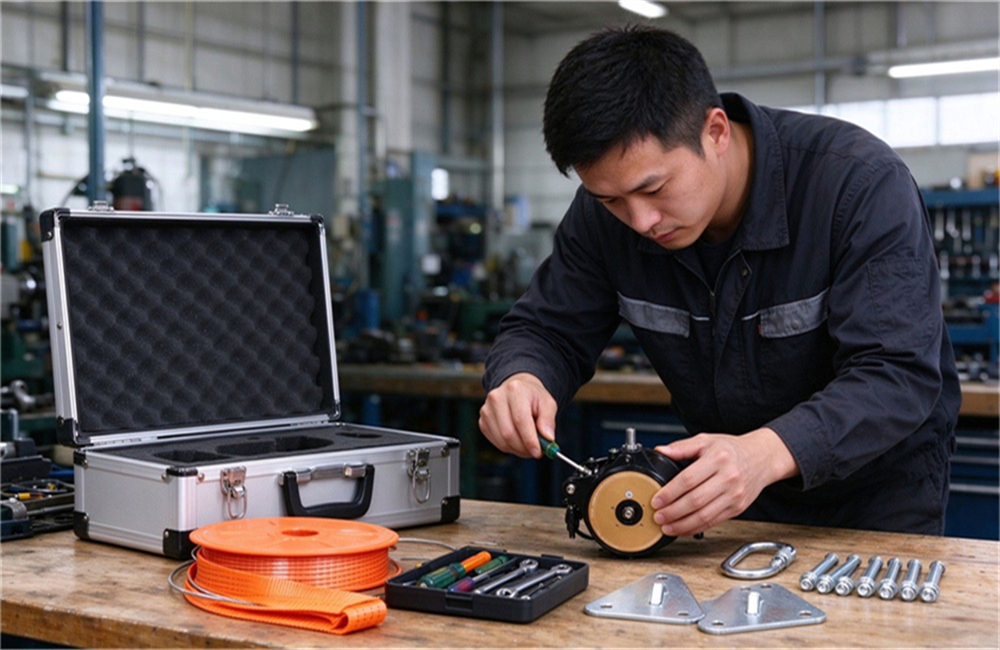
Replace the brake pads. This takes 5 minutes.
Open the case with a screwdriver.
Remove the old brake pad set.
Install the new pad set.
Close the case.
Test with a test weight.
Cable replacement:
After 5 years or 1,000 descents, replace the cable spool.
Open the case.
Remove the old spool.
Install a new 5 mm cable spool.
Close and test.
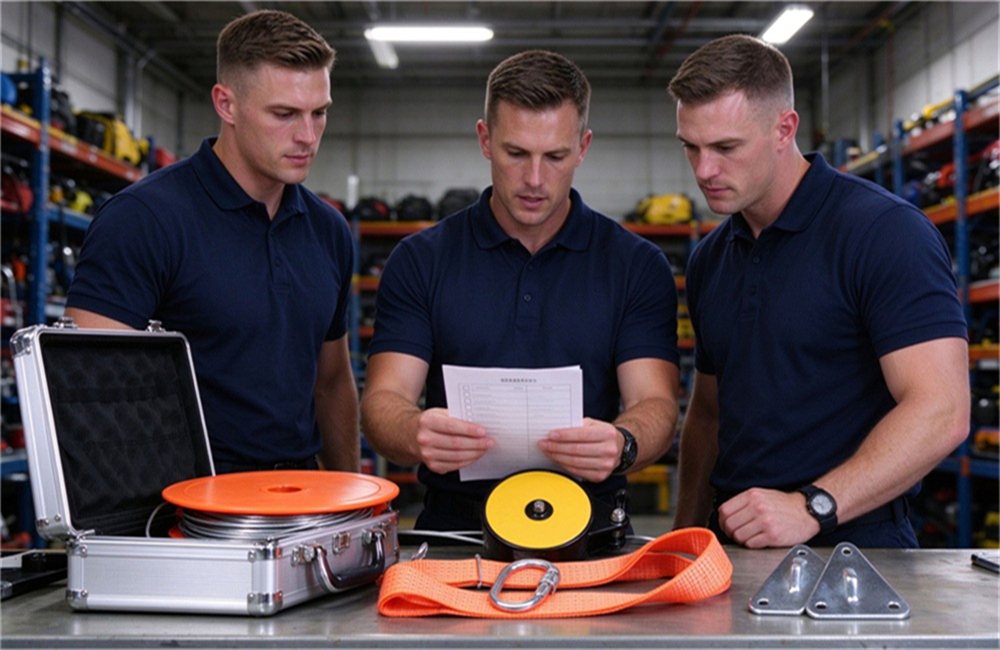
8b. Deployment for Premium Buildings
Premium buildings install a rescue descender on every high floor. Hotels and office towers buy rescue descent equipment as part of their emergency plan.
Hotel deployment
High-rise hotels place one unit per floor at the housekeeping station.
Security and housekeeping staff train on it twice a year.
Guest rooms above the 10th floor have a harness in the closet, ready to clip on.
Office tower deployment
One unit per floor, mounted near the emergency exit window.
Floor wardens are trained to operate it. Evacuation drills include a demonstration every year.
Residential high-rise deployment
One unit per floor in the stairwell landing, secured in a locked cabinet.
Property staff manage inspection and training. Tenants are shown the location during move-in.
Why buildings choose this equipment
Fixed escape slides require major construction. Portable rescue descent equipment installs in an afternoon.
It is ready at any window on the floor, not just one fixed point.
Insurance inspectors in several markets now ask about high-floor evacuation equipment during audits.
8c. Operating Notes for Rescue Teams
Teams verify the rescue descender before each drill. Experienced operators know these details. Add them to your training.
Before every deployment
Check the cable for kinks. A kink can weaken the wire.
Check the carabiner gate and lock.
Confirm the bracket is on a solid wall, not drywall.
Confirm the drop zone below is clear of debris.
During the descent
Do not let the person grab the cable. It moves.
Keep hands off the cable exit while it runs.
Guide the person to face the wall if they are nervous.
Ground crew calls out distance: "Ten meters, five meters, two meters, one."
After the descent
Unclip the harness before the person stands.
Rewind the cable slowly. Fast rewinding can cause a whiplash loop.
Log the deployment in the equipment logbook.
Replace the brake pads after 50 descents.
Never do these
Never attach the unit to a wooden door frame.
Never lower two people without confirming the 200 kg limit.
Never skip the monthly inspection.
Never store the unit wet.
These details keep the rescue descent equipment reliable when it matters.
9. Maintenance and Spare Parts
Task
Frequency
Who Does It
Visual inspection
Monthly
Building staff
Function test (test weight)
Every 6 months
Trained technician
Brake pad replacement
Every 50 descents
Trained user
Cable inspection
After each use
Operator
Full overhaul
Annually
Service center
Spare parts we stock:
Brake pad sets
Cable spools (15 m, 30 m, 50 m)
Carabiners
Wall brackets
Carry cases
Monthly checks keep the rescue descender ready for action. Spare parts available for 10 years after purchase.
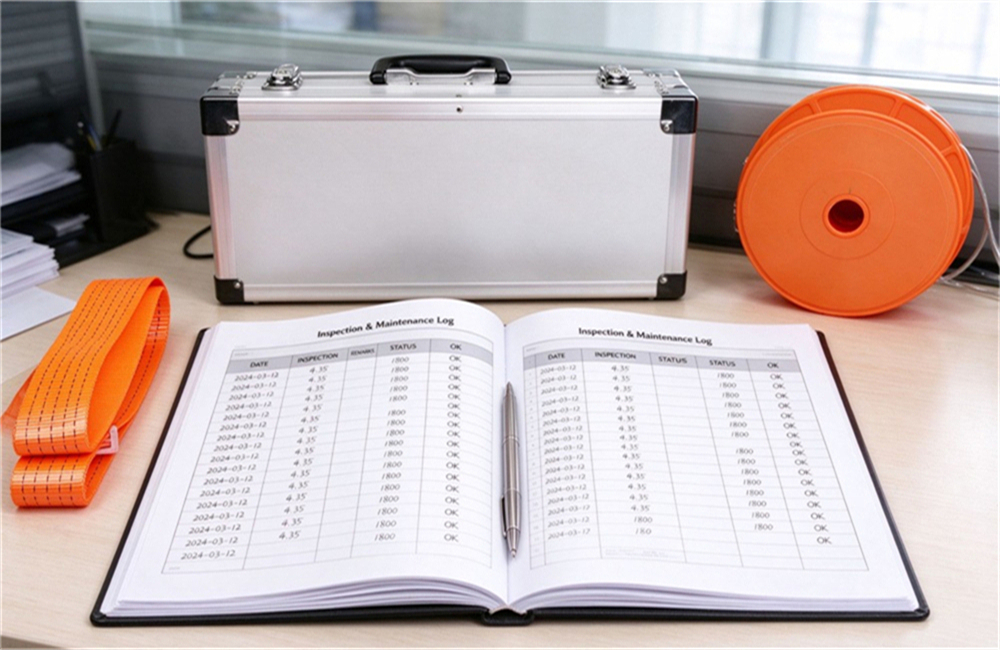
9b. Maintenance Log Template for Rescue Descent Equipment
Every unit needs a logbook. Here is what each entry should record.
Date
Rescue descent equipment task
Result
Inspector
2026-01-05
Monthly visual inspection
Pass — cable clean, no fray
J. Miller
2026-01-20
Training descent (5 reps)
Pass — steady 1.5 m/s
S. Ortiz
2026-02-02
Monthly visual inspection
Pass
J. Miller
2026-03-01
Brake pad check
Wear within limit
S. Ortiz
How to fill the log
Date every entry. Use the same format each time.
Record the task exactly as named in the maintenance table.
Write the result. Pass or fail. Add a note for anything unusual.
Every operator signs their own entry.
Keep logs for 3 years. Auditors may ask for them.
Digital logs
Some departments keep a spreadsheet or app log. Both work.
The requirement is traceability: who checked what, when, and what they found.
Rescue descent equipment with a clean log passes audits and stays in service.
9c. Troubleshooting Common Issues
Most rescue descender issues come from a dirty brake drum. Here are the common issues operators report, and what to do.
Symptom
Likely cause
Fix
Cable pulls out slowly
Cold weather stiffness
Unspool and spool once before use
Descent speed too fast
Brake pads worn
Replace brake pads
Whirring sound is rough
Dust inside the case
Clean cable exit; service the case
Cable jams when rewinding
Loop or kink in the cable
Unspool fully, find the kink, straighten
Carabiner gate sticks
Dirt or corrosion
Clean and lubricate the gate
Bracket rocks on the wall
Bolt not fully expanded
Retighten; replace bolts if needed
When to send the unit for service
After any uncontrolled descent (rope burn smell)
After a drop or impact damage to the case
After exposure to fire or chemicals
If the brake fails a test weight check twice
Never open the brake assembly yourself beyond pad replacement. The spool alignment needs a service center.
Regular care keeps this rescue descent equipment in service for a decade.
9d. Spare Parts and Replacement Schedule
Every rescue descent equipment unit needs a spare parts plan. Here is the standard schedule.
|
Part |
Replacement interval |
When to check |
|
Brake pads |
Every 50 descents |
After each training day |
|
Steel cable |
Every 5 years |
Monthly visual check |
|
Carabiner |
Every 3 years |
Each deployment |
|
Wall bracket bolts |
Every 2 years |
Annual service |
|
Aluminum case latches |
When worn |
Annual service |
|
Harness straps (optional) |
Every 5 years |
Annual service |
Why this schedule matters
A missing brake pad check is the most common cause of field failure.
Set a reminder in your maintenance calendar. Do not rely on memory.
We stock all spare parts and ship them worldwide. Order replacements when you order the unit.
Keep one full spare kit per 5 units in service. That covers unplanned damage.
10. Cold Weather and Extreme Environments
Cold (-30°C)
The rescue descender works in temperatures down to minus 20 degrees. The aluminum body works in extreme cold. The internal brake uses dry friction, not hydraulic fluid. It does not freeze.
The cable may be stiffer in cold. Unspool it slowly before use.
Heat (+60°C)
The brake pads are rated for high-temperature operation. The aluminum body dissipates heat well.
Wet and rainy
The cable is galvanized steel with a nylon jacket. It resists corrosion. After use in rain, wipe the cable dry before storing.
Dusty and sandy environments
The case is sealed. Dust does not get inside the rescue descent equipment. After use in dusty conditions, wipe the outside and inspect the cable exit.
11. Training Requirements
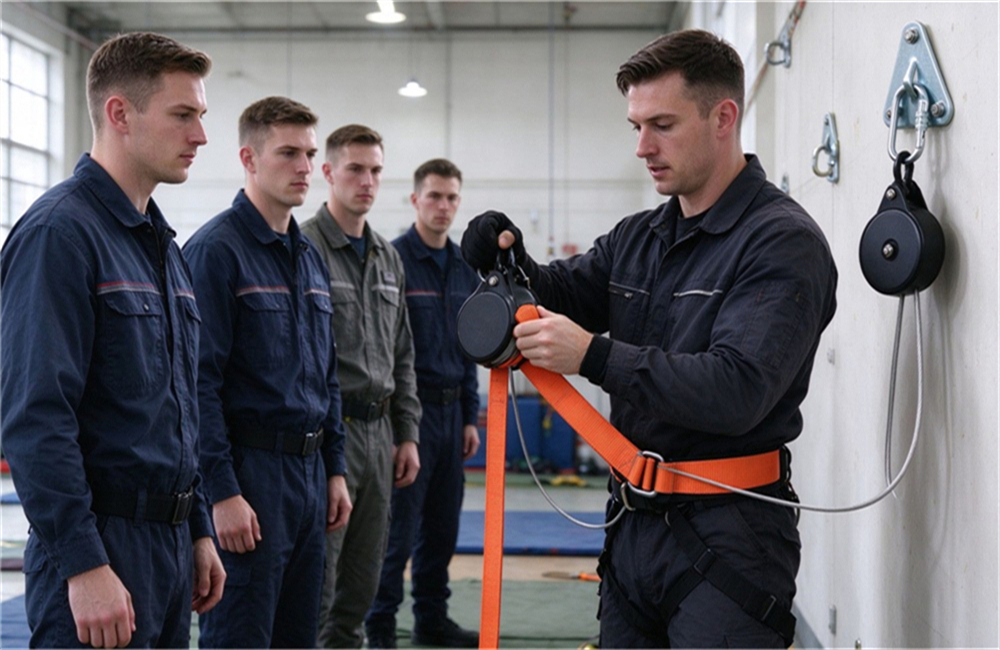
Training covers fitting and lowering with the rescue descender. This is professional equipment. It requires training.
Minimum training should cover:
How the centrifugal brake works
How to mount the bracket correctly
How to inspect the unit before use
How to fit the rescue harness
How to lower a person safely
How to reset between people
How to replace brake pads
Emergency procedures if the cable jams
Training follows the guidance of the NFPA Life Safety Code (NFPA 101) for evacuation equipment. We provide training manuals in English. On-site training can be arranged for bulk orders.
For workplace compliance, OSHA emergency action plan requirements cover employee evacuation. ISO standards for personal protective and rescue equipment give buyers a testing framework for import documentation.
These references share one principle: rescue descent equipment must be tested, inspected, and operated by trained personnel.
11b. The Procurement Process, Step by Step
Procurement starts by testing one rescue descender unit. Buying professional rescue descent equipment for a department? Here is the full process.
Step 1: Requirement analysis
Document your building heights, response areas, and training schedule.
This determines cable lengths and quantity.
Step 2: Specification
Use the tender section above as your starting point.
Send us your spec sheet. We confirm compliance and return a technical response.
Step 3: Samples and evaluation
Order one unit for evaluation. Test it with your own test weight.
Run the acceptance protocol from this page.
Step 4: Training plan
Book training for your trainers. They certify the rest of the team.
Most departments train 4-8 instructors per order.
Step 5: Rollout
Deliver units with brackets, spare pads, and documentation.
Schedule a maintenance review at 6 months.
Step 6: Annual service
We supply parts for annual overhauls. Your team does the work.
This keeps the rescue descent equipment in service for a decade or more.
11c. Sample Training Schedule
Here is a two-week training plan for a new unit.
Certification standard
Pass criteria: 20 supervised descents, one timed deployment under 5 minutes, written test 80%+.
Recertify every 12 months with a refresher and one timed drill.
A trained team keeps rescue descent equipment ready at all times.
Post the training schedule on the station board. New members join the next cycle.
Day
Session
Duration
Content
1
Classroom
2 hours
Brake theory, parts, safety rules
2
Hands-on
2 hours
Mounting, cable inspection, test weight
3
Hands-on
2 hours
Low descents (3 m) with harness
4
Hands-on
2 hours
Medium descents (6 m)
5
Hands-on
2 hours
Full descents (15 m) supervised
6-7
Rest
—
Equipment inspection and log
8
Scenario
3 hours
Simulated fire floor rescue
9
Scenario
3 hours
Two-person descent drill
10
Evaluation
2 hours
Timed deployment + written test
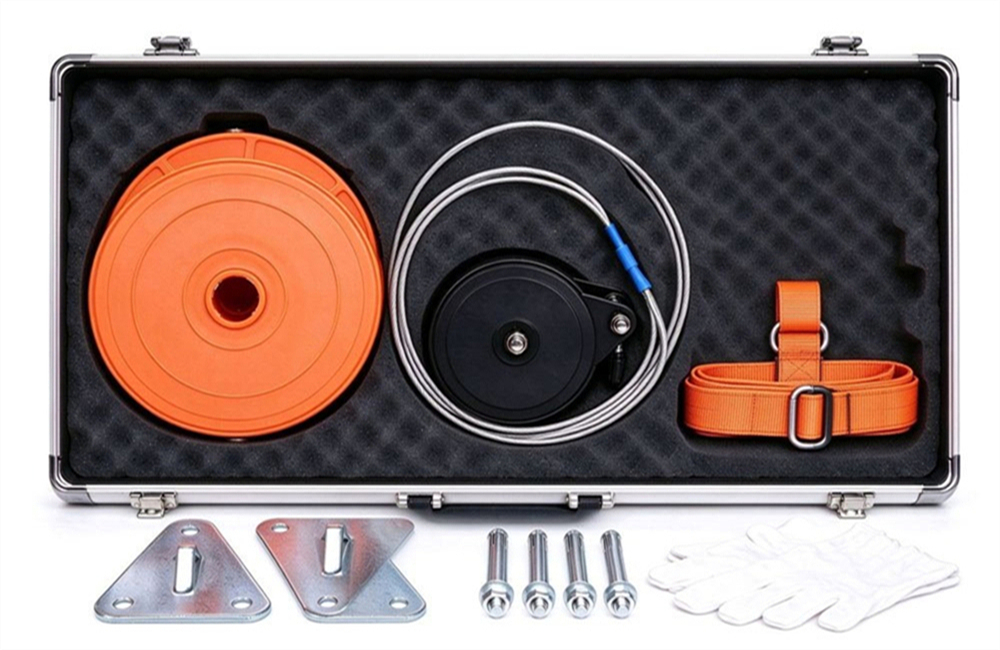
12. What's in the Box
The box includes the rescue descender, case, harness, and carabiner. Each order ships complete and ready to deploy.
No extra tools or parts are needed beyond what you see here.
Professional rescue descender unit
Steel wall bracket with expansion bolts
Aluminum carrying case
Spare brake pad set
English instruction manual
Each unit is serialized. The number is printed on the case for your logbook.
13. Writing a Tender Specification for Rescue Descent Equipment
If you are a procurement officer, here is what to put in your tender.
Minimum technical requirements:
Type: centrifugal self-braking descent device
Working load: minimum 200 kg
Descent speed: 1.0-2.0 m/s, factory set
Cable: minimum 5 mm galvanized steel, nylon jacket
Cable length: as required (15/30/50 m)
Operating temperature: -30°C to +60°C
Body: die-cast aluminum, impact-resistant
Brake pads: field-replaceable
Mount: steel wall bracket with expansion bolts
Weight: under 4 kg (unit only)
Documentation required:
Test report (breaking strength, speed test)
CE declaration of conformity (if required)
Instruction manual in local language
Spare parts list with part numbers
Warranty: minimum 2 years
14. Brand Comparison
You may be comparing our unit to other rescue equipment brands. Here is an honest comparison.
Feature
Our PD Series
Typical Imported Brand
Premium Brand (CMC/Petzl)
Price
$60-$180
$200-$400
$500-$1,200
Working load
200 kg
150-250 kg
250 kg
Speed
1.5 m/s
1.5-2.0 m/s
1.5-2.5 m/s
Field-serviceable
Yes
Yes
Yes
Spare parts
Stocked
Limited
Wide network
Warranty
2 years
1-2 years
3-5 years
Best for
Budget departments, bulk orders
Mid-size departments
Specialized rescue teams
Our unit offers professional-grade performance at a factory-direct price. For departments that need 10-50 units, the savings are significant. We provide test reports so you can verify the specs before purchase. This rescue descent equipment is made in China and exported worldwide.
14b. Quality and Testing
This is life-saving rescue descent equipment. Here is how we control quality.
Incoming material checks
Steel cable batches are checked for wire gauge and breaking strength.
Aluminum castings are inspected for porosity and dimensional tolerance.
Assembly line testing
Each unit is dry-run at the factory: 10 descents with a 100 kg test weight.
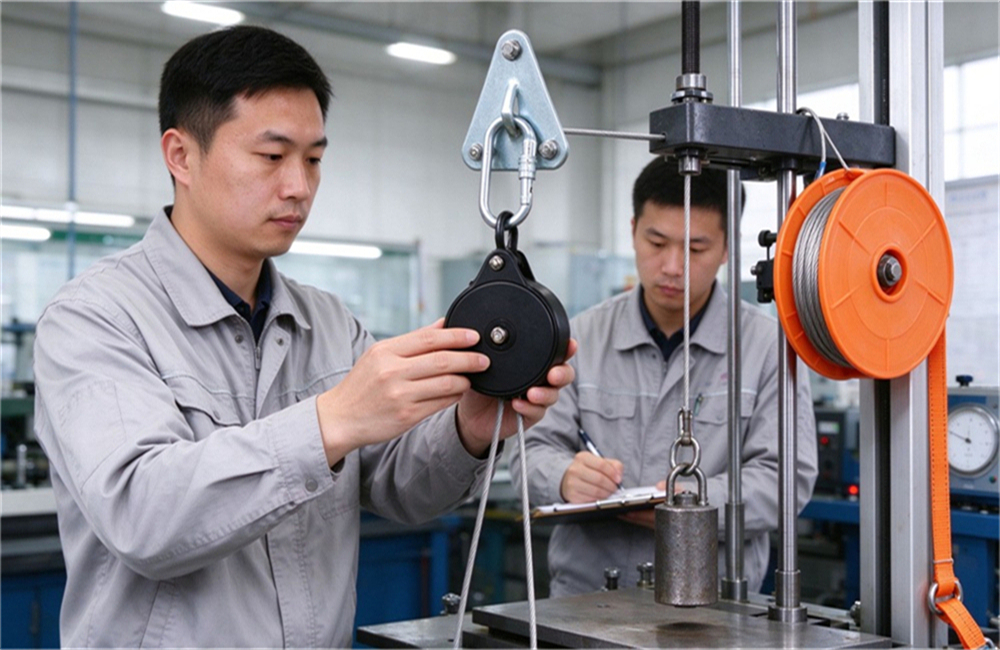
Speed is measured on every unit. Units outside 1.4-1.6 m/s are rejected and re-tuned.
Batch testing
Sample units from each batch are pull-tested to breaking point.
Test reports are available for bulk orders and tenders.
Documentation
We do not claim certifications we do not hold.
We provide test reports and factory inspection records. Tell us which documents your project needs.
Ask for the test report before ordering. That is the professional way to buy rescue descent equipment.
15. Acceptance Testing Protocol
When your order arrives, here is how to verify it works.
Unbox. Check the unit, bracket, bolts, and case are all present.
Inspect the cable. No kinks, no rust, no fraying.
Pull the cable out 2 meters. It should come out smoothly and retract.
Mount the bracket on a concrete test wall.
Attach the unit. Lock the safety pin.
Attach a test weight (50-100 kg) to the cable hook.
Lower the test weight. It should descend at a steady speed, not accelerate.
Repeat 5 times. Note any unusual noise or vibration.
Record the results. Sign the acceptance form.
Keep the acceptance record with the equipment logbook.
16. Industrial Use Cases
Wind turbine maintenance
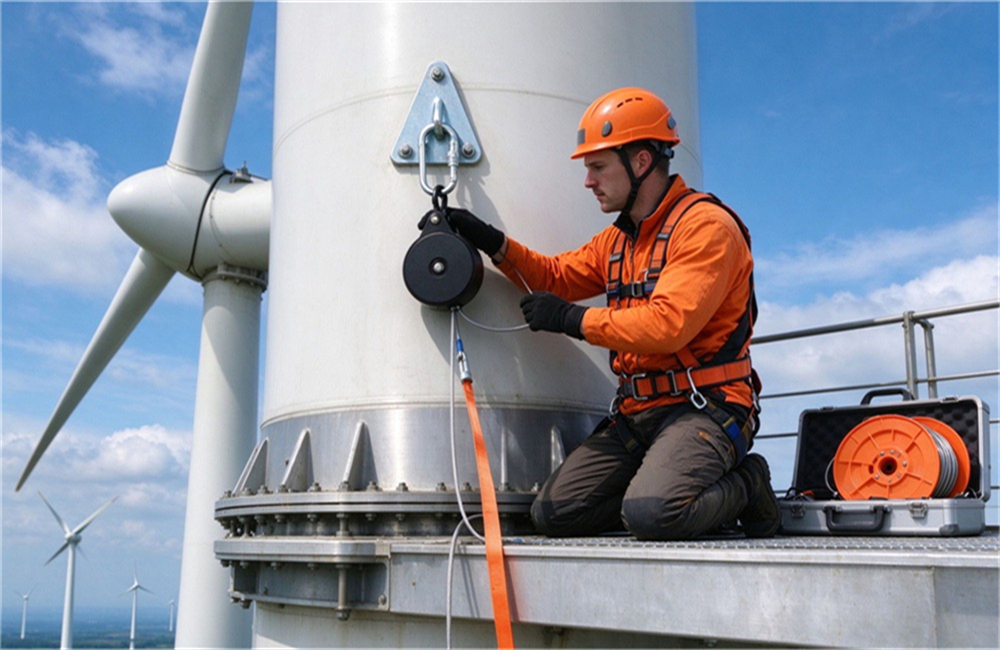
Wind turbines are 80-100 meters tall. If a technician has a medical emergency, the rescue descender lowers them from the nacelle. The portable unit clips to the turbine's anchor point. No crane needed. This is why industrial rescue teams keep one on site.
Offshore oil rigs
Offshore rigs have limited evacuation options. The descender provides a way to lower workers from the rig deck to a rescue boat below. The aluminum construction resists salt water. This is industrial rescue equipment at its most vital.
Construction sites
Workers on scaffolding or temporary platforms need a fast escape. The descender clips to a steel beam. No permanent installation needed. Move it with the crew. Versatile industrial rescue equipment for every site.
17. Why Mechanical Beats Electronic
Some rescue devices use electric winches or motorized systems. Here is why we stick with mechanical.
No battery failure
Electronic systems need batteries. Batteries die in cold weather. Batteries can fail after sitting in storage for months. Our brake works the same on day one and day 1,000.
No software bugs
Electronic systems have firmware. Firmware can crash. Firmware can have bugs. There is no reset button in a fire. A mechanical brake has no software to crash.
No maintenance schedule
Electronic systems need battery swaps, software updates, and electronic testing. Our rescue descent equipment needs a visual check and a brake pad change every 50 descents. That is it.
Proven reliability
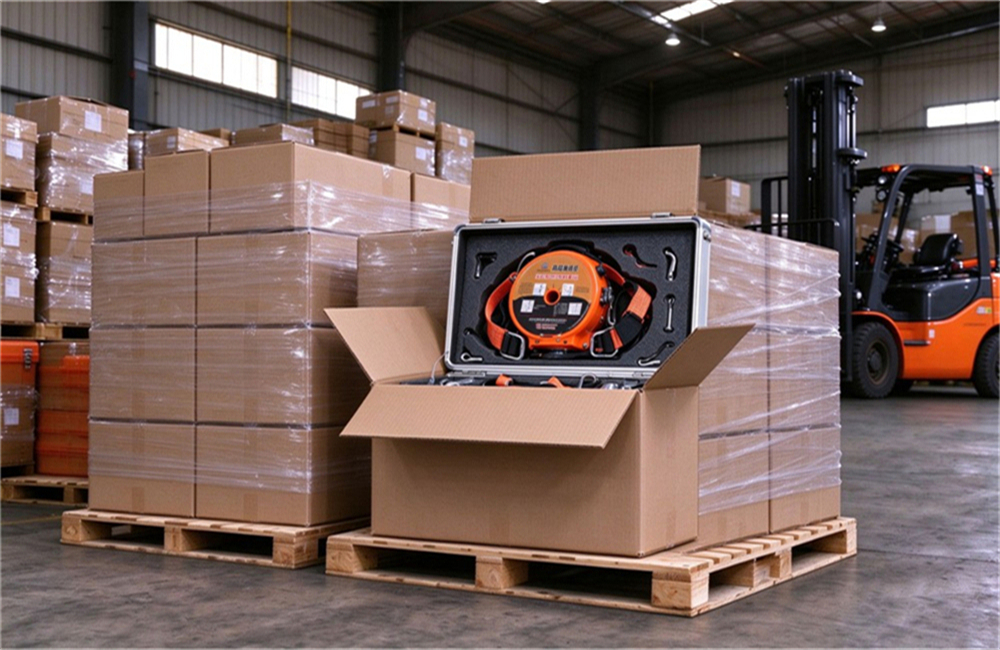
Centrifugal brakes have been used in rescue descent equipment for over 50 years. The design is mature. Every firefighter on the planet knows how it works.
17b. Portable Descender vs Fixed Escape Systems
Some buildings install permanent escape slides or fixed ladders. Here is how portable rescue descent equipment compares.
Factor
Portable Descender
Fixed Escape Slide
Fixed Ladder
Cost
Lower
Very high
Medium
Installation
Bracket + bolts
Structural work
Structural work
Flexibility
Move to any window
Fixed location
Fixed location
Training
Required
None for users
Some
Multiple people
Fast, controlled
Fast, crowd flow
Climbing speed
Best for
Departments, variable sites
Stadiums, malls
Permanent egress
Portable rescue descent equipment wins when sites change, budgets are tight, or crews need to respond anywhere.
Fixed systems win when a building needs a permanent, crowd-scale solution.
Many departments carry portable units even when buildings have fixed systems. The portable unit reaches windows the fixed system cannot.
18. FAQ
Q: Is the rescue descender rated for repeated drops? Q: Can civilians buy rescue descent equipment directly?
A: Yes, but it is designed for trained users. If you live in a high-rise as a resident, the residential version may be simpler.
Q: How fast does rescue descent equipment lower a person?
A: 1.5 meters per second. About 10 floors per minute. Automatic and constant.
Q: Can two people go at once?
A: Yes, up to 200 kg combined weight. Two adults can descend together.
Q: What if the power goes out?
A: No electricity needed. Fully mechanical. Works in a blackout.
Q: How long does the cable last?
A: 5-10 years with annual inspection. Replace if you see fraying or broken wires.
Q: Does the rescue descent equipment include a harness?
A: No. Harnesses sold separately. See our special needs rescue harness.
Q: What warranty covers the rescue descent equipment?
A: 2 years on the mechanism. Spare parts available for 10 years.
Q: Can the descent speed of rescue descent equipment be adjusted?
A: Factory set at 1.5 m/s. Custom speeds available on request for special operations.
Q: How heavy is the rescue descent equipment unit?
A: 3.5 kg for the unit. With case, 5.5 kg. One firefighter can carry it.
Q: What is the descent speed for a 200 kg load?
A: The centrifugal brake keeps it at 1.5 m/s regardless of weight. Heavier loads do not fall faster.
Q: Can the unit be used indoors for training?
A: Yes. Mount it on a training frame or use a ladder truck for practice. Many departments train with a test weight.
Q: How do you store the unit between calls?
A: In its aluminum case, in the apparatus bay. Keep it dry. Check the cable monthly.
Q: What documentation do you provide with a bulk order?
A: Test report, spare parts list, instruction manual, and CE documentation on request. We also fill out tender spec sheets.
Q: Can the speed be set slower for special operations?
A: Yes. Factory set at 1.5 m/s. Custom speeds from 0.5 to 2.0 m/s available for special operations.
19. OEM and Distributor
OEM branding is available on the rescue descender housing. We supply fire departments, rescue teams, and emergency equipment distributors worldwide.
OEM branding: Your logo on the case and unit
Custom cable lengths: 15 m, 30 m, 50 m, or custom
Custom colors: Standard orange. Other colors on request.
Sample orders: 1 unit available for evaluation
Lead time: Samples 5-7 days. Bulk 20-30 days.
Documentation: Test reports, CE documentation available on request
20. Ordering and Pricing
Factory direct pricing for fire departments. Contact us for project-based quotes.
Quantity
PD-15 (15 m)
PD-30 (30 m)
PD-50 (50 m)
20-99
$75.00
$120.00
$160.00
100-299
$65.00
$100.00
$140.00
300+
$55.00
$85.00
$120.00
20b. Export, Packaging, and Lead Time
Ordering professional rescue descent equipment internationally? Here is the shipping picture.
Export packaging
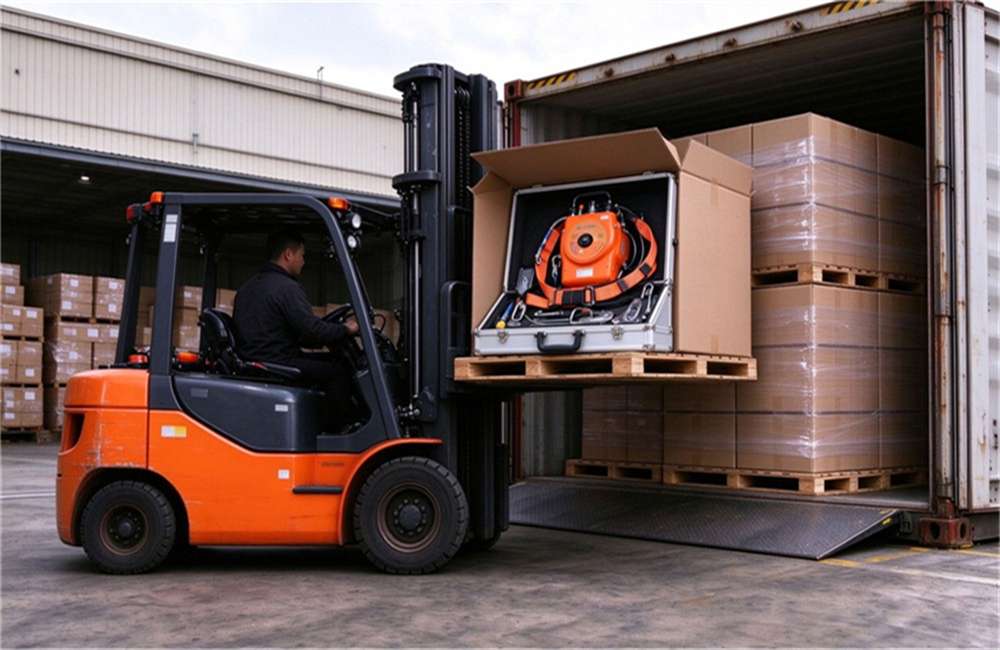
Each unit ships in its aluminum carrying case with the wall bracket and spare pads.
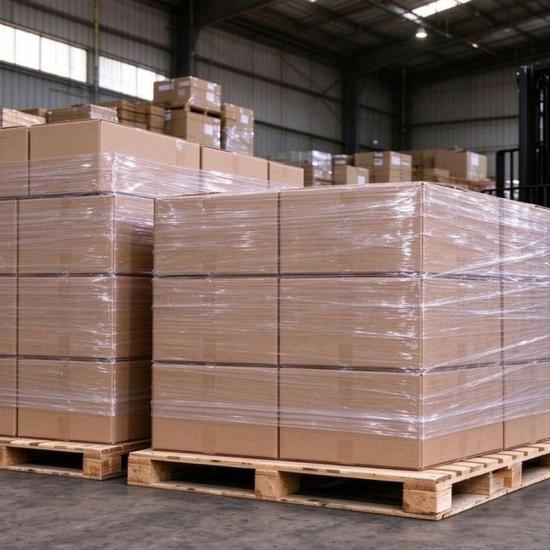
Bulk orders ship in wooden or reinforced cartons. Standard: 4 units per carton.
Cartons are palletized, strapped, and wrapped for ocean freight.
Shipping terms
We quote FOB Shanghai or Ningbo by default. CIF and DDP available on request.
Sample units ship by DHL or FedEx. Most arrive in 5-7 working days.
Lead time
Samples: 5-7 days after payment confirmation
Bulk (20-100): 20-25 days
Bulk (100+): 25-30 days
Custom colors or speeds: Add 5-7 days
Documentation for importers
Commercial invoice
Packing list
Bill of lading
Test report for the batch (on request)
CE declaration of conformity (on request)
Certificate of origin (on request)
All terms subject to contract. Send your port, quantity, and model mix for a firm quote.
21. Related Products
Complete your rescue equipment set:
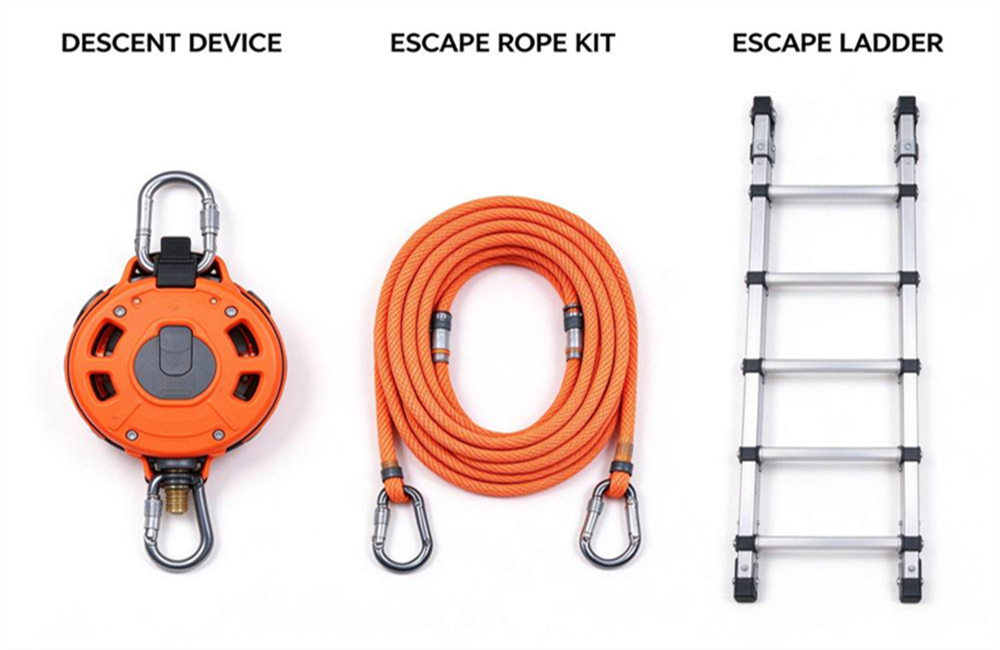
Rescue Harness — required to attach people to this unit
Rescue Descent Device — residential version for buildings
Escape Rope Kit — budget backup option
Escape Ladder — for low-rise quick escape
Note: This unit does not include a rescue harness. Harnesses are sold separately. You need both the descender and a harness to evacuate a person.
Recommended companion equipment
Pair your rescue descent equipment with these items for a complete vertical rescue kit:
Rescue harnesses in multiple sizes (adult and child)
Spare brake pad sets and cable spools
Extra carabiners and a sharpening-free cable cutter
Headlamps for night operations
Waterproof equipment bags
Training test weights (50 kg and 100 kg)
We can assemble a complete package for your department. Tell us your team size and we will list everything.
Professional rescue equipment. Requires training for proper use. We work with relief organizations worldwide.
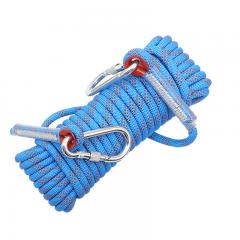 Multi-function Life Saving Rope, 8-20mm Optional, Earthquake Rescue
This high-strength rescue safety rope is made of premium polypropylene material with a load-bearing capacity up to 2741kg. Multi-channel mechanical seaming ensures firmly secured ends without loosening. High-visibility design in orange, yellow, red, and blue allows quick identification in complex rescue environments. The soft rope design is easy to tie and stays secure, available in multiple specifications from 8mm to 20mm, suitable for various rescue scenarios including earthquakes, floods, and fires, providing over 99% safety assurance for rescue personnel.
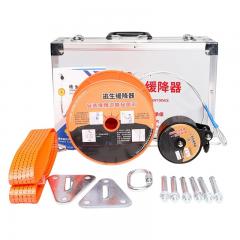 High-Reliability Escape Descender Kit for School Safety
This High-Reliability Escape Descender Kit for School Safety features YL104 die-cast aluminum, weighs only 3.5kg, offers IP65 waterproof rating, and includes high-strength steel cables withstanding 500 tons of pressure. With black body and orange markings, it complies with GB8624-2012 national safety standards, operates at heights of 4-80 meters, maintaining stable descent speed of 0.8-1.2 meters/second. Specifically designed for campus fire emergencies with simplified operation, suitable for school buildings, libraries, and dormitories, providing 98% reliable escape assurance for students and faculty.
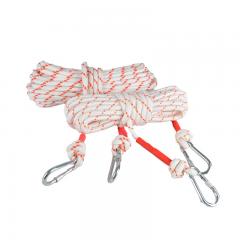 Steel Core Safety Escape Rope, Aviation-Grade, Fire Use
This Steel Core Safety Escape Rope features aviation-grade steel wire core design, 12mm standard diameter, with load capacity up to 500kg. The white body with red marking lines enhances visibility in smoky environments, while dual metal hook system ensures quick and reliable fixing in emergency situations. Heat-resistant treatment maintains functionality at fire scenes, making it essential safety escape equipment for professional fire brigades, high-rise buildings, and industrial facilities, providing reliable protection for over 200 fire departments nationwide.
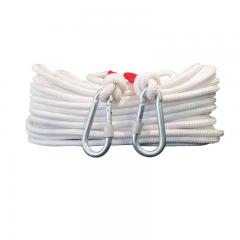 Military Grade Life Rope, Double Safety Hooks, High Altitude Rescue
This white military grade life rope is crafted from specialized tough polyester fibers with internal steel wire core reinforcement, coupled with dual safety hook structure, professionally tested with tensile strength up to 3000 Newtons. The dual safety hooks are made of aviation-grade aluminum alloy, providing secure and reliable locking. The rope surface features special treatment technology for exceptional grip, ensuring stable operation even in extreme weather conditions. Specifically designed for military training, high-altitude rescue, and emergency fire rescue operations, it is the equipment of choice for professional rescue personnel.
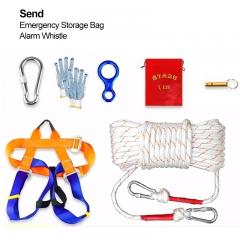 Professional Fire Escape Rope Set, High-strength Hook, 7-piece Kit
This professional fire escape rope set features high-density steel wire core technology with load capacity of 250kg, ideal for high-rise emergency evacuation. White main rope with red marker lines design facilitates quick identification in smoke environments. Equipped with blue figure-8 descent device to control stable and safe descent speed. The complete set includes 7 professional rescue tools, with orange safety belt made of flame-retardant material, and high-strength hook capable of withstanding 3000N pulling force. Suitable for homes, office buildings, schools, and other scenarios, with 10-100 meter multiple specifications, certified by international fire safety standards.
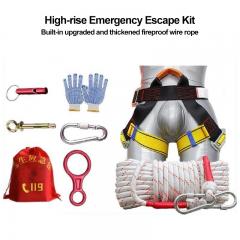 Fire Safety Rope Set, 8pcs, Building Escape Dedicated
This Fire Safety Rope Set is specially designed for building fire escape, featuring high-temperature resistant steel-core nylon structure with a single rope bearing capacity of 800kg, equipped with 8-piece professional escape gear. The set includes main rope, safety harness, descender, speed controller, anti-cutting gloves and other key components to meet emergency evacuation needs in high-rise building fires. The 20-meter rope is suitable for buildings under 8 floors, with all equipment passing national fire equipment testing standards, providing a reliable life passage for residences, office buildings, schools and other venues, making it essential home fire safety equipment.
Copyright © Custom Disaster - Relief Bedding: Tents, Sleeping Bags, Blankets All Rights Reserved
the professional team to service !