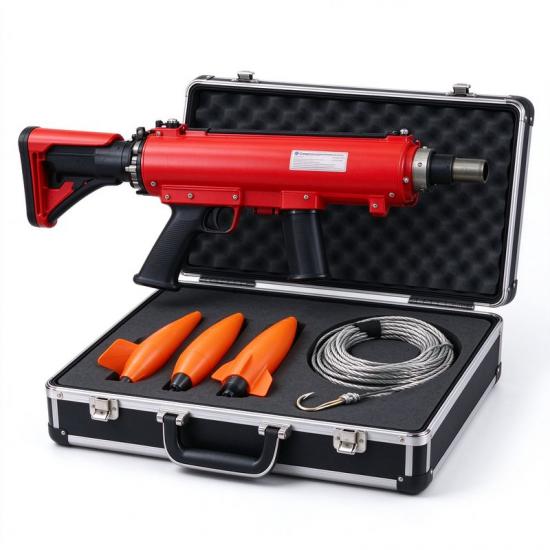
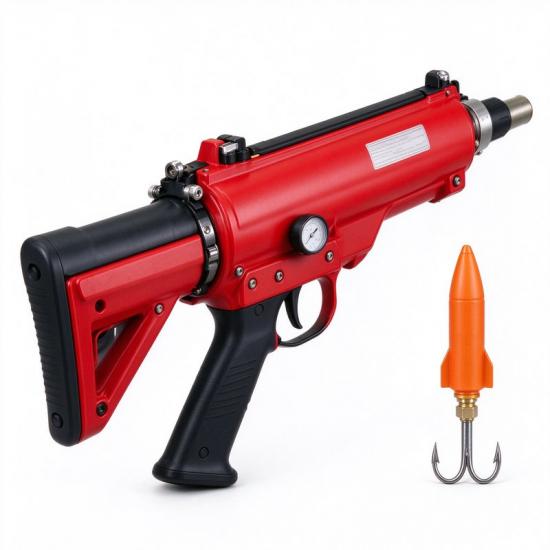
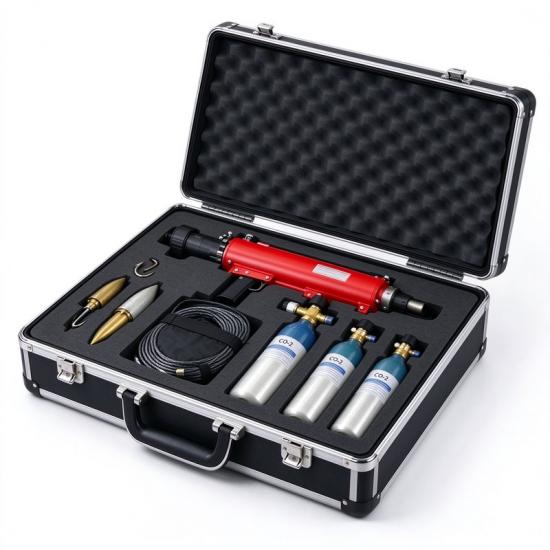
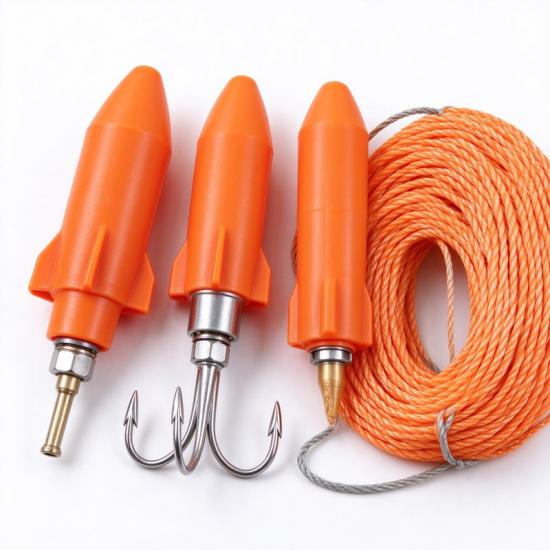
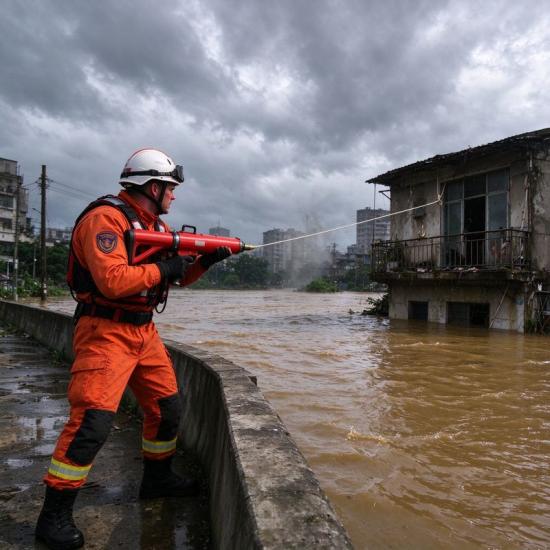
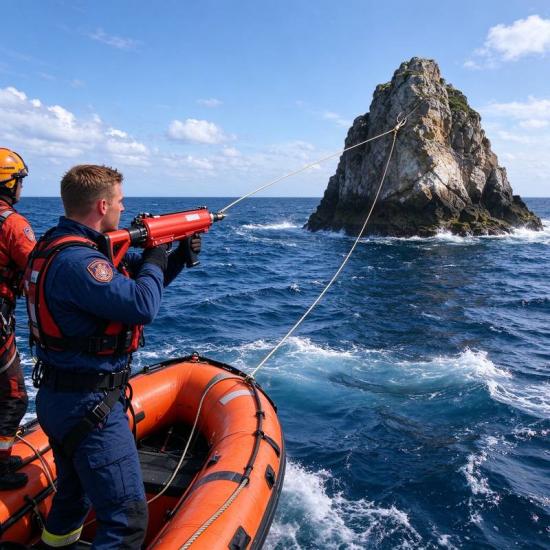
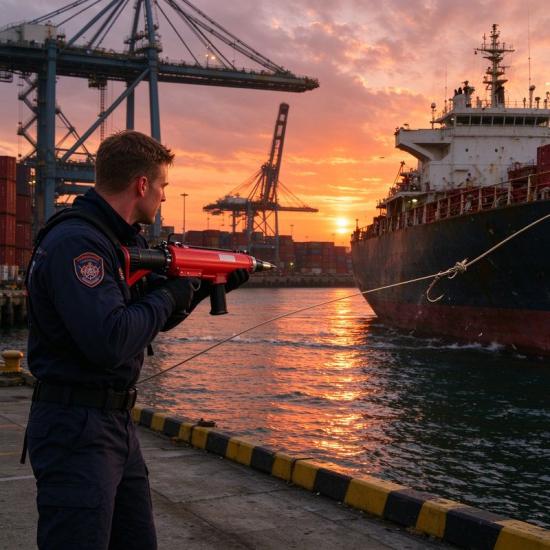
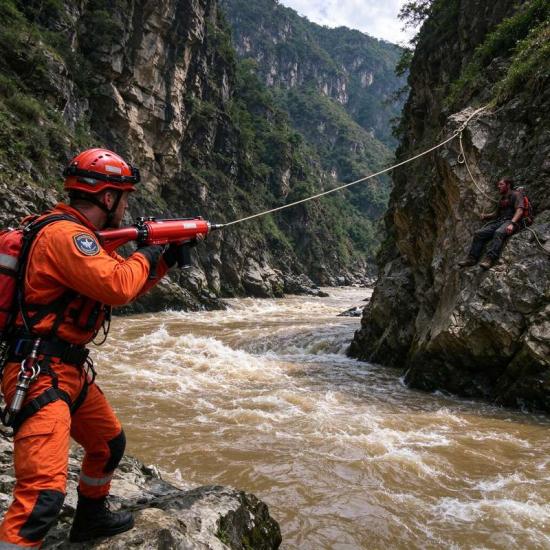
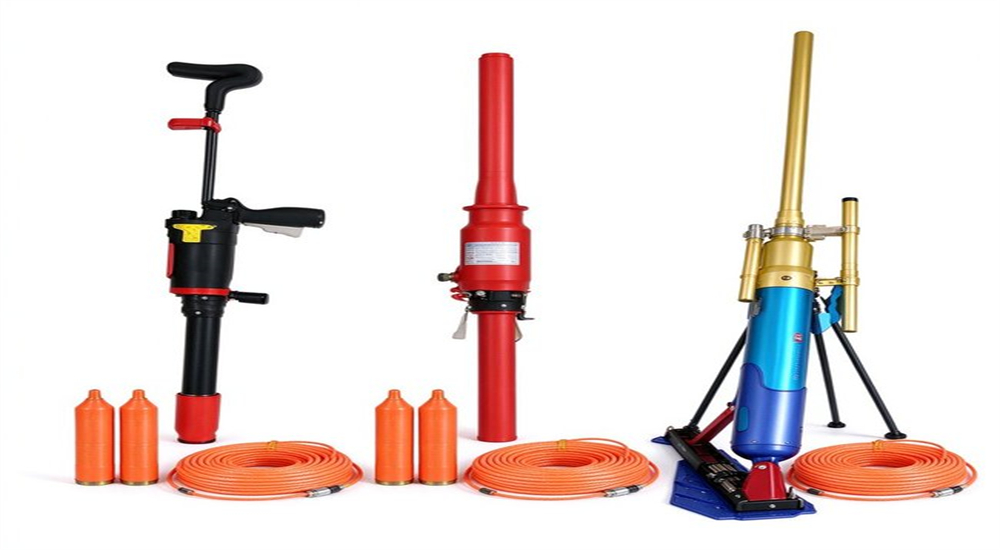
American Style Anchor Hook Pneumatic Rescue Thrower, frame-mounted design with recoil buffer. Equipped with heavy-duty anchor claw for high-rise, cliff and maritime rescue. Delivers long-distance rope deployment for swiftwater, urban flood and offshore emergency rescue. Complete kit with launcher, projectiles, rope and protective case. Support bulk wholesale and OEM customization for fire and coast guard teams.
Note: Price for reference only. Exact price based on quantity, size, weight and custom details.
model no. :
DP2-ABrand:
YRFmarket price :
$300sale price :
$158.9price range :
30-100/$158.9 100-500/$158.5Color :
Multiple Colorsport of dispatch :
Guangdong/GuangzhouPayment :
TT, Paypal, Western Unionmin order :
30original region :
Made in ChinaLead Time :
5-15days
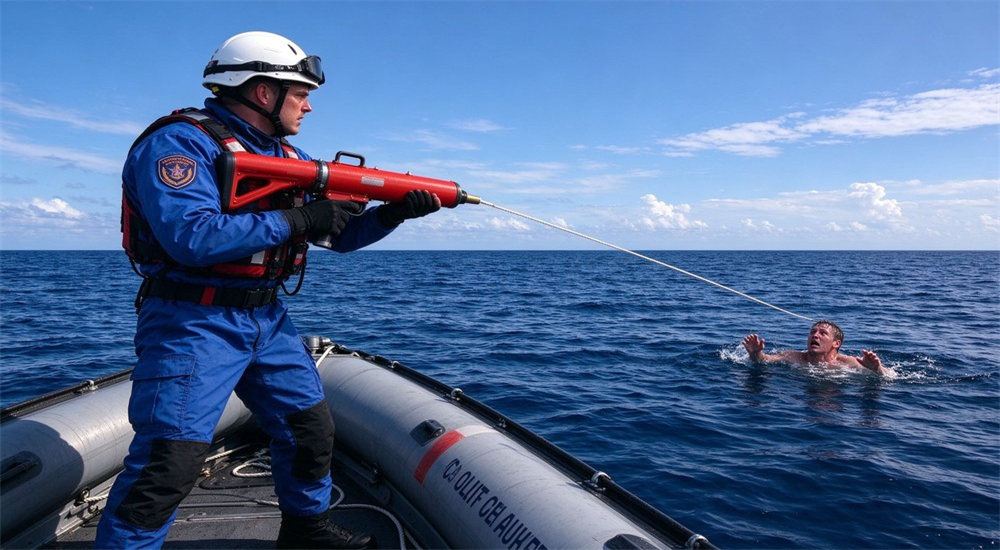
The American-style anchor hook rescue thrower is a heavy-duty pneumatic line thrower built for high-rise, cliff, and vessel-to-vessel rescue where a standard buoy is not enough. Operating at 20 MPa with a total weight under 13 kg, this anchor hook rescue thrower fires a titanium-alloy grappling hook rated at 330 kg up to 150 metres, plus a 1.5 kg floating buoy 125-135 metres over land and 105-110 metres on water.
 |

|
The 4 mm rope with 4000 N breaking strength makes this water rescue thrower the go-to choice for professional rescue teams handling multi-scenario operations from flood rescue to high-angle technical rescue.
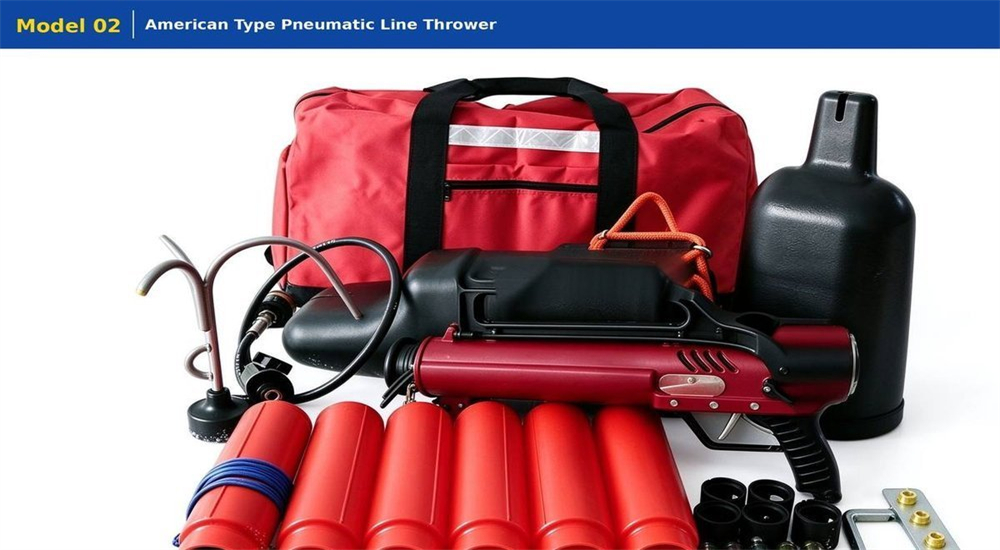
Picture a swimmer 110 metres off the breakwater, two ships rolling a metre apart unable to come alongside, or a hiker stuck on a cliff ledge 40 metres below the rim. These are the calls where a standard buoy thrower falls short and the anchor-hook system earns its place on the truck.
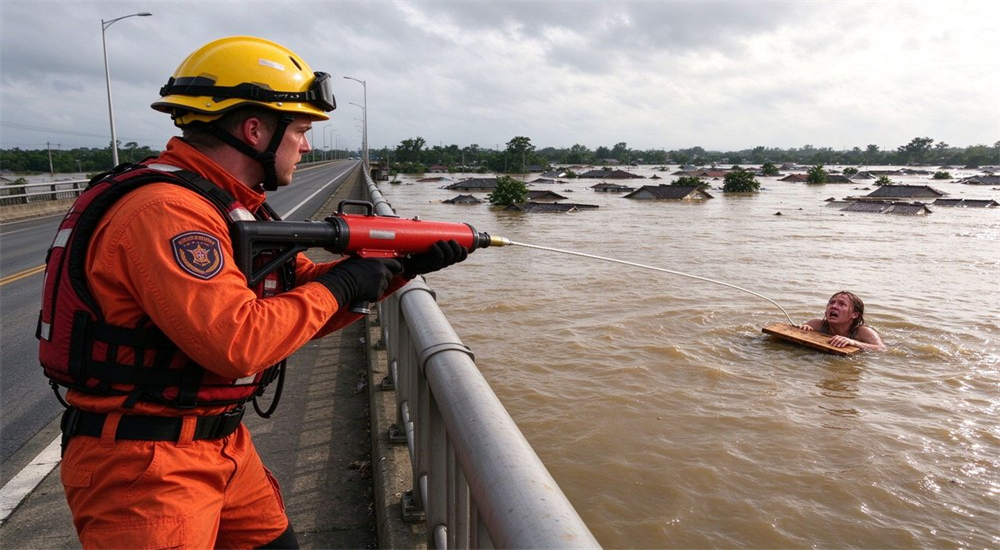
Many buyers assume every rescue thrower works the same, but the American anchor-hook (a grappling hook for high-line rescue) design and the Korean shoulder-fired layout were built for two different jobs. Where the Korean unit tops out near 80 m water, this American style anchor hook rescue thrower is a 20 MPa (a unit of pressure) pneumatic frame.
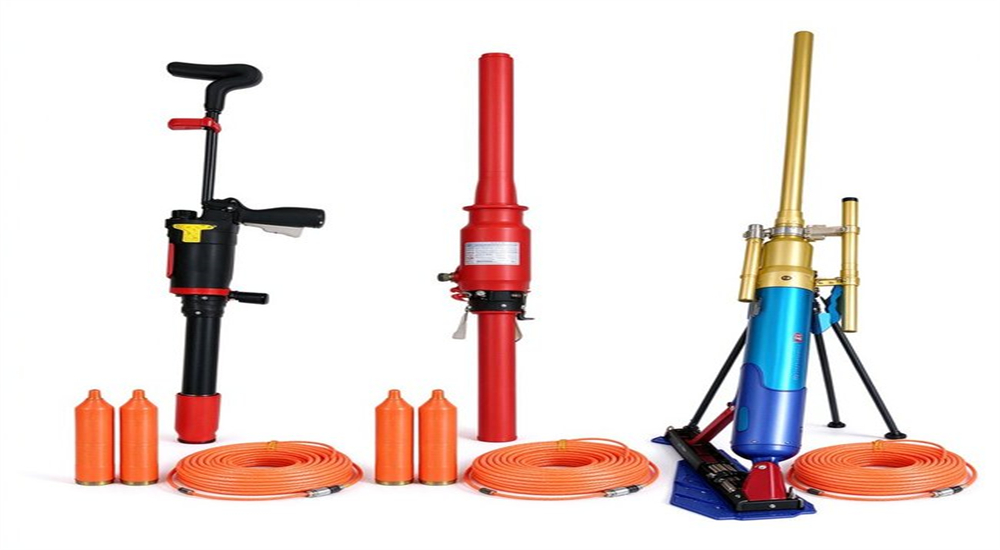
We supply American-style anchor hook rescue throwers to technical rescue teams, high-angle rescue units, and marine salvage operators worldwide. Fleet buyers get custom logo engraving, private-label cases, and OEM hook-rope configuration support. Email us for wholesale pricing, a technical data sheet, and a multi-unit quote.
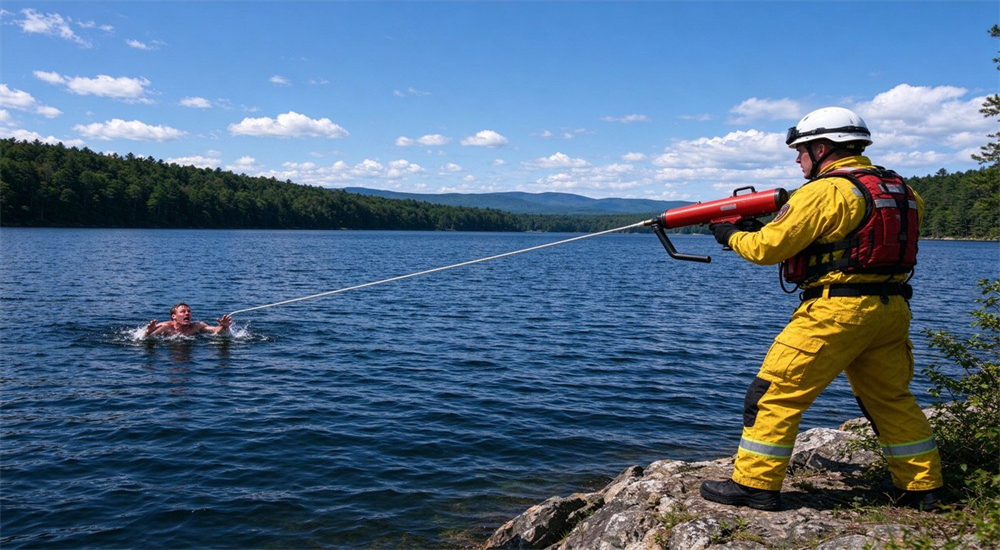
Many buyers assume every rescue thrower works the same, but the American anchor-hook (a grappling hook for high-line rescue) design and the Korean shoulder-fired layout were built for two different jobs. Where the Korean unit tops out near 80 m water, this American style anchor hook rescue thrower is a 20 MPa (a unit of pressure) pneumatic frame.
The PTQ20-Y125S100 weighs about 1.9 kg as a pneumatic unit and reaches ≥100 m over water, while the PTQ7-Y150S110Q55 anchor-hook model reaches ≥110 m on the floating rope and fires the claw out to ≥55 m.
It is the tool you reach for when a shoulder-fired gun cannot hold a steady shot on a rolling deck, a cliff face, or a high-rise balcony: professional rescue crews, cross-river teams, and high-line anchor operations that need a fixed point the light class cannot set.
Keep scrolling for the two models, the three payloads, and how that folding brace turns a heavy shot into something repeatable.
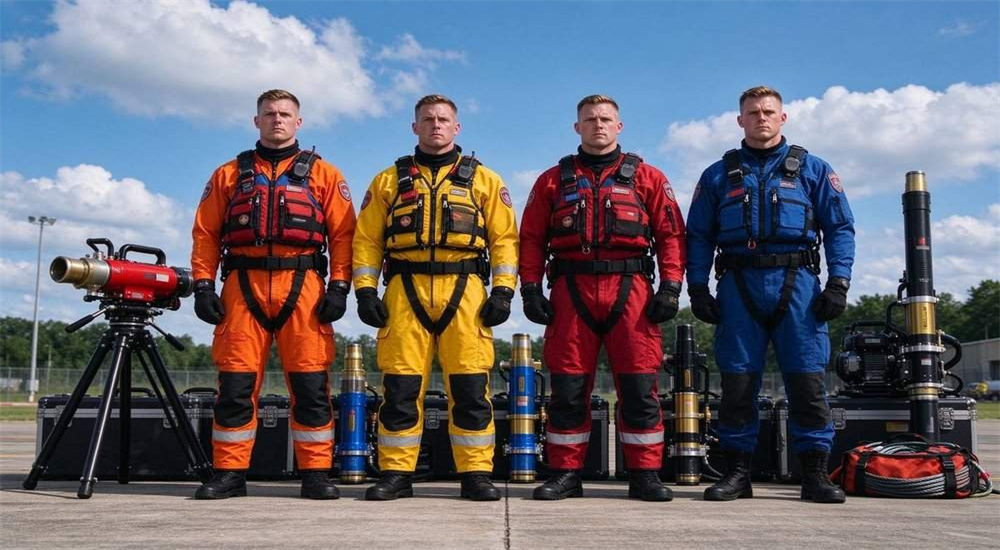
The support rod is the point of the American design. On a pitching ship deck, you cannot shoulder-fire a 20 MPa tool for a repeatable shot.
Without a buffer, the gun jumps off target and the shot lands 10 m short. The frame also protects the high-pressure valve on a moving boat.
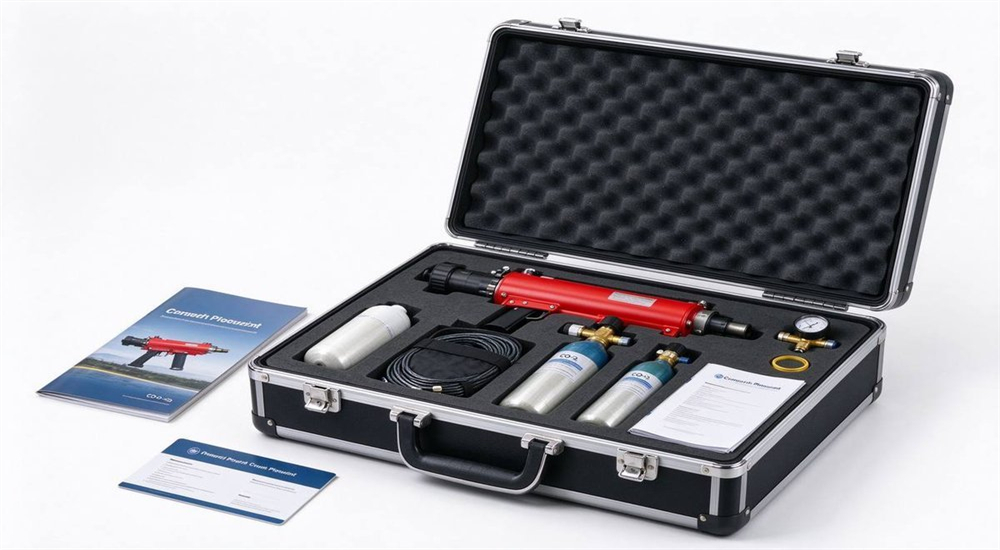
An American-style kit ships in a reinforced aluminum case. Inside: launcher body, folding support rod, high-pressure cylinder, the chosen payloads, pressure gauge, filling adapter, and manual. Stock a backup anchor hook separately for the PTQ7, because the claw can bend on a rock strike.
Item
Purpose
Notes
Launcher body
20 MPa pneumatic (powered by compressed air) frame
Reinforced aluminum
Folding support rod
Stable firing platform
Folds flat for transport
High-pressure cylinder
Compressed air supply
Fill locally on arrival
Three payloads
Land rope, water ring, anchor hook
Swap under one minute
Pressure gauge
Check cylinder charge
Read before every shot
Filling adapter
Scuba-style connector
Local dive shop fill
The American line-up covers two real models. The PTQ20-Y125S100 is the 20 MPa pneumatic line-and-ring unit; the PTQ7-Y150S110Q55 is the anchor-hook model with its own reach envelope and two firing power sources. The table below lists the core numbers to spec on this American style rescue thrower. It is the preferred choice for coast guard rescue teams, fire department water rescue units, and professional water rescue organizations handling swift water rescue and flood rescue equipment requirements.
|
Parameter |
PTQ20-Y125S100 (American pneumatic) |
PTQ7-Y150S110Q55 (Anchor hook) |
|
Working pressure |
20 MPa |
Two power sources (see below) |
|
Body weight |
About 1.9 kg |
Per model, on request |
|
Land range |
≥125 m |
≥150 m |
|
Water range |
≥100 m |
≥110 m (auto-floating rope) |
|
Anchor-hook range |
— |
≥55 m |
|
Firing power source |
Compressed air cylinder |
8 mm quick-connect inflation hose to cylinder, or 33 g CO₂ cartridge |
|
Standard |
GB/T 27906-2011 |
GB/T 27906-2011 reference |
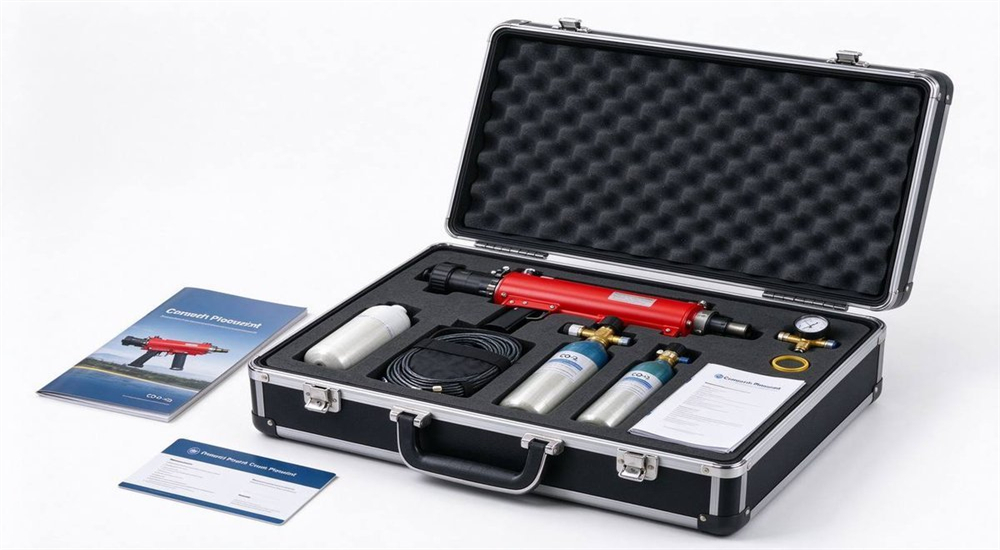
Working pressure: 20 MPa pneumatic frame
The PTQ20-Y125S100 runs at 20 MPa. The external bottle screws onto the manifold, and the quick pneumatic valve bursts stored gas behind the payload the instant you break the trigger. Flight time is a few seconds; working temperature -10°C to 45°C. The PTQ7 anchor-hook model is offered with two firing options: an inflation hose with an 8 mm quick connector that links the thrower to a gas cylinder, or a self-contained 33 g CO₂ cartridge for spots where you cannot carry a bottle.
The difference from the Korean family is not just pneumatic pressure, but the support-rod layout and the anchor-hook option.
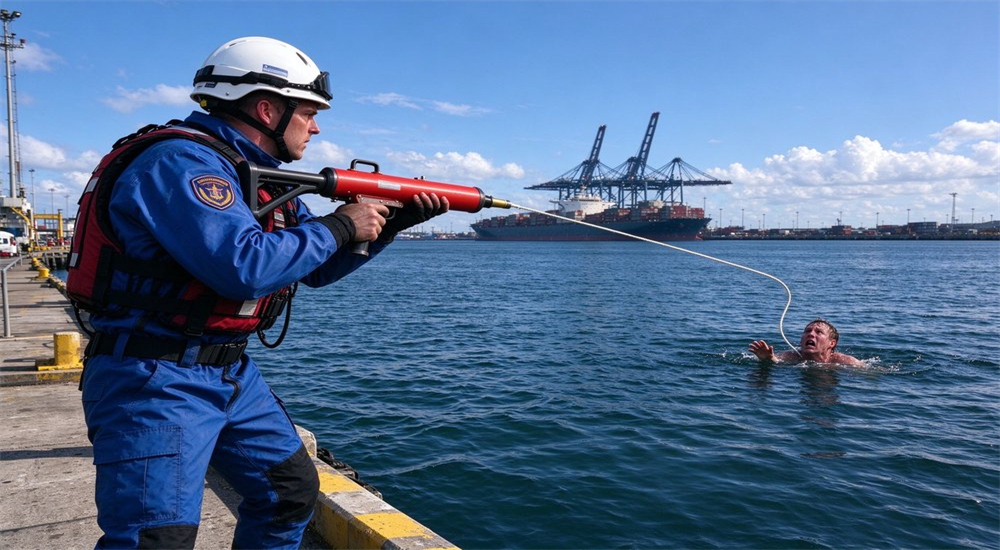
Water range is always shorter than land range, because the auto-inflating ring opens into a chamber on impact and drags like a brake. Spec open-water work by the water number: ≥100 m on the PTQ20, ≥110 m on the PTQ7 floating-rope shot.
The anchor hook on the PTQ7 reaches ≥55 m, shorter than line range because the claw and the transfer rope drag more.
The land rope is 4 mm × 150 m, rated ≥2000 N. The water line is 8 mm × 100 m, floating, rated ≥2000 N. The anchor hook is fitted with the same working rope rather than a separate abrasion-sheathed line. Match the head to the surface:
The anchor hook is a seating device for a high-line, not a stand-alone rating you hang a body on without inspection. Before you load a rescuer on the line, understand what the claw does and does not guarantee:
Every American style rescue thrower ships as a complete pneumatic kit in a reinforced aluminum flight case carried by two operators. This rescue thrower package never arrives as a bare frame. The table below lists the standard configuration, so you know what rolls off the pallet.
|
Standard Item |
Qty |
What It Does |
|
Frame (20 MPa reinforced body) |
1 |
PTQ20 about 1.9 kg, pneumatic action with recoil buffer |
|
Folding brace leg with rubber foot |
1 |
Shoots steady, stows flat for the road |
|
Pressure bottle |
1 |
Dispatched empty, filled locally once landed |
|
Dry-ground head (orange HDPE) |
1 |
Reusable solid slug for line shots |
|
Water head + self-inflating buoy |
1 |
8 kg float, opens in roughly five seconds |
|
Anchor hook (PTQ7 model) |
1 |
High-strength alloy claw for structures, ≥55 m shot |
|
Dry line (4mm × 150 m, ≥2000 N) |
1 |
Crosses dry ground |
|
Water line (8 mm × 100 m, ≥2000 N) |
1 |
Lays on top of the water |
|
Dial gauge and charge coupling |
1 set |
Local scuba-style fill |
|
English handbook |
1 |
Covers safe firing, claw seating, and upkeep |
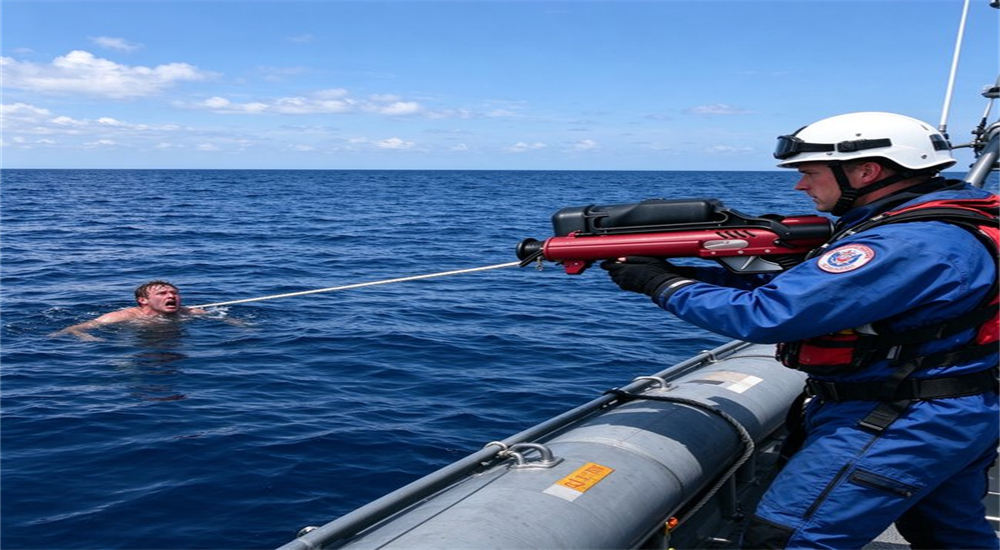
On this rescue thrower, the anchor claw, the O-rings, and the working rope that runs through the hook wear faster than the reinforced frame, and a bent prong or a stale CO2 cartridge fails on the first cliff call rather than on the bench. The table below sets a reference cycle for each consumable.
Treat the intervals as a starting point: harbour and cliff crews run ropes and seals sooner, so shorten the cycle when your shot count climbs.
Wear Part
Reference Cycle
Why
Main ring kit
Roughly one year or fifty rounds
The pressure seal hardens with age and salt air
Anchor-hook working rope
Swap after any rock scrape or shock load; else yearly
Rock cuts show outside, but inner strands hide the real damage; the claw fires on this same line
Lifebuoy CO2 charge
Verify the stamp every month
An expired charge leaves the ring flat when it matters
Anchor claw prongs
Pull from service at the first bend
A deformed prong bites wrong and lets go on the edge
HDPE land/water heads
Retire at the first crack or broken fin
Cracks alter the arc and blow the seal
The unit rides in a two-person reinforced aluminum flight case. Outer crate size and all-up weight are ballpark figures, locked down per order.
The American rescue thrower line covers two real models. The PTQ20-Y125S100 is the 20 MPa pneumatic line-and-ring unit at about 1.9 kg; the PTQ7-Y150S110Q55 is the anchor-hook model with its own reach envelope and two firing power sources. They share the same folding support rod layout and the same quick-swap payload logic; the difference is what each one can reach and how it is powered.
|
Parameter |
PTQ20-Y125S100 (American pneumatic) |
PTQ7-Y150S110Q55 (Anchor hook) |
|
Working pressure |
20 MPa |
Two power sources |
|
Land range |
≥125 m |
≥150 m |
|
Water range |
≥100 m |
≥110 m (auto-floating rope) |
|
Anchor-hook range |
— |
≥55 m |
|
Body weight |
About 1.9 kg |
On request |
|
Power source |
Compressed air cylinder |
8 mm quick-connect hose to cylinder, or 33 g CO₂ cartridge |
|
Best for |
Coast guard small boats, harbour channels, ship-to-ship transfers, open-water ring shots |
High-rise balconies, cliff and bridge high-line work, teams that need a longer land shot and a settable claw |
Not sure whether the American class is right? Short shore rescue under 80 m is the better buy on the lighter Korean style unit. Ship-to-ship, high-rise, or cliff high-line work is where this frame earns its keep.
A few notes on the two-model table:
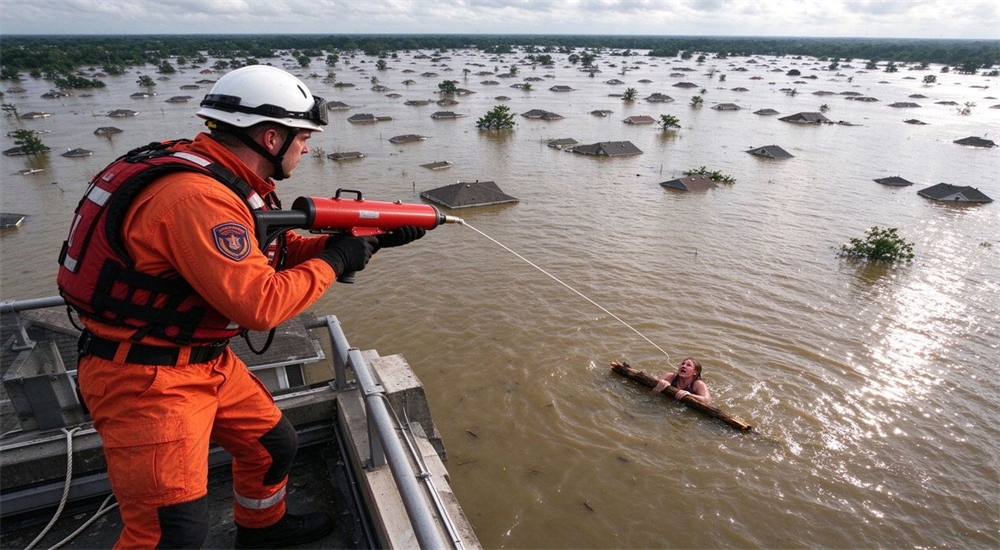
Start with the dominant payload on your job. Measure your real gap and add 30% for wind and swell before ordering.
Both units follow the same frame-mounted, support-rod layout, and out of the case they look like one family. The PTQ20 runs on a 20 MPa compressed-air cylinder; the PTQ7 adds the anchor claw on the barrel and can be powered either by an inflation hose with an 8 mm quick connector to a gas cylinder, or by a self-contained 33 g CO₂ cartridge.
Answer these in order and the SKU picks itself.
The heavier frame on this rescue thrower opens up longer shots across three modes. Most buyers order all three up front, because the real payoff is swapping payloads in under sixty seconds.
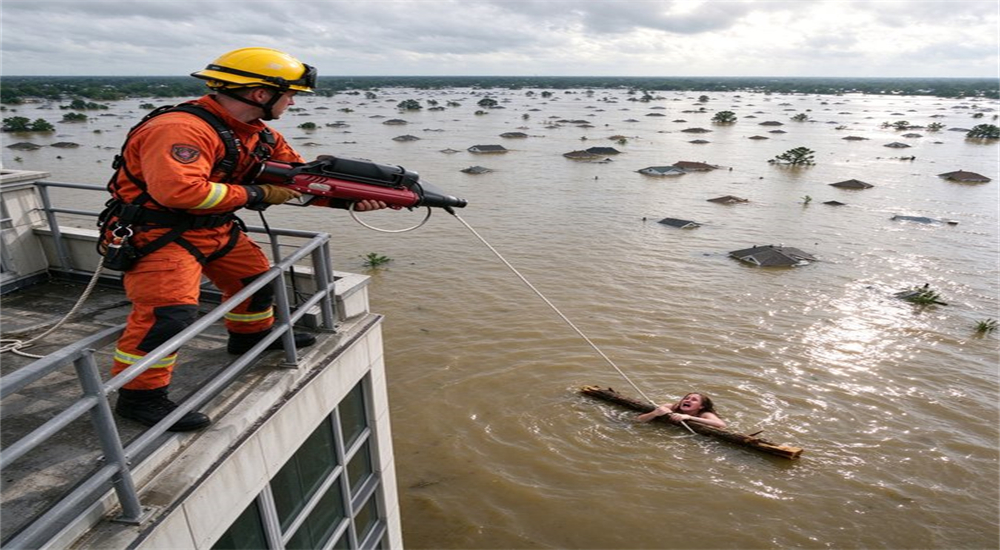
Load the solid land projectile (the payload that carries the rope) and the 4 mm × 150 m line rated ≥2000 N. It flies low and fast across a flooded street, a bridge deck, or between two hulls.
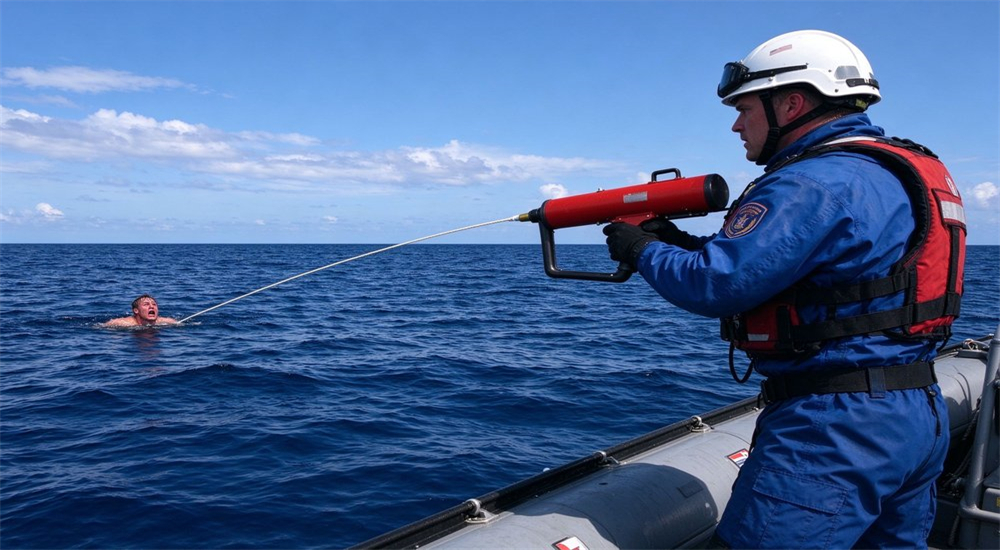
Load the water head and the 8 mm × 100 m floating rope rated ≥2000 N. The flat head flies out over open water, hits the surface, and the water-activated plunger opens the CO2 valve. This pneumatic water shot puts the lifebuoy out to ≥100 m on the PTQ20 or ≥110 m on the PTQ7, and it inflates in about five seconds with 8 kg buoyancy and under 5% loss over 24 hours.
On the PTQ7-Y150S110Q55, load the shaped anchor hook. It catches on a railing, window sill, rock crack, bridge beam, or roof lip to transfer a working line. This anchor-hook shot reaches ≥55 m. Always seat the claw on a genuinely solid edge before anyone loads on the line.
Choose a solid edge rather than a flat wall, and let the claw bite from above at a glancing angle.
Set the claw with slow, steady tension; release it cleanly so it does not bind on the edge.
The claw travels a long arc; treat the fall path as a hazard zone until the shot is confirmed seated.
On this rescue thrower, the whole frame is steady only when the rod foot bites. On each surface, plant it differently.
On this rescue thrower, an anchor-hook shot is not one pull of the trigger. From arrival to a fixed high point, the crew runs five steps in order.
The American unit is built for jobs where a lighter Korean shoulder-fired pneumatic unit falls short on reach, payload, or anchor holding. As a professional-grade water rescue thrower and line launcher, this pneumatic rescue thrower suits the four crews listed in the table below that buy it most often.
|
Team |
Typical Gap |
Payload Used |
Why American |
|
Coast guard / harbour patrol |
≥100 m water (PTQ20) / ≥110 m (PTQ7) |
Auto-inflating ring |
Stable on rolling deck |
|
High-rise fire rescue |
30 m up, 120 m across |
Anchor hook (PTQ7) |
Sets a fixed high point on a solid edge |
|
Mountain cliff rescue |
65-75 degree up-slope |
Anchor hook (PTQ7) |
High-angle ≥55 m lob |
|
Ship-to-ship / mooring |
1 m apart, rolling |
Land line or hook |
No open flame near fuel |
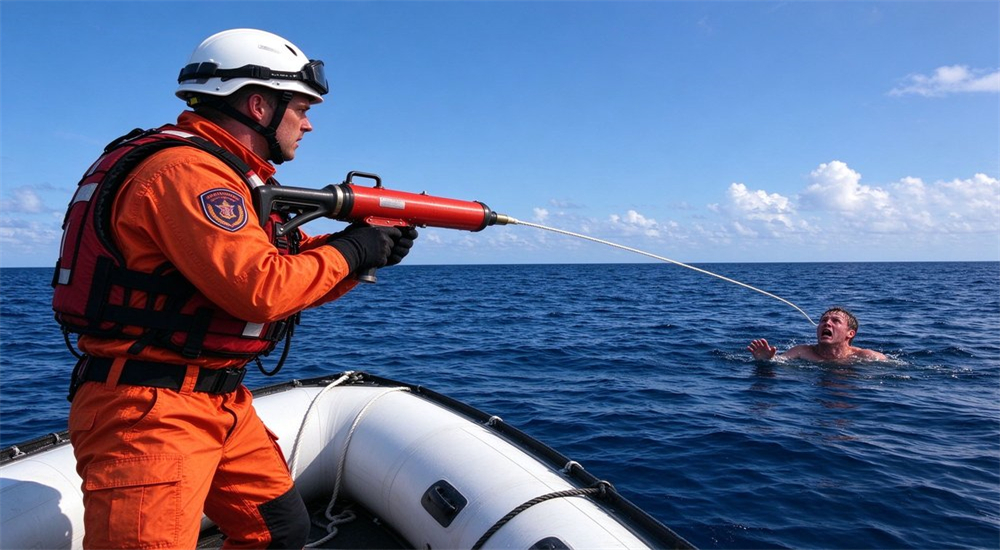
Coast guard small boats need a line-throwing tool that works on a rolling deck. The folding support rod braces against the gunwale, and the recoil buffer keeps the shot on target. For open-water and flood planning, teams also reviewNOAA flood safety guidance and water-safety materials from international relief organisations before the season starts.
Urban high-rise units face a problem no throw bag solves: a balcony edge 30 m up and 120 m across the street. On the PTQ7 the anchor claw shoots up, catches on the concrete lip, and seats as a high-line anchor point once two crew confirm the edge is solid. The crew pulls a heavier rope through and sets up rope access.
Mountain cliff teams reach a stranded hiker across a gully no trail crosses. The unit sits on the support rod, the team aims up at 65 to 75 degrees, and the claw lands on a ledge.
At sea, a thrower for ship-to-ship transfer is standard line-throwing gear. When two vessels roll a metre apart in wind, hand-thrown heaving lines are unreliable.
Three jobs share the claw but each has its own trick.
The American style anchor hook rescue thrower is part of a broader water rescue equipment line that includes lifesaving equipment, swiftwater rescue gear, and emergency rescue equipment for professional responders. We supply marine rescue equipment, search and rescue equipment, and first responder equipment to government procurement and relief organizations. As a wholesale rescue equipment supplier, we provide OEM and bulk pricing for water safety equipment, long distance rescue thrower systems, and CO2 powered rescue thrower platforms.
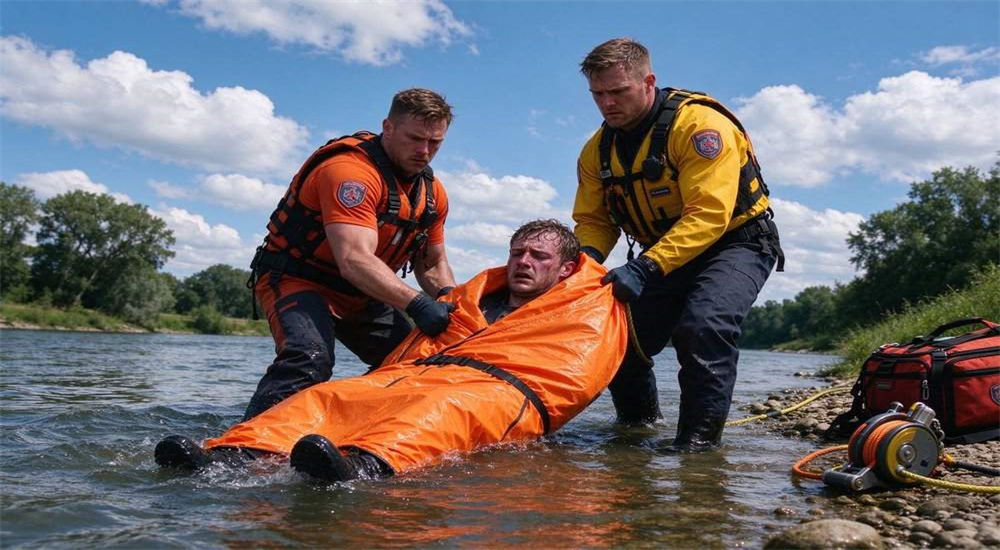
A 20 MPa pneumatic frame is pressure hardware, and on the PTQ7 an anchor claw flying on a high arc adds a second hazard: a missed claw drops. The rules below are the ones professional crews take on every shift, and they hold for every pneumatic thrower in the rig.
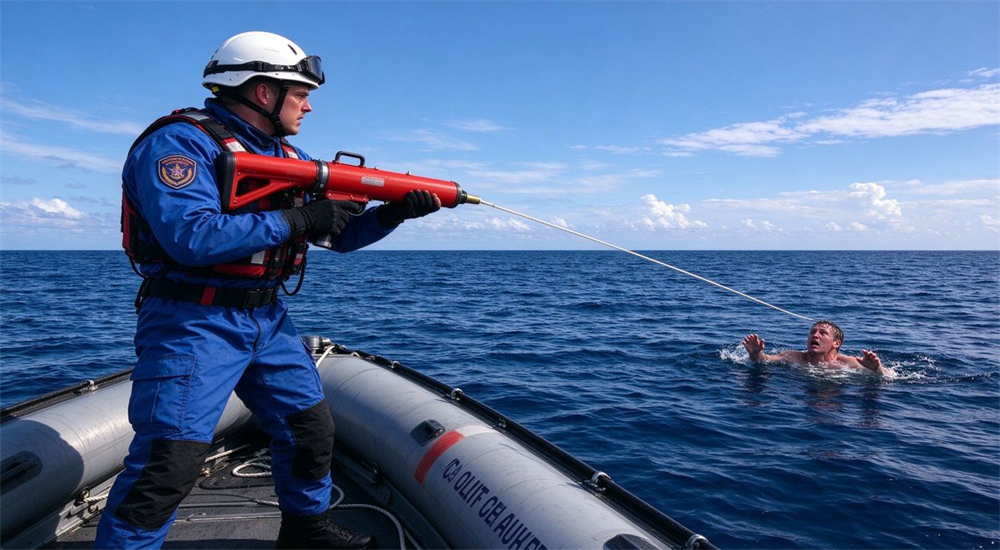
A 20 MPa pneumatic rescue thrower with a seating anchor claw is pressure hardware. The checklists below keep this pneumatic tool ready for a 03:00 call.
Run these before every shot on the pneumatic frame:
Gauge pressure is what keeps this pneumatic thrower alive. Glance at the dial before each call, and swap in a freshly topped bottle ahead of a long exercise. Keep storage between -20°C and 55°C and operation between -10°C and 45°C. On hot days, do not park a pressurized bottle baking inside a shut truck — the cabin can climb past 60°C.
After every cliff or ship call, run a finger along the anchor hook prongs looking for a bend. A bent claw comes out of service immediately, because it will not seat on an edge and can slip once loaded.
A 90-second pre-use check on your rescue thrower catches the obvious, but slow leaks, aged seals, and a bent claw only show up on a schedule. The table below lays out the monthly, quarterly, and annual checks.
Run the monthly items on the first of every shift month, and book the annual bench test into your calendar the way you would an extinguisher service, so a rescue thrower with a hidden fault is never lifted off the pallet for a night call.
When
Checks to Run
Monthly
Dial sits in the green; rings still soft; claw prongs unbent; lifebuoy CO2 cartridge within its stamp; full-length line hand-pulled; rod hinge and foot snug
Quarterly
Trigger pull even; bore blown clear; case catches and hinges firm; frame bolts at book torque; line stowed in relaxed figure-eights under cover
Annually
Swap the main ring kit; bench pressure test; renew the lifebuoy bladder if worn; look the anchor claw over for hairline cracks; write it all in the service log
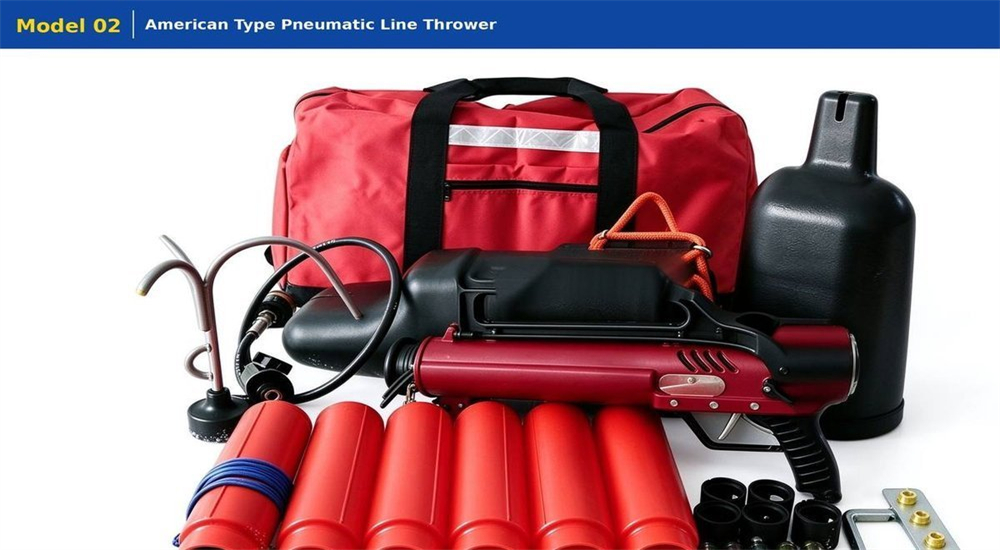
On a professional anchor hook rescue thrower, most faults are mechanical and diagnosable on scene. The table below maps symptom to cause and fix, with the claw-specific faults called out. Keep it near the case so your rescue thrower is back in service in minutes.
|
Symptom |
Likely Cause |
What to Do |
|
Shot falls well short |
Bottle pressure below green; line fouled; launch angle off; crosswind |
Repressure to 20 MPa; lay the line back in loose coils; correct the elevation; deduct wind drift from the planned range |
|
Bottle refuses to charge |
Fouled sealing face; mismatched adapter; bottle valve cracked |
Wipe the dive port and its ring; verify the coupling fits your station; spin the valve fully open |
|
Trigger will not move |
Grit in the sear; grease dried solid; firing pin bent |
Disassemble per the book, swab clean, repack with silicone lube; a bent pin goes to the bench |
|
Line fouls every launch |
Coil wound too tight; embedded kink; lineholder dragging |
Recoil in relaxed figure-eights; cut out the kink or retire the line; coach the holder to feed freely |
|
Head or valve hisses air |
Ring gone hard or nipped; face not bedding |
Bleed pressure out, swap the ring if cracked, smear silicone, reseat until it beds |
|
Dial misbehaves |
Gauge knocked out of tune; water trapped in the line |
Fit a fresh gauge and blow the line clear; never send a shot on a dial you do not trust |
|
Head drops mid-flight |
Projectile not locked in; socket worn oval |
Push the head home until it clicks; an oval socket sends the frame to the bench |
|
Anchor hook will not seat on the edge |
Hit a flat wall; wrong angle; claw prong bent |
Pick a real lip or beam; strike 30-45 degrees from above; if a prong is bent, retire the claw and switch to the backup |
|
Claw slips once loaded |
Seated on rubble or a crumbling edge; prong micro-cracked |
Do not load a second person; re-shoot to a stronger edge; retire and inspect the claw under magnification |
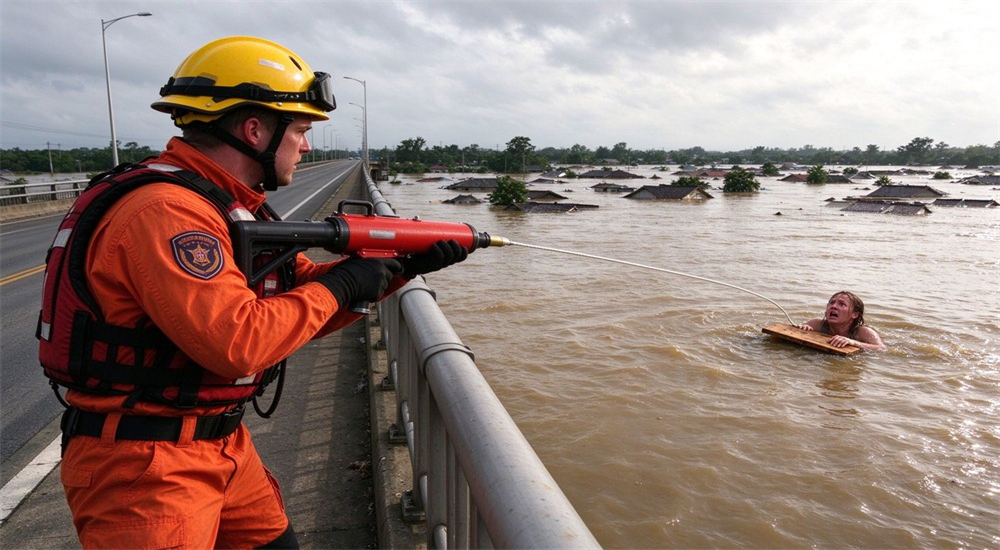
A weak landing on this frame almost always comes down to pressure, line, elevation, or breeze rather than a cracked frame.
Below are the questions professional rescue teams ask us most about the American style anchor hook rescue thrower. If your question is not here, drop us a line and we get back to you inside one working day.
What is the gap between a rescue thrower, a line thrower, and a rope thrower?
Those three names point at the same category and trip over one another in search results. Rescue thrower is the broad bucket for any gas-powered tool that puts a line across a gap.
Line thrower and rope thrower are loose hand-labels for the same hardware. When you write a tender, search all three terms together so a rival SKU does not slip past your filter.
What makes this an American style rescue thrower?
It is the frame-mounted, support-rod design used on workboats and coast guard small craft: the PTQ20-Y125S100 is about 1.9 kg, with a folding support rod, a recoil reduction buffer, and a 20 MPa pneumatic frame. It fires line and ring payloads, and the PTQ7-Y150S110Q55 adds the anchor-hook option. It is the working tool of the pneumatic family, not a shore rescue starter.
The exact land, water, and hook ranges for each model are listed in the Core Specifications and Model Comparison tables above.
What does the anchor hook actually do?
It is a seating device, not a load rating. The shaped high-strength alloy claw catches on concrete edges, rock cracks, window sills, railing bars, and roof lips so the crew can pull a working rope through and set a high line. It is not a steel nail driven into concrete; it is a claw designed to bite a solid edge and be confirmed by two crew before anyone loads on the rope.
How far can the anchor hook really reach?
On the PTQ7-Y150S110Q55 the anchor-hook shot reaches ≥55 m, shorter than the line range because the claw and the working rope drag more. A low fast shot goes the distance along a deck; a high lob drops the claw onto a balcony edge.
Always measure the real height and distance of your typical ledge, then add 30% for wind before you pick a model.
The PTQ20-Y125S100 launcher body is about 1.9 kg, light enough to position by hand, while the complete kit in the flight case with the cylinder and accessories is what you carry between calls. The folding support rod exists because on a pitching deck you want a braced platform, not a free shoulder, for a repeatable 20 MPa shot. Set the rubber foot on the deck or rock, lean into the stock, and fire.
Can one frame fire all three payloads?
Yes within each model. Load the solid land head for a thin line across dry ground, the water head for the auto-inflating 8 kg lifebuoy over open water, or (on the PTQ7) the anchor claw for a fixed high point on a building or cliff.
Swap time is under a minute. Most American-style buyers order the heads they use most up front, because half the value is the swap-in seconds on this pneumatic frame.
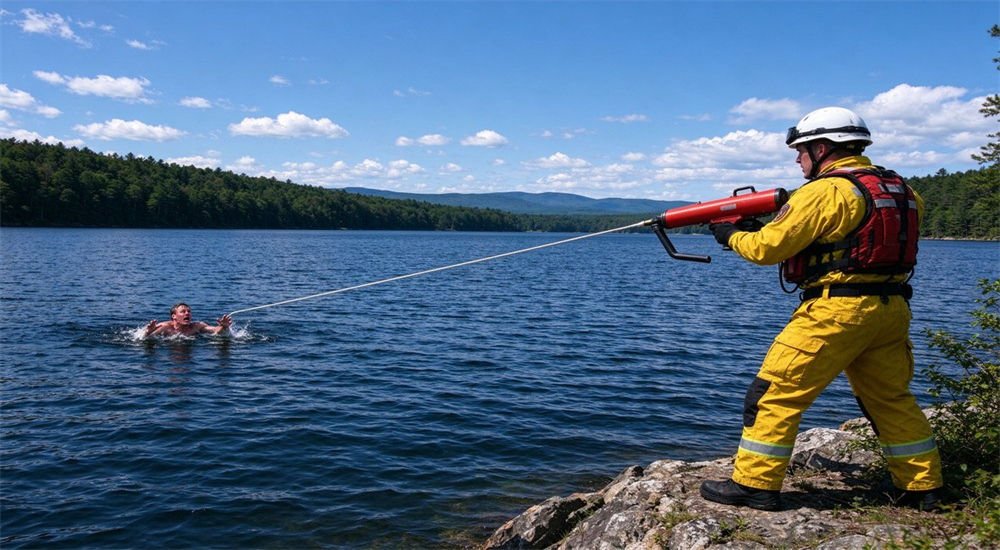
It does. A spring-loaded water plunger trips the CO2 valve the instant the head hits the surface. In roughly five seconds the lifebuoy bladder blooms out, giving about 8 kg of lift with less than 5% loss over a day.
Each monthly inspection, fire the trigger by hand; a spent cartridge is the usual reason a lifebuoy stays flat when it is needed.
Start with the PTQ20-Y125S100. It reaches ≥125 m land and ≥100 m water at 20 MPa, about 1.9 kg, which covers most harbour channels and ship-to-ship gaps.
Step up to the PTQ7-Y150S110Q55 if your crew also does open-water work at ≥110 m floating-rope reach, longer land shots at ≥150 m, or needs the anchor hook set to a distant quay edge or balcony.
When you need to set an anchor line above ground: on a balcony, a window ledge, a rock face, a bridge beam, or a pier bollard. If your calls are 100% flat-water rescue under 100 m, you do not need the hook and you can save weight and cost with the lighter Korean pneumatic class.
Minimum three: the shooter, the safety officer who watches the victim and calls stop if the line path is not clear, and the rope handler who feeds the line out smoothly.
The flight case with cylinder and accessories is carried by two. On a rolling deck, post an extra hand to brace the support rod through recoil. Never run this unit solo.
Bigger pressure packs bigger energy, so the safety drill is taken seriously. The support rod and recoil buffer exist because a 20 MPa pneumatic shot on a rolling hull needs a braced platform, not a free shoulder. Never point the unit at a person, keep the safety zone clear, and confirm the rod foot is planted before you fire.
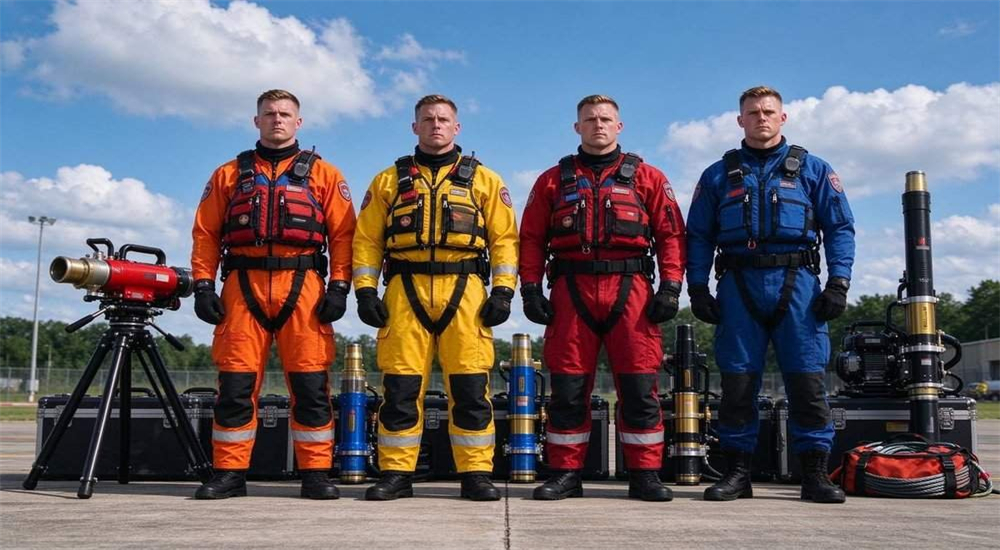
Bottles top up through the same scuba coupling found at any dive shop or industrial gas yard. We default to sending this pneumatic frame uncharged and let you fill it once the crate lands, because pressurized cylinders sit in the dangerous-goods category and the paperwork alone burns through your budget.
Pre-charged bottles instead? Drop the destination country into your RFQ and we will quote the lane.
The line is built to GB/T 27906-2011 on pressure rating, line pull, and inflation timing, and the test report pages for the SKU you are bidding can be sent over once asked.
Bidding against a GB/T 27906 reference? Send us the SKU you plan to quote, and we will forward the matching report pages ahead of your bid. We do not bundle certified and non-certified SKUs into one quote so you have to guess which is which.
We want to be clear. This line is built to the Chinese GB/T 27906-2011 rescue-thrower standard, and that is the only compliance reference we quote. We do not hold or claim overseas type approvals on units that do not carry them.
If your tender requires a specific overseas approval number, tell us the SKU and the standard up front and we will tell you straight whether that SKU carries it.
Quick inspection after every use, including a bend check on the anchor hook. Dial and ring check monthly on this pneumatic frame. Full line, trigger, and frame look-over every quarter.
Swap the main ring kit and book the bench test once a year. Rinse salt off every part after harbour work. The hook prongs, lifebuoy bladders, and lines are treated as scheduled consumables.
Swap the rope out the moment you spot fuzzy sleeves, snapped outer strands, flattened kinks, or faded UV color. After any severe shock load — say a full body hanging off the line — retire it right away, no matter how intact it appears.
Working loads: the land line carries ≥2000 N, the floating water line ≥2000 N. Keep it figure-eight coiled, out of direct sun, and clear of salt spray.
Inspect the prongs after every cliff shot. If a claw bends from hitting a rock edge at the wrong angle, pull it from service. Once deformed, it cannot grip a lip reliably and will slip on the edge.
That is why we suggest ordering a backup anchor hook with every kit. The land and water projectile heads are reusable if there are no cracks in the HDPE body.
Open with a small trial batch, step up to per-unit pricing once the pneumatic model proves out, then lock framework rates for annual call-offs. The true MOQ and lead time go into the signed contract, because they flex with the chosen model and whether that SKU carries certification. Active distributors earn their regional territory protected.
We do. On branding, you can pick deep laser marking on the aluminum frame for a permanent premium look, or pad printing on the plastic end caps for a budget-friendly bulk finish. The reinforced case and support rod sleeves can also be recolored.
Mid-to-bulk buyers get fully private-label packaging on this pneumatic thrower — your own box art, manual, and warranty card.
Storage band is -20°C to 55°C; working band is -10°C to 45°C. On hot summer days, do not park a charged bottle inside a shut-up vehicle, since the cabin can climb past 60°C. In cold-season coast guard duty, the external-cylinder layout keeps pressure more stable than a disposable CO2 cartridge setup.
Is training hard for a professional crew?
No for a professional crew, but non-negotiable. Basic operation is: load the chosen head, plant the support rod, check the gauge, aim, and fire this pneumatic frame. A new crew member needs half a day on the range, plus a full session on anchor-hook seating before they ever shoot at a real edge.
An English handbook goes out with every gun. On mid-to-bulk orders we run a live remote session with your lead instructors. Anchor-hook work is the one payload you cannot pick up from a book.
This heavy-duty unit is also called a line throwing device, line throwing apparatus, or rescue line gun for high-angle operations. In maritime settings, it may be called a pneumatic line launcher or rescue buoy launcher. The anchor hook variant is sometimes referred to as a grappling hook thrower or technical rescue line launcher.
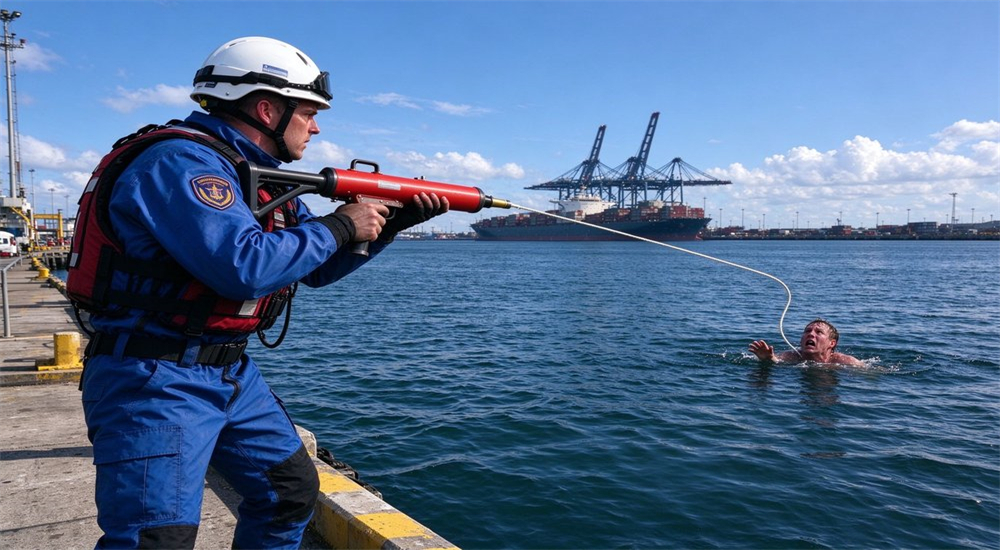
Stocking a regional catalog or outfitting a handful of high-rise and cliff crews? The buying process for a wholesale pneumatic rescue thrower runs the same either way. MOQ and lead time are finalized in the signed contract.
Professional crews want to shoot this pneumatic frame on their own deck or cliff before committing to a station order. We support a sample route so your lead instructors can validate the handling first.
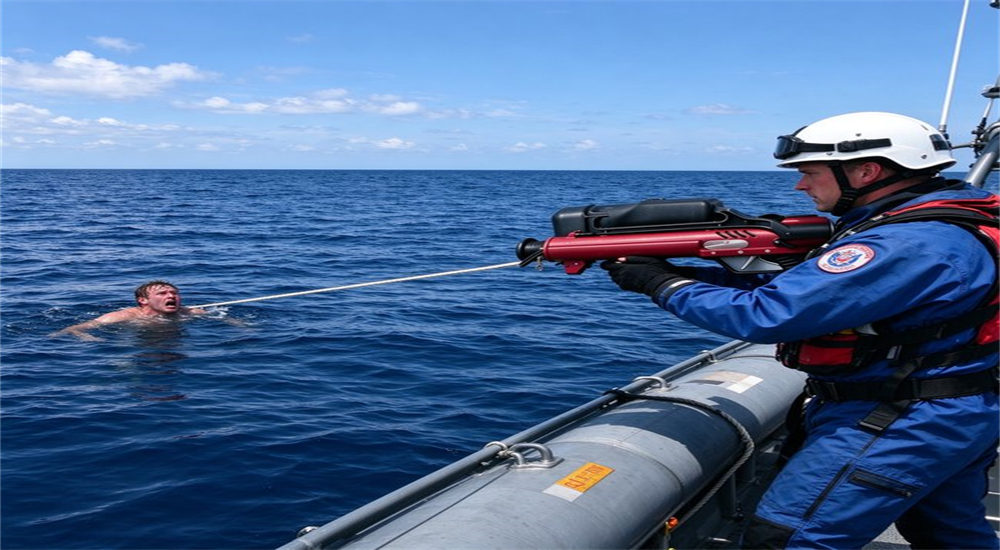
Private-label and custom builds run on this pneumatic frame, the reinforced case, and the add-on accessories, rather than a sticker applied at the end.
Each pneumatic thrower ships inside a reinforced aluminum flight case sized for two shoulders. Add a charged bottle and the whole pallet flips into dangerous-goods territory.
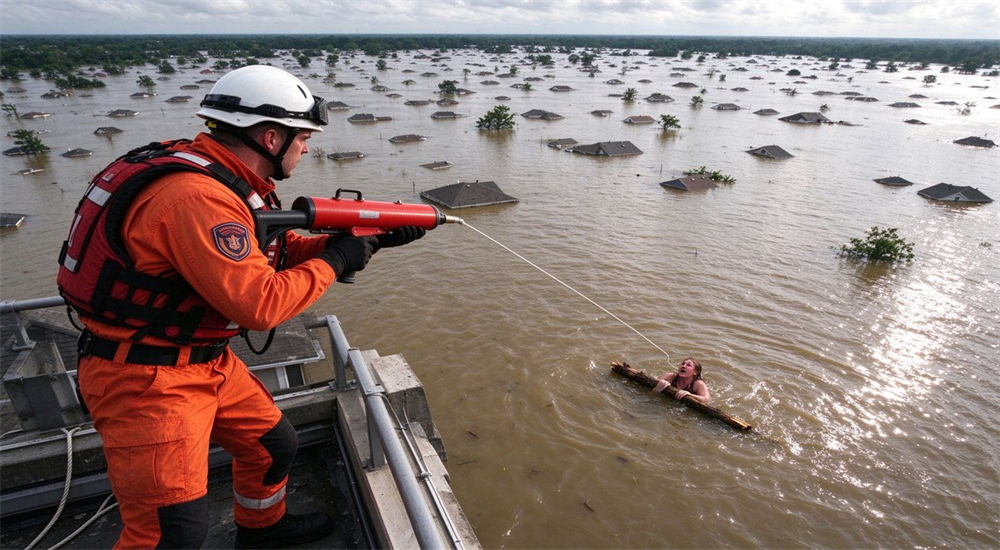
We are a rescue equipment supplier and wholesaler based in China, focused on water rescue tools that hold up under field use. Our range spans American style anchor hook rescue thrower pneumatic units, rescue line launchers, floating rescue ropes, throw bags, and anchor hook systems.
One contact covers the whole buy: the pneumatic frame, the folding support rod, the anchor claw spares, ropes, and private-label branding. You do not juggle three suppliers for one anchor-hook kit.
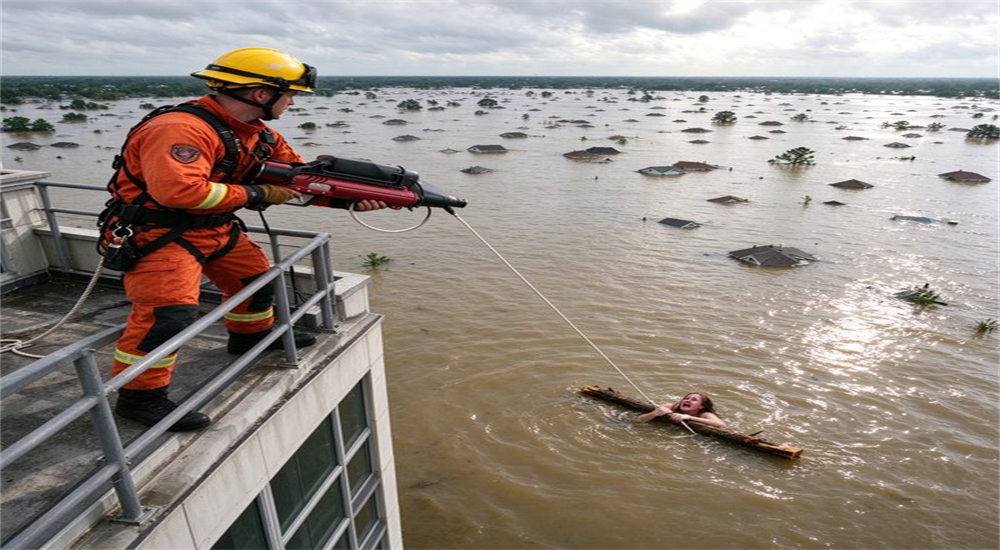
Sourcing through us means straight answers and a supplier that owns what it ships. We are upfront about which SKUs carry GB/T 27906 reports and do not claim overseas type approvals we do not hold. Our gear goes to fire departments, maritime teams, water police, and mountain rescue units setting high lines over cliffs, balconies, and ship rails.
Previous :
Portable Rescue Thrower | Folding Stock Pneumatic Line Thrower for Flood and Swift WaterNext :
Korean Style Pneumatic Rescue Thrower PTQ20-Y100S70 | 20 MPa ≥100 m Land / ≥70 m Water Professional Rescue Launcher, Aluminum Alloy, Fire Fighting Essential
This orange-yellow professional rescue launcher is made of aviation-grade aluminum alloy, with maximum working pressure of 200bar, throwing distance of 150-230 meters on land and 80-210 meters on water. Certified by the National Fire Equipment Quality Standard, it reaches maximum initial velocity of 60m/s. It provides efficient solutions for fire teams, flood control, and water rescue operations, saving lives in critical moments as essential equipment for all rescue teams.
 Customized Life-saving Thrower, High Strength, Long-range Rescue
This professional life-saving thrower is made of high-strength composite materials, with a throwing distance of 50 meters and a load-bearing capacity of 150kg, achieving a 99% rescue success rate. Its orange-yellow design ensures high visibility on water, equipped with non-slip handle and high-strength rescue rope. Specifically designed for flood control, water rescue and emergency disaster relief, it is essential equipment for fire departments, maritime rescue units, water rescue teams and flood control forces, participating in over 200 flood rescue missions annually.
 High-Pressure Pneumatic Rope Launcher, Rescue Special, 120m Range
This high-pressure pneumatic rope launcher uses compressed air as power source, with projection distance ≥80 meters on water and ≥110 meters on land, equipped with 120-meter high-strength rescue rope. The main body weighs less than 3.5kg, offers simple and quick operation, and features a spark-free design ensuring safe use in flammable environments. The accompanying auto-inflating life ring inflates within 5 seconds with buoyancy >8kg. Ideal for flood disaster relief, water rescue, maritime rescue and other complex scenarios, it's essential equipment for emergency rescue departments.
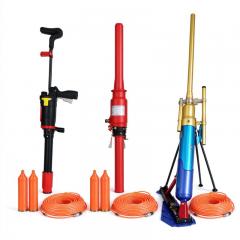 Wholesale Pneumatic Line Thrower: 100m–640m Rescue Rope Launcher
This pneumatic line thrower delivers reliable long‑distance rope deployment for swift‑water, flood, maritime and ice rescue scenarios. Multiple configurations cover short, long and ultra‑long throwing distances. Complete kits include launcher, projectiles, rescue ropes, CO2 cylinders and protective carry case. Quick setup, simple operation for fire, coast guard and emergency rescue teams worldwide. Note: Price for reference only. Exact price based on quantity, size, weight and custom details.
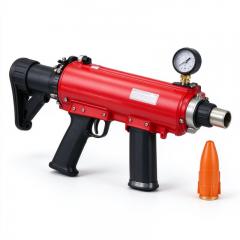 Korean Style Pneumatic Rescue Thrower PTQ20-Y100S70 | 20 MPa ≥100 m Land / ≥70 m Water
Korean Style Pneumatic Rescue Thrower PTQ20-Y100S70, 20 MPa shoulder-fired launcher. ≥100m land range and ≥70m water range, equipped with auto inflating lifebuoy head and 2000N high tensile rope. Complies with GB/T 27906-2011. Complete aluminum hard case kit. Support bulk wholesale, OEM custom logo for fire, coast guard and flood rescue teams. Note: Price for reference only. Exact price based on quantity, size, weight and custom details.
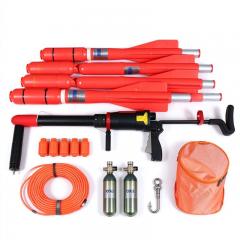 Portable Rescue Thrower | Folding Stock Pneumatic Line Thrower for Flood and Swift Water
Portable folding stock pneumatic rescue thrower with lightweight titanium alloy body, working pressure 6.5MPa. It reaches ≥185m on land and ≥125m on water, equipped with 3 interchangeable projectile heads. Two variants BM06 and BM07 for selection. Single-person operation, ideal for mountain, urban flood and swiftwater rescue. Support bulk wholesale and OEM customization for emergency response teams. Note: Price for reference only. Exact price based on quantity, size, weight and custom details.
Copyright © Custom Disaster - Relief Bedding: Tents, Sleeping Bags, Blankets All Rights Reserved
the professional team to service !