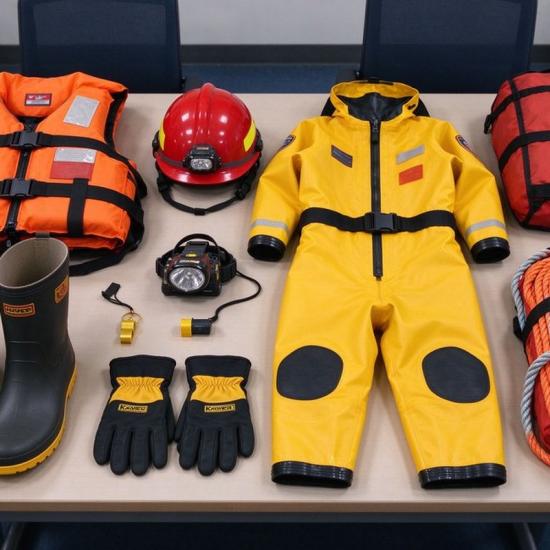
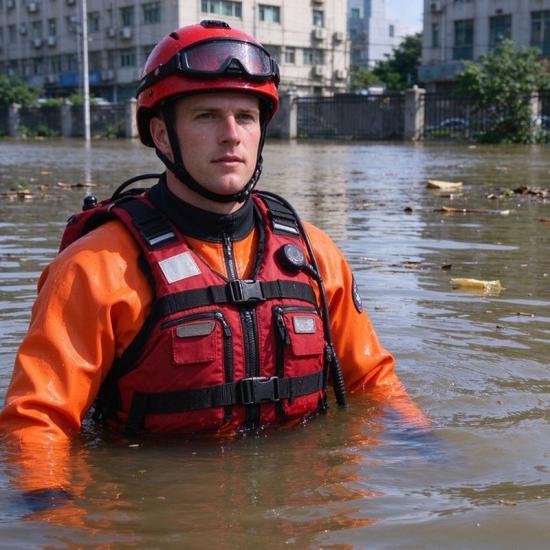
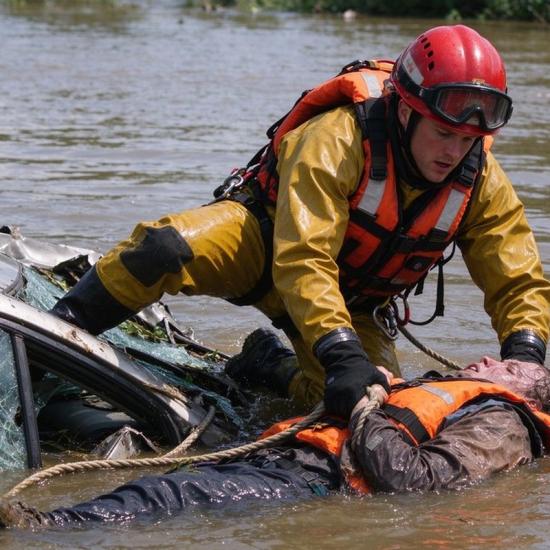
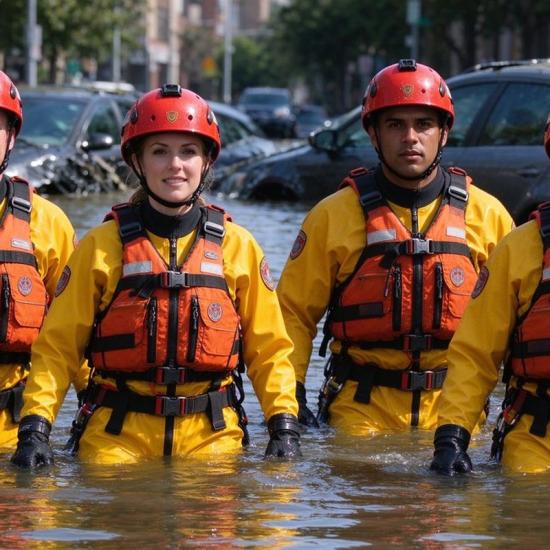
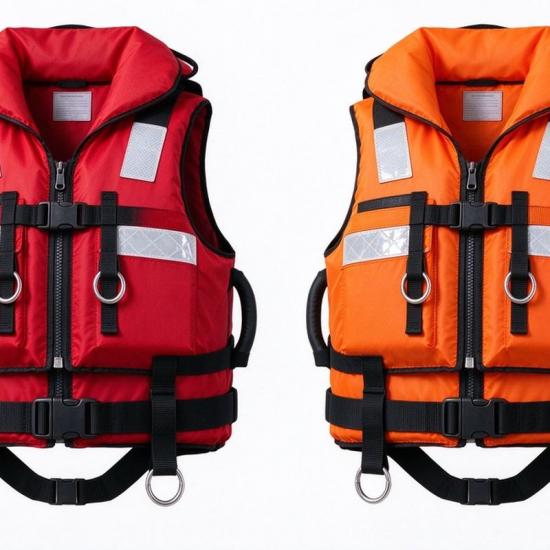
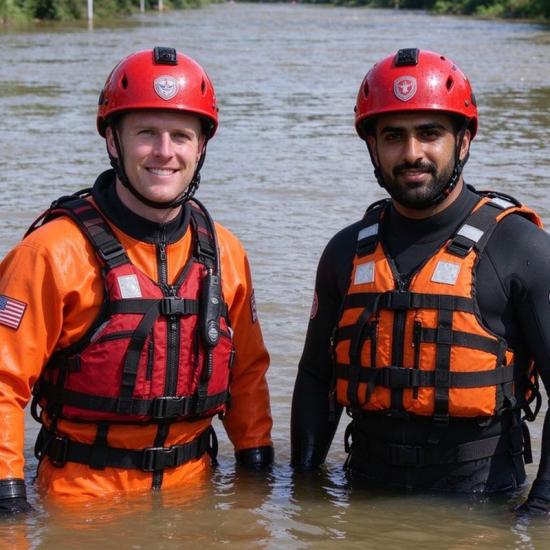
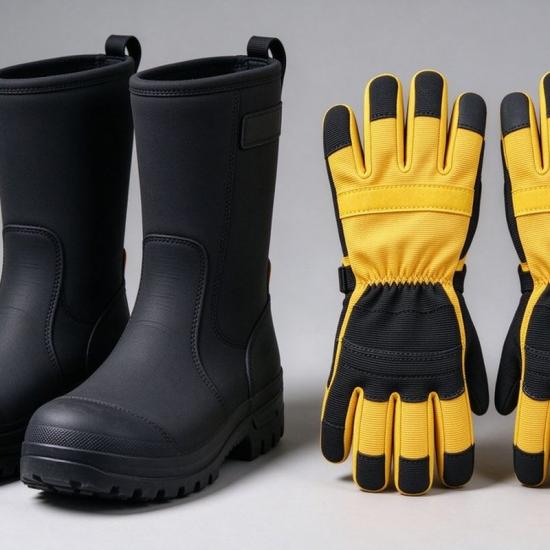
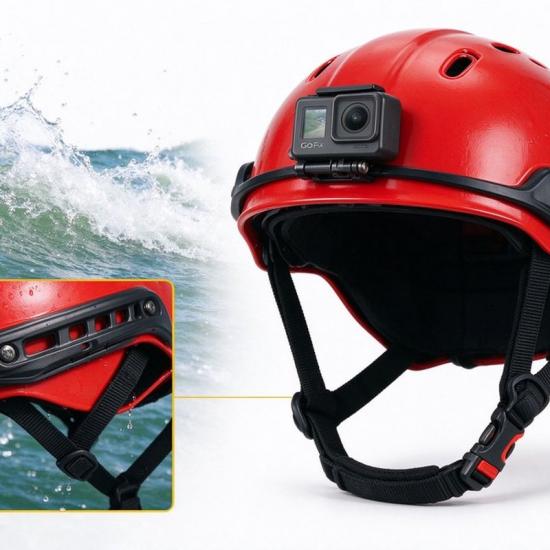
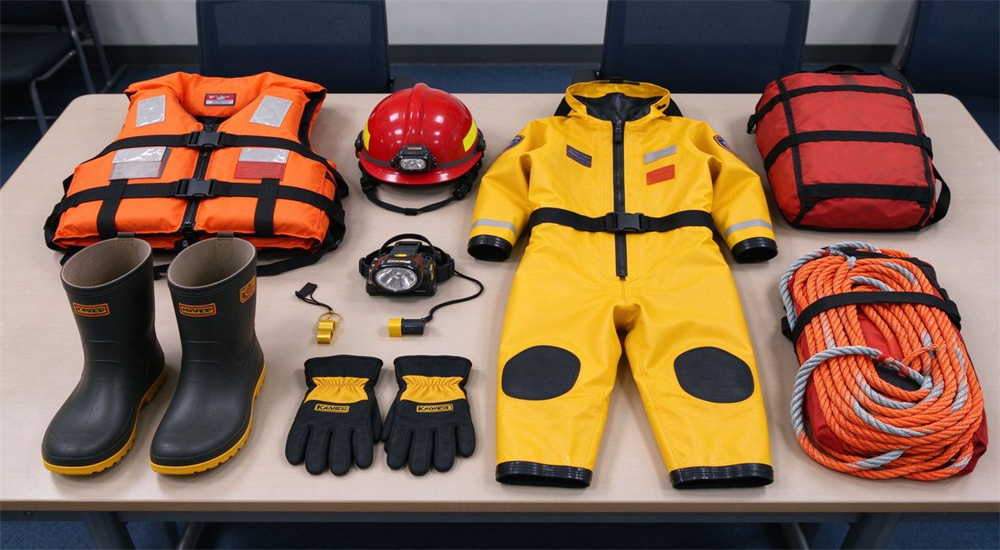
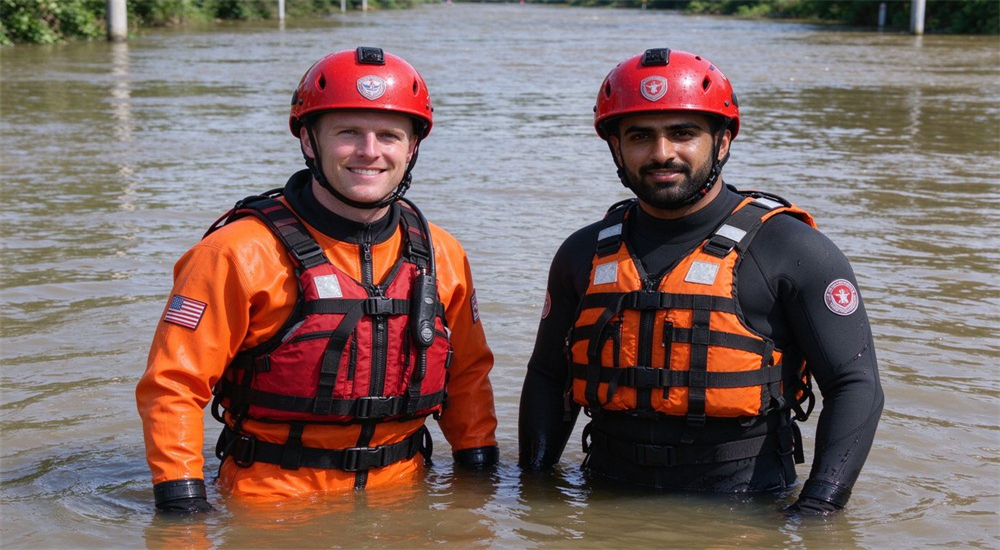
Complete flood rescue gear set includes high‑visibility PFD life jackets, water rescue helmets, neoprene dry suits, steel‑shank rescue boots and Kevlar palm gloves. Equipped with quick‑release harness, D‑rings and reflective panels for better safety. Abrasion‑resistant, reliable for swiftwater, urban flood and ice rescue missions. Available in multiple colors, support bulk order and government institutional procurement.
Note: Price for reference only. Exact price based on quantity, size, weight and custom details.
model no. :
RLJ-06Brand:
YRFmarket price :
$75.4sale price :
$37.7price range :
30-500/$37.7 501-1000/$36.7Color :
Multiple Colorsport of dispatch :
Guangdong/GuangzhouPayment :
TT, Paypal, Western Unionmin order :
30original region :
Made in ChinaLead Time :
5-15daysSize :
Universal Size |
Flood Rescue Clothing & Gear for Professional Teams
Complete flood rescue equipment kits — life jackets, dry suits, helmets, boots, gloves & accessories. Wholesale pricing, custom configurations, and bulk order support for government agencies, fire departments, and NGOs worldwide.
When floodwaters rise, every second counts. Flood rescue clothing is not ordinary workwear — it is the barrier between your team and hypothermia, contamination, and injury. A properly equipped flood rescue team needs layered protection: buoyancy aids to stay afloat, dry suits to stay warm in cold water, helmets to protect from debris, and boots and gloves for grip and dexterity. This guide walks through the complete gear configuration for flood rescue operations, from individual personal protective equipment (PPE) to team-level kits and bulk procurement.
Flood rescue is one of the most common and dangerous emergency responses worldwide. According to the World Health Organization, floods affect more people than any other natural disaster, and rescue teams must operate in fast-moving water, submerged vehicles, collapsed structures, and contaminated environments. The right flood rescue gear reduces response time, improves survivability, and protects your most valuable asset — your people.
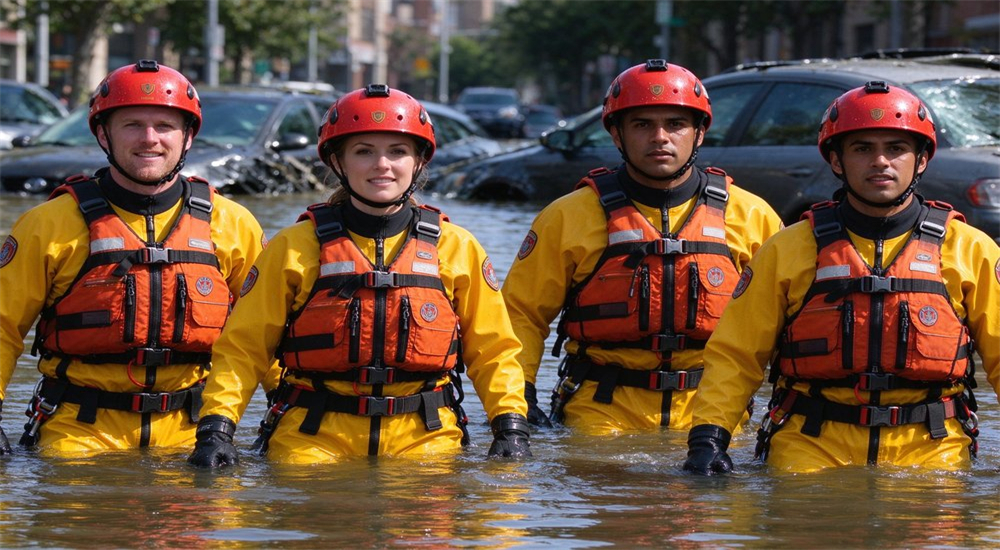


Table of Contents
Why Flood Rescue Clothing Matters
Boots, Gloves & Accessories
Core Flood Rescue Gear Checklist
Team Configuration & Role-Based Gear
Life Jackets & PFDs for Flood Rescue
Certifications & Standards
Dry Suits & Wetsuits for Flood Operations
Bulk Orders, Wholesale & Customization
Helmets & Head Protection
Flood Rescue Clothing FAQ
Before we dive into specific products, it is important to understand that flood rescue gear is role-specific. A swiftwater rescue technician needs different equipment than a flood evacuation support member. The following sections break down each category by function, so you can build the right kit for each role on your team.
Why Flood Rescue Clothing Matters
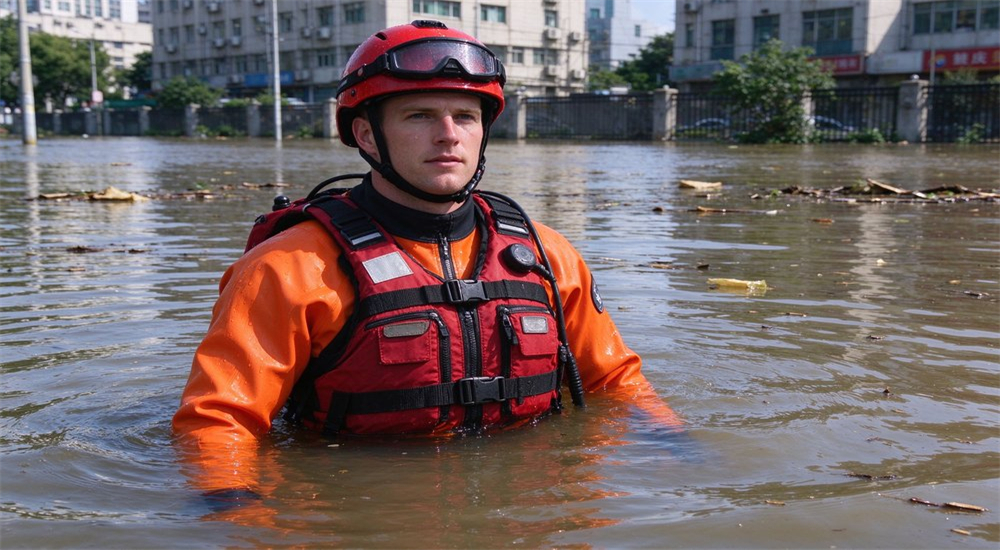
Flood rescue operations present unique hazards that ordinary rain gear or work uniforms cannot handle. The three primary risks are hypothermia, water contamination, and impact injury from debris. Proper flood rescue clothing addresses all three simultaneously.
Hypothermia Risk in Flood Water
Even in warm climates, flood water is often significantly colder than air temperature. A person immersed in 15°C (59°F) water can develop hypothermia in under an hour. For rescue workers who spend hours in and out of the water, thermal protection is not optional — it is a safety requirement. Dry suits provide full thermal isolation by keeping water completely out, while wetsuits offer a thinner layer of insulation for warmer water conditions.
Contamination & Chemical Exposure
flood water is rarely clean. It often contains sewage, agricultural runoff, fuel, and industrial chemicals. Contact with contaminated water can cause skin infections, gastrointestinal illness, and long-term health issues. Waterproof and chemical-resistant flood rescue clothing creates a barrier between the rescuer and contaminated water. Seams must be fully taped or welded, and zippers must be waterproof to prevent seepage.
Impact & Abrasion Protection
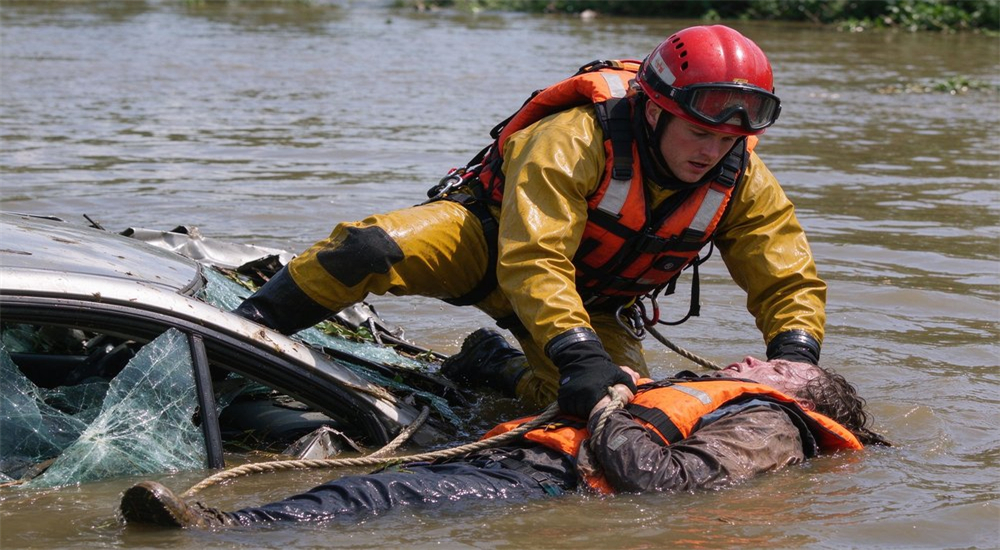
Flood waters carry debris — broken glass, metal fragments, tree branches, and building materials. Rescue workers are often pushed against submerged objects or dragged through debris fields. Reinforced knees, elbows, and seat areas on flood rescue suits prevent cuts and abrasions. Helmets protect against head impact from falling debris or low-head dams.
Core Flood Rescue Gear Checklist
Every flood rescue team member should be equipped with the following core items. This checklist serves as a baseline — specific roles may require additional specialized equipment.
The table below lists the essential flood rescue gear for each team member, organized by category with key selection criteria. Use this as a procurement checklist when building or upgrading your team's flood rescue equipment.
This equipment checklist provides a baseline for flood rescue team configuration. The specific quantities should be adjusted based on your team size, typical deployment duration, and the characteristics of your operational area. Teams responding to urban flooding may require additional personal protective equipment for contaminated water, while rural teams may need more rope and boat equipment.
Summary: The core flood rescue kit covers buoyancy, thermal protection, head/foot/hand protection, visibility, and communication. Teams operating in cold water or night conditions should prioritize dry suits and helmet lights. Every item should be individually sized and inspected before each deployment.
Category
Essential Item
Key Feature
Role Priority
Buoyancy
Rescue Life Jacket (PFD)
150N+ buoyancy, quick-release harness
All personnel
Thermal
Dry Suit or Wetsuit
Waterproof, taped seams, thermal liner
Water-entry team
Head
Water Rescue Helmet
ABS shell, EPS liner, drainage holes
All personnel
Footwear
Rescue Boots
Neoprene, steel shank, non-slip sole
All personnel
Hand
Rescue Gloves
Neoprene, Kevlar palm, quick-don
All personnel
Visibility
Reflective Gear & Whistle
Hi-vis panels, pea-less whistle
All personnel
Lighting
Headlamp / Helmet Light
Waterproof, rechargeable, 200+ lumens
Night operations
Communication
Waterproof Radio Pouch
IPX7 rated, chest-mounted
Team leaders
Life Jackets & PFDs for Flood Rescue
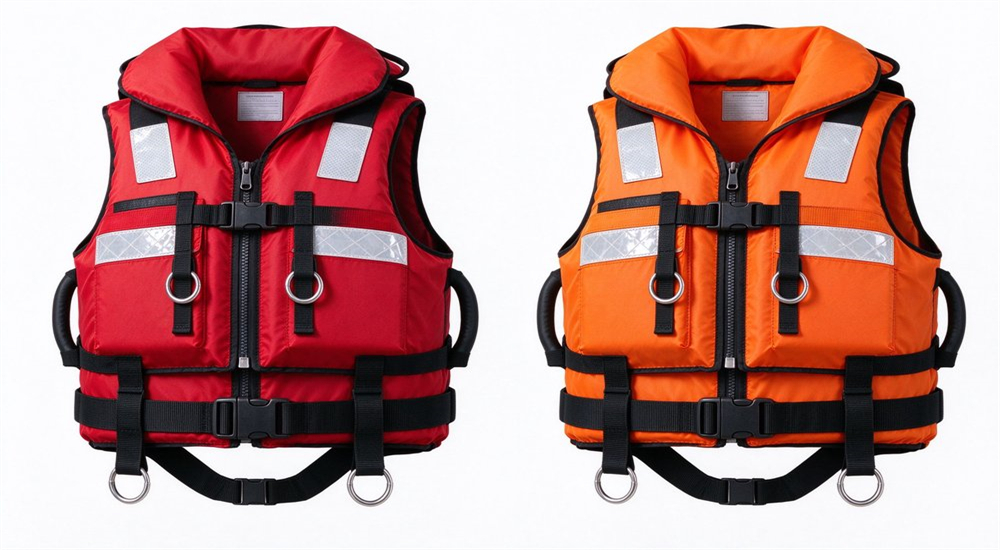
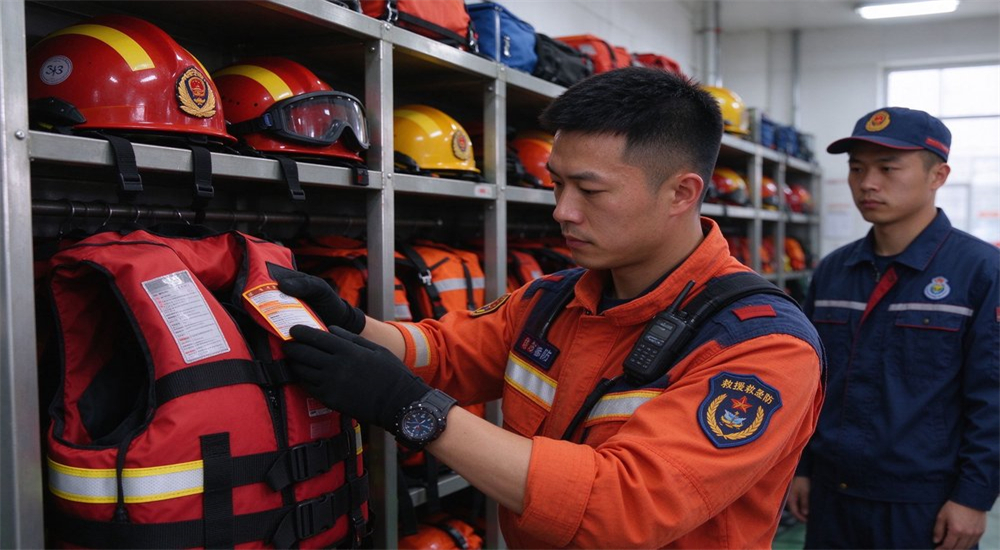
The rescue life jacket is the single most important piece of flood rescue equipment. Unlike recreational life vests, rescue PFDs are designed for active swimming, rope work, and victim contact. Key differences include higher buoyancy, quick-release harness systems, and attachment points for rescue equipment.
Buoyancy Ratings Explained
Life jacket buoyancy is measured in Newtons (N). For flood rescue, the minimum recommended buoyancy is 150N, with 200N+ preferred for swiftwater and heavy gear. A 150N PFD provides approximately 15kg of flotation, enough to keep an adult's head above water even when wearing heavy clothing and equipment. Higher buoyancy ratings (200N-275N) are recommended for rescue technicians who carry tools, radios, and rope bags.
Quick-Release Harness System
The most critical safety feature on a flood rescue life jacket is the quick-release harness. This system allows a rescuer who has become entangled in rope or debris to disconnect from the tether with one hand. In fast-moving water, a rescuer who cannot release from a rope can be pulled underwater. The quick-release mechanism must be intuitive, operable with gloves, and tested regularly.
Foam vs. Inflatable Life Jackets
Foam life jackets are inherently buoyant and require no activation — they work immediately upon entering the water. They are bulkier but more reliable for continuous flood operations. Inflatable life jackets are compact and comfortable for long shifts, but they rely on CO2 cartridges that must be inspected and replaced regularly. For flood rescue, foam PFDs are generally preferred for primary water-entry personnel, while inflatable models may be suitable for support roles.
Attachment Points & Gear Loops
Professional flood rescue life jackets feature multiple D-rings and gear loops for attaching carabiners, rope bags, whistles, and lights. Look for PFDs with at least two front D-rings (one on each shoulder strap) and a lower attachment point for a rescue tether. Mesh pockets for storing small items are also useful, but ensure they do not interfere with the quick-release mechanism.
Maintenance & Care of Rescue PFDs
Proper maintenance extends the lifespan of flood rescue life jackets and ensures reliable performance. After each use, rinse the PFD with clean water and hang dry in a shaded, well-ventilated area — never machine wash or dry clean. Inspect before and after each deployment: check for torn fabric, broken buckles, compromised flotation material, and corrosion on D-rings. Store flat or on wide hangers to prevent compression of foam panels. Avoid contact with oil, gasoline, and harsh chemicals which can degrade fabrics and foam. Most rescue PFDs have a service life of 5-7 years with proper care; replace immediately if any structural damage is found.
Dry Suits & Wetsuits for Flood Operations
The choice between a dry suit and a wetsuit depends on water temperature, expected immersion time, and budget. Both have a place in flood rescue, and many teams maintain both types for different conditions.
Dry Suits: Full Thermal Isolation
Dry suits are designed to keep the wearer completely dry. They feature waterproof zippers, latex or neoprene neck and wrist seals, and fully taped seams. The wearer wears thermal base layers underneath, which can be adjusted based on conditions. Dry suits are essential for cold water (below 15°C / 59°F), long-duration operations, and contaminated water environments. They are also the preferred choice for ice rescue and winter flood operations.
Wetsuits: Flexible Warm-Weather Option
Wetsuits allow a thin layer of water to enter, which is then warmed by body heat. They are more flexible and less expensive than dry suits, making them popular for warm-climate flood rescue and training. Wetsuits are available in thicknesses from 3mm (warm water) to 7mm (cold water). For flood rescue, a 5mm full-body wetsuit with reinforced knees and elbows is a good all-around choice. Wetsuits do not provide contamination protection, so they are not ideal for sewage or chemical-contaminated flood water.
The following comparison helps teams decide between dry suits and wetsuits based on operational conditions. Most professional flood rescue teams maintain both types and select based on water temperature and mission profile.
The role-based configuration table ensures that each team member has appropriate equipment for their assigned function. Swimmers require maximum mobility and flotation, while rope tenders need different harness configurations. Government procurement teams should use this table as a starting point and customize based on their specific operational protocols and training standards.
Summary: Dry suits are the primary choice for professional flood rescue teams operating in variable conditions. Wetsuits serve as a cost-effective backup for warm-water operations and training. Teams should allocate approximately 70% of their suit budget to dry suits and 30% to wetsuits for flexibility.
Factor
Dry Suit
Wetsuit
Water Temperature
Below 15°C (59°F)
Above 15°C (59°F)
Immersion Time
Long-duration (2+ hours)
Short-duration (under 2 hours)
Contamination Protection
Full barrier
None (water enters)
Flexibility & Mobility
Moderate (stiffer seals)
High (very flexible)
Cost
Higher ($300-$800)
Lower ($100-$300)
Maintenance
Seal & zipper care required
Rinse & dry only
Best For
Cold water, contamination, ice rescue
Warm water, training, short ops
Helmets & Head Protection
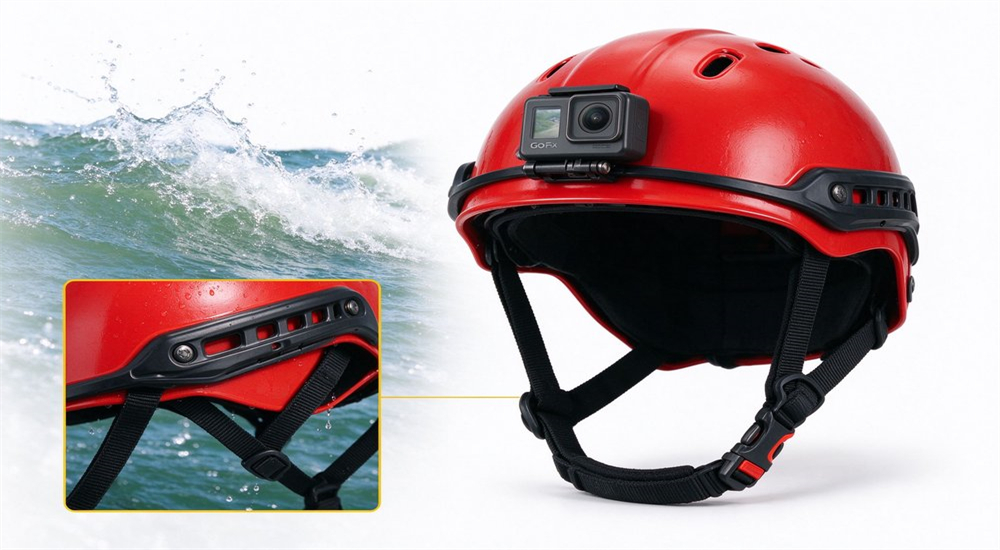
Flood rescue helmets are purpose-built for water environments. They differ from construction helmets in several key ways: they have drainage holes to prevent water from pooling on top, they feature chin straps that keep the helmet secured in fast-moving water, and they often include accessory rails for mounting lights and cameras.
Shell & Liner Construction
Most flood rescue helmets use an ABS outer shell for impact resistance and an EPS or EVA foam liner for shock absorption. The combination provides protection against both sharp impacts (debris) and blunt force (submerged objects). Look for helmets with 8-10 drainage vents around the crown to allow water to escape quickly. The retention system should include a ratchet dial at the rear for one-handed adjustment, even while wearing gloves.
Accessory Mounting Systems
Professional flood rescue helmets feature side rails for mounting helmet lights, cameras, and communication devices. Some models also include a front NVG (Night Vision Goggle) mount or GoPro-style bracket. For night flood operations, a helmet-mounted light is essential — it frees both hands for rope work and victim handling. Ensure the helmet you select has a standardized rail system compatible with your team's lighting equipment.
Color & Visibility
Helmet color serves a functional purpose in flood rescue. Bright colors (red, orange, yellow) improve visibility in murky water and low-light conditions. Some teams use color-coding to identify roles — for example, red for team leaders, orange for swimmers, yellow for support. White helmets are also common but can be difficult to see in foam and whitewater. Reflective strips on the helmet improve visibility during night operations.
Boots, Gloves & Accessories
While the life jacket and suit get the most attention, boots, gloves, and small accessories are what make flood rescue operations practical and safe.
Rescue Boots
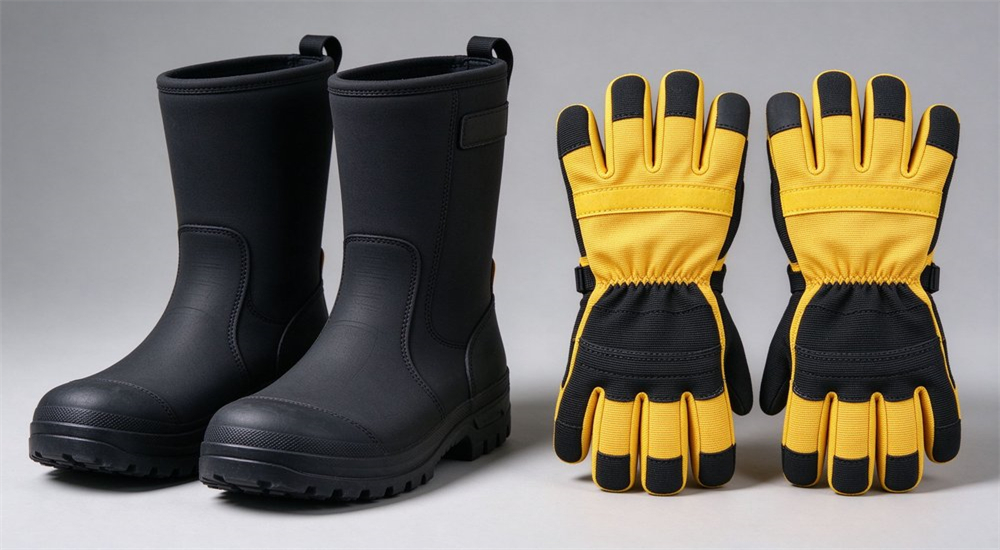
Flood rescue boots are typically made from neoprene with a reinforced rubber sole. They should fit over the foot seal of a dry suit or be integrated into a wetsuit. Key features include a steel or composite shank for protection against submerged nails and debris, a non-slip sole pattern for grip on wet surfaces, and a quick-don design for rapid deployment. Boots should be high-cut (above the ankle) to prevent debris from entering and to provide ankle support on uneven terrain.
Rescue Gloves
Gloves for flood rescue must balance protection with dexterity. Rescuers need to tie knots, operate carabiners, and handle victims — all while wearing gloves. Neoprene gloves with Kevlar-reinforced palms offer good cut resistance and grip. Look for gloves with extended cuffs that overlap the suit sleeve, preventing water from running down the arm. Some models feature a quick-release loop so gloves can be removed quickly if they become snagged.
Whistles & Signaling Devices
A whistle is the most basic but essential signaling device in flood rescue. Pea-less whistles work reliably when wet and are preferred over traditional pea whistles, which can jam. Attach the whistle to the life jacket shoulder strap with a lanyard. For longer-range signaling, consider a small air horn or electronic signaling device, but these should supplement — not replace — a basic whistle.
Helmet Lights & Illumination
Flood rescue operations frequently extend into nighttime hours. A waterproof helmet light with at least 200 lumens is standard equipment. Rechargeable LED models are preferred, with a runtime of at least 4 hours on high mode. Look for lights with an IPX7 or higher waterproof rating and a tool-free mounting system compatible with your helmet rails. Spare batteries or a backup light should be carried by each team member.
Team Configuration & Role-Based Gear
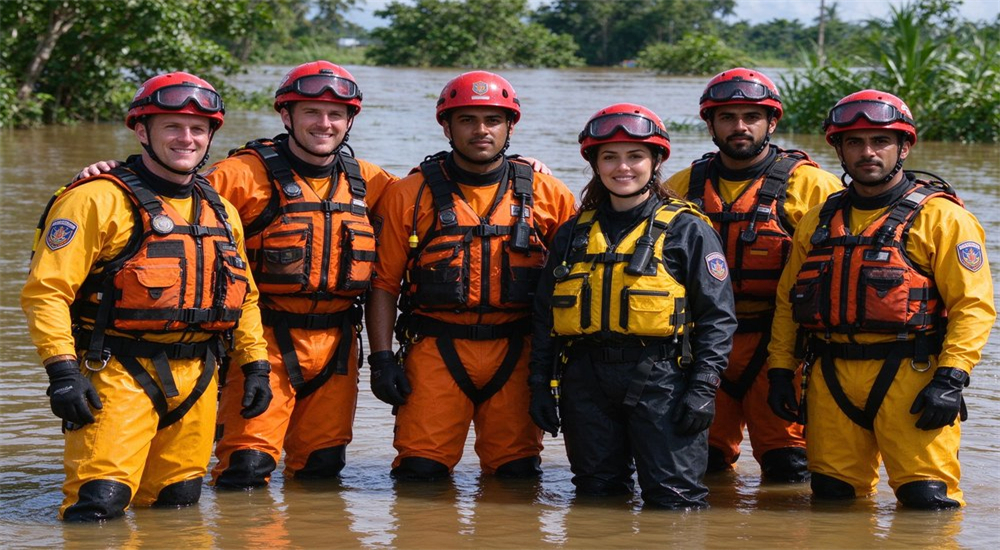
Not every flood rescue team member needs the same equipment. Role-based gear allocation ensures that each person has what they need without overloading support personnel. The following configuration is based on a standard 6-person flood rescue team.
This table outlines a typical 6-person flood rescue team configuration with role-specific gear requirements. Adjust based on your team's size, training level, and operational scope.
The maintenance schedule is designed to ensure equipment readiness between deployments. Flood rescue equipment is often stored for extended periods and must be ready for immediate activation. Consider implementing a rotating inspection schedule so that all equipment is checked at least quarterly, with formal testing before each flood season.
Summary: A 6-person flood rescue team needs 6 helmets, 6 PFDs, 4 dry suits (swimmers, leader, boat operator), 2 wetsuits or waders (rope tender and medical), 6 pairs of boots and gloves, and role-specific equipment. Bulk ordering complete team kits reduces per-unit cost and ensures consistency.
Role
Headcount
Primary Gear
Additional Equipment
Team Leader
1
Helmet, PFD, dry suit, radio
GPS, map, whistle, clipboard
Swimmer / Rescuer
2
Helmet, 200N+ PFD, dry suit, boots, gloves
Rescue tether, knife, whistle, light
Rope / Tender
1
Helmet, PFD, wetsuit or dry suit
Rope bag, harness, carabiners, pulley
Boat Operator
1
Helmet, PFD, dry suit
Boat controls, throw bag, radio
Medical / Support
1
Helmet, PFD, waders or dry suit
First aid kit, OPEP, spinal board
Role Responsibilities & Gear Rationale
Each role on a flood rescue team has specific responsibilities that dictate gear requirements. The Team Leader coordinates operations, communicates with incident command, and makes tactical decisions — requiring reliable radio communication and full PFD protection. Swimmers are the primary water-entry personnel, performing victim contact and extraction — requiring maximum buoyancy (200N+), thermal protection, and maximum mobility. Rope Tenders manage shore-based rope systems, belaying swimmers and setting up mechanical advantage systems — requiring harness compatibility and rope management gear. Boat Operators handle watercraft navigation and positioning — requiring secure PFD attachment and weather protection. Medical/Support personnel provide on-scene patient care and equipment management — requiring quick access to medical supplies and wading capability.
Building a Team Kit: Quantity Planning
When procuring flood rescue gear for a team, plan for at least 1.5 sets per active team member. This allows one set to be in use while another is being cleaned and dried, and provides spares for equipment failure or new team members. For a 6-person team, this means a minimum of 9 life jackets, 6 dry suits, 3 wetsuits, 9 helmets, 9 pairs of boots, and 9 pairs of gloves. Rotating equipment also extends the lifespan of each piece by reducing continuous use.
Certifications & Standards
Professional flood rescue equipment should meet recognized international standards. While certification does not guarantee performance, it provides a baseline level of quality and safety that teams can rely on.
Life Jacket Standards
Look for life jackets certified to ISO 12402 (international) or USCG (United States Coast Guard) standards. ISO 12402-5 covers buoyancy aids (50N), while ISO 12402-4 covers life jackets (100N) and ISO 12402-3 covers 150N life jackets. For flood rescue, 150N (ISO 12402-3) or higher is recommended. Some rescue-specific PFDs may also meet NFPA 1952 (Standard on Protective Equipment for Technical Rescue) or CAN/ULC-S521 (Canadian swiftwater rescue PFD standard).
Suit & Helmet Standards
Dry suits and wetsuits for rescue use may be certified to CE EN 14594 (diving suits) or meet manufacturer specifications for rescue applications. Helmets should meet CE EN 1385 (whitewater helmets) or ANSI Z89.1 (industrial head protection), with water-specific modifications (drainage holes, chin strap). Always verify that the certification applies to the specific model and size you are purchasing.
How to Verify Certification & Avoid Counterfeits
Counterfeit and mislabeled flood rescue equipment is a serious safety risk. To verify certification, always check for physical certification labels on the product itself — ISO-certified PFDs carry a label with the certification body logo, standard number, and buoyancy rating. USCG-approved life jackets have a permanent label with the approval number. Request copies of certification certificates from your supplier and cross-reference with the issuing body's online database. Be wary of prices significantly below market rate, products with no certification labels, or suppliers unable to provide test reports. For government procurement, consider third-party inspection services such as SGS or BV to verify compliance before shipment.
Quality Control & Inspection
Regardless of certification, all flood rescue equipment should be inspected before and after each use. Life jackets should be checked for torn fabric, broken buckles, and compromised flotation. Dry suits should be pressure-tested for leaks at the seals and zippers. Helmets should be inspected for cracks in the shell and compression of the EPS liner. Establish a formal inspection log and replace any equipment that shows signs of wear or damage.
Bulk Orders, Wholesale & Customization
Government agencies, fire departments, and NGOs typically procure flood rescue equipment in bulk. Bulk ordering offers several advantages: lower per-unit cost, consistent equipment across the team, and the ability to customize colors, logos, and configurations. Custom logo printing is available for department identification and brand consistency. We support OEM and ODM manufacturing with full specification control per your requirements. Our gear meets the durability standards required by military and naval rescue units. Bulk packaging options support government emergency stockpile programs and pre-positioning contracts. We work with rescue organizations worldwide to ensure consistent equipment quality across deployments. Flood evacuation requires coordinated equipment deployment, with personal flotation devices, throw ropes, and rescue boats staged at accessible points for rapid response. Water rescue operations in flood conditions demand specialized gear that performs in debris-filled, fast-moving water where standard equipment may fail.
Wholesale Pricing & MOQ
Wholesale pricing for flood rescue clothing typically starts at quantities of 50-100 pieces per item, though minimum order quantities (MOQs) vary by product. Life jackets and helmets generally have lower MOQs (50+), while custom dry suits may require 100+ pieces. The more items in your order, the better the per-unit pricing. Many manufacturers also offer package deals when you order complete team kits (life jacket + suit + helmet + boots + gloves) rather than individual items.
Customization Options
Customization options for flood rescue gear include:
Color matching — match your organization's uniform colors or role-based color system
Logo printing — screen printing or embroidery of agency logos on life jackets, suits, and helmets
Reflective customization — custom reflective patterns or agency name in reflective material
Size grading — custom size runs to fit your team's specific body types
Kit packaging — pre-packaged individual kits in labeled bags for easy distribution
Lead Times & Production
Standard flood rescue equipment typically has a production lead time of 30-45 days for bulk orders. Custom orders (special colors, logos, custom sizing) may require 45-60 days. Plan procurement well in advance of flood season or training cycles. For emergency orders, some manufacturers maintain stock of popular sizes and colors in standard configurations that can ship within 7-14 days.
Procurement Process: 5 Steps from Order to Delivery
Understanding the bulk procurement timeline helps your organization plan effectively. Step one is requirement assessment — determine the number of personnel, role-based gear needs, and sizing distribution. Step two is sample approval — request a pre-production sample in your most common size and verify fit, materials, and customization. Step three is production deposit and manufacturing, which typically takes 30-45 days for standard items. Step four is pre-shipment inspection, where you or a third-party inspector verifies quality and quantity. Step five is shipping and delivery, with sea freight taking 25-35 days and air freight taking 5-7 days for urgent orders.
Quality Control & Inspection Process
Professional flood rescue gear manufacturers implement multi-stage quality control. Raw materials are inspected upon arrival — fabrics tested for tensile strength and waterproof rating, foam tested for buoyancy consistency, and hardware tested for corrosion resistance. During production, inline inspections check stitching quality, seam taping, and hardware installation at each workstation. Finished products undergo final inspection including buoyancy testing, zipper operation tests, and visual inspection. Request copies of inspection reports and batch test certificates with your order documentation.
Packaging, Labeling & Logistics
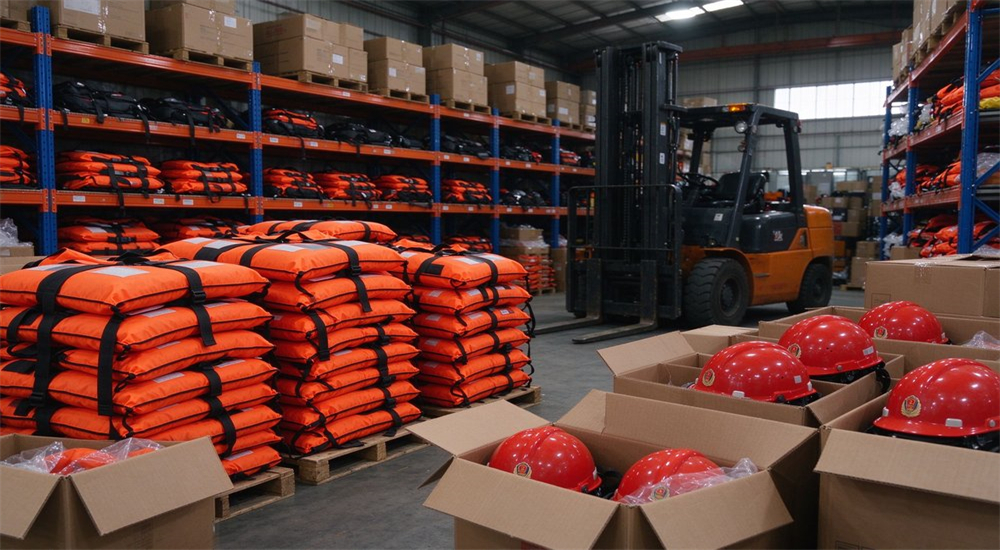
Bulk flood rescue gear is typically packaged in individual poly bags, then packed in export cartons with moisture-proof lining. Each carton should be labeled with product name, quantity, size distribution, and batch number. For government procurement, custom labeling with asset tags, department codes, or serial numbers can be applied during production. Shipping options include sea freight (most economical for large orders, 25-35 days), air freight (faster for urgent restocking, 5-7 days), and express courier (for samples and small quantities, 3-5 days). Always confirm Incoterms (FOB, CIF, or DDP) before placing your order to avoid unexpected costs.
Quality Assurance for Bulk Orders
When placing a bulk order, request a pre-production sample for approval before full manufacturing begins. This allows you to verify fit, materials, and customization before committing to the full quantity. Upon delivery, inspect a random sample of at least 5% of the order for quality consistency. Reputable manufacturers will replace defective units at no cost. Keep detailed records of batch numbers and inspection results for your equipment management system.
Related Products & Resources
Flood Rescue Clothing FAQ
Q1: What equipment is essential for flood rescue teams?
Essential flood rescue equipment includes PFDs or life jackets (150N minimum), dry suits or wetsuits depending on water temperature, rescue helmets, throw bags, rope systems, inflatable boats, and personal lighting. Communication devices and first aid kits are also critical.
Q2: How should flood rescue gear be maintained after deployment?
After each deployment, rinse all equipment with fresh water to remove contaminants, inspect for damage, and dry thoroughly before storage. Ropes should be washed with specialized rope soap, inspected for core damage, and logged according to your equipment management system.
Q3: What PFD rating is required for flood rescue operations?
For professional flood rescue, a minimum 150N buoyancy rating is recommended, with 200N+ preferred for swiftwater and when wearing heavy gear. The PFD should have quick-release harness capability, rescue tethers, and high-visibility coloring.
Q4: Can flood rescue equipment be used for other water rescue scenarios?
Most flood rescue gear is versatile and can be used for swiftwater, still water, and coastal rescue. However, ice rescue requires specialized thermal protection, and whitewater may require additional helmet and body protection.
Q5: What is the recommended team size for flood rescue operations?
A standard flood rescue team consists of 4-6 members: a team leader, a primary swimmer, a backup swimmer, a rope tender, and a boat operator if watercraft is deployed. Additional support personnel may be needed for large-scale operations.
Q6: How often should flood rescue equipment be inspected?
Perform a pre-use inspection before every deployment. Conduct a detailed formal inspection monthly, including buoyancy testing of PFDs, rope inspection and retirement logging, and functional testing of all mechanical equipment. Annual third-party certification is recommended.
Q7: What considerations apply to flood rescue in contaminated water?
In contaminated flood water, use fully sealed dry suits with face protection, gloves, and boots. Decontamination protocols should be established for both personnel and equipment. N95 or higher respiratory protection may be needed for airborne contaminants.
Q8: How do I build a flood rescue equipment inventory for my department?
Start with a needs assessment based on your operational area, team size, and typical flood scenarios. Prioritize personal PPE for each team member, then shared equipment like boats and rope systems. Maintain a 10% spare inventory for critical items.
Q9: What is the shelf life of inflatable rescue boats?
With proper maintenance, hypalon inflatable boats last 10-15 years, while PVC boats typically last 5-8 years. Factors include UV exposure, storage conditions, and frequency of use. Annual pressure testing and inspection are essential.
Q10: Can flood rescue ropes be used for other applications?
Rescue ropes are specifically designed for water rescue with high visibility, water resistance, and appropriate stretch characteristics. They should not be used for climbing, hauling heavy loads, or general utility purposes, as this can cause hidden damage.
Q: What is the minimum buoyancy rating for flood rescue life jackets?
A: For flood rescue operations, a minimum buoyancy rating of 150N is recommended. Rescue technicians who carry additional equipment (tools, radios, rope bags) should use 200N-275N PFDs. Higher buoyancy ensures the rescuer's head stays above water even when fully clothed and equipped.
Q: Should I choose a dry suit or wetsuit for flood rescue?
A: Dry suits are recommended for cold water (below 15°C / 59°F), contaminated water, and long-duration operations. Wetsuits are suitable for warm water (above 15°C), short-duration missions, and training. Most professional teams maintain both types and select based on conditions. If budget allows for only one type, dry suits offer more versatility across conditions.
Q: How often should flood rescue equipment be replaced?
A: Life jackets should be replaced every 5-7 years or sooner if damaged. Dry suits typically last 5-10 years with proper maintenance (seal replacement every 2-3 years). Helmets should be replaced after any significant impact or every 5-7 years. Boots and gloves are consumable items and should be replaced every 1-2 years depending on use. Always follow the manufacturer's recommended service life.
Q: Can flood rescue clothing be customized with our agency logo?
A: Yes, most manufacturers offer logo printing or embroidery on life jackets, dry suits, and helmets. Customization typically adds 7-14 days to production time and may require a minimum order quantity. Provide your logo in vector format (AI or EPS) for best results. Reflective printing is also available for high-visibility applications.
Q: What certifications should I look for when purchasing flood rescue gear?
A: For life jackets, look for ISO 12402 (150N or higher) or USCG certification. Helmets should meet CE EN 1385 (whitewater) or ANSI Z89.1 standards. Dry suits may be certified to CE EN 14594. Always verify that the certification applies to the specific model and size, and request copies of certification documents from the supplier.
Q: How do I properly clean and store flood rescue equipment?
A: After each use, rinse all equipment with clean water to remove contaminants. Hang dry in a shaded, well-ventilated area — avoid direct sunlight which degrades neoprene and fabrics. Store life jackets flat or on wide hangers to prevent compression of flotation material. Dry suits should be stored loosely folded or on hangers, with zippers partially open and seals dusted with talcum powder. Keep all equipment in a cool, dry location away from chemicals and ozone sources.
Q: What is the typical lead time for a bulk flood rescue gear order?
A: Standard in-stock items ship within 7-14 days. Custom orders (special colors, logos, custom sizing) require 45-60 days for production. Plan procurement at least 3 months before your operational season or training cycle. For emergency restocking, ask about available stock in standard sizes and colors.
Q: Can I mix and match equipment from different manufacturers?
A: Yes, flood rescue equipment is generally interoperable between manufacturers. However, for consistency and ease of maintenance, many teams prefer to standardize on a single manufacturer for core items (life jackets, suits, helmets). Accessories (gloves, boots, lights) can be sourced from different suppliers based on best fit and price. Ensure that attachment systems (D-rings, rails) are compatible across your equipment.
Q: What size range should I order for my team?
A: For adult teams, order a range of sizes from XS to XXL, with the majority in M, L, and XL. A typical distribution is: 10% XS/S, 40% M, 35% L, 15% XL/XXL. Dry suits and wetsuits should be individually fitted — consider scheduling a fitting session with your supplier before placing a bulk order. Helmets typically come in adjustable one-size or two-size (S/M, L/XL) options.
Q: Do you provide equipment training or usage instructions?
A: All flood rescue equipment comes with manufacturer usage and care instructions. For teams new to this equipment, we recommend partnering with a certified swiftwater rescue training organization for hands-on training. Proper fit, donning/doffing technique, and equipment inspection should be covered in your team's standard operating procedures. We can provide product-specific training materials upon request.
Q: What is the difference between a rescue PFD and a recreational life jacket?
A: Rescue PFDs differ from recreational life jackets in several key ways: higher buoyancy (150N+ vs. 50-100N), quick-release harness systems for tethered rescue, multiple D-rings and attachment points for equipment, reinforced shoulders and grab handles, and shorter torso length for improved mobility while swimming. Recreational life jackets are designed for passive floating, while rescue PFDs are designed for active swimming and victim contact.
Q: How should I size a dry suit for flood rescue?
A: Dry suits should fit snugly but allow room for thermal base layers underneath. Measure chest, waist, inseam, and height, and compare to the manufacturer's size chart. The neck and wrist seals should create a watertight seal without restricting circulation. If between sizes, size up and use the adjustable neck seal or wear a thicker base layer. Always test the suit in water before operational use to verify no leaks at the seals or zipper.
Previous :
Coastal Rescue Gear for Maritime Emergency ResponseNext :
Wholesale Ice Rescue Suits for Professional Cold Water Teams Firefighting Life Jacket, Quick Auto-Inflation, Universal Orange
This professional firefighting life jacket features a wear-resistant waterproof Oxford fabric outer layer with EPE high-density polyethylene foam filling, providing ≥100N total buoyancy with ≥50N inherent buoyancy. Equipped with a ≤5-second quick auto-inflation system, it meets emergency rescue needs in firefighting, floods, and inundations. The high-visibility orange design with reflective strips enhances night recognition, while the chest rescue whistle facilitates emergency distress signals. Universal size fits most rescue personnel, with customizable organizational logos and functions.
 Floating Rescue Vest High-Visibility Waterproof Earthquake Safety
This flood prevention life jacket is made of 200D Oxford polyester fabric with polyethylene foam buoyancy material, providing ≥8.5kg buoyancy. Measuring 65×50cm, it fits most adults. Featuring 6 evenly distributed reflective patches and an emergency whistle, it's specifically designed for maritime storms, floods, and earthquake-induced water disasters. The orange/green design ensures high visibility during water rescue operations. Professional teams can customize specifications, markings, and special features according to their requirements.
 Rescue Life Jacket, Thickened Waterproof, 74N High Buoyancy Design
Professional rescue life jacket features 200D thickened Oxford fabric outer layer, high buoyancy ≥74N design, compliant with GB/T32227-2015 rescue equipment standards. Standard size 58×42×5.5cm, lightweight for quick mobility. Orange-yellow high-visibility color with shoulder reflective strips ensures maximum visibility in extreme conditions like floods and tsunamis. Ideal for flood rescue, sea storm rescue and earthquake-induced flood disasters, an essential equipment for professional rescue teams.
 Flood Control Life Vest, 200D Oxford Fabric, Orange-Yellow High Visibility
Professional flood control life jacket features 200D thickened Oxford fabric outer layer, standard size 58×42×5.5cm, with ≥74N buoyancy value tested to GB/T32227-2015 standards. High-visibility orange design with night reflective strips, lightweight for unrestricted movement. Ideal for flood disasters, earthquake-induced floods, sea storm rescues and extreme conditions, providing reliable buoyancy support for rescue personnel, improving water rescue efficiency by 99% - essential equipment for emergency rescue operations.
 Professional Flood Rescue Life Jacket High Buoyancy Vest
This professional flood rescue life jacket features a 450D waterproof Oxford fabric outer layer with EPE high-buoyancy filling material, providing ≥88N buoyancy to ensure water rescue personnel safety. Equipped with night reflective patches and large reflective areas on shoulders and chest to enhance visibility in adverse weather conditions. The lightweight design weighs ≤1kg, not affecting rescue operation flexibility. Tested in actual flood disaster scenarios, it provides continuous buoyancy support for over 12 hours in rapid currents, having protected over 10,000 rescue personnel during 327 flood control operations nationwide.
 88N Buoyancy Water Rescue Life Vest Emergency Disaster Vest
This professional water rescue life vest features a 450D waterproof Oxford fabric outer layer with EPE high-buoyancy filling material, providing ≥88N buoyancy support to ensure rescuers remain stable in rapid currents. Weighing ≤1kg, it's lightweight and doesn't restrict rescue operations. Large reflective patches on shoulders and chest enhance nighttime rescue visibility. Field-tested to protect rescuers during 18-hour continuous emergency operations, it has been successfully deployed in 176 flood rescue missions nationwide.
Copyright © Custom Disaster - Relief Bedding: Tents, Sleeping Bags, Blankets All Rights Reserved
the professional team to service !