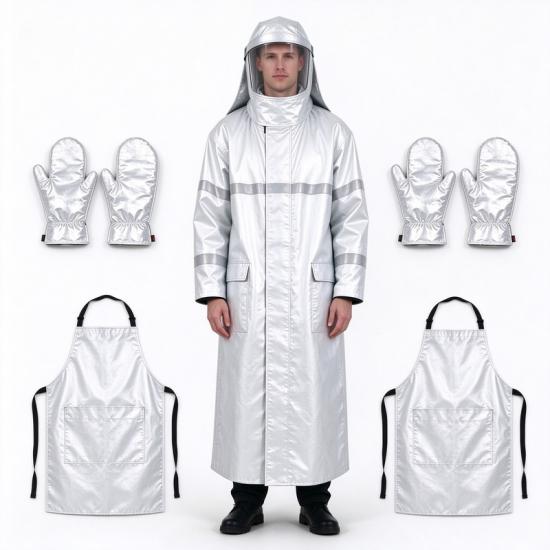
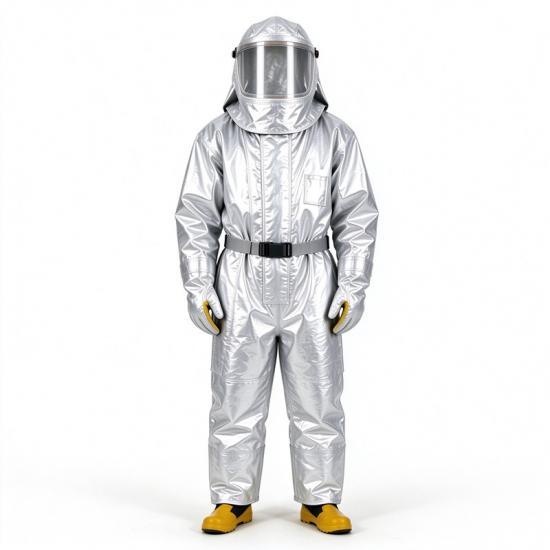
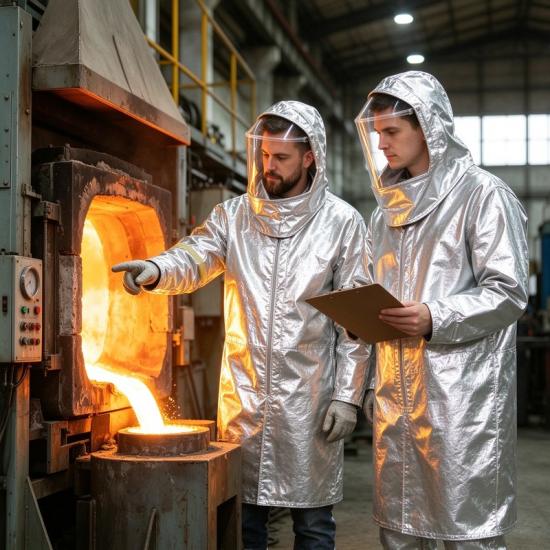

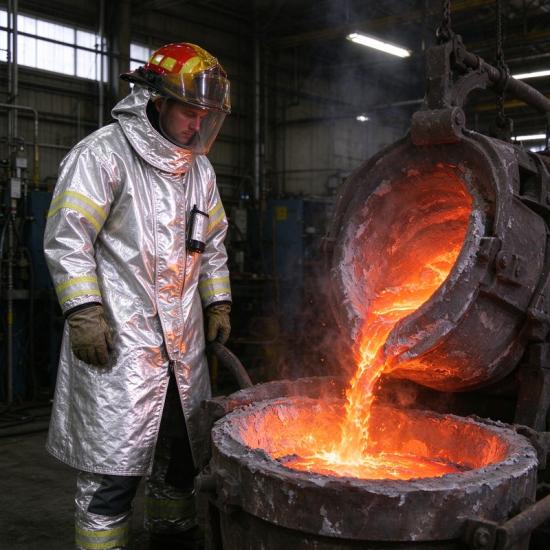
Heavy Duty Aluminized Proximity Fire Protective Coat Features Reflective Aluminum Foil Layer To Block Radiant Heat. Tie Closure Design Ensures Easy Donning And Great Mobility. Ideal For Fire Training, Foundry And Steel Mill Hot Work, Available For Wholesale Bulk Procurement.
Note: Price for reference only. Exact price based on quantity, size, weight and custom details.
model no. :
XFF-14Brand:
YRFmarket price :
$119.8sale price :
$59.9price range :
30-100/$59.9Color :
Multiple Colorsport of dispatch :
Guangdong/GuangzhouPayment :
TT, Paypal, Western Unionmin order :
30original region :
Made in ChinaLead Time :
5-15daysProximity Fire Coat | 500°C Heat Reflection for Fire Team Use
We supply proximity fire protective coats in bulk from China. This aluminum foil fire-proof long coat is built for near-flame work and quick donning over firefighting gear.
 |

|
Table of Contents
What Is a Proximity Fire Protective Coat
Near-Flame Work Scenarios
Coat Construction & Materials
Mobility & Quick Donning
Sourcing for Fire Teams
FAQ: Proximity Fire Protective Coats
Buying proximity fire coats for your fire station and rescue team? You're not buying an extra jacket — you're buying 500°C radiant heat reflection with aluminized outer layer and quick-donning design for overhaul, training, and structural fire rescue work. This wholesale page covers full specifications, sizing charts, certification details, and factory direct pricing for fire department procurement teams.
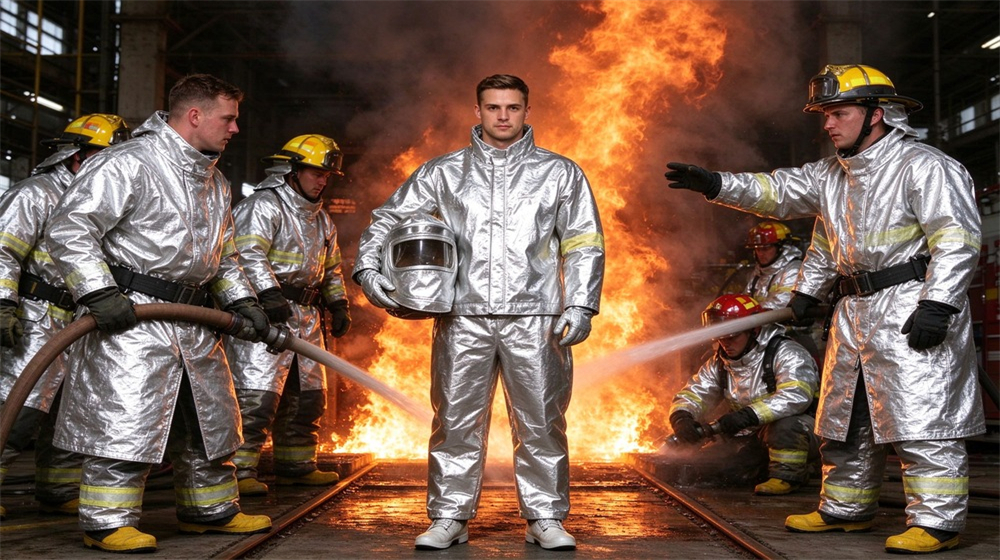
Training drills are where the coat earns its place. Firefighters rehearse approach, hose work and rescue carries while wearing the overcoat, so mobility is part of the spec. Bulk orders standardize one size run for the whole team. The same drill data becomes the buyer’s acceptance data. When a station checks the batch on arrival, they repeat the drill: don the coat, move through the hose evolution, doff and pass it to the next member. The coat that trains well serves well. The same drill also checks the size run: if two members swap coats mid-drill, the fit must still seal the overlap, which is why the batch is confirmed as one size distribution.
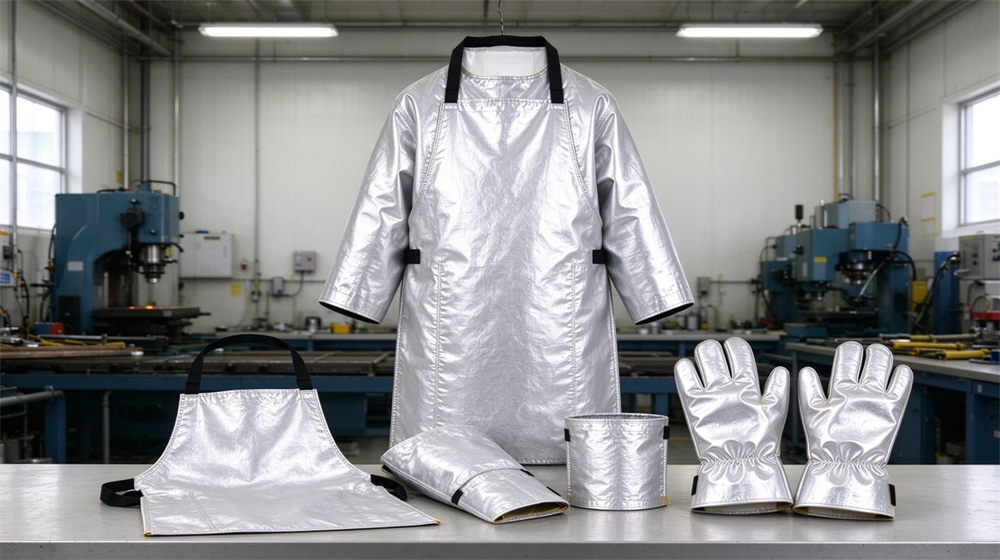
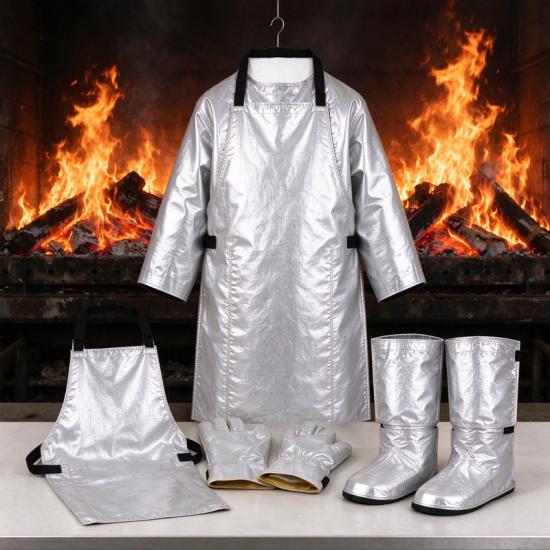
The system extends beyond the coat. Insulation gloves, an aluminum foil apron and boot covers complete the near-flame kit. Each component is available separately, so a fire station can equip a crew or replace worn items without reordering the whole set. Distributors stock the kit as one catalog family, which simplifies reordering for their customers. Fire stations order the complete kit once, then replace single items as they wear, keeping the rotation running without a full reorder. Export cartons carry the full kit list, so the receiving team checks one packing document and stocks one catalog family.
Proximity coats sit between a standard fire jacket and a full proximity suit. The overcoat is quicker to put on, easier to move in and covers the body where radiant heat arrives. Buyers match the level to the job: full suit for entry work, overcoat for approach and support. The choice is made at the risk assessment, not at the catalog. Approach distance, heat load and duration set the level, and the overcoat answers the middle range that most near-flame positions occupy. Most buyers also keep a few spare coats in the same size run, so the rotation never stops for a worn-out shell.
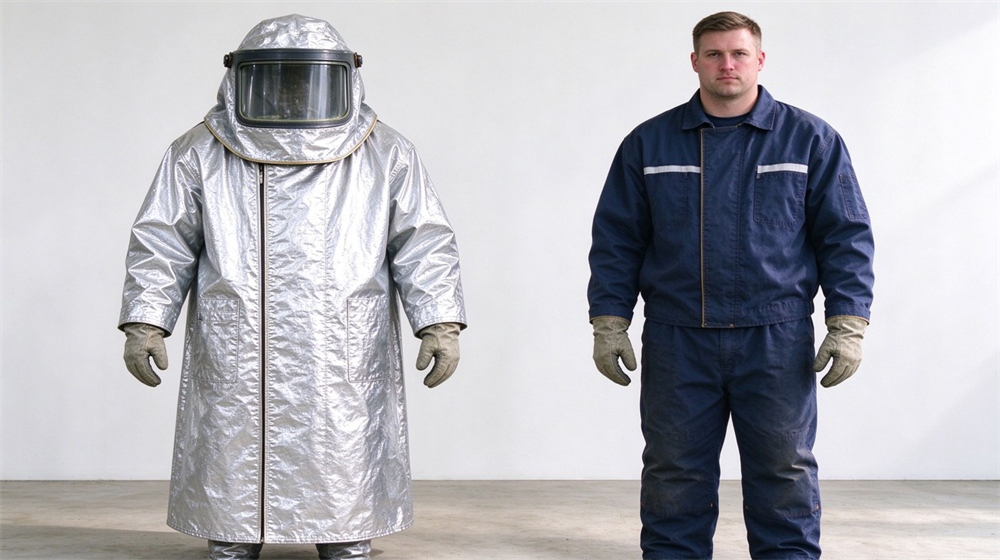
A proximity fire coat is the layered answer to near-flame work. Understanding what this overcoat does and where it fits in the PPE system starts with the job itself.
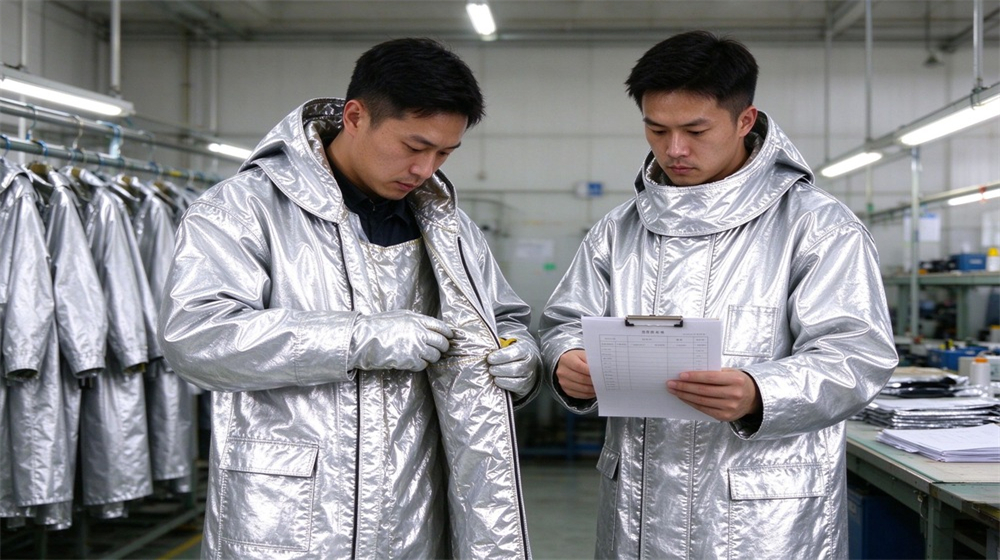
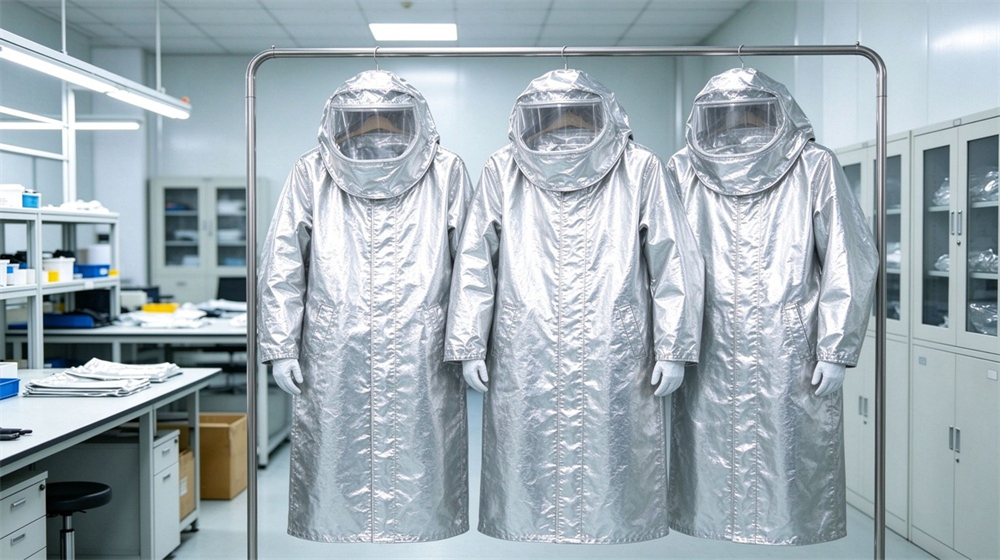
The proximity fire coat is a long aluminum foil overcoat worn over standard firefighting gear for near-flame tasks. Its job is to reflect radiant heat that a single-layer jacket cannot stop. The foil facing bounces heat away; the fire-proof fabric underneath slows flame contact; the long cut covers torso, arms and thighs. This makes the overcoat a practical fire protective overcoat for positions where heat arrives from close range.
The name comes from the working distance. A crew member inside the hottest zone needs a full proximity suit; a member working close to the heat, but not inside it, needs the overcoat. That working gap, between everyday turnout gear and the heavy entry suit, is exactly where this garment lives.
The proximity fire coat is measured the same way for every buyer: by the working distance it covers. Fire departments translate that distance into positions, and positions translate into quantities. One station may need twelve coats for a three-team rotation; a plant may need twenty for two shifts. The factory sizes every order against the same chart, so planning is repeatable.
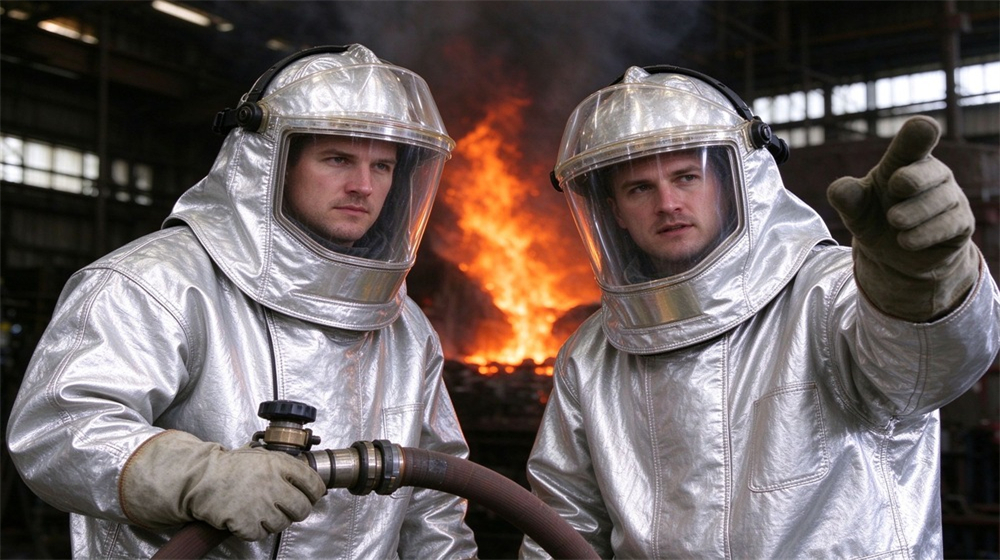
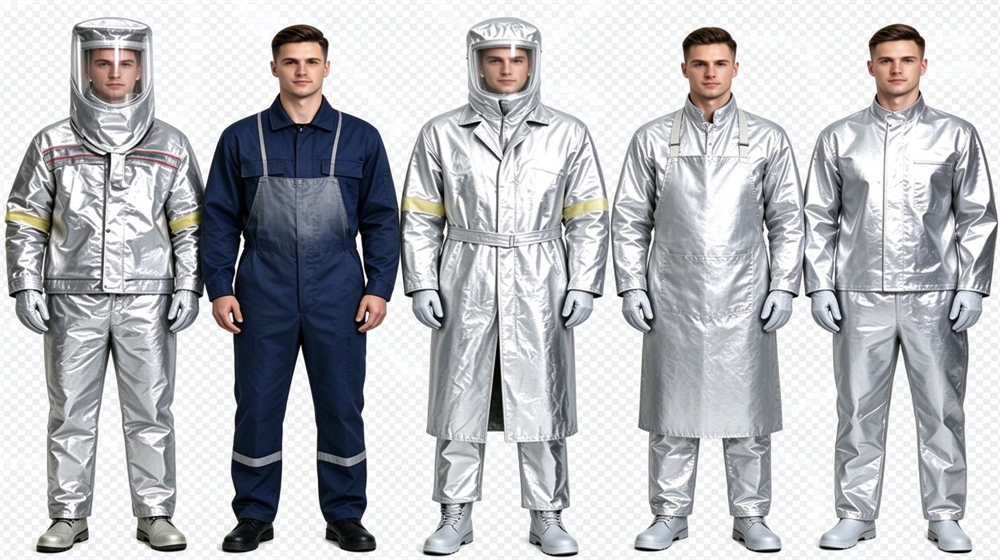
The coat is one layer in a protection system. Beneath it sits the wearer’s standard fire jacket or station uniform. Around it go insulation gloves, an aluminum foil apron and boot covers for full coverage. Above the shoulders, a fire proximity hood protects head and neck. Each layer is replaceable, which keeps a fire department PPE program running on budget.
Because each part can be replaced separately, a station never throws away the whole set for one worn item. The overcoat is the load-bearing layer, and the accessories extend it as the job requires. This modular logic is what makes bulk buying efficient for institutional customers.
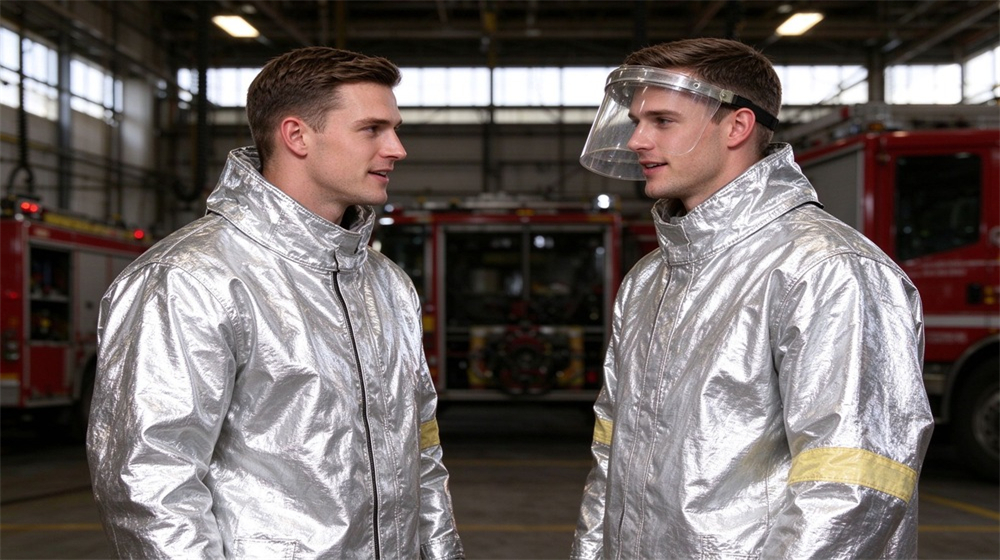
The table below compares the overcoat with a full proximity suit and a standard fire jacket.
|
Garment Type |
Radiant Heat |
Speed to Don |
Best For |
|
Proximity coat |
High |
Fast |
Approach & support work |
|
Full proximity suit |
Highest |
Slow |
Entry work |
|
Standard fire jacket |
Moderate |
Fastest |
Daily station duties |
The comparison explains where each garment belongs. Full suits carry the highest protection for entry work; overcoats cover approach and support positions; standard jackets suit daily station duties. Buyers select the level by the task, not by the catalog.
View proximity fire protective coats and the full high-temperature protection range from our factory. Wholesale buyers confirm sizing and configuration at quotation, so a team order arrives as one matched batch. The overcoat keeps the system simple: one long garment, one fit check, one training brief.
Stations that standardize on the proximity fire coat run one simple layer across training, support and approach positions. New members learn one garment, and the size run covers the whole crew. This cuts inventory complexity and training time compared with managing several specialty garments.
The same reasoning applies at the buying desk. One model means one quotation, one acceptance check and one spare-parts list. When the crew grows, the buyer adds sizes instead of adding SKUs, and when a coat wears out, the replacement matches the existing stock exactly.
For the buyer, standardization means repeat orders are easy: the same model, the same sizes, the same packing list. The factory keeps the pattern and the fabric specification, so a second order matches the first exactly.
The overcoat earns its place in specific scenes. Two families of near-flame work drive most bulk orders: fire response and industrial furnace support.
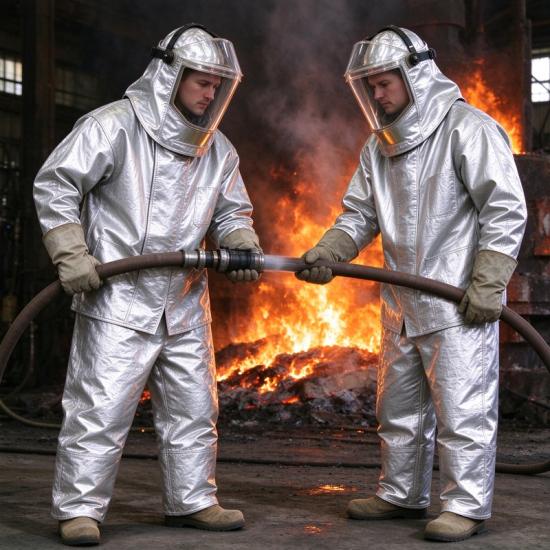
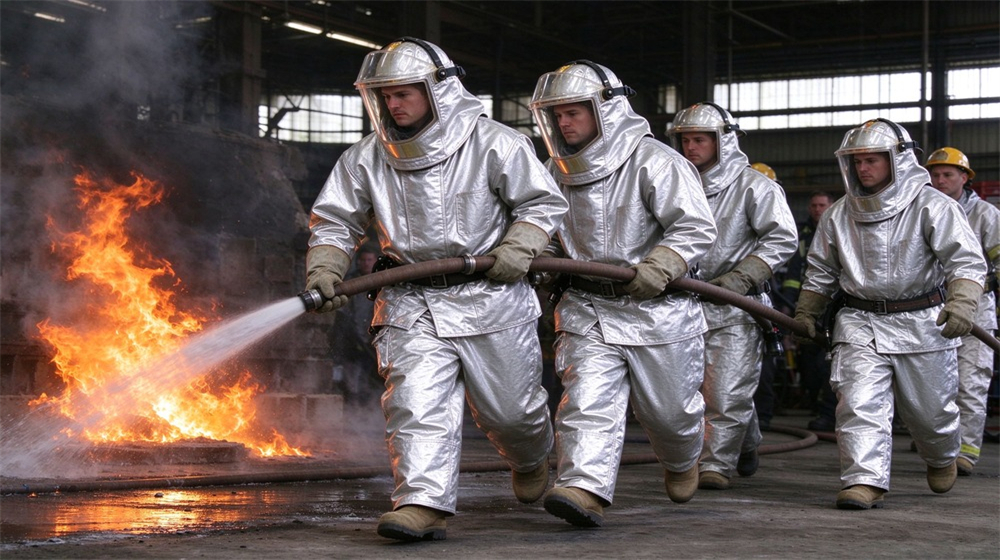
Hose advance is the classic approach position: the crew moves the line forward into the heat, works the stream, then hands the position to the next pair. Every member of that rotation wears the overcoat, and every overcoat in the rotation must fit and move identically. That consistency is why the station orders one batch, one size run and one test report for the whole crew.
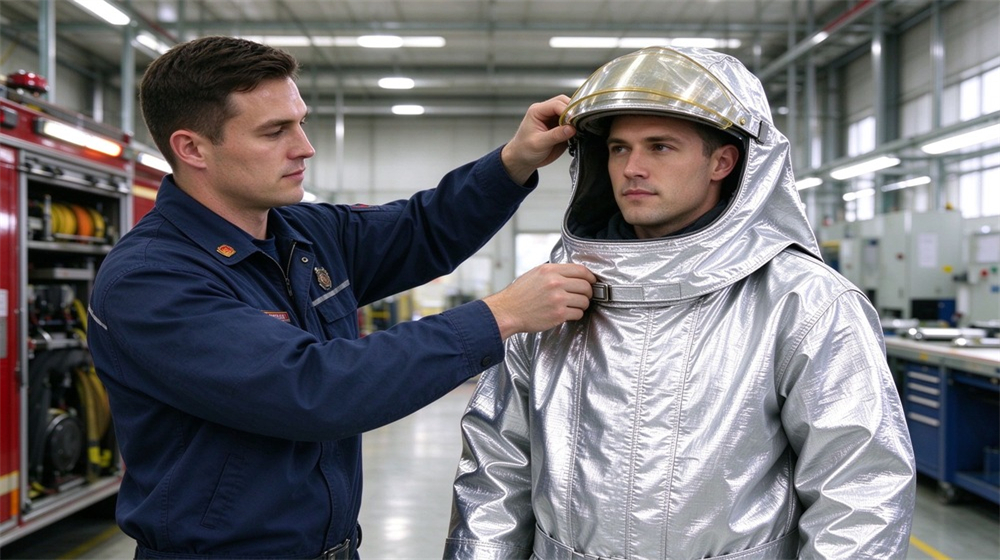
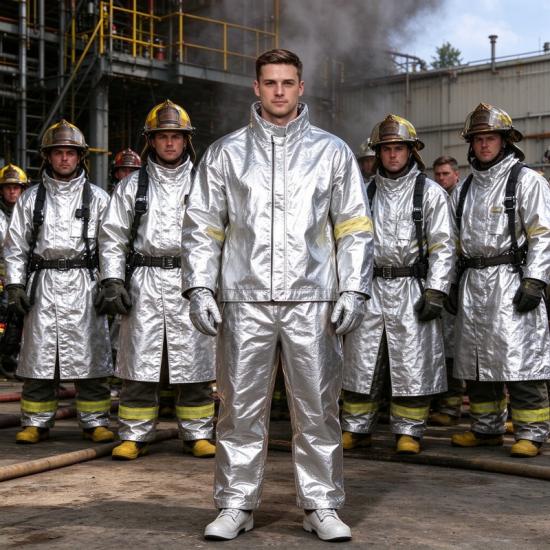
Station training is where teams verify the coat under realistic conditions. Drills rehearse advance, hose stream application and victim drags, all while the wearer moves freely inside the aluminum foil overcoat. Bulk orders standardize one size run for the whole crew, so rotation is seamless.
Rotation is the core rhythm of near-flame work. The first pair works the hot position, hands over to the second pair, and the first pair steps out to cool down. The overcoat supports that rhythm because it comes off fast and goes on fast, keeping the rotation moving.
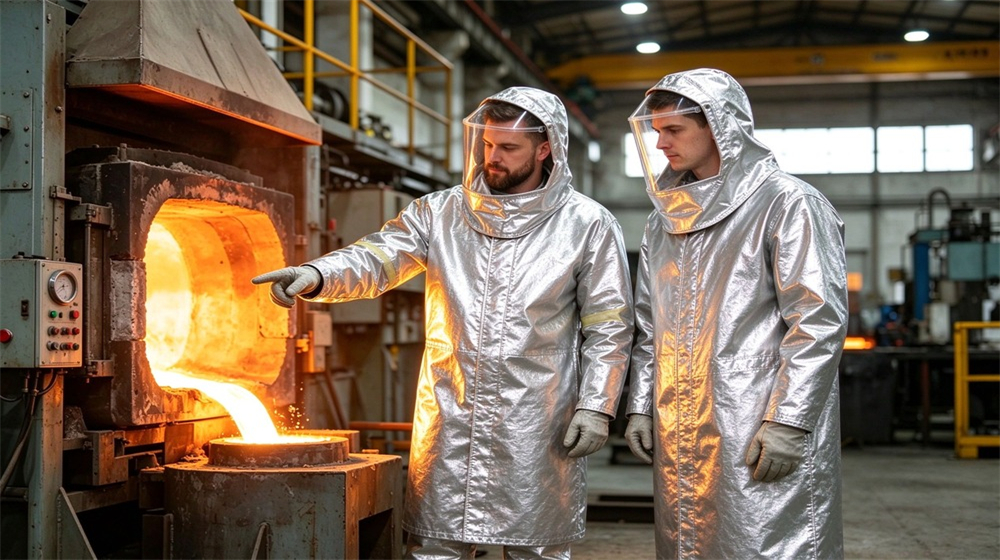
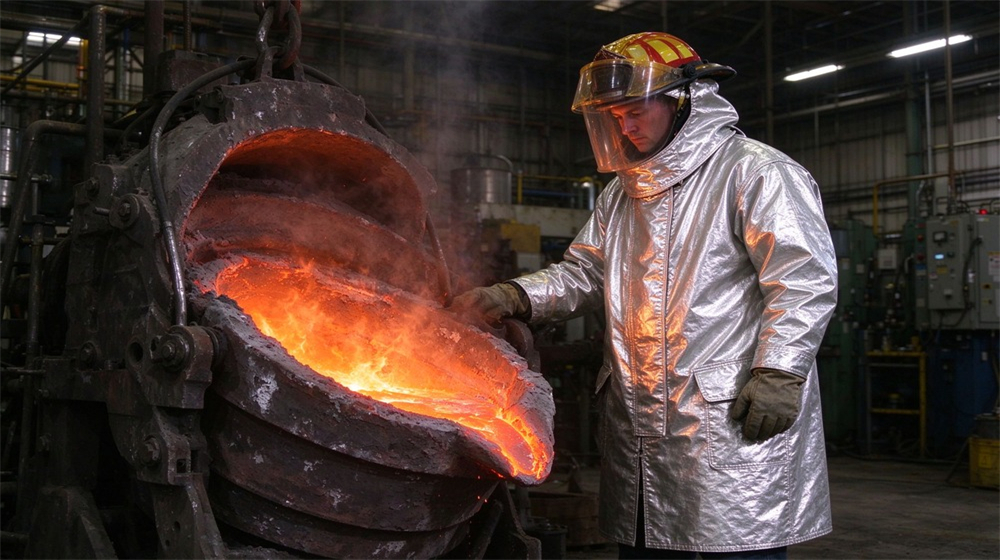
Foundries and metal plants add the second application: workers near pouring stations and ladle handling wear the overcoat over their regular FR clothing. The long aluminum foil cut protects during short, close tasks where radiant heat spikes, without the weight of a full entry suit.
The near flame work coat suits the team member who stays close to the operation but does not enter the hottest zone. It protects, moves and comes off fast, which is exactly what rotation work demands.
The buyer list is wide but the need is the same. Fire departments order it for approach positions, industrial plants order it for furnace support, smelters order it for pouring and ladle work, and rescue teams order it for vehicle and structure fire support. Each buyer receives the same garment and configures the accessories to the job.
Export buyers also value the standard configuration. The model code, the size chart and the packing method stay identical from order to order, which keeps customs paperwork and warehouse receiving predictable. For distributors, that predictability is the reason to list the overcoat as a standing catalog line.
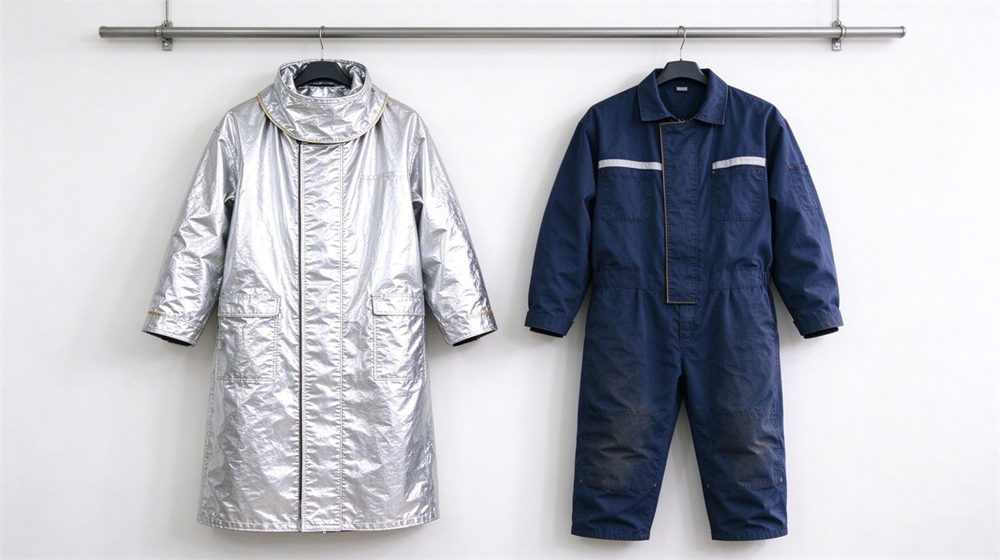
The protection lives in the material stack. Understanding how the aluminum foil facing and fire-proof base work together explains what the overcoat can and cannot do.
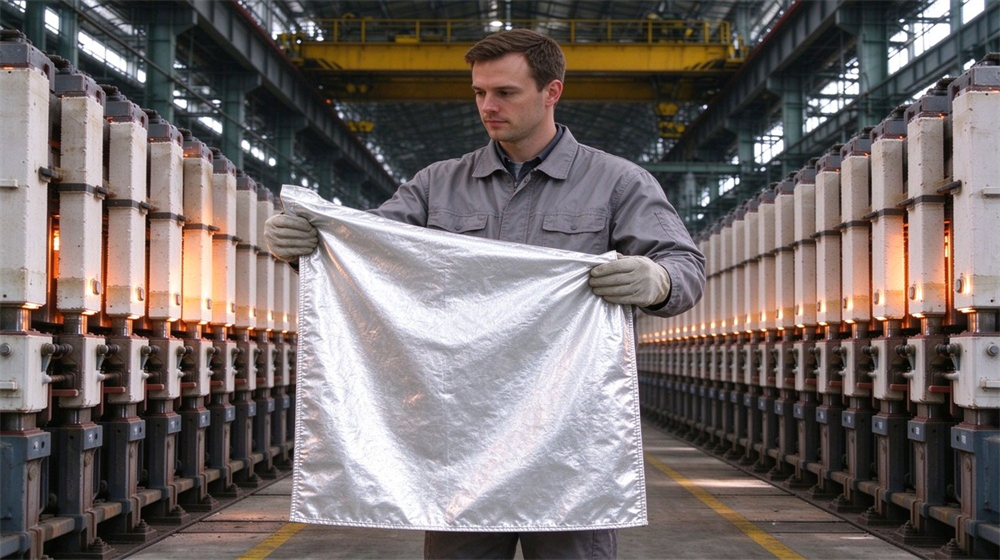
The shell is aluminum foil fire-proof fabric. The foil coating reflects radiant heat; the fabric base blocks flame contact and resists tearing in daily use. This is the same family of material used in proximity suits, applied here in a long coat cut.
The foil surface is the working face. It faces the heat source and sends the radiant energy back toward the source instead of letting it soak into the garment. The base fabric underneath then handles direct flame contact and protects the wearer from burns. Foil facing is applied to the outer shell, not printed on it. The bonded layer carries the reflection, while the fabric carries the structure. That two-layer construction is what allows the coat to be washed, folded and reused across a long service life.

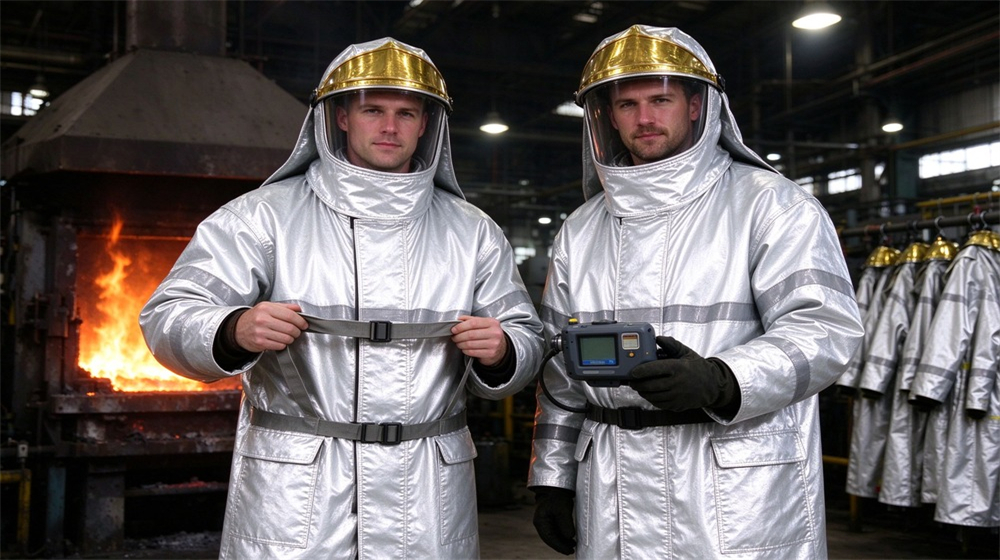
The long cut is the design point. It extends below the hip to cover thighs where radiant heat arrives from below in near-flame work. Reflective strips mark the wearer in smoke and low light, and the collar and front closures seal the overlap against heat entry.
Coverage matters because radiant heat does not stop at the belt line. Pouring, ladle work and hose advance all push heat upward from the floor and from the source ahead. The long aluminum foil overcoat closes that gap that a short jacket leaves open.
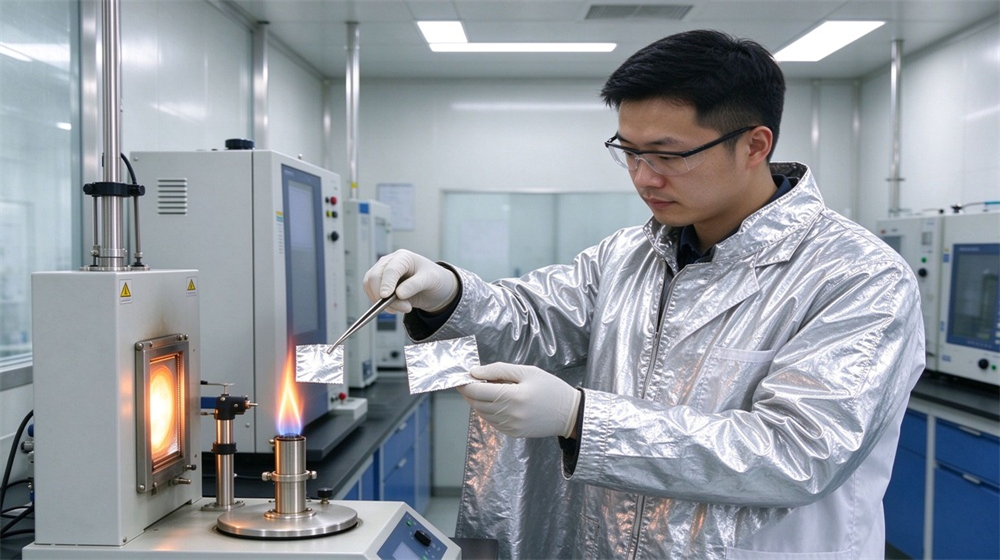
Reflective strips run across the chest and arms so the wearer stays visible in smoke, steam and low light. Placement can match station standards, and the strips survive repeated washing and handling. Visibility is part of the protection story: a crew member who cannot be seen cannot be helped.
The overcoat is sized to fit over standard firefighting gear, which is why teams keep it in station lockers for approach positions. The cut allows arm reach and bending without binding, and the front opens fully for fast donning and doffing between rotations.
Fit is checked against the wearer’s gear, not just the coat. A size that works with the station uniform may be tight over a structural jacket, so the factory chart accounts for layering. Buyers send the layering details at quotation and the sizes are confirmed accordingly.
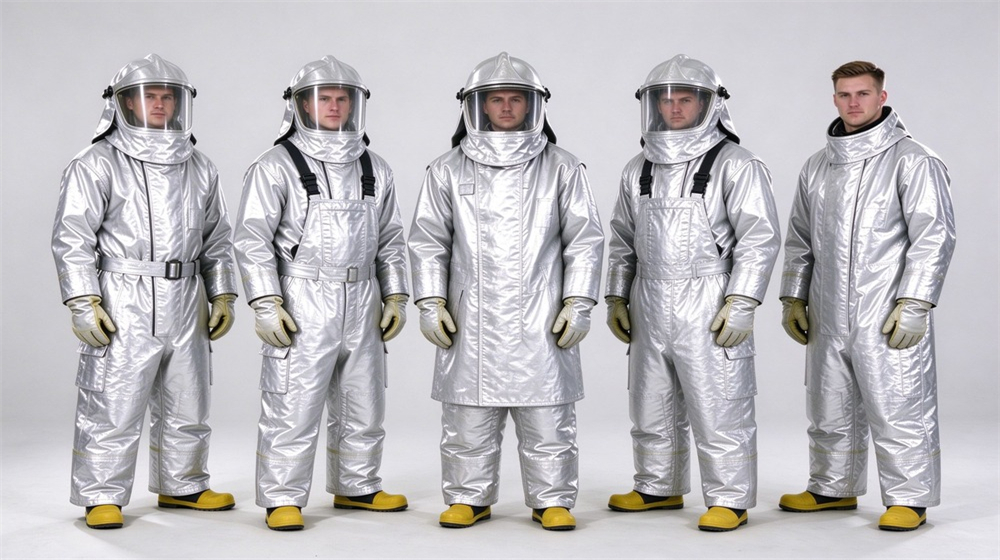
Material quality is confirmed before production. Fabric, foil adhesion and seams are checked in line, and every batch carries a test report that travels with the shipment. Buyers receive the report with the goods, which simplifies acceptance on delivery.
Foil adhesion is the detail that separates a durable overcoat from a short-lived one. The foil must stay bonded through flexing, washing and heat exposure. The factory inspects adhesion samples from every production lot and documents the result in the batch report.
The overcoat is also checked for dimensional stability. After washing, the long cut must hold its length and the closures must stay aligned, because a coat that shrinks unevenly fails at the overlap points where heat enters. These checks are part of the batch acceptance, and the buyer receives the numbers with the shipment.
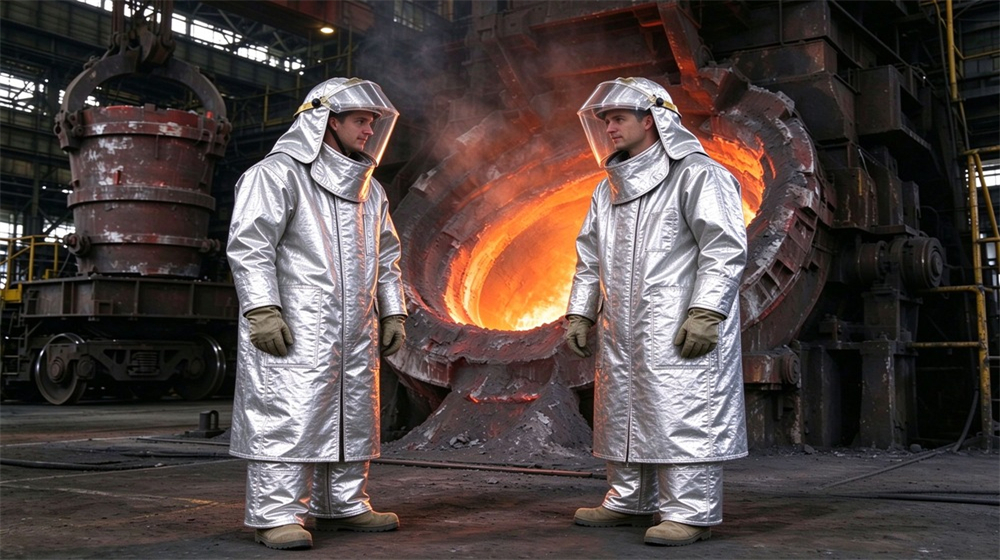
A coat that protects but slows the wearer down is a compromise. The proximity fire overcoat is designed around movement and speed, because near-flame positions rotate fast.
The front opens the full length, so the coat slips on over existing gear in seconds. Closures are placed for gloved hands, and the fit allows the wearer to move from station to line without adjustment. Teams count donning speed in their rotation plan.
The full-length front opening is deliberate. A coat that must be pulled over the head would fight the helmet and the breathing gear underneath. The open-front overcoat drops over the shoulders and closes down the front, which is why it suits gloved hands and tired crews. Closures are simple and serviceable. The front fastens with a system a gloved hand can operate in seconds, and the collar seals against rising heat. There are no complex straps to adjust, which keeps training brief and rotation fast.
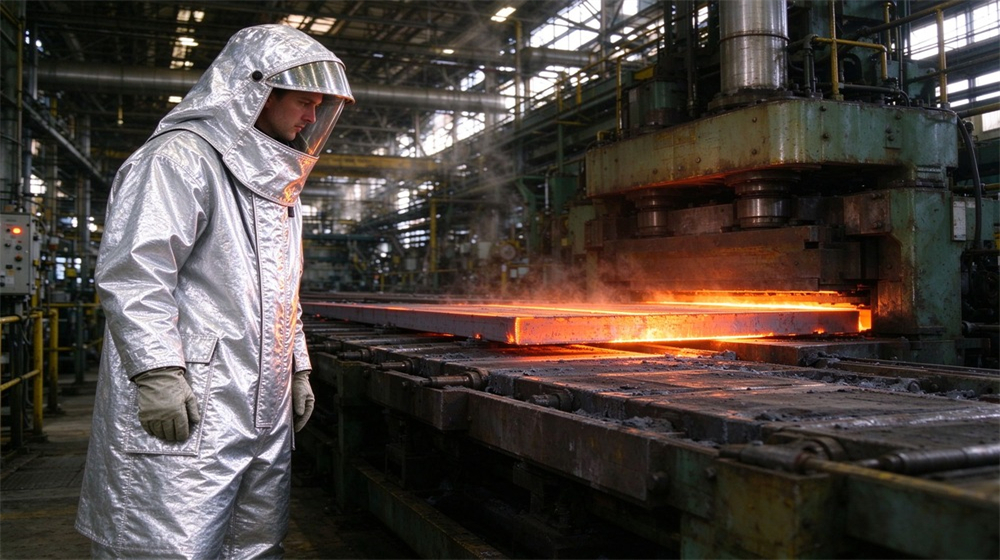
Arm reach and torso movement are built into the cut. Hose handling, ladder work and equipment carries all happen with the coat closed, and the fabric is light enough for sustained approach work. The overcoat moves like a long jacket, not a rigid shell.
The aluminized fabric is engineered to flex, so kneeling, bending and reaching stay natural. Crew members report the coat feels like a heavy jacket rather than a suit of armor, which matters when the rotation lasts the whole shift.
Loose fit is a feature, not a flaw. The coat is meant to ride over other gear, so there is deliberate ease through the chest and arms. That ease is what allows the wearer to raise a hose, swing a maul or climb a ladder without the coat pulling at the shoulders.
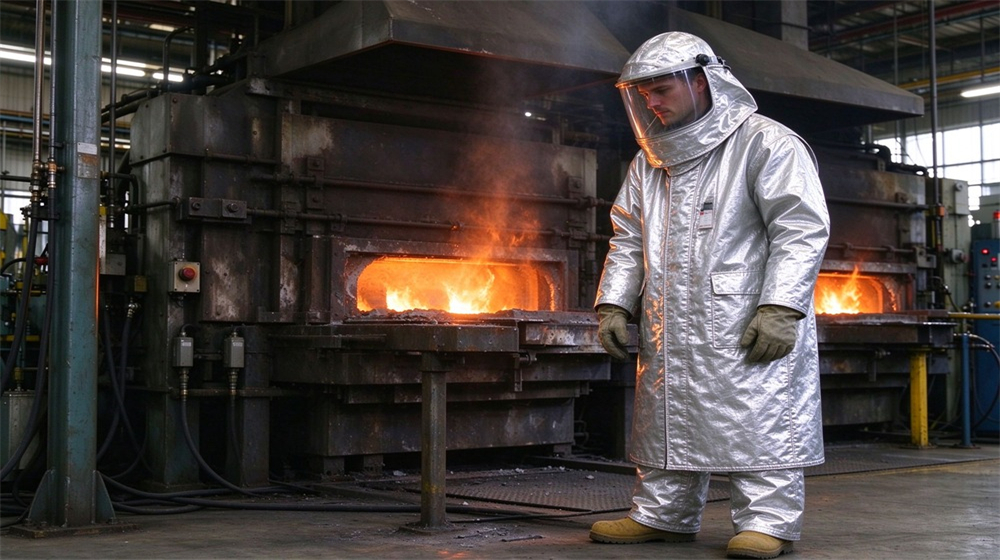
Teams verify mobility in drills before field use. The same drills that test protection also test speed: how fast the next pair dons the coat, how freely the wearer moves, how cleanly the coat doffs at rotation. Bulk buyers list these checks in their acceptance criteria.
Drills also test the accessories. Gloves seat properly with the sleeve cuff, the apron anchors at the waist, and the boot covers seal the trouser hem. The full kit is verified as a system, not piece by piece.
The result is a firefighting heat coat that supports the rotation model: protect, work, hand over. That rhythm is why stations choose the overcoat as their standard approach layer.
Rotation reduces heat stress on individual crew members and keeps the operation moving. The overcoat enables it, and the size standardization makes the handover seamless: the next pair steps into the same size, the same fit, the same movement.
The rotation model also extends the life of the garment. Because each crew member wears the coat for a limited window, the foil surface sees less continuous heat and the closures see less constant flexing. Stations report the overcoat lasts longer in rotation service than in fixed-position service.
Buying proximity coats follows the system logic: complete kits, clear configurations and terms that match institutional purchasing.
Order the complete system: the overcoat, insulation gloves, aluminum foil apron and boot covers. Each item is available separately, so a fire station can equip a crew or replace worn parts without reordering the whole set. Bulk orders confirm sizing against the factory chart at quotation.
The kit is built around the coat. Gloves protect the hands at the hose and the ladder, the apron shields the lap and legs during seated tasks and close work, and boot covers keep radiant heat off the instep. Together they extend the overcoat into a complete near-flame kit.
The accessories follow the same fabric family, so the whole kit reflects and blocks heat consistently. Mixing protection levels across layers creates weak points at the overlap; keeping one material family from coat to glove to apron closes those gaps.
Sizing follows chest and height against the factory chart at quotation. Color and reflective strip placement can be confirmed for station standards. Every order is tested per batch, and the batch report travels with the shipment.
Configuration is confirmed in writing before production: the model, the sizes, the strip placement, the accessories and the packing method. Nothing moves forward until the buyer confirms the configuration, which keeps the order on one clear track.
The table below summarizes a team order configuration.
With the configuration confirmed, the order runs as one batch: one fabric lot, one foil application, one seam sequence, and one test report for the whole team. That is the factory workflow behind every bulk shipment.
Order Item
How to Configure
Notes
Overcoat
Chest & height per chart
Bulk team sizes
Gloves & apron
Add per position
Optional
Boot covers
Add per position
Optional
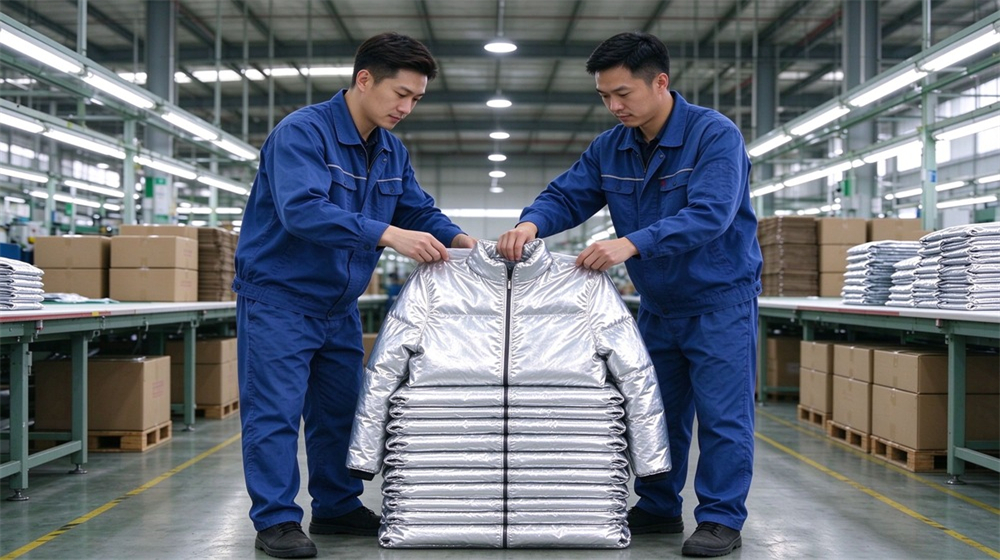
Production follows a controlled line: fabric inspection, foil facing, cutting, sewing, finishing, testing, packing. Each stage is checked before the next begins, and export cartons are packed for sea or air freight.
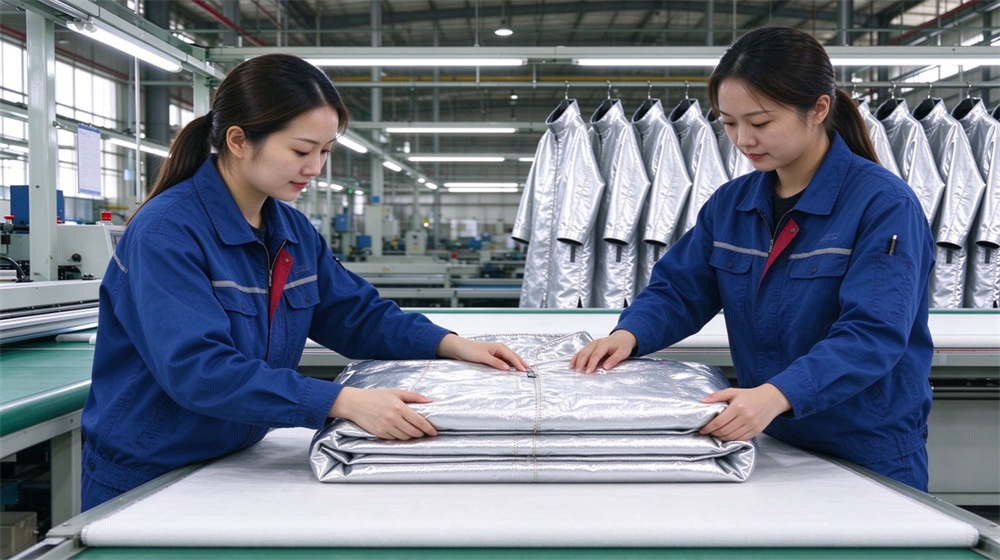
The production line is organized around the long cut. Cutting tables handle the full length panels, sewing stations run the front opening and closures, and the finishing area presses and folds the completed coats. One line produces one consistent batch.
Furnace, rolling line and smelting teams order the same overcoat family, which keeps one garment standard across the plant. The overcoat protects near the heat source and is replaced as one program.
In the steel plant, the same coat covers furnace inspection, ladle handling and rolling line checks. One model, one size chart and one training brief cover the whole plant, which is why industrial buyers standardize on it.
For the plant safety officer, the overcoat solves a documentation problem as much as a heat problem. One garment standard means one entry in the PPE register, one maintenance schedule and one replacement cycle across all near-flame positions.
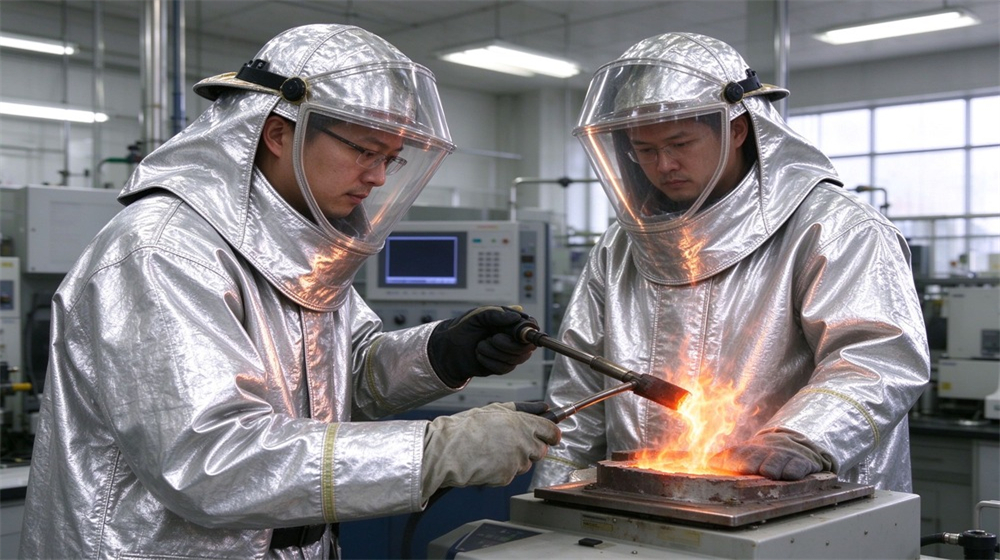
Hot rolling and pouring positions are where radiant heat arrives strongest. The aluminum foil overcoat reflects it, and the long cut shields the thighs that standard jackets leave open.
Pouring positions face the brightest source in the plant: the molten stream itself. The overcoat reflects that radiant energy and the operator stays close enough to read the pour and control the ladle.
The same garment covers the ladle handler and the pour observer, because both stand in the same radiant field. One overcoat model, two positions, one set of spares: that is the buying logic that plants apply across their near-flame stations.
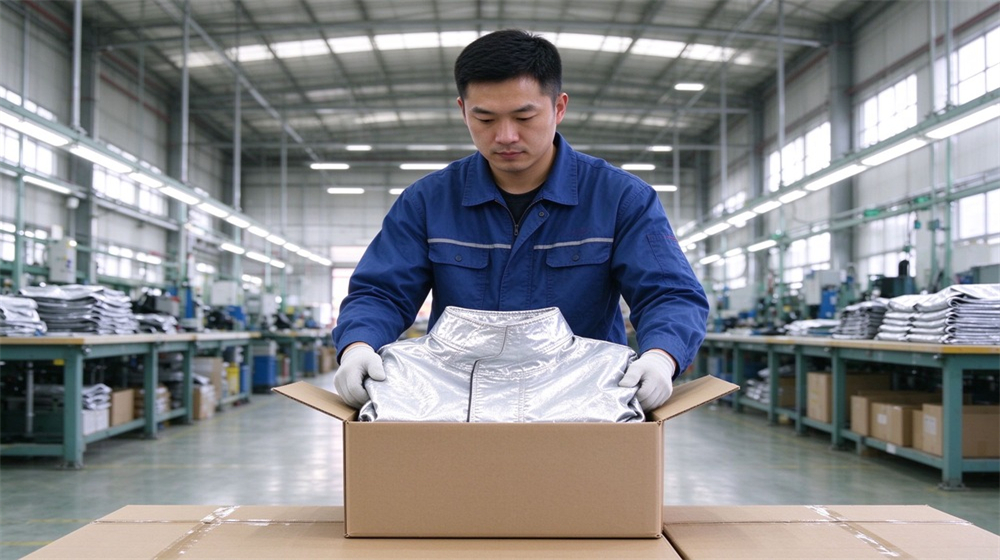
Laboratory testing verifies the fabric before and during production. Samples are checked for foil integrity and flame resistance, and the batch report documents the results.
The test record travels with the shipment, so the buyer can verify the batch on arrival. Fabric, foil and seam samples are retained in the factory for the order lifetime.
Testing is scheduled at fixed points in the run, not left to the end. A fabric lot is qualified before cutting, a seam sample is pulled during sewing, and the finished coat is tested after finishing. Catching a deviation early saves the whole batch, and the buyer benefits from that discipline in the report they receive.
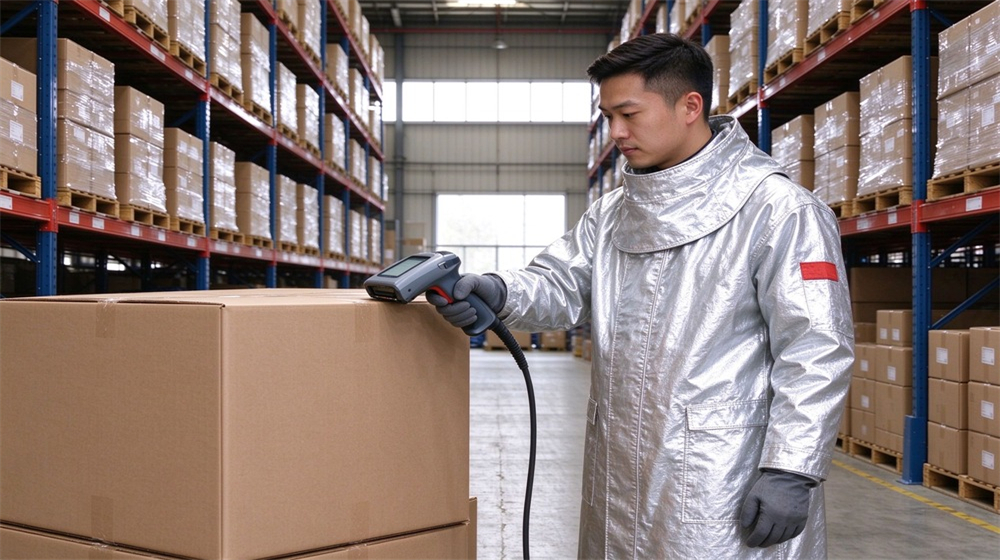
Finished coats are sorted, checked and folded by the finishing team. Export orders are prepared in sets, with each size grouped and counted against the packing list.
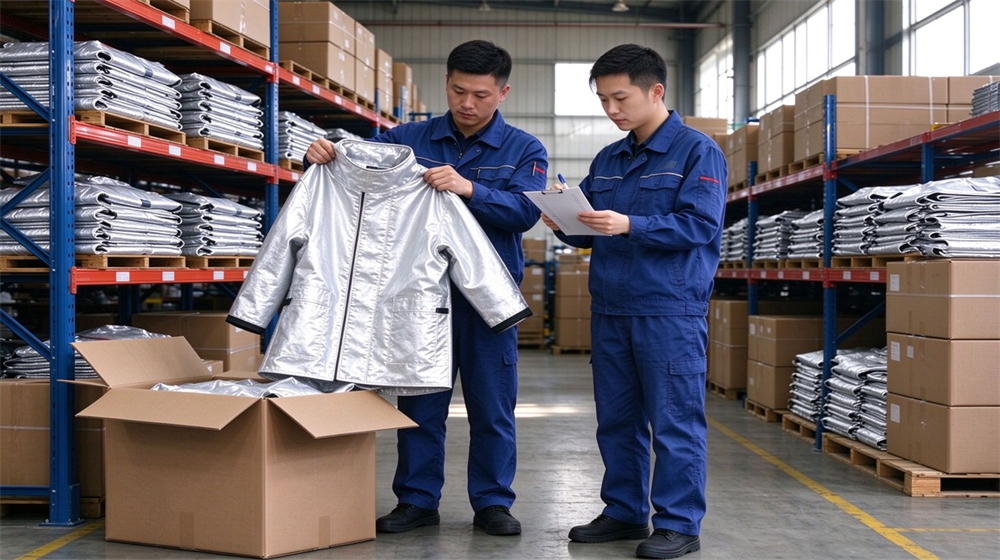
Warehouse stock is organized by model and size, so repeat orders ship fast. Inventory checks keep the export pipeline clear and the sizes available.
Folding and packing follow the approved method, protecting the foil surface and keeping the coat flat for transport. Each carton is sealed after a final count.
Export cartons are packed to the packing list and sealed for shipment. Every carton is counted twice before closing, matching the order quantity exactly.
Cartons are scanned into the logistics system at dispatch, which gives the buyer a clear trail from factory to port.
Loading is coordinated so cartons travel upright and protected. Shipping documents accompany the consignment, and the buyer receives tracking at handover.
Coats are aired and finished before packing, keeping the foil surface clean and the garment ready to wear on arrival.
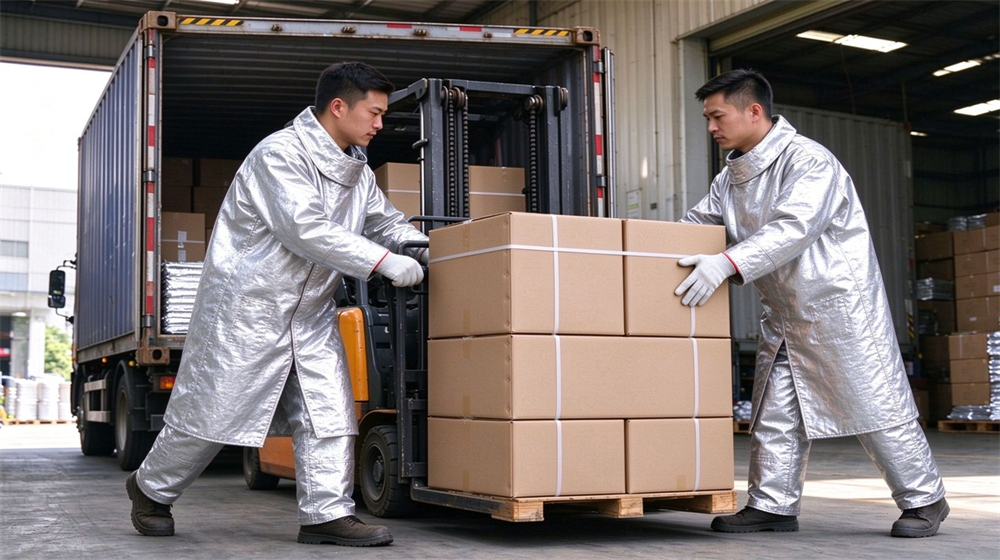
MOQ and production timeline are confirmed per order based on configuration and agreed in writing before production. We accept T/T payment; we do not offer L/C terms. The factory documents and test reports are reviewed before dispatch. Payment and delivery terms are written into the quotation, so the commercial side of the order is settled before the first panel is cut.
Quotations are prepared against the final configuration, so the price reflects the actual order: the coat model, the accessory list, the sizes and the quantity. Nothing is estimated in the quotation that will not be produced, which keeps the commercial side as precise as the garment side.
The overcoat is supplied as a complete export unit: the coat, the accessories and the batch documentation travel together. Receiving checks are simple because the packing list matches the quotation line by line.
For guidance on protective clothing selection and use, refer to the OSHA personal protective equipment pages, the NIOSH heat stress guidance, and the ISO 11612 standard for heat and flame protective clothing.
Frequently Asked Questions
What is a proximity fire coat?
A long aluminum foil overcoat worn over standard firefighting gear for near-flame work. It reflects radiant heat with the foil facing and blocks flame contact with the fire-proof fabric base. The long cut covers torso, arms and thighs, and the full front opening makes it fast to put on over existing gear.
How is it different from a full proximity suit?
The overcoat is faster to don and easier to move in, covering approach and support work. The full suit covers entry work with higher protection, including the hood and integrated gloves. Buyers match the level to the job: full suit for the hottest zone, overcoat for close support.
The full suit adds hood, integrated gloves and heavier insulation for work inside the hottest zone. The overcoat leaves the helmet and breathing gear in place and covers the body where radiant heat arrives. That is why most teams buy both: the suit for entry, the overcoat for the rotation around it.
What is the fabric?
Aluminum foil fire-proof fabric. The foil facing reflects radiant heat, the fire-proof base blocks flame contact, and the long cut covers torso, arms and thighs. The same material family is used in proximity suits, applied here in a lighter long coat cut.
Is it worn over other gear?
Yes. The overcoat is sized to fit over standard firefighting clothing or station uniform, with a full front opening for fast donning. Buyers confirm the layering details at quotation so the size works with the wearer’s existing gear.
What does near-flame work mean?
Tasks close enough to feel radiant heat but not inside the fire: hose advance, exposure protection, casting and pouring support. The overcoat reflects that heat while the crew works, and it comes off fast when the rotation ends.
Typical near-flame positions include the hose team advancing on a structure fire, the exposure crew protecting adjacent buildings, and the industrial operator watching a ladle pour. In each case the heat arrives from close range and the task lasts minutes, which is exactly the window the overcoat is built for.
What sizes are available for the Proximity Fire Protection Coat?
Sizing follows chest and height against the factory chart, confirmed at quotation. Bulk orders standardize one size run for the whole team, so rotation between crew members is seamless.
Sizes follow chest and height against the factory chart. The overcoat is built to fit over existing gear, so the chart accounts for layering. Bulk orders confirm the size distribution before production, and each size is grouped and counted in the packing list.
How is it worn over other gear?
The overcoat is sized to fit over the wearer’s existing firefighting clothing or station uniform. Buyers send the layering details at quotation, and the factory confirms the size against that layering.
The overcoat is sized to fit over the wearer’s existing firefighting clothing or station uniform. Buyers send the layering details at quotation, and the factory confirms the size against that layering, so the coat seals over the collar and overlaps the gloves without binding the arms. The full front opening keeps donning fast even over a structural jacket.
How should the coat be stored?
Store the overcoat flat or hung in a dry locker, away from direct heat and sunlight. The foil facing keeps its reflectivity when the coat is aired after use and folded along the original creases.
Store the overcoat flat or hung in a dry locker, away from direct heat and sunlight. The foil facing keeps its reflectivity when the coat is aired after use and folded along the original creases. For team orders, the factory includes the storage and care notes with the batch documentation, so every station and plant follows the same maintenance routine.

Are reflective strips included?
Yes. Strips mark the wearer in smoke and low light, and placement can match station standards. They survive repeated washing and handling, and they add high visibility in industrial production halls.
Strips are placed across the chest and arms in a pattern that suits station standards, and the placement is confirmed in writing before production. Because the batch is produced from one pattern, every coat in the order carries identical strip positions, so the team looks uniform on scene and in training.
What is the minimum order quantity for the Proximity Fire Protection Coat?
MOQ varies by configuration and confirmed at quotation. Bulk team orders are common, and repeat orders follow the same model and sizes.
A station crew of twelve typically orders twelve coats plus two spares in the same size distribution. Industrial plants order per shift and per position. Because the size run and packing method stay identical, the buyer can extend the order at any time without restarting the process.
How is quality controlled for bulk Proximity Fire Protection Coat production?
Each batch is tested and the report travels with the shipment. Fabric, foil adhesion and seams are inspected in line, and samples are retained for the order lifetime.
Quality control runs at three points: fabric is qualified before cutting, a seam sample is pulled during sewing, and the finished coat is tested after finishing. The batch report documents all three checks, and the buyer receives it with the goods for acceptance on arrival.
What is the production timeline for bulk Proximity Fire Protection Coat orders?
Confirmed per order based on configuration and agreed in writing before production. Timeline covers fabric preparation, production and packing.
What payment terms do you offer for wholesale Proximity Fire Protection Coat orders?
We accept T/T payment; we do not offer L/C terms. Terms are confirmed in the quotation and the order agreement.
Can we add custom branding or unit marking to the Proximity Fire Protection Coat?
Custom options are confirmed at quotation. Artwork placement and colors match your specification, and production samples can be arranged for large orders.
Logo placement follows the same rules as the reflective strips: confirmed in writing before production. The factory prepares an artwork check for large orders, so the final marking matches the buyer specification exactly.
How do I order for a whole team?
Send chest and height for each member. Sizes are confirmed at quotation and one batch covers the crew, with each size grouped and counted against the packing list.
Do you supply the gloves and apron too?
Yes. The system includes insulation gloves, an aluminum foil apron and boot covers, each available separately. The kit is built around the overcoat as the load-bearing layer.

The gloves protect the hands at the hose and the ladder, the apron shields the lap during seated tasks, and the boot covers keep radiant heat off the instep. Each item follows the same aluminum foil material family, so the whole kit reflects heat consistently with no weak overlaps.
Near-flame work needs a layer that goes on fast and moves with the wearer. The proximity fire protective coat reflects radiant heat, covers the body with a long aluminum foil cut, and ships in bulk to fire teams worldwide. One model, one size run and one batch report keep the order simple from quotation to delivery, and the accessory system extends the coat into a complete near-flame kit for the whole crew.
Previous :
Steam Protective Suit | High Temp Steam and Hot Water InsulationNext :
Aluminized High Temp Coverall | 500-1000°C Radiant Heat Foundry Deep Blue Firefighting Suit Set, Forest Fire Fighting Specialized, Full-body Protection
This Deep Blue firefighting suit set is specially designed for forest fire fighting, using special flame-retardant fabric that can withstand 700°C open flames in the wild, with a thermal protection value (TPP) of 25CAL/AM2. The vivid Deep Blue color combined with enhanced reflective strips enables identification from 500 meters away in forest smoke. The lightweight design of only 4.5KG does not affect mountain action speed, with a waterproof rating >40KPA, adapting to camping fire fighting and long-term field operations. The anti-plant puncture design increases wear resistance by 50%, making it professional equipment for forest firefighting, mountain rescue, and outdoor fire fighting actions, providing all-around body protection for forest firefighters.
 High-temperature Resistant Firefighting Suit Set, Emergency Rescue, Quick-wear
This high-temperature resistant firefighting suit set is made of professional-grade flame-retardant materials, capable of withstanding extreme temperatures up to 750°C, with a thermal protection value (TPP) of 26CAL/AM2, providing reliable protection for emergency rescue. The innovative quick-wear design allows complete dressing in 40 seconds during emergencies, with hydrostatic pressure resistance >45KPA and excellent breathability. Designed according to ergonomic principles, weighing only 4.8KG, it effectively reduces the burden on rescue personnel and is suitable for high-risk scenarios such as building fires, tunnel rescues, and industrial firefighting, making it an ideal equipment choice for professional firefighting teams.
 Professional Firefighting Suit Set, Flame-retardant Protection, Rescue Essential, 14-3C Certified
This professional firefighting suit set is made of high-grade flame-retardant cotton fabric, 14-3C certified, capable of withstanding extreme temperatures up to 800°C, with a thermal protection TPP value of not less than 28CAL/AM2. The three-layer composite protection structure, with waterproof static pressure resistance >50KPA and breathability >5000G/M²·24H, ensures comprehensive safety for rescue personnel in complex environments such as building fires, forest fires, and special chemical plant fires. Available in three models: 97/02/14, meeting different rescue scenario requirements.
 02 Firefighting Suit Multi-layer Composite Material Rescue Protection
This Type 02 firefighting suit is made of professional flame-retardant materials with excellent heat resistance, fire protection grade meeting international rescue standards, and waterproof puncture resistance rate of 98%. The deep blue body is equipped with eye-catching yellow reflective strips, increasing night visibility by 85%. The complete six-piece configuration provides comprehensive protection for firefighting, forest firefighting, earthquake rescue, and other scenarios, providing reliable protection for 300+ professional rescue teams.
 Forest Fire Rescue Service with Heat-Resistant Design
This professional forest fire rescue service uses flame-retardant heat-resistant material, achieving GB8624-A2 fire rating standard with heat resistance up to 800°C, and features high-visibility reflective strips visible from 300 meters away. It's suitable for emergency rescue scenarios such as forest fires, mountain rescues, and industrial disasters, providing comprehensive personal safety protection. Each set has undergone 10,000 abrasion tests and proven its reliability and safety in over 1,500 rescue operations nationwide.
 Fire Rescue Cap, Aramid Flame-Resistant Material, Forest Fire Emergency
This professional-grade forest firefighting vest and hat set is made of polyester/cotton blended flame-retardant fabric, with reflective visibility up to 300 meters, capable of resisting short-term flame contact, improving protection efficiency by 85%. The bright orange design with double-layer reflective strips complies with international rescue standards, ensuring 360° visibility in smoke and low light environments. Suitable for forest fire fighting, wilderness emergency rescue, post-earthquake sites, and other emergency disaster relief scenarios, providing comprehensive protection for rescue personnel.
Copyright © Custom Disaster - Relief Bedding: Tents, Sleeping Bags, Blankets All Rights Reserved
the professional team to service !