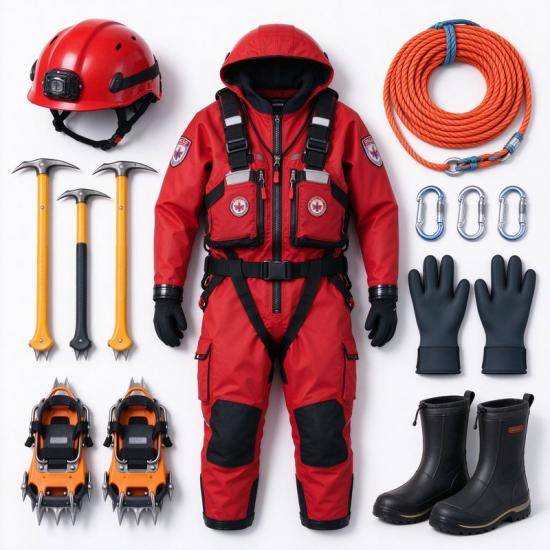
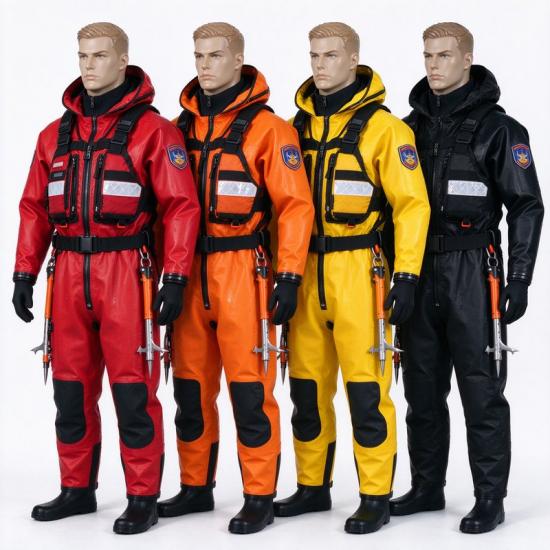
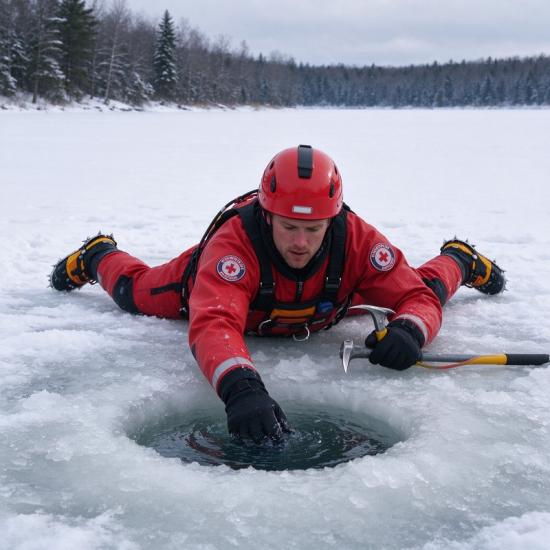
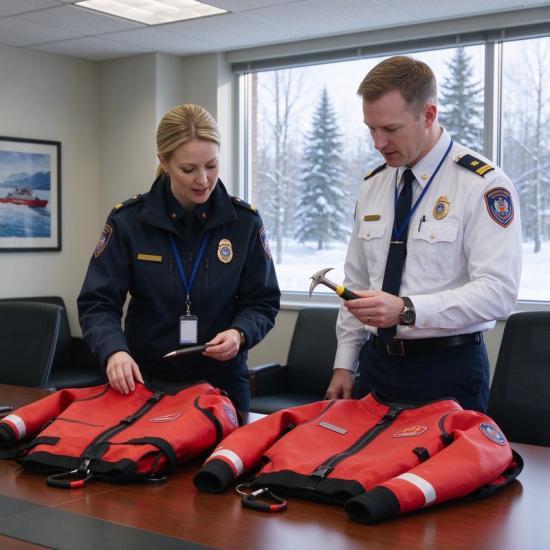
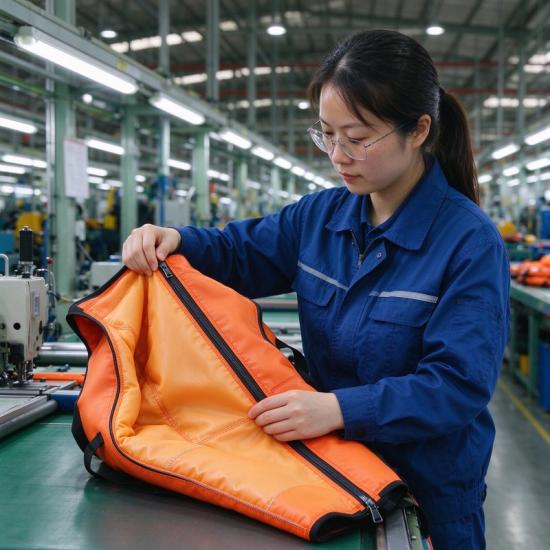
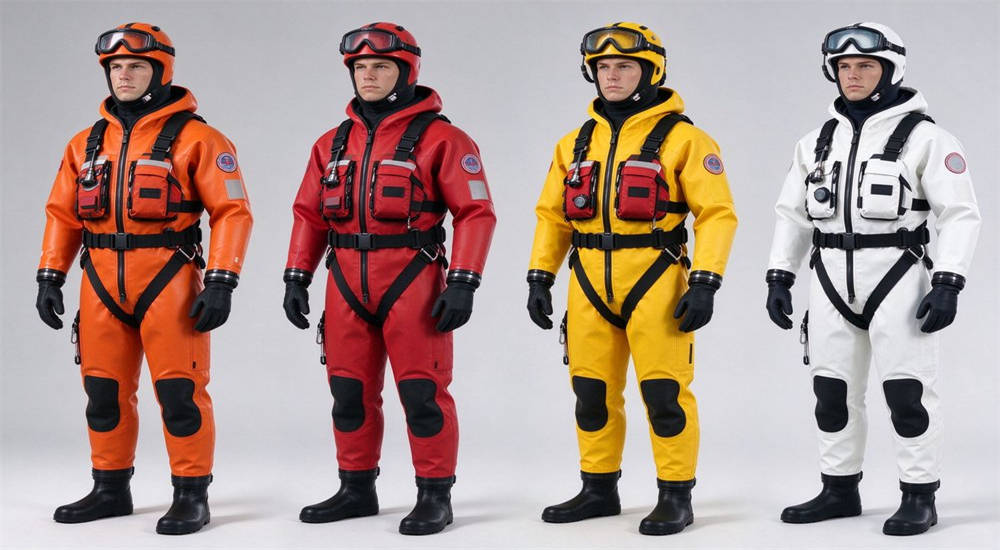
Ice rescue suit is fully sealed immersion garment with built-in over 150N buoyancy. PU coated nylon shell with welded seams, removable closed cell foam liner. Integrated chest harness, attached hood gloves and boots. Reinforced neoprene panels resist ice abrasion. SOLAS reflective tape, high visibility color. Suitable for fire and cold water rescue teams, OEM available, MOQ 10 units.
Note: Price for reference only. Exact price based on quantity, size, weight and custom details.
model no. :
RLJ-04Brand:
YRFmarket price :
$16.8sale price :
$7.8price range :
30-500/$7.8 501-1000/$6.8Color :
Multiple Colorsport of dispatch :
Guangdong/GuangzhouPayment :
TT, Paypal, Western Unionmin order :
30original region :
Made in ChinaLead Time :
5-15daysWholesale Ice Rescue Suits for Professional Cold Water Teams


1. Ice Rescue Suit Types & Range
6. Selecting the Right Suit
2. Buoyancy & Thermal Performance
7. Care, Maintenance & Inspection
3. Materials & Sealed Construction
8. Bulk Orders & Procurement
4. Ice-Specific Safety Features
9. Industry Trends & Advice
5. Certifications & Standards
10. Frequently Asked Questions
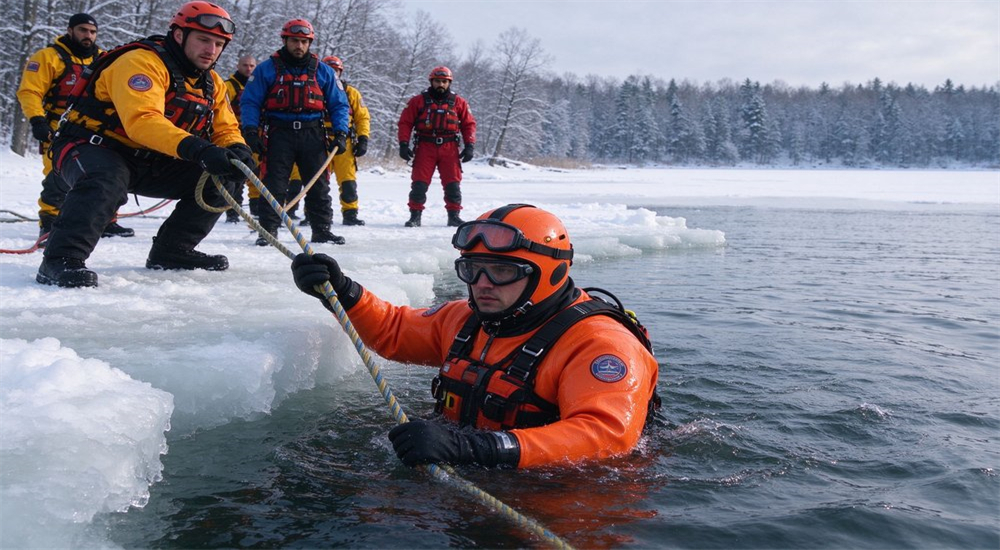
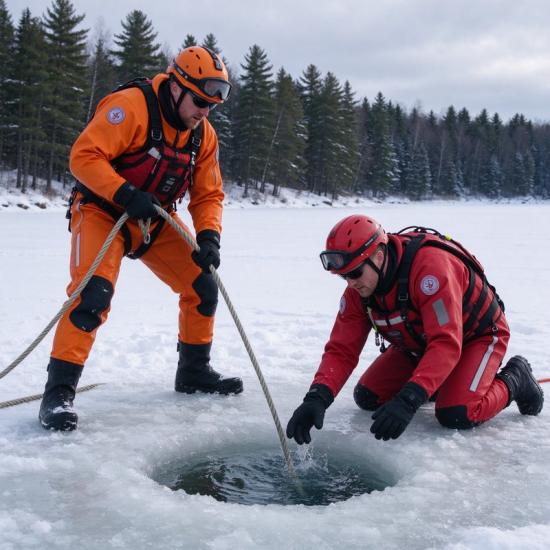
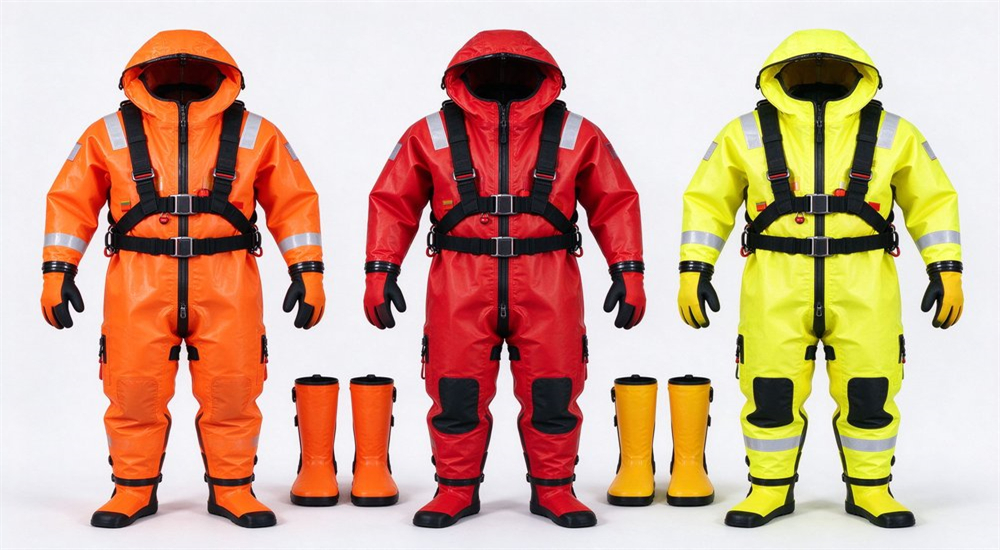
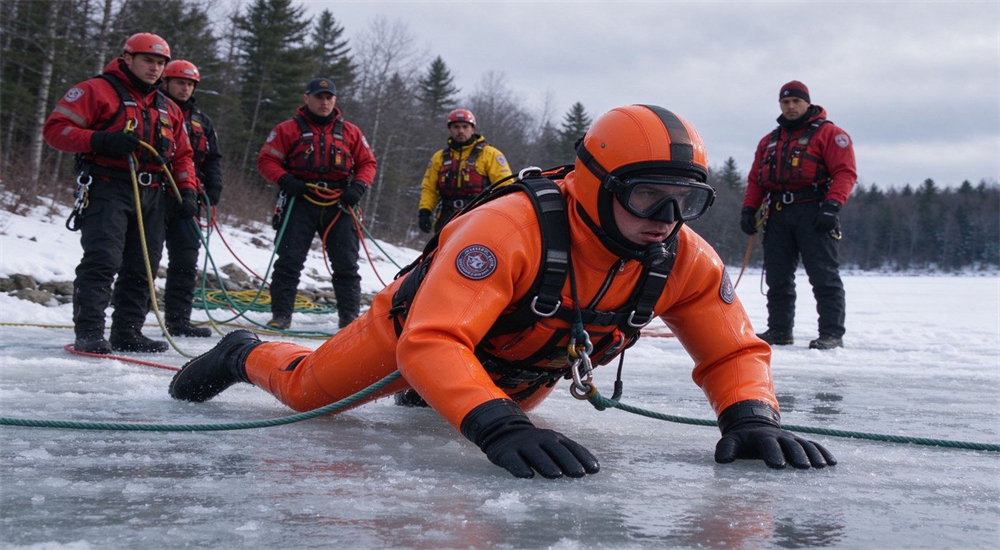
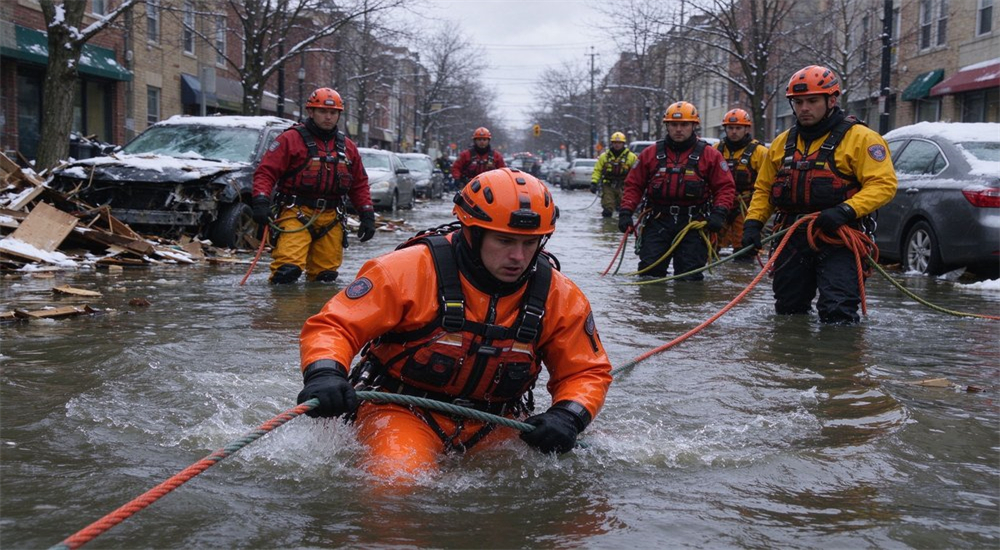
The standard ice rescue suit is the workhorse of municipal fire department and coast guard ice response teams. It features a fully sealed polyurethane-coated nylon shell, removable closed-cell foam buoyancy liner, integrated chest harness, and attached boots and gloves. The front-entry watertight zipper with oversized pull handle allows rapid donning even with cold or gloved hands. This model is ideal for general ice rescue, cold water entry, and winter flood operations where full immersion protection and inherent flotation are required.
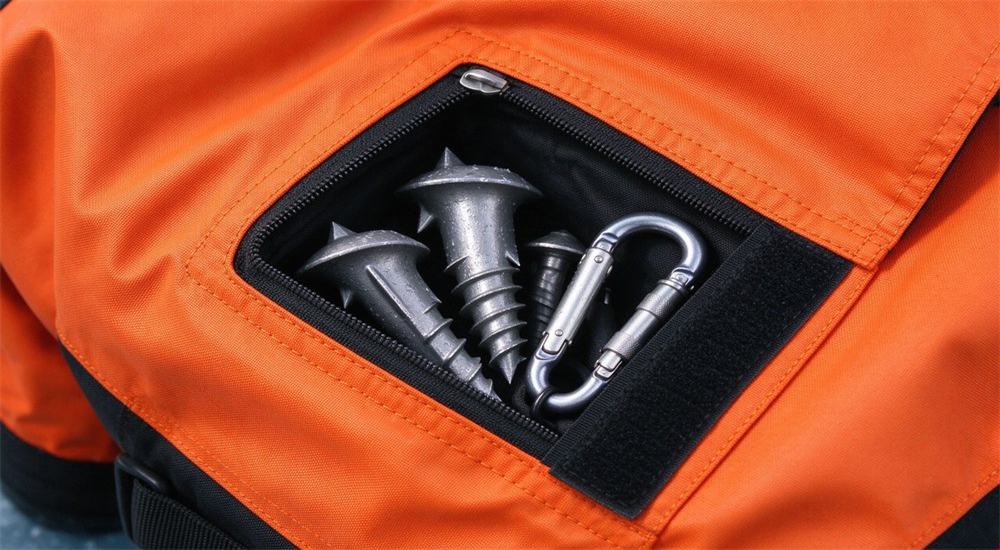
The heavy-duty variant upgrades the standard shell with thicker polyurethane coating, additional abrasion panels at the seat and thighs, and reinforced boot soles with ice-grip tread. It includes an extended face seal for better protection against spray and ice chips, and a larger accessory pocket system for carrying ice screws, carabiners, and signaling devices. This model is preferred by dedicated ice rescue teams and military cold-water units that encounter frequent ice crawling and extended exposure scenarios.
The lightweight model uses a slightly thinner shell material and a streamlined buoyancy liner to reduce total weight to approximately 4.8kg while maintaining the same sealed system and minimum 150N buoyancy. It is designed for teams that prioritize rapid deployment and mobility over maximum abrasion resistance, such as seasonal ice response teams or multi-purpose water rescue units that need a suit that transitions between ice and open-water operations.
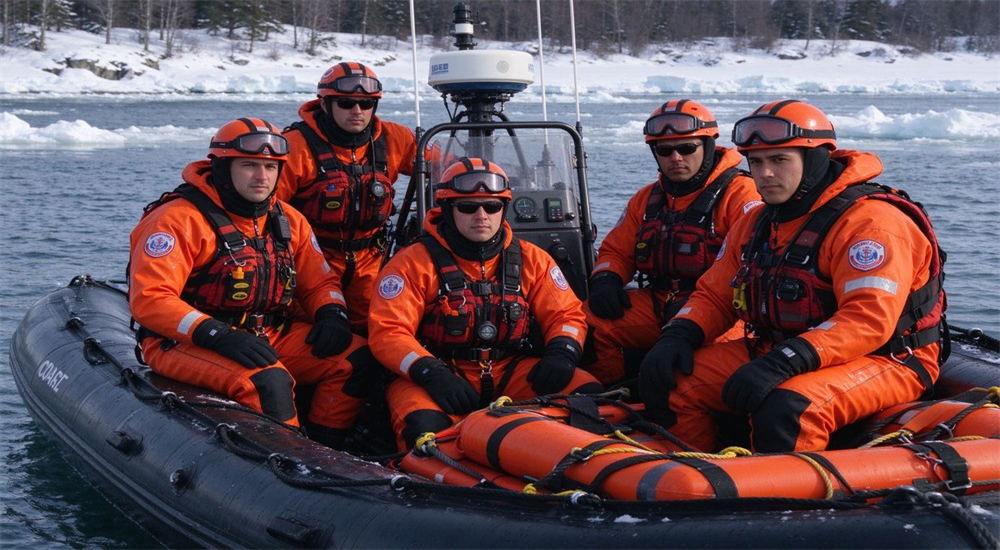
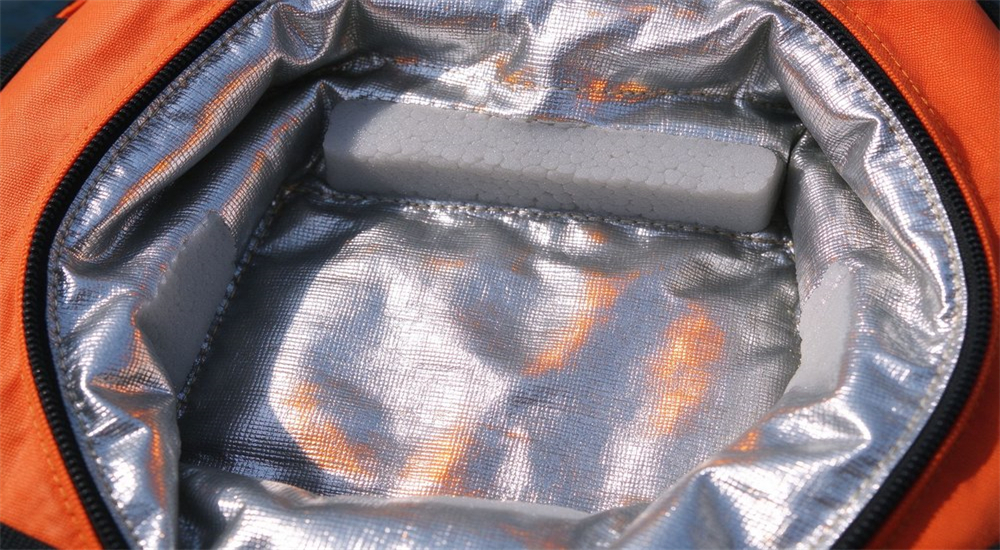
The maritime-grade ice immersion suit is engineered to meet stricter thermal performance requirements, with verified insulation capable of limiting body temperature drop to less than 2°C over six hours in 2°C water. It features enhanced neck and face seals, a thermal-reflective inner liner, and a storage temperature range of -30°C to 45°C. This model is suitable for coast guard vessels, offshore platforms, and any application where extended immersion survival is a critical requirement.
The following table summarizes the key differences across our ice rescue suit range. Procurement officers should match the model to the team's primary mission profile, expected exposure duration, and frequency of ice crawling operations.
Most municipal fire departments select the Standard model for fleet-wide issuance, while dedicated ice rescue teams and military units prefer the Heavy-Duty variant. The Lightweight model suits seasonal or multi-purpose teams, and the Maritime Grade is reserved for coast guard and offshore applications requiring verified extended immersion performance.
|
Feature |
Standard |
Heavy-Duty |
Lightweight |
Maritime Grade |
|
Shell Material |
PU-coated nylon |
Thick PU-coated nylon |
Lightweight PU nylon |
Heavy PU-coated nylon |
|
Buoyancy |
≥150N |
≥150N |
≥150N |
≥150N |
|
Weight |
~5.5kg |
~6.2kg |
~4.8kg |
~5.9kg |
|
Thermal Rating |
2°C/6hrs |
2°C/6hrs |
2°C/4hrs |
2°C/6hrs+ |
|
Abrasion Panels |
Knees/elbows |
Knees/elbows/seat |
Knees only |
Knees/elbows/seat |
|
Best For |
General ice rescue |
Frequent ice crawling |
Rapid deployment |
Extended immersion |
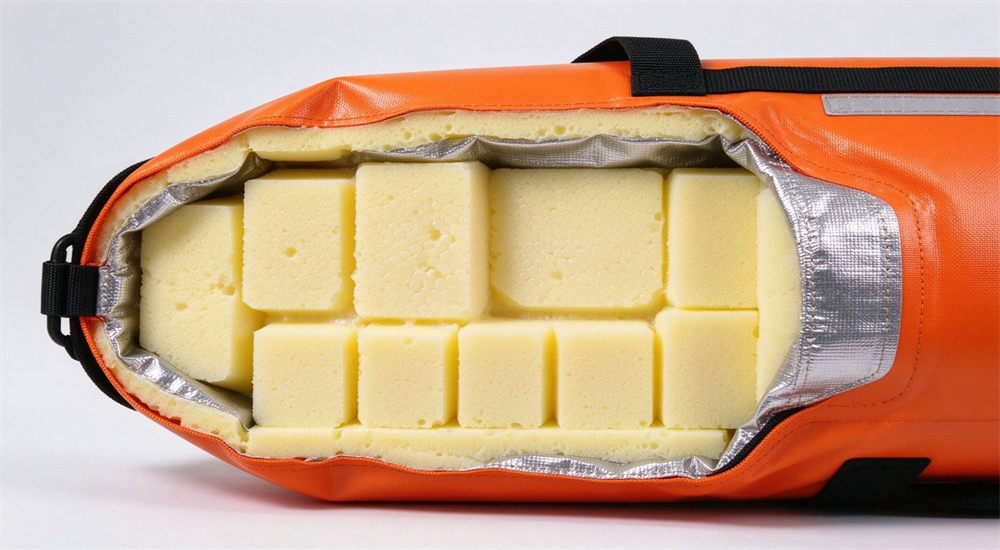
The defining feature that separates an ice rescue suit from a conventional dry suit is its inherent buoyancy. The removable internal liner is constructed from closed-cell foam that generates over 150N of flotation, ensuring that a wearer—even if unconscious—floats face-up in the water. This eliminates the need for a separate PFD and reduces the total gear a rescuer must don during an ice emergency. The liner can be decompressed and removed for on-site repair, cleaning, or replacement, extending the service life of the outer shell.
Thermal protection in an ice rescue suit operates on a different principle than a wetsuit. Rather than allowing a thin layer of water to enter and be heated by the body, the ice rescue suit is fully sealed—zero water entry through the hood, gloves, waist, or boots. The closed-cell foam liner traps a layer of insulating air against the body, and the thermal-reflective inner coating radiates body heat back toward the wearer. In laboratory testing at 2°C water temperature, a properly fitted suit limits core body temperature drop to less than 2°C over a six-hour immersion period.
Closed-cell foam buoyancy is extremely stable over time. After 24 hours of continuous immersion, buoyancy loss is less than 5%, meaning the suit maintains its face-up flotation characteristic even during extended rescue operations or victim transport. This is a critical safety factor: rescuers who enter the water for prolonged victim management or who become trapped under ice can rely on the suit's flotation to keep their airway clear without active treading.
Cold water immersion triggers cold shock response within the first minute, incapacitating gasping, and hyperventilation that can lead to water inhalation. An ice rescue suit delays the onset of cold stress by maintaining a microclimate between the liner and the skin. For rescuers performing ice crawling, the suit's sealed system prevents meltwater from soaking undergarments, which is the primary cause of rapid heat loss during approach. Teams operating in regions with prolonged ice seasons should consider pairing the suit with an optional heated undergarment liner for extended standby operations below -10°C.
Understanding how ice rescue suits compare to other cold-water protective systems helps procurement officers justify the investment. The table below compares thermal and buoyancy characteristics across common rescue garment types.
Thermal performance ratings should be evaluated alongside the undergarment system, as the suit itself provides only part of the total insulation. In 0°C water, even the best suit requires appropriate thermal layers to maintain core temperature beyond 30 minutes. We recommend consulting with your team's medical advisor to establish minimum thermal protection standards for your operational environment.
The ice rescue suit is the only system that combines zero water entry, inherent buoyancy, and ice-specific mobility in a single garment. While a dry suit plus separate PFD can achieve similar thermal performance, the two-system approach increases donning time and creates potential for PFD misplacement during ice emergencies.
|
System |
Water Entry |
Inherent Buoyancy |
Typical Thermal Duration |
Ice Crawling Suitability |
|
Ice Rescue Suit |
Zero (fully sealed) |
Yes (≥150N) |
6+ hours at 2°C |
Excellent |
|
Dry Suit + PFD |
Zero (if sealed) |
No (separate PFD) |
4-6 hours |
Good |
|
Wetsuit (5mm) |
Thin layer |
No |
1-2 hours |
Poor |
|
Immersion Suit (maritime) |
Zero |
Yes |
6+ hours |
Fair (bulky) |
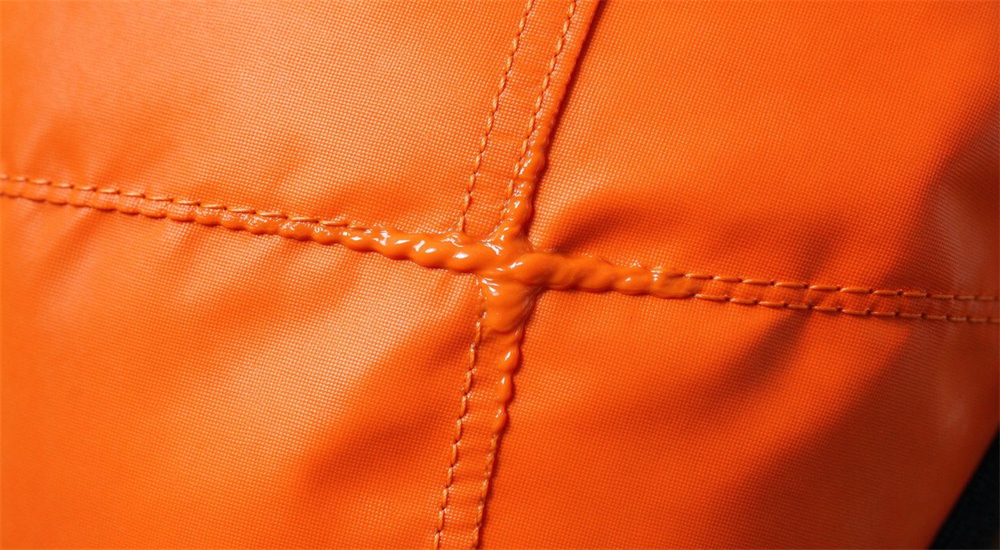
The outer shell is constructed from high-performance polyurethane-coated nylon fabric, welded at all seams to create a continuous waterproof barrier. The polyurethane coating provides excellent resistance to abrasion from ice, chemicals, and petroleum products commonly encountered in flood and ice rescue environments. The nylon substrate contributes tensile strength and tear resistance, while the coating ensures that even pinhole-level leaks are eliminated. The shell material is easy to clean with fresh water and mild detergent, and it resists UV degradation during outdoor storage.
Every seam on the ice rescue suit is welded rather than stitched, eliminating the needle holes that are the primary leak point in conventional sewn garments. The welding process fuses the polyurethane coatings of adjacent panels under heat and pressure, creating a bond that is stronger than the base material itself. Critical stress areas such as the crotch, underarms, and shoulder harness attachment points receive double-welded reinforcement. This construction method is what enables the suit to maintain its waterproof integrity even after repeated ice crawling and rope hauling.
A true ice rescue suit is a fully integrated sealed system, not a jacket and pants combination. The following components are permanently attached and sealed:
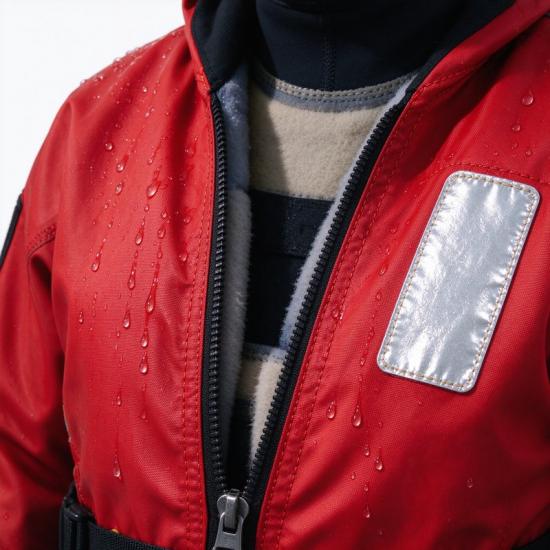
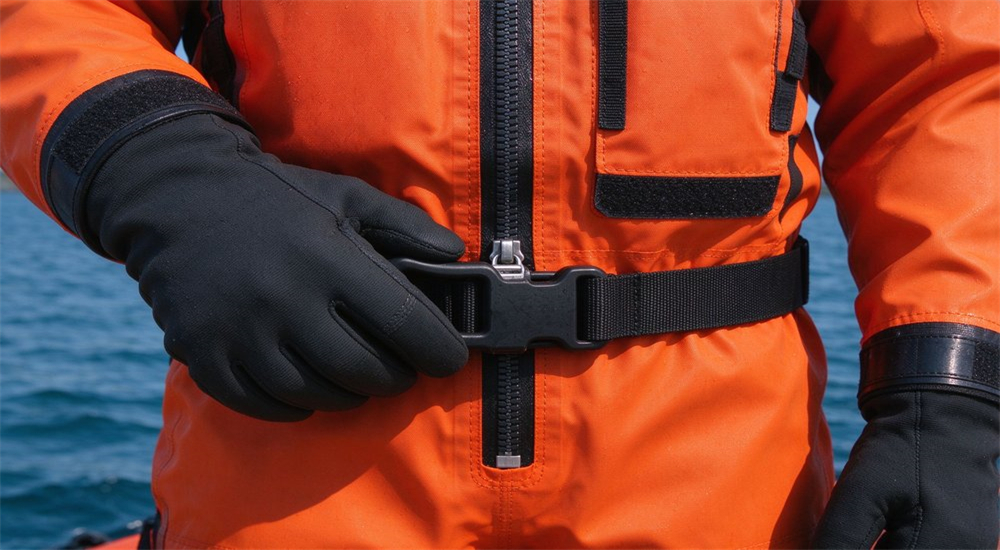
The front-entry watertight zipper features an oversized pull handle designed for operation with cold or gloved hands. The zipper is protected by an external storm flap with hook-and-loop closure, providing a secondary barrier against water and ice. The zipper runs from the upper chest to the lower abdomen, allowing the wearer to step into the suit and pull it on without assistance. A zipper lubrication point is included for regular maintenance to ensure smooth operation in freezing conditions.
The front-entry watertight zipper features an oversized pull handle designed for operation with cold or gloved hands. The zipper is protected by an external storm flap with hook-and-loop closure, providing a secondary barrier against water and ice. The zipper runs from the upper chest to the lower abdomen, allowing the wearer to step into the suit and pull it on without assistance. A zipper lubrication point is included for regular maintenance to ensure smooth operation in freezing conditions.
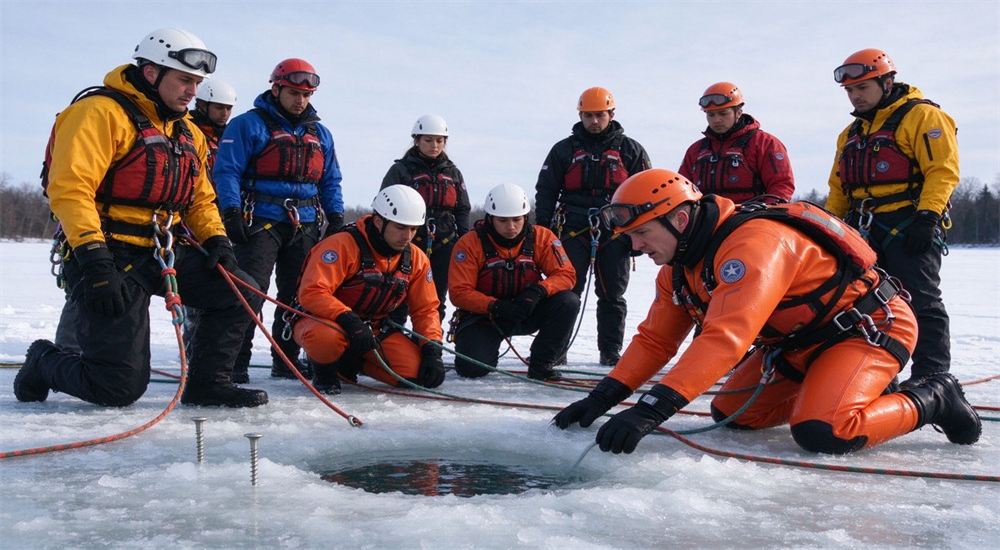
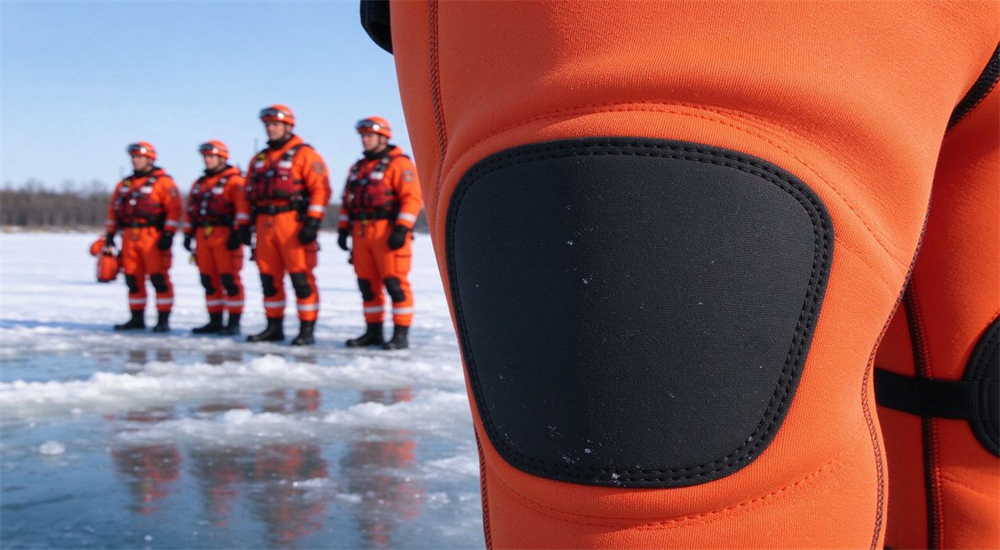
Ice crawling is the most physically demanding phase of an ice rescue, and the suit must withstand repeated contact with rough ice surfaces. 2.5mm neoprene reinforcement panels are bonded to the knees, elbows, seat, and lower legs, providing a durable sliding surface that protects the shell from cuts and abrasion. The seat area receives additional fluorescent-green shell fabric reinforcement for teams that perform frequent seated ice approaches. These reinforced zones are field-repairable with standard neoprene cement and patch material.
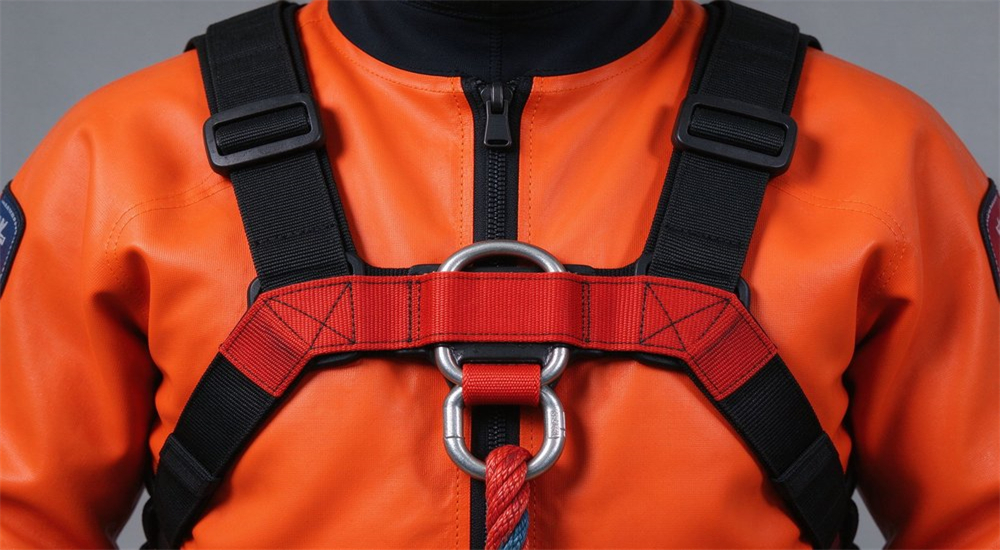
The integrated chest harness is a critical ice rescue feature that allows a rescuer to be directly connected to a safety rope or towline without wearing a separate harness. The harness is built into the suit's structure with reinforced attachment points at the chest and shoulders, rated for rescue loads. This means a rescuer who falls through the ice can be hauled out by the rope without the harness riding up or causing injury. The harness also facilitates victim towing—rescuers can clip directly to a tether line while performing contact tows.
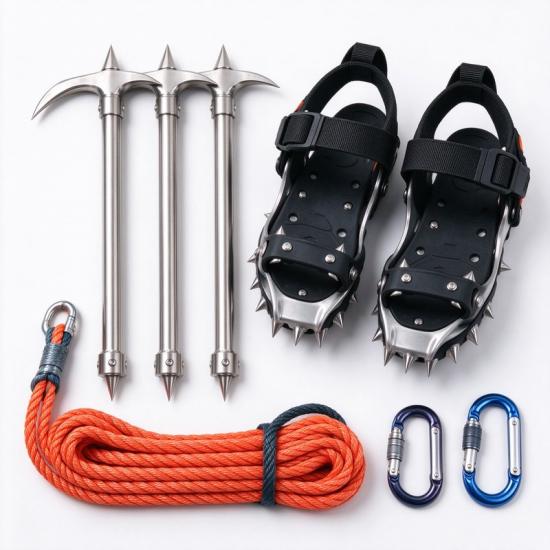
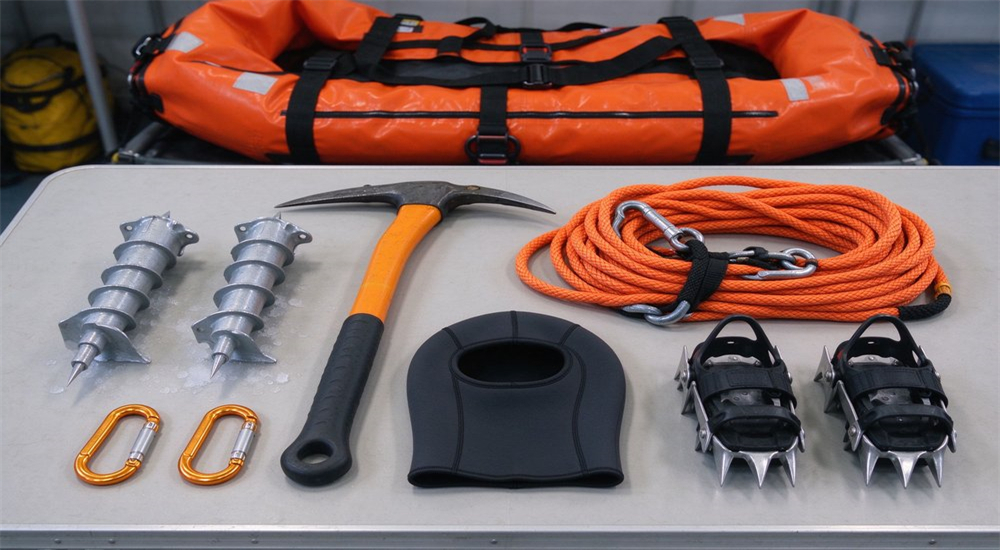
Dedicated pockets on both upper arms provide secure storage for ice screws, carabiners, and signaling devices. The pockets close with heavy-duty hook-and-loop fasteners that can be operated with gloved hands, and they are positioned for access while lying prone on the ice. A larger rear pocket accommodates a folding ice rescue crawler or throw bag. These pockets eliminate the need for a separate equipment belt and ensure that critical tools are always within reach during an ice approach.
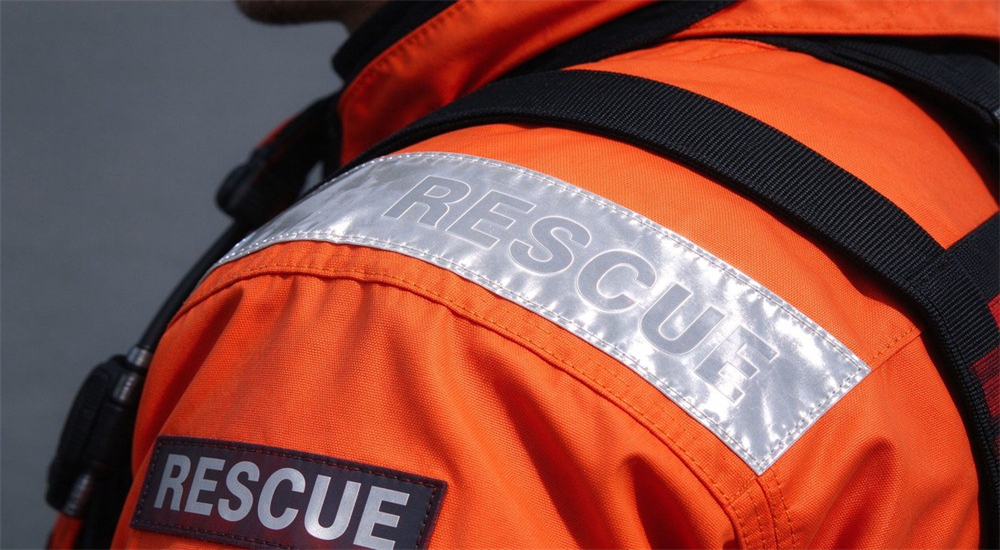
High-visibility is a matter of life safety in ice rescue, where whiteout conditions and snow glare can obscure a rescuer from shore-based team members. The suit features SOLAS-grade reflective tape at four front positions, two rear positions, and one on the hood, providing 360-degree visibility in low light and snow conditions. The shoulders display reflective RESCUE lettering for immediate identification. The fluorescent orange, red, or yellow shell color provides contrast against snow and ice even before the reflective tape is activated by light.
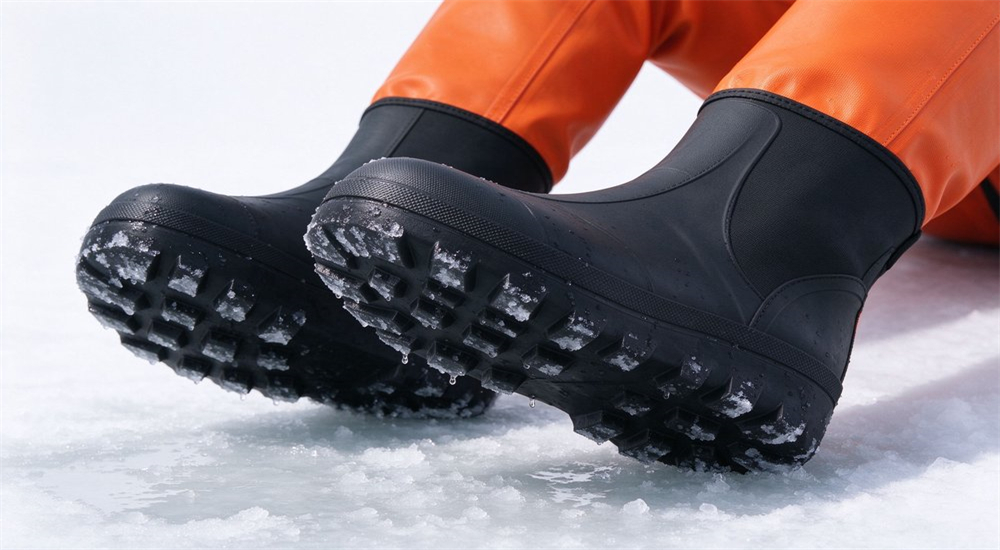
The integrated rubber boots feature a lugged sole pattern designed for traction on wet ice, snow, and boat decks. The sole compound remains flexible in sub-zero temperatures, unlike standard rubber that becomes brittle and slippery. Optional ice cleats can be strapped over the boots for extreme ice conditions, and the boot opening is sized to accommodate neoprene sock liners for additional thermal protection. The boots are permanently sealed to the suit leg, eliminating the gap-through-water-entry problem common with separate boot systems.
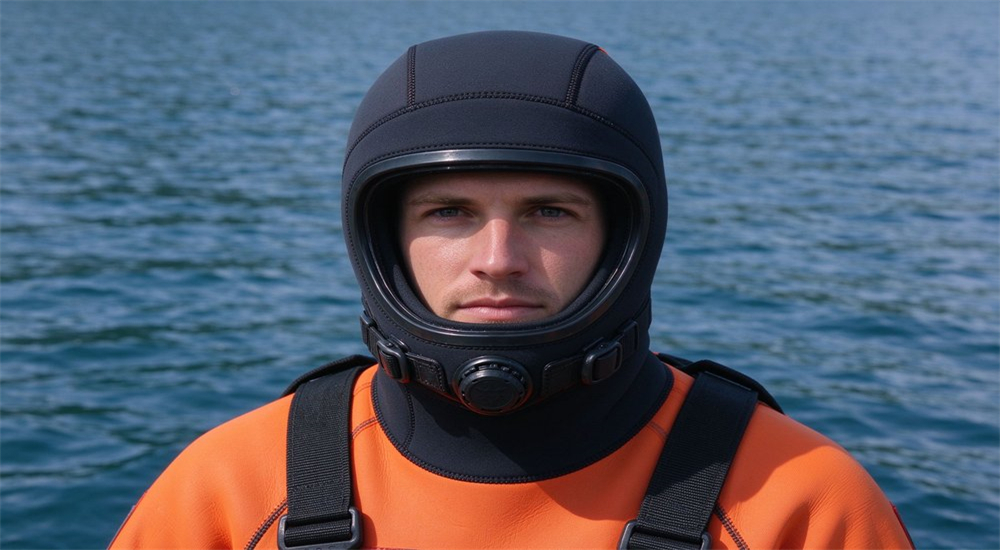
The close-fitting neoprene hood incorporates an adjustable face seal that conforms to the wearer's facial contours, preventing water entry during full immersion and blocking wind-driven spray during ice approaches. The hood is cut to allow full head movement and peripheral vision, critical for rescuers who must monitor ice conditions and victim location while crawling. A neoprene chin flap prevents the hood from riding up during rope hauling. The hood material is the same 2.5mm neoprene used in the abrasion zones, providing both insulation and ice-impact protection.
The following table consolidates all ice-specific safety features and their operational purpose, helping procurement officers verify that each requirement is met before purchase.
Sizing for ice rescue suits requires accounting for the thick thermal layers worn underneath. Order one size larger than standard measurements to accommodate layering. A properly fitted suit should allow full range of motion for crawling, climbing, and swimming without excessive material that could catch on ice.
Every safety feature on the ice rescue suit serves a specific operational function identified through feedback from professional ice rescue teams. No feature is decorative—each contributes to rescuer safety, operational efficiency, or both.
|
Safety Feature |
Location |
Operational Purpose |
|
Integrated chest harness |
Chest/shoulders |
Direct rope connection for hauling and towing |
|
Ice accessory pockets |
Both upper arms |
Quick access to ice screws and carabiners |
|
SOLAS reflective tape |
Front/rear/hood |
360° visibility in whiteout conditions |
|
Anti-slip boot soles |
Feet |
Traction on wet ice and boat decks |
|
Face seal hood |
Head/neck |
Water exclusion and wind protection |
|
RESCUE identification |
Shoulders |
Immediate role recognition |
Our ice rescue suits are manufactured in facilities certified to ISO 9001 quality management standards, ensuring consistent production quality across batch orders. The polyurethane-coated nylon shell material meets relevant waterproof and abrasion resistance specifications, and all welded seams undergo 100% inflation testing during production. Each suit is individually inspected for seam integrity, zipper function, and hardware attachment before packaging.
Buoyancy performance is verified through hydrostatic testing, confirming minimum 150N flotation with less than 5% loss over 24 hours of immersion. Thermal performance is validated through controlled water immersion testing at 2°C, measuring core temperature retention over six hours. These test parameters align with recognized cold-water immersion suit standards and provide procurement officers with verifiable performance data for tender documentation.
The reflective tape used on all ice rescue suits meets SOLAS (Safety of Life at Sea) reflective material standards, ensuring minimum retroreflective performance even after prolonged exposure to sunlight, saltwater, and freezing temperatures. This is the same reflective material specified for life rafts and life jackets on commercial vessels, providing a known and trusted visibility benchmark for rescue operations.
For government and institutional procurement, we provide complete technical documentation packages including material test reports, buoyancy certification, thermal performance data, and production quality records. These documents can be formatted to meet specific tender requirements, and our team can assist with specification alignment and compliance verification for any market. All documentation is available in English and can be certified as true copies for official submission.
Selecting the appropriate ice rescue suit requires matching the garment to the team's mission profile, operating environment, and budget constraints. Organizations should first assess their primary response scenarios—whether that is municipal lake ice rescue, coast guard cold-water boarding, or military arctic operations—and then evaluate the frequency and duration of expected ice exposure. Next, consider whether the team requires heavy abrasion protection for frequent ice crawling or a lighter suit for rapid multi-purpose deployment. Finally, evaluate customization needs such as department logos, color specifications, and accessory pocket configurations. Slip resistance is essential for ice operations, with specialized boot soles that provide traction on frozen surfaces and prevent falls during victim approach.
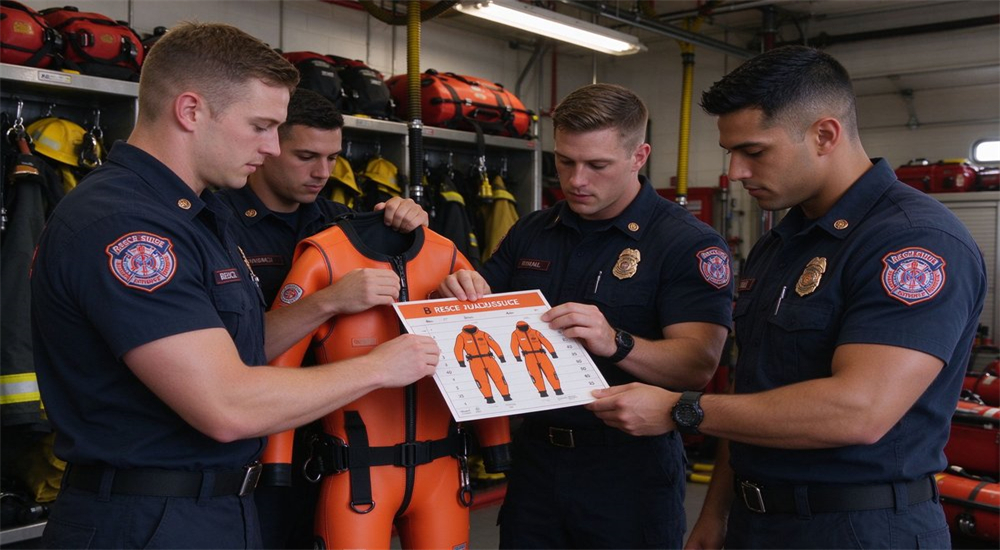
Ice rescue suits use a one-size-fits-most design accommodating wearers from 50kg to 150kg and 1.5m to 2.0m in height. The adjustable internal straps and elasticized cuffs ensure a secure fit across this range. However, teams with members outside these parameters—particularly very tall or very large personnel—should request custom sizing evaluation. A properly fitted suit should allow full range of motion for ice crawling and swimming while maintaining the face seal and wrist seals in contact with the skin. Teams should conduct fit testing in actual cold-water conditions, not just dry fittings, to verify seal performance during active movement.
Different organizational types have different ice rescue requirements. The following recommendations are based on typical mission profiles and should be adjusted based on local conditions and historical deployment data.
The maintenance requirements for ice rescue suits are more demanding than standard dry suits due to the extreme conditions they face. Pay special attention to the buoyancy foam, which can absorb water if the outer shell is compromised. Annual buoyancy testing is essential to verify that the suit still meets its rated flotation specification.
For urban flood rescue and coast guard boarding operations that occasionally encounter ice, the Standard model provides the best balance of protection and cost. Dedicated ice rescue teams should invest in the Heavy-Duty model, as the additional abrasion protection pays for itself in extended suit service life.
|
Organization Type |
Recommended Model |
Key Priority |
Typical Order Size |
|
Municipal Fire Dept |
Standard |
Versatility + value |
10-50 suits |
|
Dedicated Ice Rescue Team |
Heavy-Duty |
Abrasion + features |
5-20 suits |
|
Coast Guard Unit |
Maritime Grade |
Extended immersion |
20-100 suits |
|
Seasonal Response Team |
Lightweight |
Rapid deployment |
5-15 suits |
|
Military Cold-Water Unit |
Heavy-Duty |
Durability + harness |
50-200 suits |
While the ice rescue suit is a complete system, certain accessories enhance operational capability. We recommend pairing each suit with a neoprene balaclava for additional face insulation, a pair of ice rescue gloves for dexterity when the attached gloves are removed for equipment handling, and a set of ice cleats for extreme ice conditions. For teams operating below -10°C for extended periods, a heated undergarment liner with three-temperature settings can be worn inside the suit to maintain core temperature during long standby phases. All accessories are available as add-on items in bulk orders.
After every deployment, the ice rescue suit should be rinsed thoroughly with fresh water to remove ice melt residue, mud, and contaminants. Pay particular attention to the zipper track, face seal, and boot soles where debris accumulates. Use a mild detergent and soft brush for stubborn stains, then rinse completely. Hang the suit to dry in a well-ventilated area away from direct heat sources and sunlight. Never machine wash or dry clean the suit, as these processes can damage the welded seams and polyurethane coating.
Before each ice season and after every deployment, conduct a systematic inspection: inflate the suit through the oral inflator or by sealing all openings and applying pressure, checking for audible leaks at seams and zippers; inspect the face seal and wrist seals for cracks, tears, or loss of elasticity; verify zipper operation with zipper lubricant; check all reflective tape for peeling or discoloration; inspect the chest harness webbing and D-rings for fraying or corrosion; confirm the buoyancy liner is properly secured and not compressed. Document all inspections in a maintenance log for audit and liability protection.
Before each ice season and after every deployment, conduct a systematic inspection: (1) inflate the suit through the oral inflator or by sealing all openings and applying pressure, checking for audible leaks at seams and zippers; (2) inspect the face seal and wrist seals for cracks, tears, or loss of elasticity; (3) verify zipper operation with zipper lubricant, ensuring smooth travel without sticking; (4) check all reflective tape for peeling or discoloration; (5) inspect the chest harness webbing and D-rings for fraying or corrosion; (6) confirm the buoyancy liner is properly secured and not compressed. Document all inspections in a maintenance log for audit and liability protection.
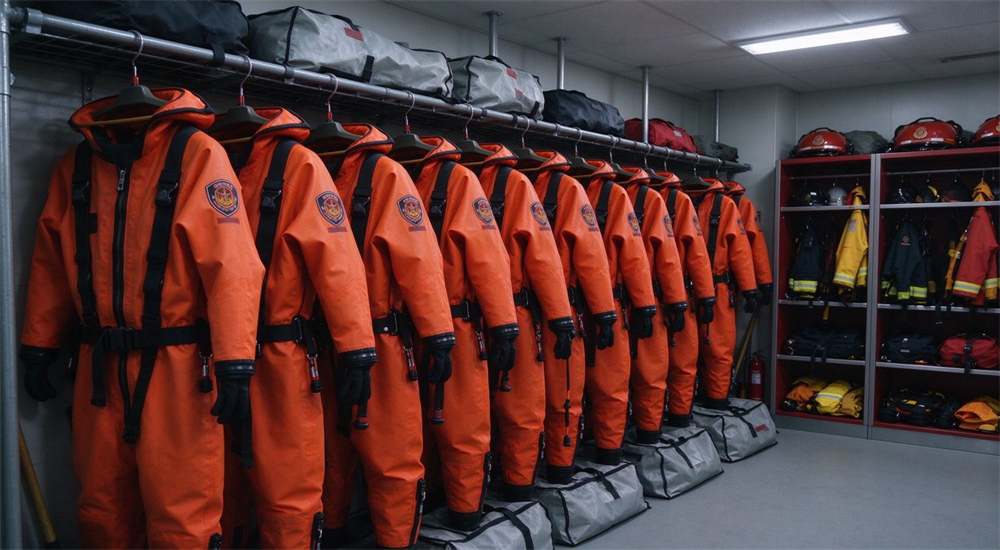
Store ice rescue suits in a cool, dry environment with a temperature range of -30°C to 45°C. Hang the suit on a wide-shoulder hanger to prevent creasing at the shoulders, and ensure the zipper is partially open to reduce stress on the zipper teeth. Avoid folding the suit for long-term storage, as creases can become permanent weak points in the welded seams. Keep suits away from direct sunlight, ozone sources, and petroleum products that can degrade the polyurethane coating. Each suit should be stored in its dedicated breathable storage bag to protect from dust and mechanical damage while allowing air circulation.
With proper care and regular inspection, an ice rescue suit has a typical service life of 5-7 years. Minor punctures and seam leaks can be repaired in the field using the included neoprene cement and patch kit. Zipper replacement, face seal replacement, and harness repair should be performed by qualified service personnel. We maintain production capability for at least 5 years after initial order, ensuring replacement parts and expansion orders match existing fleet specifications. Teams should establish a retirement schedule based on inspection results rather than arbitrary age limits, as usage intensity varies significantly between organizations.
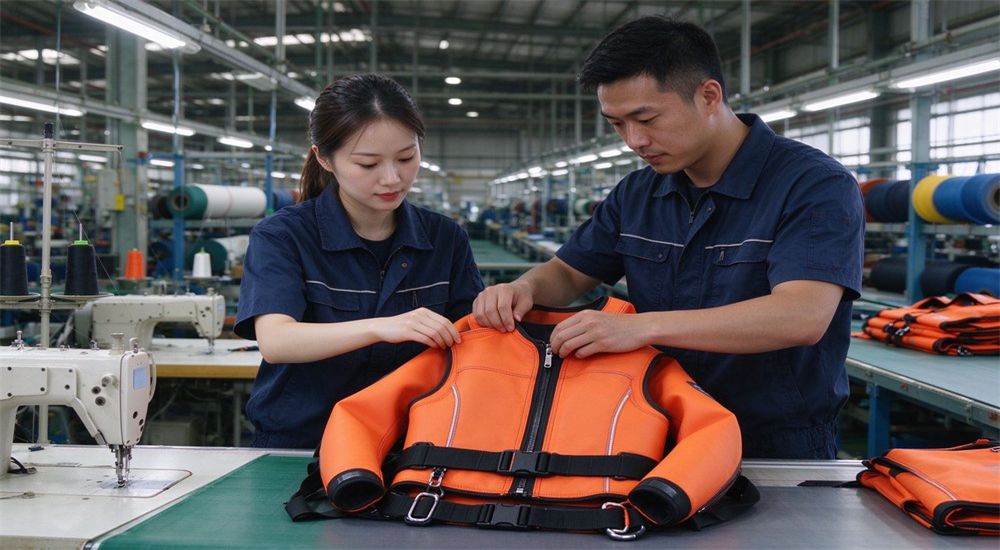
Bulk orders support comprehensive customization including: screen-printed department logos and unit identifiers, custom color combinations with Pantone matching, embroidered name tags and badge numbers, reflective tape pattern modifications, pocket configuration changes, and zipper placement adjustments. Custom sizing and extended size ranges are available for teams with specific requirements. All customizations maintain the same construction standards and material specifications as standard models, ensuring that personalized suits meet the same performance and safety criteria. Our procurement team understands government procurement processes and can support tender documentation requirements. Custom logo printing is available for department identification and brand consistency. We support OEM and ODM manufacturing with full specification control per your requirements. Bulk packaging options support government emergency stockpile programs and pre-positioning contracts. We work with rescue organizations worldwide to ensure consistent equipment quality across deployments.
As a direct ice rescue suit wholesale supplier, we provide complete procurement support for government tenders and institutional purchases, including: detailed technical specification sheets, material test reports and compliance documentation, sample suits for evaluation and team fitting, competitive pricing for volume orders, flexible payment terms for established institutional buyers, and dedicated account management for repeat customers. Our team can assist with tender document preparation, specification alignment, and compliance verification for any market-specific requirements.
Standard models in common colors and sizes typically ship within 15-25 working days from order confirmation. Customized orders with logo printing, special colors, or modified configurations require 25-40 working days depending on complexity. Large institutional orders (500+ units) may require phased delivery schedules. We provide production progress updates and can arrange pre-shipment inspections before final dispatch. Rush production options may be available for emergency procurement situations, such as unexpected ice season early onset or disaster response mobilization.
Each suit is individually packed in a breathable storage bag with product labeling and size identification. Bulk orders are packed in export-grade cartons with moisture protection. Carton labeling includes purchase order number, item description, size breakdown, and quantity. We support EXW, FOB, CIF, and DDP shipping terms. For government stockpile orders, we can coordinate with designated logistics providers and provide advance shipping notices for inventory management integration. Each carton is designed to fit standard apparatus compartment dimensions for fire department and coast guard storage.
Post-delivery support includes: warranty coverage against manufacturing defects, replacement parts availability (zippers, face seals, reflective tape, harness webbing), repair guidance and refurbishment services, size exchange program for ill-fitting suits, and ongoing technical consultation for fleet management. We maintain production capability for at least 5 years after initial order, ensuring replacement and expansion orders match existing fleet specifications. Customer satisfaction is tracked through post-delivery surveys and continuous improvement programs.
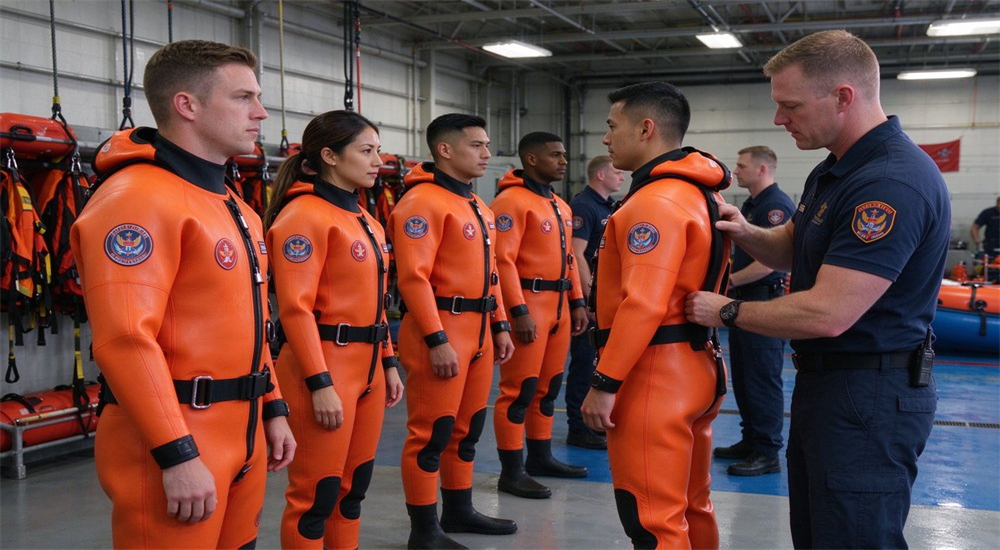
The global trend in cold-water rescue equipment is moving toward integrated personal protective equipment systems rather than separate garment components. Ice rescue suits exemplify this trend by combining waterproofing, thermal insulation, flotation, and harness capability in one garment. This integration reduces donning time, eliminates the risk of forgotten PFDs, and simplifies fleet procurement and maintenance. Procurement officers should evaluate total cost of ownership across the integrated system rather than comparing individual garment prices.
Changing climate patterns are altering ice rescue requirements in unexpected ways. While some regions experience shorter ice seasons, others face more unpredictable ice conditions—thinner ice, rapid freeze-thaw cycles, and unexpected ice breakups—that increase the risk of ice-related emergencies. Municipalities that historically maintained minimal ice rescue capability are now investing in dedicated suits and training. This trend is driving demand for versatile ice rescue suits that can transition between ice, cold water, and winter flood operations, making the Standard model the most popular choice for expanding programs.
Manufacturers are exploring more sustainable materials for ice rescue suit construction, including recycled nylon substrates and water-based polyurethane coatings that reduce VOC emissions during production. While these materials are still emerging in the professional rescue market, procurement officers with sustainability mandates should inquire about available eco-friendly options. The closed-cell foam buoyancy liner is also being evaluated for recyclability at end of service life, with some manufacturers offering take-back programs for retired suits.
Based on experience with government and institutional buyers worldwide, we recommend the following procurement approach: (1) Issue a request for sample suits before committing to a large order, allowing the team to conduct real-water fit and performance testing; (2) Specify minimum buoyancy (150N), thermal performance (2°C/6hrs), and sealed system requirements in tender documents to ensure all bidders meet the same baseline; (3) Require ISO 9001 certification and test documentation for all critical performance claims; (4) Plan for a 5-7 year replacement cycle and budget accordingly; (5) Consider ordering 10-15% extra units for training, spares, and fleet expansion. Following these practices ensures that procurement delivers equipment that teams trust and that performs when needed most.
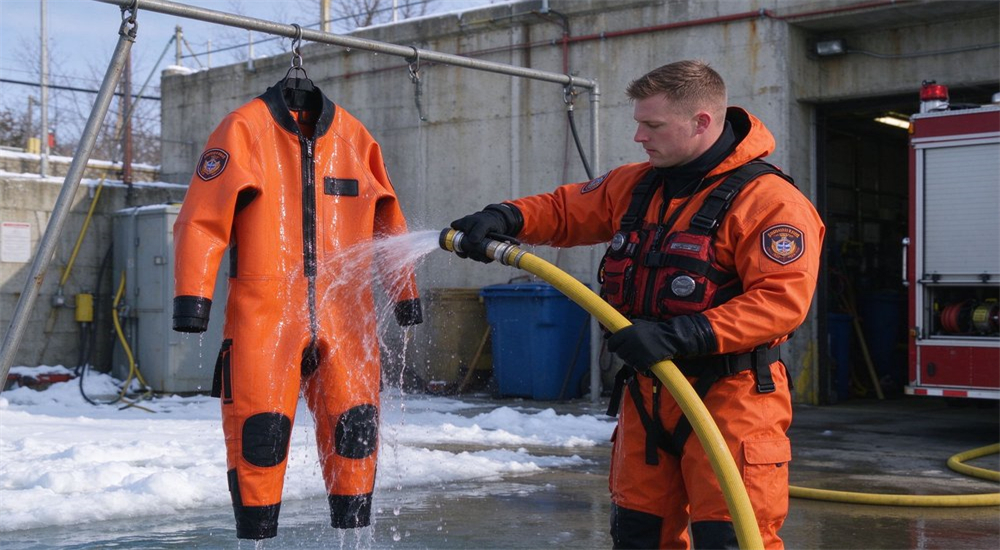
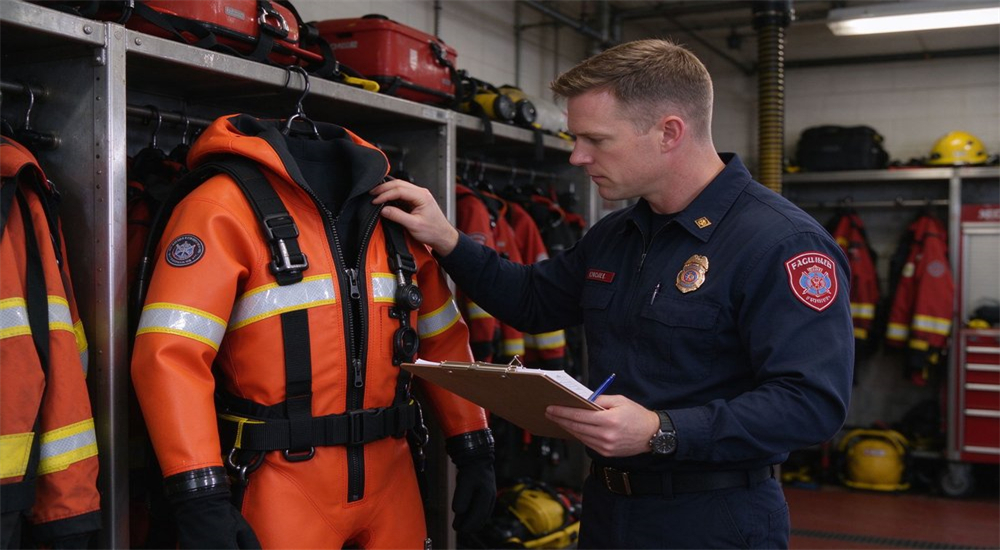
Ice rescue suits feature enhanced thermal insulation rated for ice water immersion, high-visibility colors, integrated flotation, and specialized features like ice claw attachment points, tow tethers, and reinforced knee and elbow pads for crawling on ice.
With proper thermal undergarments, our ice rescue suits provide thermal protection for 30-60 minutes of active immersion in 0-4°C water. This exceeds the typical 10-15 minute useful consciousness window for unprotected individuals.
Yes, our ice rescue suits include integrated buoyancy foam providing 75-100N of flotation, allowing the wearer to remain afloat even if unconscious. This is supplementary to—but does not replace—a properly rated PFD for full operations.
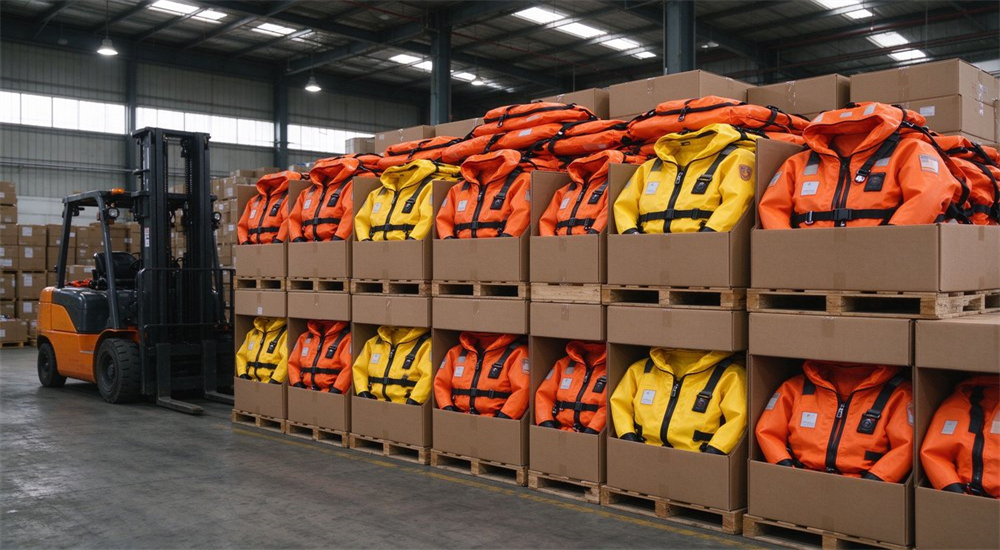
One-piece suits provide better waterproof sealing and are faster to don for emergency response. Two-piece systems (jacket + bib pants) offer more flexibility for sizing and can be worn separately for training or maintenance. Both meet professional standards.
Store in a cool, dry location away from direct sunlight and ozone sources. Hang loosely on wide hangars or fold according to manufacturer guidelines. Ensure the suit is completely dry before storage to prevent mold and mildew.
While designed specifically for ice rescue, these suits can also be used for cold water rescue, flood operations in winter conditions, and any scenario requiring maximum thermal protection. They are not recommended for warm water due to overheating risk.
After each use: rinse with fresh water, inspect all seals and zippers, check buoyancy material for damage, and dry thoroughly. Monthly: lubricate zippers, inspect reflective tape, and test inflation valves. Annually: perform full buoyancy and thermal testing.
Compatible accessories include ice claws, rescue throw bags, tow tethers, communication systems, helmet mounts, and glove systems. Our suits feature standardized attachment points compatible with most major rescue equipment brands.
Sizing is based on height, weight, and chest circumference. Because these suits are worn over thermal layers, order one size larger than standard clothing measurements. We provide detailed size charts and can supply sample suits for fitting.
Standard colors and sizes have no minimum order. Custom colors, logos, or specialized configurations require minimum orders of 20-50 units depending on the modification. Contact us for specific requirements.
Q1: What is the difference between an ice rescue suit and a dry suit?
An ice rescue suit is a fully sealed immersion system with built-in buoyancy (≥150N), an integrated chest harness, and attached boots and gloves. A dry suit provides waterproofing but requires a separate PFD for flotation and does not include ice-specific features like accessory pockets for ice screws or reinforced ice-crawling abrasion panels. The ice rescue suit is purpose-built for ice and cold-water rescue, while a dry suit is a more general cold-water garment.
Q2: How does the built-in buoyancy work?
The removable internal liner is made of closed-cell foam that generates over 150N of flotation. This means the suit floats the wearer face-up even if unconscious, without needing a separate life jacket. The buoyancy is stable over time—less than 5% loss after 24 hours of immersion. The liner can be removed for cleaning or repair.
Q3: What sizes are available?
Our ice rescue suits use a one-size-fits-most design accommodating wearers from 50kg to 150kg (110-330 lbs) and 1.5m to 2.0m (4'11" to 6'7"). Adjustable internal straps and elastic cuffs ensure a secure fit. Custom sizing is available for team members outside this range—contact us for evaluation.
Q4: How long does the suit keep someone warm in ice water?
In controlled testing at 2°C (35.6°F) water temperature, a properly fitted suit limits core body temperature drop to less than 2°C over six hours of full immersion. Actual performance varies based on wearer body composition, activity level, and water conditions. The Maritime Grade model offers enhanced thermal performance for extended immersion scenarios.
Q5: Can I wear clothing under the ice rescue suit?
Yes, the suit is designed to be worn over base layers or mid-layers. We recommend moisture-wicking thermal base layers and, for extreme cold, an optional heated undergarment liner. Avoid cotton layers that retain moisture. The suit's internal volume accommodates typical rescue team uniform layers without compromising the seal.
Q6: How do I inspect and maintain the suit?
After each use, rinse with fresh water and hang to dry away from direct heat. Before each ice season, perform an inflation leak test, inspect all seals and zippers, check reflective tape, and verify harness integrity. Lubricate the zipper regularly. Store on a wide hanger in a cool, dry area. Full inspection instructions are included with each suit.
Q7: What is the minimum order quantity for bulk orders?
Standard models have a minimum order quantity of 10 units. Customized orders with logos or special colors typically require 20-50 units depending on the customization scope. We can accommodate smaller sample orders for evaluation purposes before committing to a full fleet purchase.
Q8: Can you add our department logo to the suits?
Yes, we offer screen-printed department logos, unit identifiers, and embroidered name tags as customization options. Provide your logo in vector format (AI/EPS) for best results. Logo placement is typically on the chest, back, or both, and can be specified during the order process.
Q9: What certifications do the suits have?
Suits are manufactured in ISO 9001 certified facilities. Buoyancy is verified through hydrostatic testing (≥150N, <5% loss over 24hrs). Thermal performance is validated through 2°C/6-hour immersion testing. Reflective tape meets SOLAS standards. Full test documentation is available for tender submissions.
Q10: How long does production take?
Standard models ship in 15-25 working days. Customized orders (logos, colors, configurations) require 25-40 working days. Large orders (500+ units) may use phased delivery. Rush options may be available for emergency procurement—contact us to discuss timelines.
Q11: Are replacement parts available?
Yes, we stock replacement zippers, face seals, wrist seals, reflective tape, harness webbing, and D-rings. We maintain production capability for at least 5 years after your initial order, ensuring replacement parts and expansion suits match your existing fleet.
Q12: Can the suit be repaired in the field?
Minor punctures and seam leaks can be repaired in the field using the included neoprene cement and patch kit. Zipper lubrication and minor adjustments can also be performed by team members. Major repairs—zipper replacement, face seal replacement, harness repair—should be handled by qualified service personnel.
Q13: What is the service life of an ice rescue suit?
With proper care and regular inspection, the typical service life is 5-7 years. Actual lifespan depends on usage intensity, storage conditions, and maintenance practices. Teams should retire suits based on inspection results rather than arbitrary age limits. We provide retirement guidance as part of our after-sales support.
Q14: Do you offer training or usage guidelines?
Each suit includes a comprehensive user manual with donning instructions, care procedures, and inspection checklists. For bulk orders, we can provide digital training materials and can connect teams with certified ice rescue training organizations. We recommend that all users complete formal ice rescue technician training before operational deployment.
Q15: Can the suit be used for flood rescue as well?
Yes, the ice rescue suit's fully sealed system and inherent buoyancy make it suitable for winter flood and cold-water rescue operations where standard wetsuits provide inadequate thermal protection. The Standard and Lightweight models are particularly versatile for multi-purpose water rescue teams that encounter both ice and open-water scenarios.
Q16: What shipping terms do you support?
We support EXW, FOB, CIF, and DDP shipping terms. For government stockpile orders, we can coordinate with your designated logistics provider and provide advance shipping notices. Each carton is labeled with PO number, item description, size breakdown, and quantity for easy inventory management.
Previous :
Flood Rescue Clothing & Gear for Professional TeamsNext :
Wholesale Wetsuit Water Rescue Suits for Professional Rescue Teams Firefighting Life Jacket, Quick Auto-Inflation, Universal Orange
This professional firefighting life jacket features a wear-resistant waterproof Oxford fabric outer layer with EPE high-density polyethylene foam filling, providing ≥100N total buoyancy with ≥50N inherent buoyancy. Equipped with a ≤5-second quick auto-inflation system, it meets emergency rescue needs in firefighting, floods, and inundations. The high-visibility orange design with reflective strips enhances night recognition, while the chest rescue whistle facilitates emergency distress signals. Universal size fits most rescue personnel, with customizable organizational logos and functions.
 Floating Rescue Vest High-Visibility Waterproof Earthquake Safety
This flood prevention life jacket is made of 200D Oxford polyester fabric with polyethylene foam buoyancy material, providing ≥8.5kg buoyancy. Measuring 65×50cm, it fits most adults. Featuring 6 evenly distributed reflective patches and an emergency whistle, it's specifically designed for maritime storms, floods, and earthquake-induced water disasters. The orange/green design ensures high visibility during water rescue operations. Professional teams can customize specifications, markings, and special features according to their requirements.
 Rescue Life Jacket, Thickened Waterproof, 74N High Buoyancy Design
Professional rescue life jacket features 200D thickened Oxford fabric outer layer, high buoyancy ≥74N design, compliant with GB/T32227-2015 rescue equipment standards. Standard size 58×42×5.5cm, lightweight for quick mobility. Orange-yellow high-visibility color with shoulder reflective strips ensures maximum visibility in extreme conditions like floods and tsunamis. Ideal for flood rescue, sea storm rescue and earthquake-induced flood disasters, an essential equipment for professional rescue teams.
 Flood Control Life Vest, 200D Oxford Fabric, Orange-Yellow High Visibility
Professional flood control life jacket features 200D thickened Oxford fabric outer layer, standard size 58×42×5.5cm, with ≥74N buoyancy value tested to GB/T32227-2015 standards. High-visibility orange design with night reflective strips, lightweight for unrestricted movement. Ideal for flood disasters, earthquake-induced floods, sea storm rescues and extreme conditions, providing reliable buoyancy support for rescue personnel, improving water rescue efficiency by 99% - essential equipment for emergency rescue operations.
 Professional Flood Rescue Life Jacket High Buoyancy Vest
This professional flood rescue life jacket features a 450D waterproof Oxford fabric outer layer with EPE high-buoyancy filling material, providing ≥88N buoyancy to ensure water rescue personnel safety. Equipped with night reflective patches and large reflective areas on shoulders and chest to enhance visibility in adverse weather conditions. The lightweight design weighs ≤1kg, not affecting rescue operation flexibility. Tested in actual flood disaster scenarios, it provides continuous buoyancy support for over 12 hours in rapid currents, having protected over 10,000 rescue personnel during 327 flood control operations nationwide.
 88N Buoyancy Water Rescue Life Vest Emergency Disaster Vest
This professional water rescue life vest features a 450D waterproof Oxford fabric outer layer with EPE high-buoyancy filling material, providing ≥88N buoyancy support to ensure rescuers remain stable in rapid currents. Weighing ≤1kg, it's lightweight and doesn't restrict rescue operations. Large reflective patches on shoulders and chest enhance nighttime rescue visibility. Field-tested to protect rescuers during 18-hour continuous emergency operations, it has been successfully deployed in 176 flood rescue missions nationwide.
Copyright © Custom Disaster - Relief Bedding: Tents, Sleeping Bags, Blankets All Rights Reserved
the professional team to service !