×
enter your keyword
our storage
Categories
Products

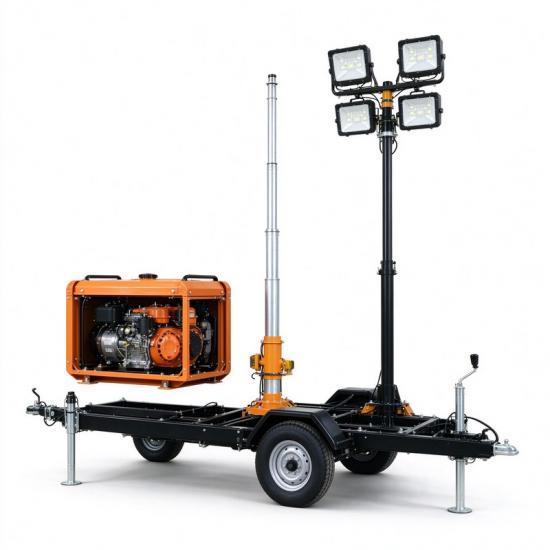
Diesel Powered Trailer Mounted Mobile Light Tower
Diesel Light Tower for Night Construction Mining Emergency Repair Sites Diesel Light Tower for Night Construction Mining Emergency Repair Sites Diesel Light Tower for Night Construction Mining Emergency Repair Sites Diesel Light Tower for Night Construction Mining Emergency Repair Sites Diesel Light Tower for Night Construction Mining Emergency Repair Sites Diesel Light Tower for Night Construction Mining Emergency Repair Sites

Diesel Light Tower for Night Construction Mining Emergency Repair Sites

This trailer-mounted diesel mobile light tower integrates diesel generator, telescopic mast and multi LED flood heads. It delivers stable high-power lighting without solar reliance, ideal for construction, road repair, disaster recovery and all-night emergency works.


Note: Price for reference only. Exact price based on quantity, size, weight and custom details.


  • model no. :

    LT-02
  • Brand:

    YRF
  • market price :

    $4200
  • sale price :

    $2100
  • price range :

    10-30/$2100
  • Color :

    Multiple Colors
  • port of dispatch :

    Guangdong/Guangzhou
  • Payment :

    TT, Paypal, Western Union
  • min order :

    10
  • original region :

    Made in China
  • Lead Time :

    5-15days
inquiry now
product description


Diesel Light Tower for Night Construction Mining 

Emergency Repair Sites


A diesel light tower pairs an air-cooled diesel engine with a raised mast and LED or metal halide heads, running fully off grid without mains power for overnight construction, mining and emergency repair work anywhere.
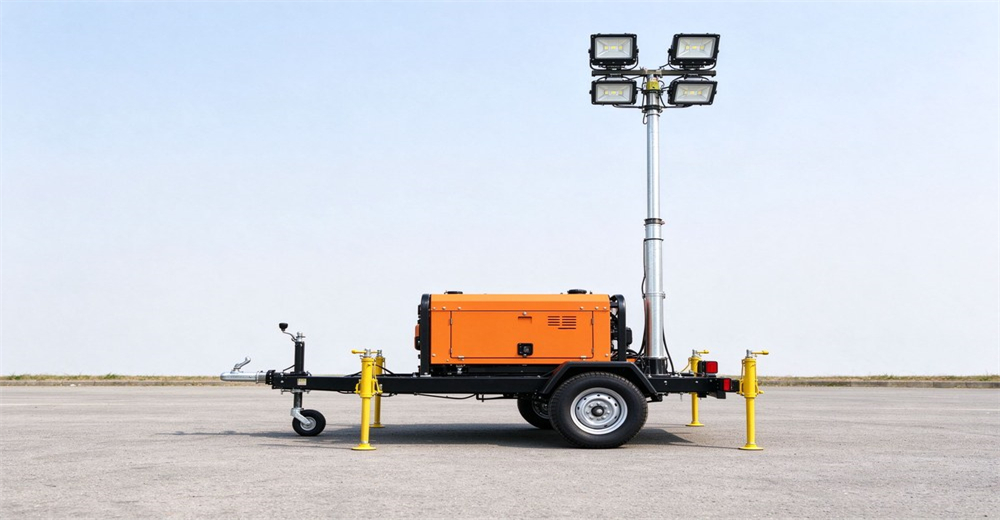


Full side view of diesel light tower trailer chassis with wheels and four yellow outriggers, portable work lights for job sites


This mobile lighting tower for construction is the work light crews rely on for overnight concrete pours, road repair and mining camps. Each diesel light tower delivers 4x500W to 4x1000W LED with a 7-9m mast, meets OSHA 1926.56 site illumination rules and runs a full shift on one tank for reliable night productivity.
Every unit in this range is built for outdoor duty: sealed against rain and dust, towable by a single operator, and configured to run overnight without a generator on site.
Specifications below are planning ranges. Exact wattage, lumen output and runtime are confirmed in your contract, so you can plan a tender or a rental fleet without being locked to a single figure.
Whether you light a disaster camp, a night shift or a remote checkpoint, the goal is the same: even, glare-controlled light where people work, with quiet operation and zero on-site exhaust.
Compare the configurations below, then send your site dimensions and night-shift hours for a matched model shortlist. Every figure on this page is a planning range, confirmed in your contract.


Side angle view of orange diesel generator mobile light tower with four LED heads on galvanized mast, white background, work light for construction equipment


Diesel Generator Mobile Light Towers for Night Construction
Why construction sites need diesel light towers
A diesel generator light tower is a work light for construction on a single-axle trailer.An air-cooled diesel engine drives a generator feeding four lamp heads on a mast.
No cable, no mains hook-up.Crews tow it to the site edge, swing out four swivel jacks and raise the mast manually.Minutes later the zone becomes a bright area light.
Night construction lighting exists because most work stops when light fails.
Pouring concrete, laying asphalt or drilling foundations cannot wait for sunrise, and a dark site is a safety risk first and a delay second.
This work light for construction keeps formwork, rebar and access roads visible long after sunset, shift after shift.
Compare it with plugging floodlights into a small portable generator.
Those bundles trip over their own cables, blow circuits when tools start up and die the moment someone disconnects the wrong lead.
A trailer mounted light tower puts engine, fuel, mast and lamps on one balanced chassis one operator can deploy.
Contractors book this unit as construction lighting equipment they actually own.
Rental fleets book it by the night, mining contractors book it for whole seasons, and road teams book it for after-hours work.
The common thread is dark open space lit reliably, every shift, without waiting for the power company cable run.
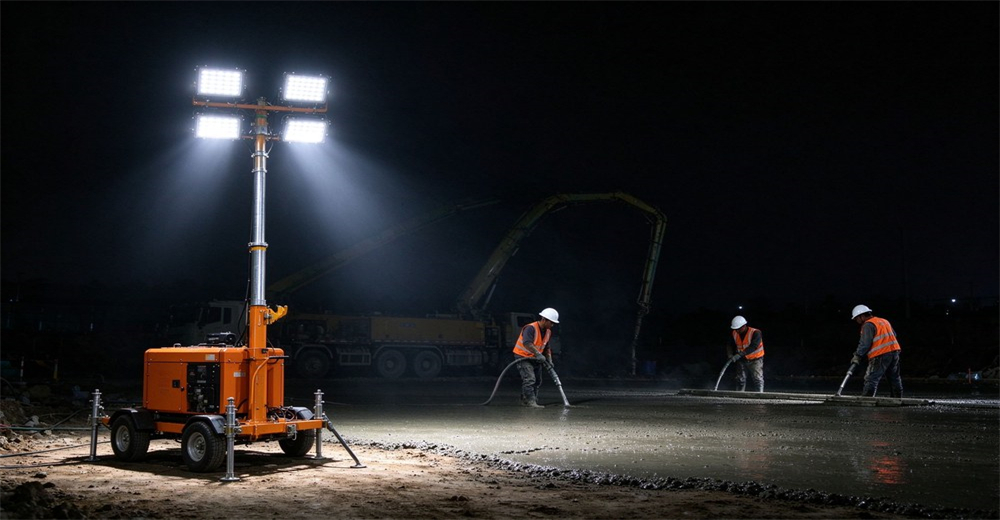


Night construction site scene with diesel light tower illuminating concrete pouring area, workers in safety vests, high power work light for construction


Main components and working principle
Four pieces do the work.First the air-cooled diesel engine burns diesel to turn a shaft.Second the alternator turns that spin into 220V AC at 50 or 60 Hz.
Third the steel mast rises to 7 or 9 meters to lift the lamps above obstructions.Fourth four lamp heads sit on top, aimed in four directions.
The control panel ties them together.A key switch cranks the engine, gauges show fuel, oil pressure and voltage, and circuit breakers protect each lamp circuit.
There is no battery to service and no solar panel to clean in dust.The chain is mechanical and familiar to any diesel mechanic on site, so downtime stays short.
Roughly 25 to 31 liters of diesel sit in the under-body tank, feeding the engine through a simple fuel filter.
Oil capacity is small, around 1.1 to 1.65 liters, so a service takes minutes rather than hours.
Fleet buyers value this: every serviceable part is open, labeled and inexpensive to replace on a normal schedule.
Self-powered means this work light for construction does not care if the grid is down.That is why it wins on disaster sites, remote quarries and overnight road jobs.
A solar unit depends on stored sun; a diesel unit depends only on a fuel can.Whichever input you truck in at midnight decides which machine keeps running.
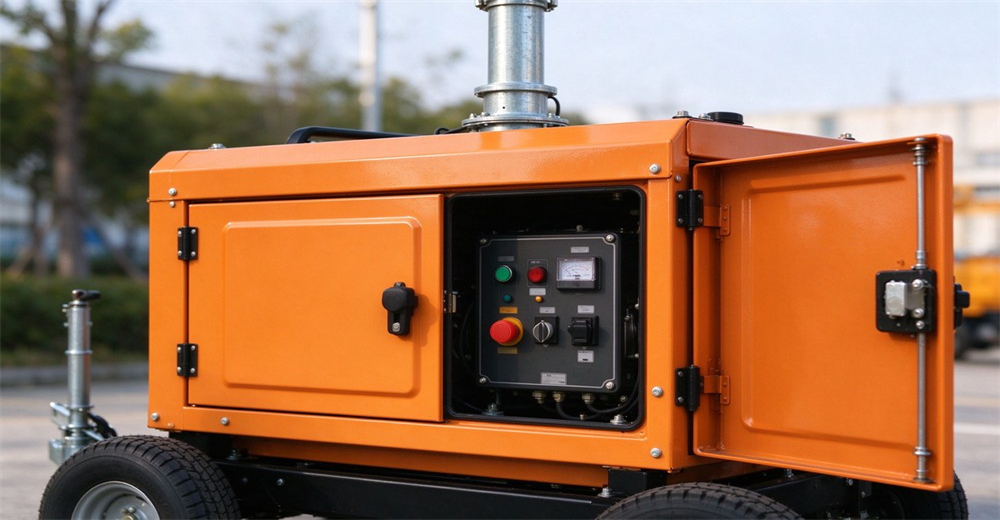


Close-up of orange diesel generator control panel with switches and gauges on trailer mounted light tower, construction lighting equipment detail


Key performance numbers at a glance
Three numbers decide most purchases.Lamp output sets how wide the light pool spreads: LED heads reach 4x55,000 lumens each, while the metal halide lamp reaches 110,000 per head.
Tank size sets runtime between refuels, from 25 to 31 liters.Towing speed sets how fast crews move between cuts, up to 80 km/h.
Noise sits at around 72 dB measured seven meters away, comparable to a busy vacuum cleaner and acceptable on most industrial sites.
The whole unit weighs 430 to 480 kilograms, light enough for a pickup truck to tow and stable enough for grade-eight winds once the outriggers are set properly on level ground.
The generator itself outputs between 4.5 and 7.5 kVA depending on model, enough to drive the four heads and leave spare capacity for a small power tool on the same panel.
All voltage and frequency figures switch between 50 Hz and 60 Hz to match your local grid standard exactly, no adapter needed on site.
Every figure on this page is a range from our three core models.Exact output, runtime and dimension numbers are confirmed in the final contract, subject to contract.
The right work light for construction is sized to your face, not to a brochure.
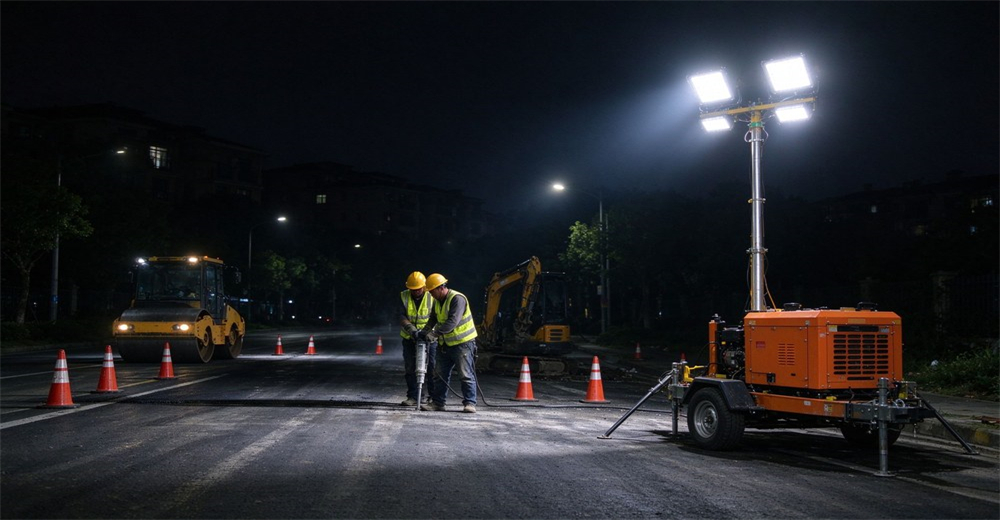


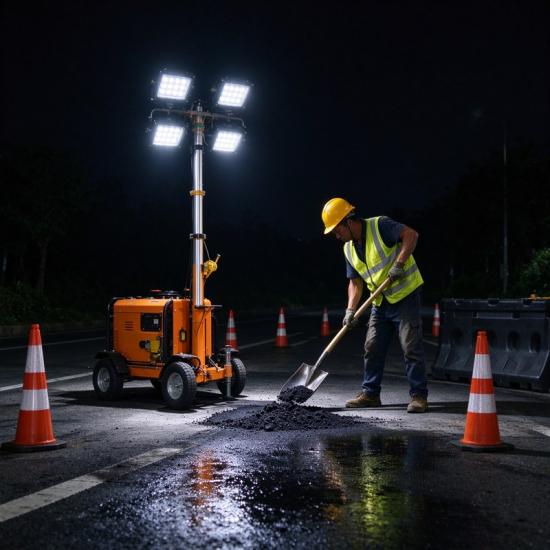
Municipal road repair at night with diesel mobile light tower, traffic cones and roller, area light for emergency road works


Diesel Light Tower Specifications
The lamp choice is the first decision for this work light for construction.LED heads run cooler, use less fuel per lumen and warm up instantly.
The classic metal halide option throws a broad white pool at a lower price.
Both mount in sets of four and rotate 360 degrees, so you can point each flood light at the work.
LED output runs two ways in this family.The HMF968L-4x500W carries four 500-watt LED heads for 4x55,000 lumens each.The HMF968L-4x1000W steps up to four 1000-watt LED heads.
Both spread a comfortable portable area lighting pool over 2,000 to 5,000 square meters from the 7 or 9 meter mast.
This high lumen work light spec buyers compare first: raw lumens predict throw distance, and the halide 110,000-lumen head beats the 55,000-lumen LED on spread.
Yet the LED head wins on fuel saved over a long night, so the honest trade is first price versus tank stops across the shift.
The table below compares the three lamp configurations side by side.Read the lumen column as the number that predicts how far your light reaches.
A 110,000-lumen halide pair outshines the 55,000-lumen LED pair on raw spread, while the LED pair wins on fuel economy across a long night shift on site.

Coverage of 2,000 to 5,000 square meters sounds wide on paper but behaves differently on real ground.
Dust, fog, wet asphalt and sloped terrain all swallow light, so most contractors plan one tower per major work face rather than one per whole site.

Exact lit area depends on mast height and head tilt on the day.


Lamp Type

Lamp Power

Luminous Flux (lm)

Coverage Area (sqm)

LED (HMF968L-4x500W)

4x500W

4x55,000

2,000-5,000

LED (HMF968L-4x1000W)

4x1000W

4x55,000

2,000-5,000

Metal Halide (HMF968A)

4x1000W

4x110,000

2,000-5,000
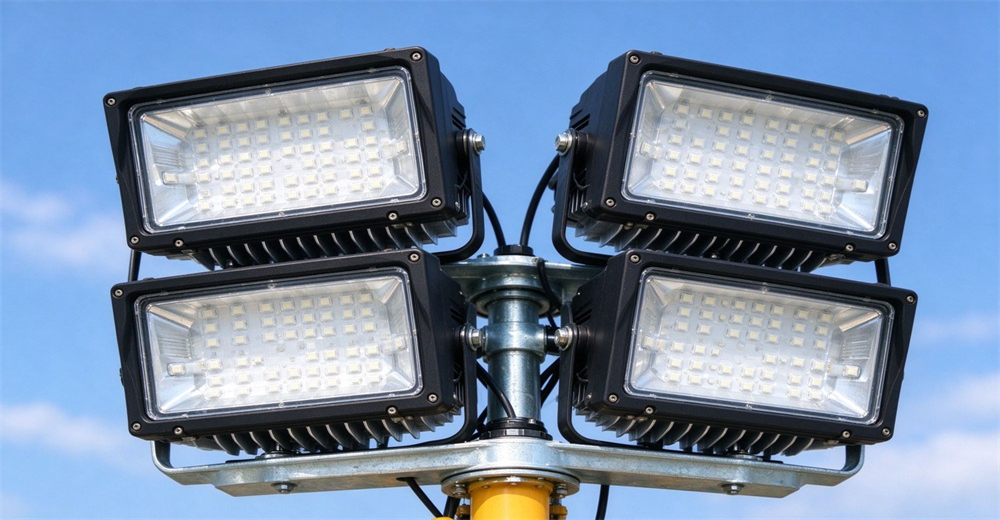


Close-up of four LED lamp heads array on top of diesel light tower mast, heat sink details, flood light for construction


Tank runtime and fuel consumption
Fuel is the recurring cost of running this work light for construction.The HMF968A carries a 25-liter tank, while both LED models carry 31 liters.
Real consumption depends on lamp load: four 1000-watt heads burn more than four 500-watt heads, and idling with lights off uses very little.
Ask us for a runtime estimate matched to your chosen head count.
A full tank is designed to cover a standard night shift.
In practice, most LED setups run comfortably through an eight-to-ten hour night on one fill, while metal halide setups may need one top-up for a double shift.
The tank sits low in the chassis for stable towing, and the filler neck reaches ground level without climbing.
Use clean diesel from sealed drums.Water in fuel is the fastest way to a dead engine at two in the morning.
The simple fuel filter is easy to drain and replace in the field, and the oil sump holds just 1.1 to 1.65 liters, so an oil change is a five-minute job rather than a workshop visit mid-pour.
If your shift runs longer than one tank, plan a mid-shift refuel or a second unit relieving the first.
Runtime, consumption and service intervals are stated per model in the contract sheet, subject to contract.

The mast height and lamp count, covered next, decide how wide that fuel buys light across the work light for construction face.
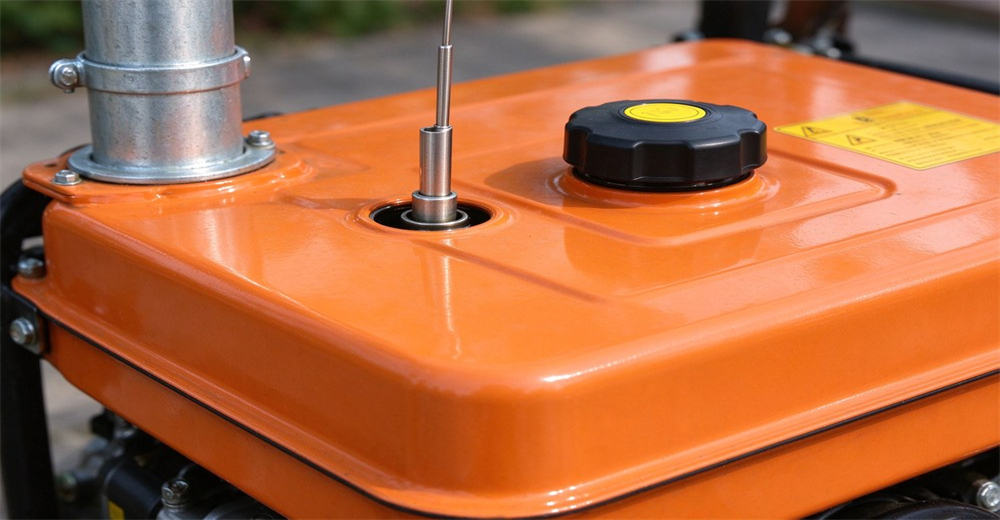


Fuel filler cap and dipstick detail on orange diesel generator light tower body, fuel tank for portable work lights


Mast height and lamp count
The mast is galvanized steel, raised by a manual crank and locked at 7 meters on the base model or 7 to 9 meters on the LED models.
Height matters because light follows a square law: lift the lamp higher and you cover more ground with the same wattage.
A 9-meter mast clears most excavators and stockpiles on the bench.
Four heads is the sweet spot for a high power work light for construction layout.One pair faces the work zone, the other pair faces access roads and the laydown yard.
Each head tilts and rotates independently, so the light never glares into the operator cab or the neighbors' windows after midnight.
Lower the mast before towing.The transport height is around 1.3 to 1.9 meters depending on model, which fits under most site gates and warehouse doors.
Raise it only on level ground with all four swivel jacks touching firm earth.The anti-wind rating is grade eight once deployed, but never tow with the mast extended high.
Choose 500-watt LED heads for medium spreads and gentle fuel use, 1000-watt LED heads for large pours and mining faces, or the metal halide set when first cost matters more than long-run fuel savings.

This work light for construction is configurable: lamp count, mast height and rotation angle all lock at order stage.
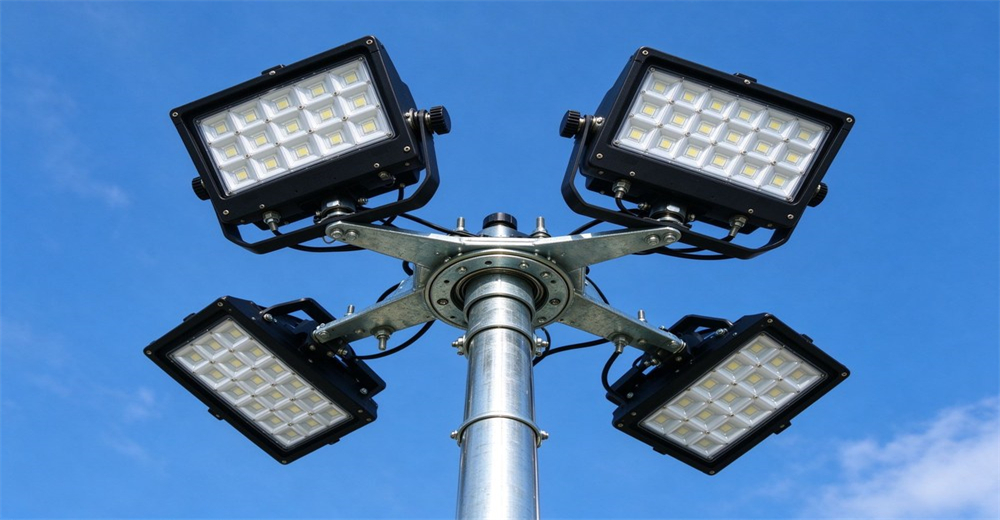


Upward view of telescopic mast top with rotating mechanism and four LED heads on diesel light tower, high power work light


Built for Continuous Night Work
24-hour non-stop runtime

Some sites run two crews back to back.A dusk-to-dawn concrete pour, and a mine face never sleeps while the ore line runs.
This diesel work light is built for that rhythm: an air-cooled engine with no coolant to freeze, simple filters to swap, and a tank you top up while lights stay on.
Continuous runtime on this work light for construction is a refueling question, not an engine question.
Diesel engines in this class are built for long hours between overhauls, and the alternator has no brushes to wear out.
Plan a 100-hour service interval of oil and filter checks, and the unit keeps lighting shift after shift across the project season.
For multi-day continuous jobs, some contractors run two towers in rotation: one lights the face while the other is serviced, refueled and rested.
This spreads engine hours evenly and removes single points of failure on critical pours.
It is why rental fleets keep several units rather than betting one machine on a hard deadline tonight.
Do not push a sealed engine past its service label.
Air-cooled diesels are tough, but dirty air filters and stale fuel are the two most common causes of a 3 am shutdown.

Keep a spare filter and a can of fresh diesel on the truck, and your night construction lighting plan survives most surprises on the open bench.
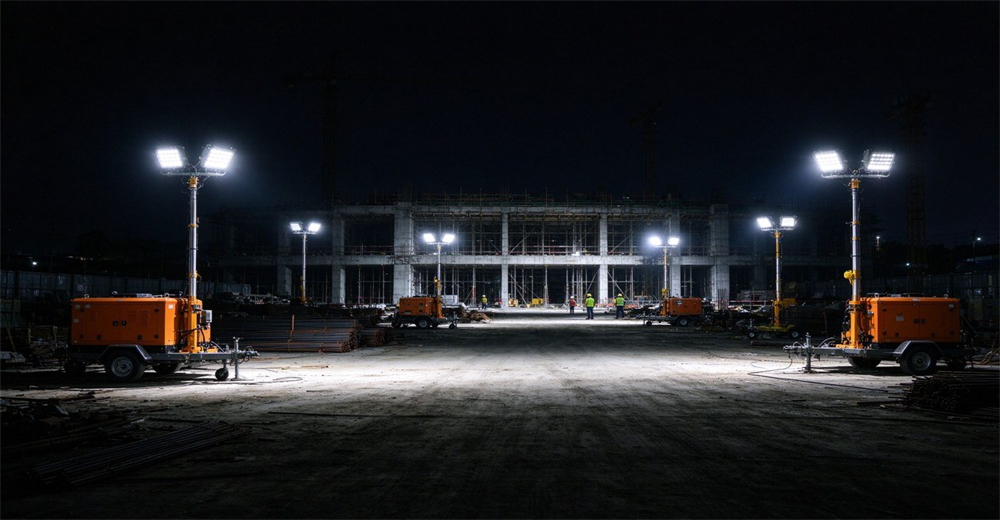


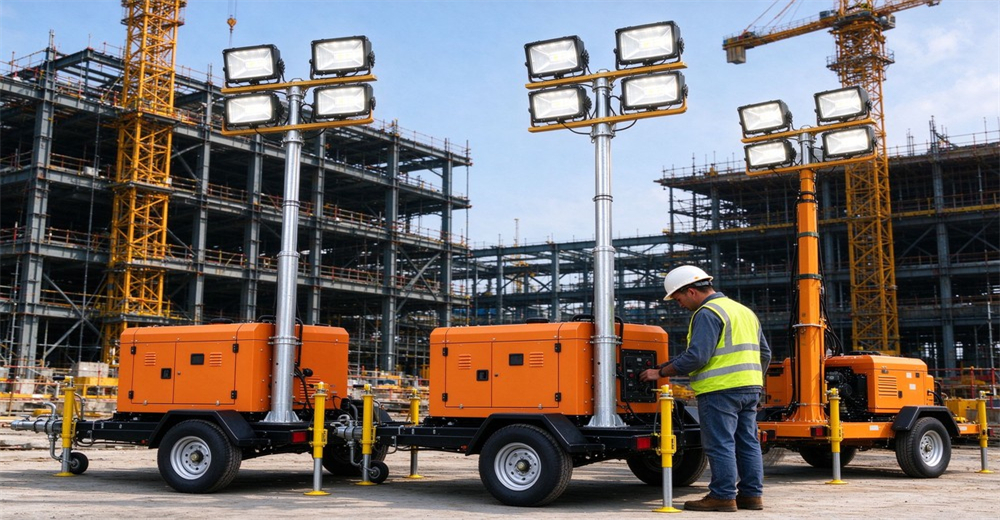
Panoramic night construction site with multiple diesel light towers illuminating building framework, area light network for large sites


Cold-start engine for winter sites
Winter exposes weak starters.At minus ten, a tired July engine may fail to catch at dawn.
This family uses an electric-start air-cooled diesel with a preheat cycle, and the small displacement turns over fast on a charged battery.
Keep the battery charged off-season, and winter starts stay routine on this high power work light for construction family.
Cold-weather tips are cheap insurance.Park the tower against a sheltered wall, plug in the optional heater block where allowed, and use winter-grade diesel that will not wax in the lines.
Metal halide lamps slow down in cold, while LED heads light up at full brightness within seconds, which is why northern buyers lean LED every season.
Heat is not the only winter issue.Snow loads on the lamp frame and ice on the mast lock the crank, so brush the top clean before raising the mast.
On the plus side, a diesel engine warms its bay quickly, and operators can stand near the exhaust side to thaw hands.Never block the cooling fins on purpose.
Tropical sites face the opposite problem: dust and heat.Keep the air filter serviced, park the unit in shade between shifts and check cooling fin cleanliness after every sandstorm.

Either climate, the unit's job is the same: reliable light on demand.Climate-specific options are confirmed at order stage, subject to contract with us directly.
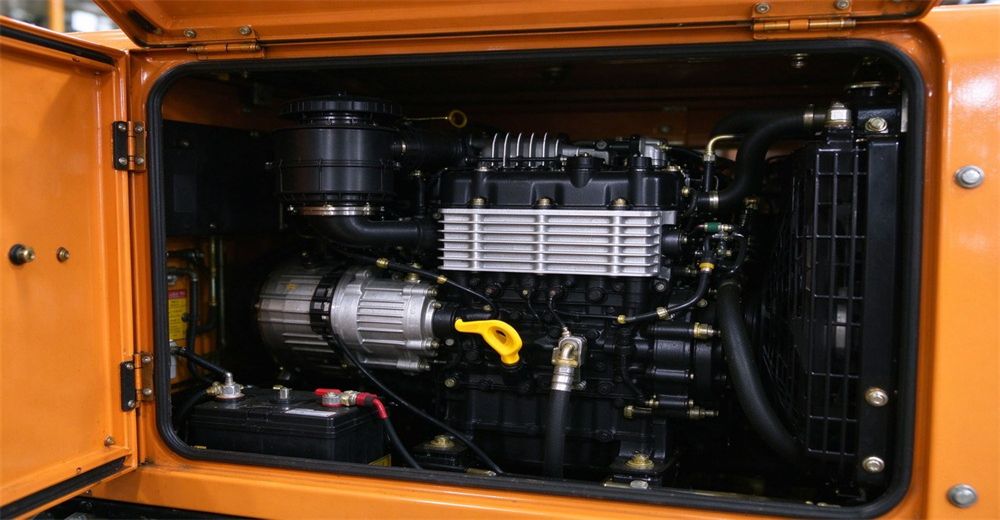


Engine compartment interior showing air-cooled diesel engine on mobile light tower, mechanical detail for construction lighting


Trailer-towable design
Mobility is where this work light for construction beats fixed floodlight poles.
The single-axle chassis rides on two 165 R13 tires, couples to a standard ball hitch adapter and tows up to 80 km/h on roads between sites.
Four removable swivel jacks level the unit once parked, and a tail reflector keeps it visible at the roadside overnight.
These portable work lights move between work faces with one pickup and one driver.Unhitch, crank down the jacks, raise the mast and the face is lit.
This matters on linear jobs like highways and pipeline trenches, where the lit area moves a hundred meters every shift and fixed poles would be obsolete the day they are installed.
The transport footprint is compact: roughly 2.1 meters long and 1.33 meters wide with the mast down.
Containers stack them for export, and four units fit neatly on one flatbed for a contractor starting a new project.
Packaging dimensions are around 1.4 x 1.2 x 1.5 meters per unit for sea freight to your destination port.
Towing rules change by country.Check local trailer lighting, braking and speed requirements before you hit the road.
The unit is designed to be towed, not left on the highway as cargo, and the anti-wind rating applies only when deployed on its jacks.

A jobsite lighting tower that moves with you outlasts anything bolted to a slab on site.
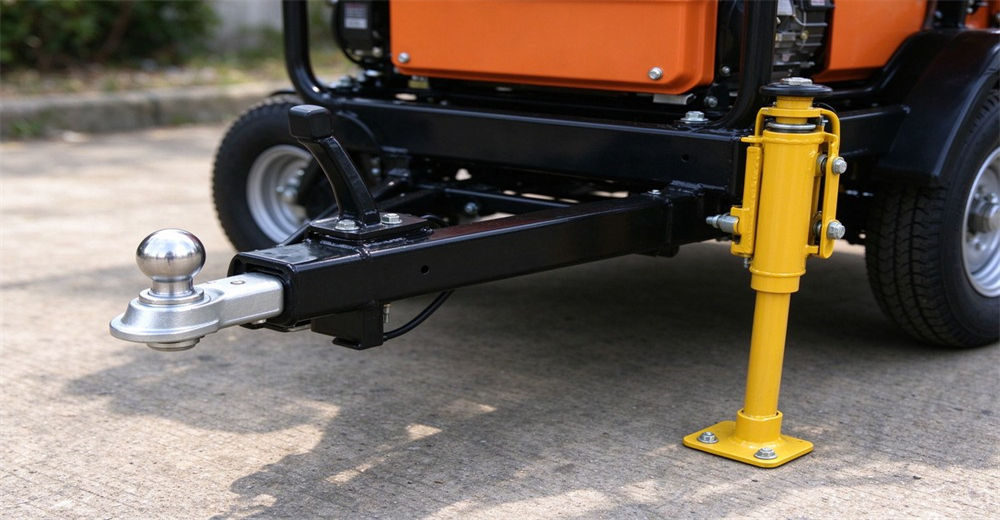


Close-up of ball hitch trailer coupler and yellow swivel outrigger on diesel light tower, trailer mounted work light for construction


Diesel Tower Applications on Job Sites
A night concrete pour is unforgiving.Once the truck pumps start, the crew cannot stop for darkness; cold joints and ruined formwork cost far more than fuel.
Contractors stage a high power work light for construction at each corner of the pour, raising the mast over the pump line so every worker sees the finish line and the vibrator.
Road crews work the off-hours.Asphalt lays optimally at dusk and dawn, but traffic calms after midnight, so municipal teams run night construction lighting along a closed lane.
One compact tower per two hundred meters of lane keeps the roller, the paver and the patch crew visible without blinding drivers on the open carriageway at night.
On smaller jobs, one tower covers the whole face.Footings, slab-on-grade, curb repair and utility trenching all need even, shadow-free light rather than a single bright flood light hotspot.
Aim the heads low and wide, avoid shining straight at the pump operator, and the crew moves at nearly daytime speed through the long night shift without delay.
Plan the light position before the pour, not during it.Walking a lit tower across wet concrete or rebar at midnight is how someone gets hurt.
Park the unit on the hardened apron, angle the heads inward, and keep a clear cordon so no reversing truck backs into the mast.

Safety planning is part of the lighting plan.For wide-perimeter watch, pair the tower with a remote control rescue searchlight.
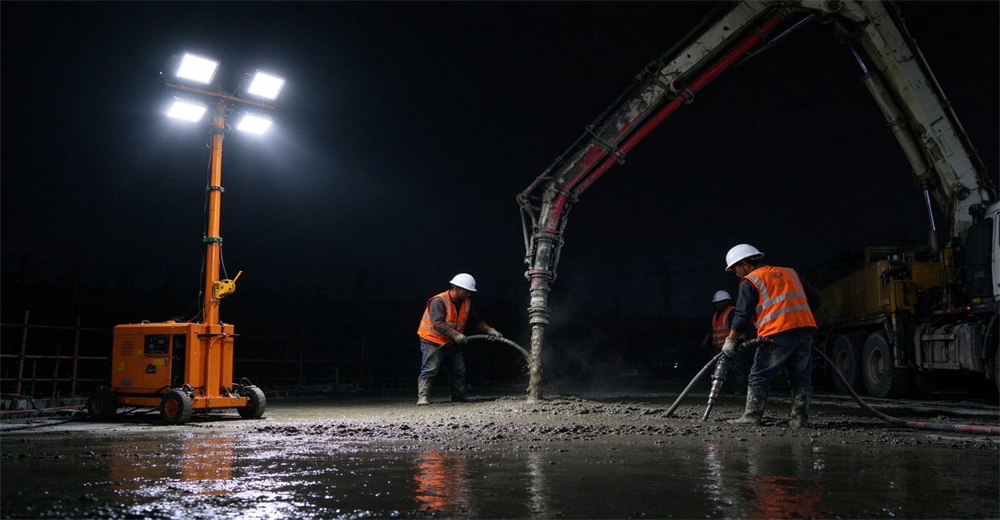


Night concrete pump pouring scene with diesel light tower, wet concrete reflective surface, workers finishing slab, flood light


Emergency and disaster repair sites
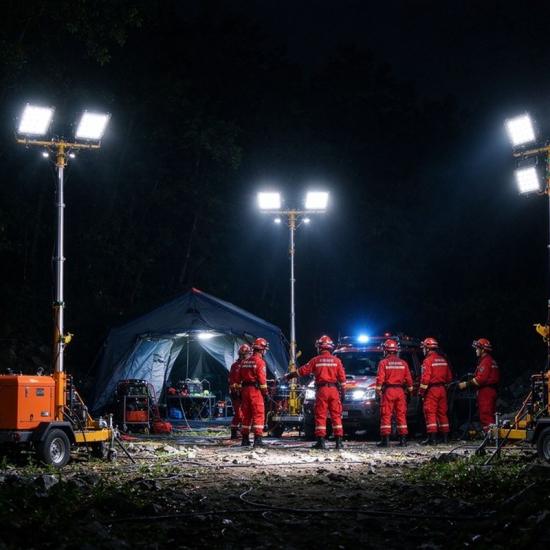
After a storm, flood or quake, the grid is usually the first thing that breaks and the last thing repaired.Rescue and repair teams need light within hours, not days.
A self-powered diesel generator light tower needs no cable run, no transformer and no utility company.
You tow it in, drop the jacks and the corridor is lit within minutes, see coastal rescue gear for maritime emergency response.
These sites are rough.Mud, rubble and broken asphalt mean the unit must sit level on uneven ground, and the four swivel jacks are designed exactly for that.
Teams also stack several towers in a loose grid: one over the access road, one over the work face, one over the supply yard, so no team operates blind at night.
Because disaster budgets are urgent, units are usually ordered in small fleets of one to three.
The metal halide HMF968A is popular here for its broad throw and simple service, while LED models win where refueling trucks cannot reach often.
Either way, the unit runs on diesel you carry in jerry cans through the debris field after dark.
The configuration table below matches four common job scenarios to our three base models.
Read the recommended column as a starting point; final quantity depends on your actual face size and shift plan, and every number is subject to contract with your supplier before production starts on the factory floor for this work light for construction order.


Scenario

Recommended Model

Qty

Coverage (sqm)

Note

Night concrete pouring

HMF968L-4x1000W

1-2 units

4,000-10,000

Mass continuous pours

Municipal road repair

HMF968L-4x500W

1 unit

2,000-5,000

15-minute setup

Emergency disaster repair

HMF968A

1-3 units

2,000-15,000

Self-powered, no mains

Mining night extraction

HMF968L-4x1000W

2-4 units

4,000-20,000

Multi-tower network
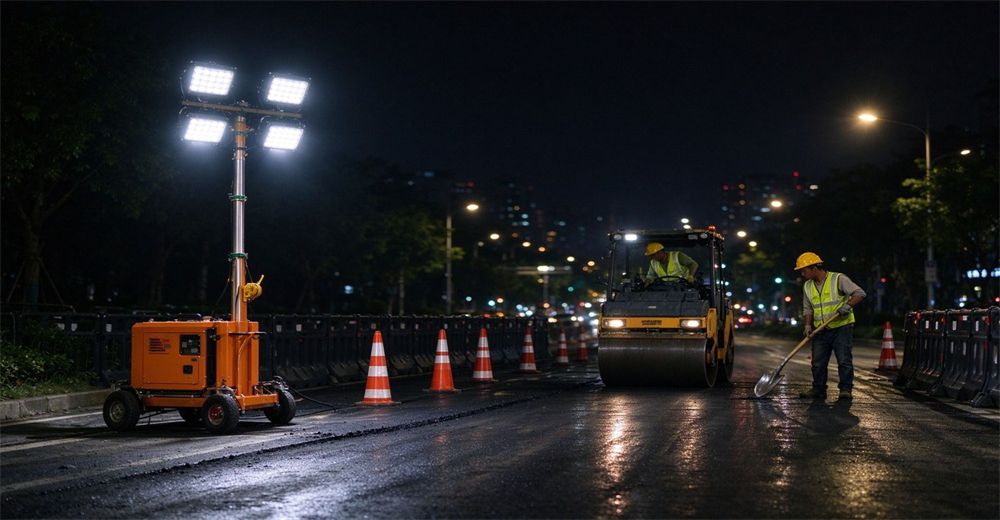

Road repair night scene with diesel light tower, traffic cones, road roller and worker with shovel, area light for municipal works


Mining and short-term high-power jobs where a portable flood light setup is needed fast
Mining is the place where a jobsite lighting tower earns its keep.
Open-pit faces, crusher pads and haul roads stretch over tens of thousands of square meters, and no wall outlet exists anywhere nearby.
Contractors network two to four HMF968L-4x1000W towers so the whole bench stays visible after the last daylight, see industrial fire rescue equipment for night operations.
High wattage here is not wasted.A 1000W LED head on a 9-meter mast throws deep into a cut where shadow hides loose rock.
Haul truck drivers judge distances by the same light that guides the shovel, so even coverage matters more than peak brightness.
Several towers overlapped beats one very bright tower on the bench after dark.
Short-term high-power jobs, shutdowns, plant turnarounds and event builds, book construction lighting equipment for days or weeks.Rental companies love these because the unit does not sit idle between bookings.
The same chassis that pours your concrete tonight can light a festival stage next Friday across town on short notice.
Whatever the face, the deployment rule is the same: level ground, extended jacks, raised mast, aimed heads, clear cordon.
Models and quantities above are ranges; your site plan decides the final mix.

This work light for construction pairs with our rechargeable work light for close-range tasks for every dark corner of the job site.
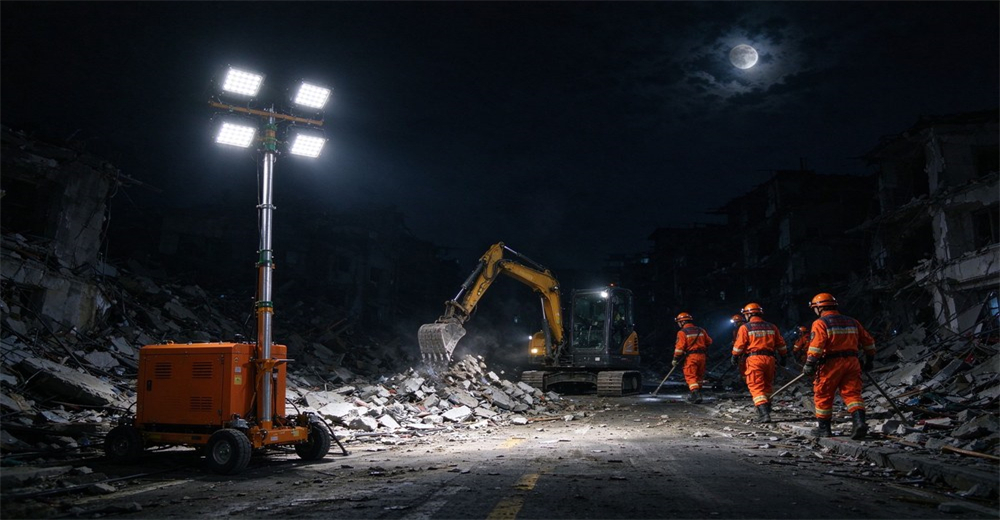


Disaster recovery site at night with diesel light tower illuminating excavation and rescue workers, emergency work light for construction


Buy vs Rent a Diesel Light Tower
Daily rental vs purchase over 12 months

The buy-or-rent question is really about how often this work light for construction works.
A contractor pouring every night for a season should calculate purchase; a contractor needing light for one weekend event should call the rental yard.
The tipping point falls around six to seven nights per month: below that, renting keeps cash free; above that, ownership wins.
Rental pricing hides three extras.Fuel is often not included, delivery and pickup add distance charges, and damage waivers sit on top of the day rate.
Ownership hides its own extras: a service bay, filters, oil, tires and somewhere to park the unit between jobs.
Count both sides before you sign either paper for the coming year ahead.
The six-dimension table below lays the choice out plainly.Match your project calendar to the buying column and the renting column, and you will see which way your own operation leans.
Numbers below are decision directions, not prices; actual quotes are subject to contract once your hours per year are known to both sides of the deal.

 Fuel cost deserves its own paragraph because it never stops.Whether you buy or rent, diesel is consumed on site and billed to the project.
Ownership means you buy fuel by the drum at your own price; renting means the owner may bundle it or charge it back.
Either way, LED heads lower that line item versus halide every night.
Maintenance follows the ownership line.If your company runs a mechanic and a service truck, owning means maintenance is already your core business.
If you are a small crew that owns only hand tools, renting means the rental shop swaps a dead unit next morning rather than you fixing it at midnight under the stars on site.
Relocation flexibility differs too.Owned portable work lights sit in your yard the moment you decide, with no scheduling call to the rental desk.

Rented units depend on what the branch has left this week.On multi-project companies with overlapping deadlines, waiting on a rental slot is a real hidden cost every month on site.


Dimension

Buy One Unit

Rent One Unit

Buying Wins

Renting Wins

Upfront cost

High one-off

Low per-day entry

Used >6 months/year

A few days only

Fuel cost

You carry

Depends on contract

Fixed long term

Flexible short term

Maintenance

Budget yourself

Owner handles

You own a crew

You have no crew

Relocation

Available anytime

Schedule a slot

Multi-project work

Single project only

Depreciation

You carry it

None at all

Heavy use year round

Light occasional use
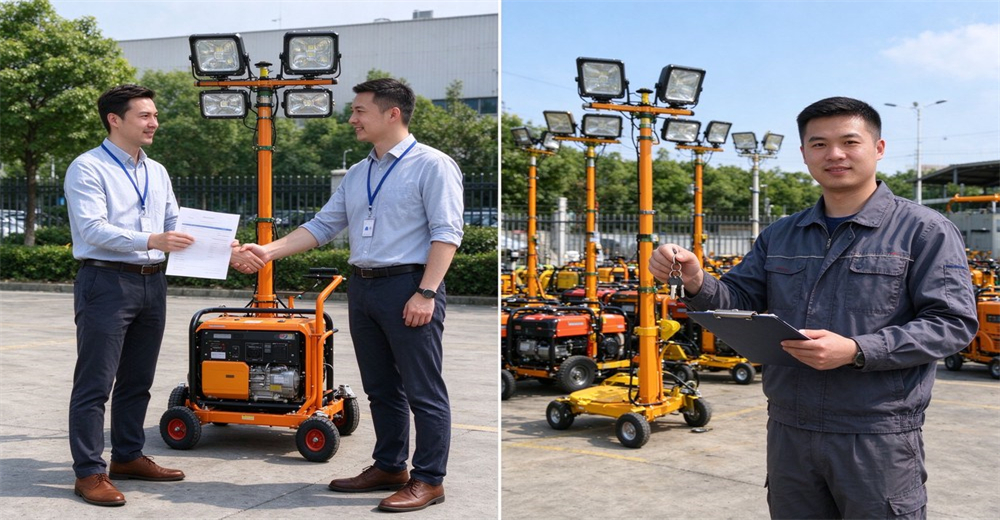


Split screen comparison of buying versus renting a diesel light tower, left purchase ownership right daily rental, work light decision


Total cost of ownership breakdown
Total cost of ownership for this work light for construction is not the invoice price.
It is fuel over two years plus services, tires, insurance and yard space, minus whatever resale value remains.
A cheap tower that burns thirty percent more fuel and breaks every other month is usually the expensive choice by month eighteen on site.
Buyers often fixate on the headline price of a diesel work light and forget the operating line items.
On a heavily used tower, fuel over three years can match the purchase price itself.
That is why the LED versions, despite a higher first cost, often pay back through lower tank stops on long night construction lighting seasons year after year.
Depreciation is the silent partner.A trailer mounted light tower built from steel and a simple engine depreciates slowly compared with electronics, and it keeps working long after the warranty ends.
Resale markets for basic diesel gear stay liquid because every contractor on Earth needs exactly this machine sooner or later on their own site.
Risk allocation matters on one-year jobs.Renting pushes breakdown risk onto the rental company; buying pushes it onto you.
For a single twelve-month project with a defined end date, that risk trade is often worth a few extra dollars of rent.
For a company that reuses the unit next winter, ownership keeps every night's light on the balance sheet.
Run the math for your own hours per year, fuel price and maintenance crew size.
Most fleet owners land on a hybrid: own the workhorses used year round, rent the spike units for the busy season.

That same mix works for the work light for construction budget line in most mid-sized contractor accounts across the region today.
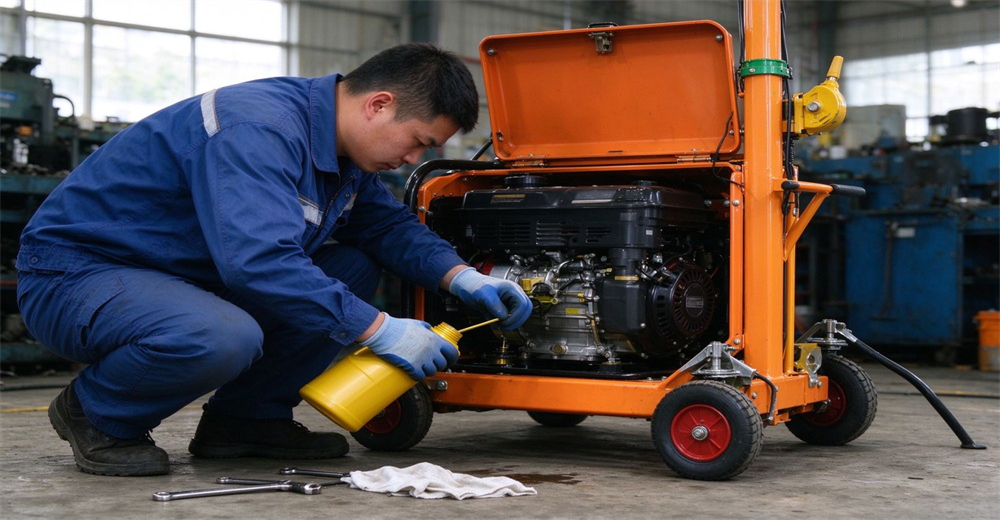


Worker in safety vest checking engine oil on diesel generator light tower, maintenance scene for portable work lights fleet


Choosing a Diesel Tower for Construction
Decision tree by site area and runtime

When you shortlist portable work lights, start with the two numbers you can measure tonight.How big is the lit area, and how long is each night shift?
Under 2,000 square meters and eight hours, the HMF968L-4x500W fits.Between 2,000 and 5,000 square meters, choose either LED model by fuel budget.Over 5,000, plan multiple towers, not one over-powered unit.
Runtime narrows it further.Shifts of ten hours or more lean on the 31-liter tank versions, both LED models.
Shifts under eight hours could even use the 25-liter HMF968A and save on first cost.
Ask yourself how often the unit runs: a tower used twice a month wants a different spec than one run six nights a week.
Terrain changes the answer when sizing this work light for construction.Soft mud, steep haul roads and low clearance push you toward the lighter chassis and lower mast.
Exposed open cuts with strong wind push you toward the heavier, longer mast on its jacks.
Send us phone photos of your site and we will point at the model that fits.
Budget is the last gate, not the first.LED costs more upfront and saves fuel nightly; metal halide costs less upfront and burns more diesel.
If you run it more than about forty nights a year, the LED premium comes back in saved tank stops.
If it is occasional, the halide model is the rational pick for the job site.
The model table below condenses the three base units and the custom option into one quick comparison.
Use it as a shortlist, then send the chosen row to us for a formal quote on this work light for construction.

All price cells read "subject to contract" because your voltage, frequency and mast choice change the build.


Model

Lamp Power

Fuel Tank

Suited For

Price

HMF968L-4x500W

4x500W LED

31L

Mid/small sites, road repair

Subject to contract

HMF968L-4x1000W

4x1000W LED

31L

Large pours, mining faces

Subject to contract

HMF968A

4x1000W metal halide

25L

Emergency, traditional sites

Subject to contract

Custom build

Configurable

Extendable

Special needs, branding

Subject to contract



Construction site manager reviewing cost reports on laptop with diesel light tower in background, total cost of ownership for work light


Decision tree by lamp, engine and lift
Now look inside the machine.Lamp type splits the family: LED for fuel economy and instant brightness, metal halide for maximum raw lumens at low cost.
Engine rating follows the lamps: the 4.5 kVA model runs 500W LED heads, the 7.5 kVA model runs 1000W LED heads, and the 5 kVA model drives the metal halide set with ease.
Mast choice is shorter than people think.Most buyers are happy with 7 meters for sites under 3,000 square meters.
Step to the 9-meter option when excavators, stockpiles or viewer stands sit inside the lit zone.
The manual crank suits occasional moves; if you relocate the unit several times a night, ask about powered lift options for the chassis.
Verify quality before you sign off.
At our worksites, finished towers are inspected by eye: lamp brackets tight, mast sections slide smoothly, jack threads clean, tires inflated, control panel labeled in your language.
We never ship a unit someone has driven around the test yard.Visual check, weight check, folding check, then crate it safely for export.
Spare parts planning is part of choosing a work light for construction.Air, fuel and oil filters and fuses are cheap to pack in the crate.
Keep one set on the service truck and a second in stores.
We supply the spares list with every order so your mechanic can fix most faults without waiting on a container from China.
Finally, decide how the unit wears your brand.
Rental fleets want their logo on the lamp frame and the tow bar; government projects want a neutral grey chassis; some contractors want the orange safety paint.
These branding choices lock at order time.A portable flood light for construction is also available if your face is cramped.
Bring your site area, shift length, lamp preference and brand paint to the inquiry, and we come back with a confirmed configuration sheet, not a generic brochure.

Compare the LED light tower if your site is quiet and noise-sensitive; for loud, tough, overnight work.
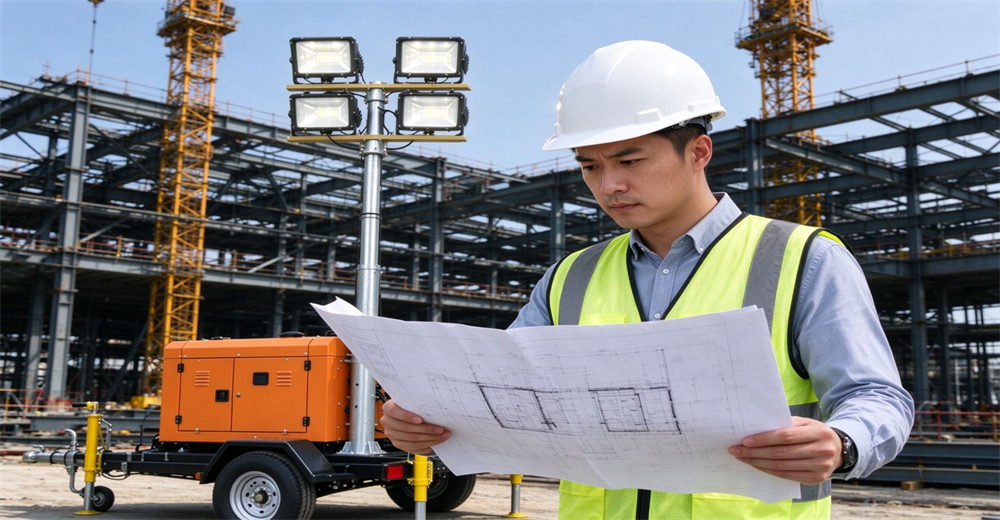


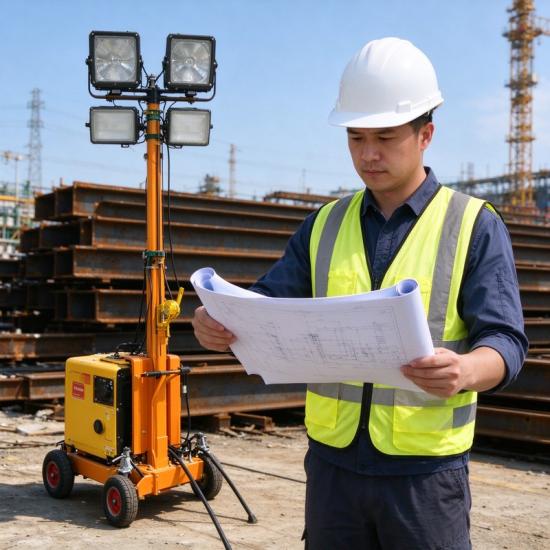
Engineer holding blueprints next to diesel light tower on construction site, selection and sizing for high power work light


Engine Fuel Consumption and Emission Tier: Kubota / Perkins Tier 4 Final vs EU Stage V

A diesel light tower is sold on one number above all: grams of fuel per kilowatt-hour. This anchor compares the two mainstream engine families and explains the Tier 4 Final versus Stage V emission gap.


Specific Fuel Consumption at 50% / 75% / 100% Load
The Kubota D1803 (turbo, 1800 rpm) delivers roughly 245 g/kWh at rated 18.2 kW. At 75% load it drops to about 235 g/kWh, the sweet spot most towers run at. The Perkins 1103A-33G sits at 255 g/kWh rated, slightly thirstier but with a wider parts network in Africa.
Over 2000 running hours the difference between 235 and 255 g/kWh is about 4% of fuel spend. In a 1000-hour year at $1.2/L diesel that is roughly $300 per tower. For a 50-tower rental fleet that is material.


Engine

Rated power

g/kWh @ rated

g/kWh @ 75%

Emission tier

Kubota D1803-T

18.2 kW

245

235

Tier 4 Final / Stage V ready

Perkins 1103A-33G

24.0 kW

255

245

Tier 4 Interim / Stage IIIA

Yanmar 4TNV88

20.5 kW

250

240

Tier 4 Final
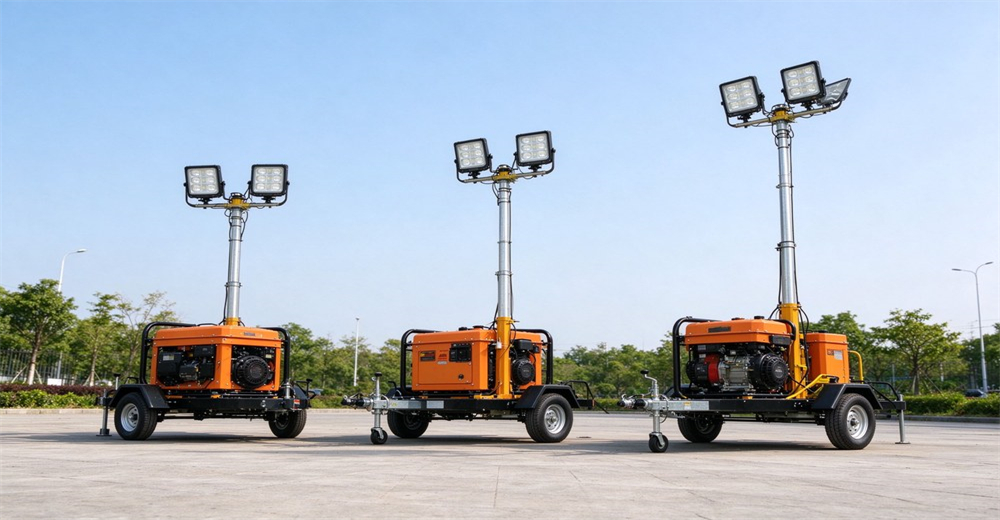


Three different diesel light tower models lined up side by side, model comparison for construction lighting equipment selection


Tier 4 Final (US) vs EU Stage V NOx and PM Limits
Tier 4 Final caps NOx at 0.4 g/kWh and particulate matter at 0.02 g/kWh for engines 19-56 kW. EU Stage V tightens PM to 0.015 g/kWh and adds a particle-count limit of 1×10¹² #/kWh. The NOx limit is the same at 0.4 g/kWh.

Practically, this means a Stage V tower requires a DPF plus DOC. Tier 4 Final engines in the 19-56 kW band often run DOC-only with EGR. The DPF adds 6-12 months of regeneration planning. Specs reference EPA Tier 4 Final nonroad emission and EU Stage V nonroad emission.


DPF, DOC and SCR After-Treatment Need
A DOC-only package is sufficient below 19 kW. Above 19 kW Tier 4 Final requires DPF. Stage V requires DPF plus a diesel oxidation catalyst. SCR with urea dosing appears only above 56 kW, which no light tower uses.
DPF regeneration runs passively at load. If the tower idles below 30% load for more than 4 hours, a forced regen cycle kicks in. Crews should plan for 30 minutes of high-load operation per 8-hour shift.

Engine power measurement follows SAE J1349 engine power. Generating-set rating classification follows ISO 8528-1/-5 generator rating.


Fuel Tank Runtime Math and 24-Hour Continuous Duty Cycle

Buyers ask "how long on one tank?" The answer is a simple division. This anchor shows the math and the heat-rejection rules for night-long runs.


Runtime = Tank L ÷ (g/kWh × Engine kW / 1000)
Take a tower with 100 L tank, 250 g/kWh engine, 15 kW running at 75% load (≈11 kW electric). Fuel flow is 250 × 11 / 1000 = 2.75 L/h. Runtime is 100 / 2.75 = 36 hours at 75% load. At 100% load (15 kW) fuel flow rises to 3.75 L/h, giving 26.7 hours.

Most 100 L towers therefore cover two full night shifts on one tank. A 24-hour non-stop site only needs a refuel every day and a half.


24-Hour Non-Stop Duty Cycle and Heat Rejection
Continuous duty follows ISO 8528-1 prime power rating. The cooling system is sized with a 20% heat-rejection margin. Ambient rating is 40°C; above 40°C the derate curve cuts output by 2% per °C.

Oil change interval is 250 hours for mineral oil, 500 hours for synthetic. Oil filter is a spin-on canister, changed at every oil interval. Air filter is a dry-element with a service indicator; clean it every 2 weeks in dusty sites.


Refuel Interval and On-Site Logistics

A 100 L tank takes 8 minutes to fill with a 20 L jerry can. Plan on 5 jerry cans per refuel, or a 200 L drum for a 20-tower fleet. Diesel storage should be shaded, at 15-25°C, with water traps drained weekly.


Cold-Start Capability at -15°C / -25°C and Block Heater Options

Night construction in Nordics or mountain mines is where diesel towers earn their keep. Cold-start performance is not negotiable below -10°C.


Glow Plug vs Intake Air Heater
Direct-injection Kubota and Perkins engines start at -15°C without external aids. Glow plugs pre-heat the combustion chamber for 8-12 seconds. Below -15°C the starter motor draws 600-800 A and cranks for longer.

Intake air heaters are an option on the Yanmar line. They heat incoming air by 40°C in 30 seconds but do not warm the block. For arctic duty we always add a block heater.


Block Heater (110V / 230V) and Battery CCA
A 110V or 230V, 1.5 kW immersion block heater warms the coolant to 30°C in 2 hours. The tower plugs into site power overnight. Battery CCA requirement is ≥600 A at -18°C for a 2.0 L engine. We spec a 100 Ah AGM battery as standard.

Battery insulation blankets are optional in arctic packages. Fuel anti-gel additive is mandatory below -10°C.


Arctic Package: Fuel Grade and Oil Viscosity
Diesel fuel must switch to -35°C cloud-point grade below -15°C. Summer grade gels at -5°C and blocks the filter. Oil viscosity switches to 0W-30 per SAE J300 oil. Diesel fuel specs follow ASTM D975 diesel.


Quality control inspector visually checking LED lamp heads on diesel light tower in workshop, QC for work light for construction


FAQ: Deep Questions on Diesel Light Tower Fuel and Emission
Why does a Stage V tower cost more than a Tier 4 Final tower?

The DPF and DOC add roughly $800-1200 per tower. The particle-count limit also tightens machining tolerances on injectors. Over 5 years the DPF payback comes from lower fuel carbon tax in EU markets.


How long does a 100L tank last on a night construction site?

At 75% load (typical), 100 L lasts about 36 hours. At full load it is 26.7 hours. Plan on one refuel per day and a half for a 24/7 site.


Can I start a diesel tower at -25°C without a block heater?

No. Glow plugs alone reach -15°C. Below -15°C add a 1.5 kW block heater and switch to -35°C diesel. Battery CCA must be ≥600 A at -18°C.


Is a diesel light tower noisy enough for residential zones?
A diesel light tower runs at 65-75 dB at 7 m, so it is too noisy for residential zones after curfew.

Quiet sites choose a battery unit, but a diesel light tower stays the top choice for remote mines and highway work.


What maintenance schedule keeps a diesel light tower reliable?
Service a diesel light tower every 250 running hours: change oil, fuel filter and air filter, and test the battery charger.

This schedule prevents breakdowns on site, and a serviced diesel light tower starts first time in any season.


Can a diesel light tower be rented for short projects?
Yes, a diesel light tower is widely rented for 1-6 month projects where buying is uneconomical.

Rental of a diesel light tower includes service, and the diesel light tower returns to the fleet after the job ends.
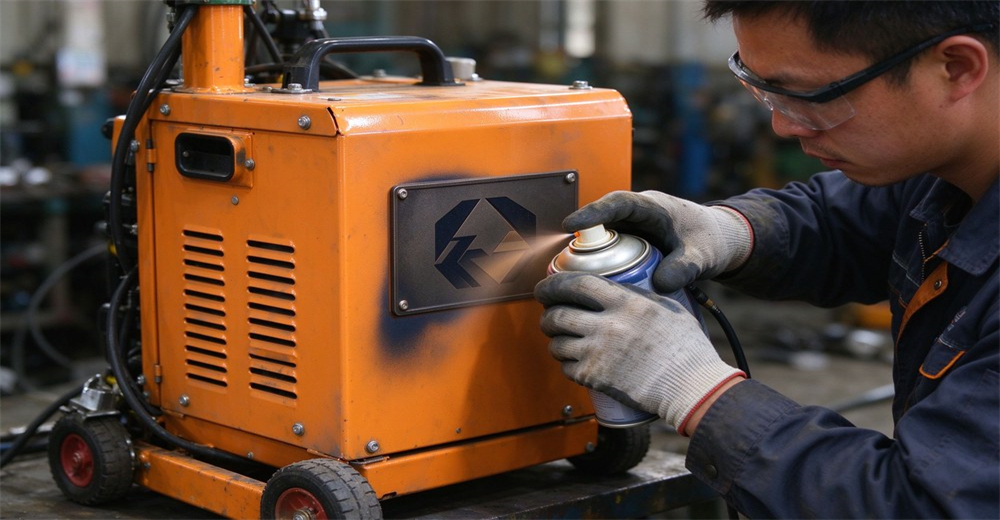


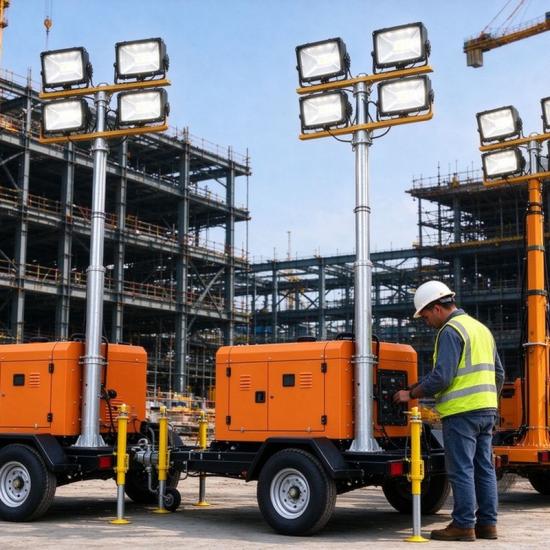
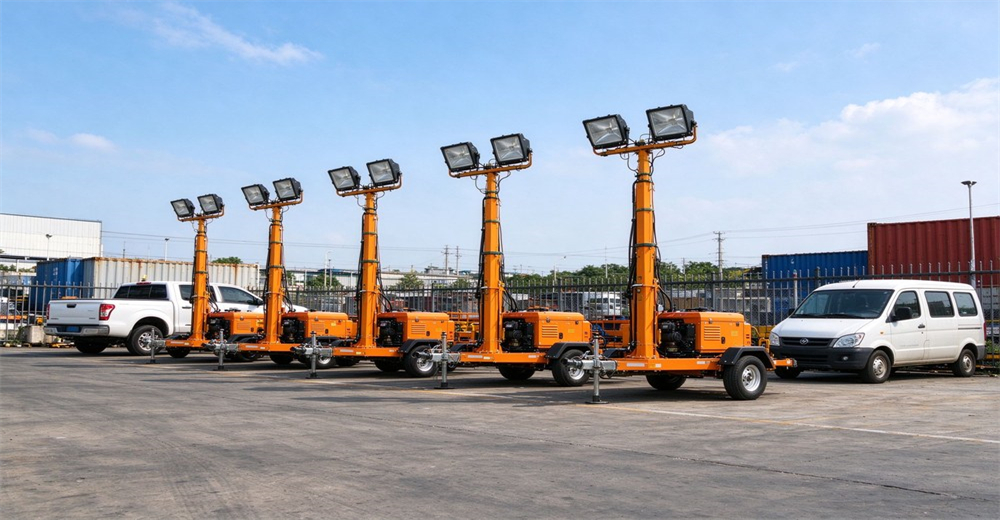
Fleet of five diesel generator light towers parked in row at construction yard, bulk order portable work lights for contractors


What fuel consumption should I budget for a diesel light tower?
A diesel light tower burns about 3-5 litres an hour, so a 60 L tank runs 10-15 hours between refuels.

Track this when costing a diesel light tower, because fuel is the biggest recurring expense on a diesel light tower over a long project.


How do I service a diesel light tower between shifts?
Service a diesel light tower by checking oil, fuel filter and air filter every 250 hours, and bleeding the fuel line after long storage.

This routine keeps a diesel light tower starting in cold weather, and the engine life of a well-kept diesel light tower exceeds 8,000 hours.


How noisy is a diesel light tower and where is it restricted?
A standard diesel light tower runs at 65-75 dB at 7 m, so it is restricted near hospitals, housing and noise-controlled zones.

For remote mines a diesel light tower remains a strong overnight source, while quiet sites switch to a battery or solar unit.


Do I need a separate generator to run a diesel light tower?
No, a diesel light tower has its own air-cooled engine on board, driving the alternator and the LED heads directly.

It is fully self-contained on a trailer, so a diesel light tower needs only fuel and flat ground, no external generator.


What generator standard and fuel tank runtime does a diesel light tower meet?
A standard diesel light tower uses an air-cooled engine built to ISO 8528-3 generator set norms, with a 40-60 L tank for 8-12 hours of runtime.

Confirm local exhaust and noise rules for urban sites, as a diesel light tower emits fumes. Most buyers take the 60 L tank to cover overnight pours without refuelling.


Can a diesel light tower start reliably in winter cold?
A winterized diesel light tower starts down to -15 C with glow plugs and low-temperature fuel; above that the standard unit starts easily.

Below -15 C specify an engine block heater and arctic diesel. The alternator keeps the diesel light tower battery charged while the engine runs.
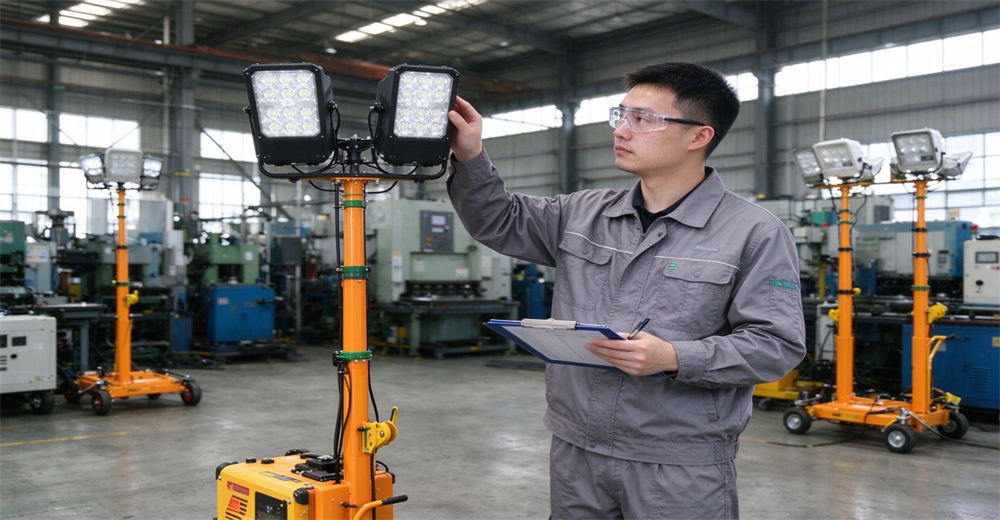


Office desk with bid documents, spec sheets and small diesel light tower model, tender support for construction lighting equipment


Field Case: A Diesel Light Tower on a Siberian Highway Night Project

A 50 km highway upgrade in Irkutsk runs 6 months of night work at -25°C. Eight diesel light towers cover the paving train, the asphalt plant and the crash-truck zone. This case shows how the engine numbers stack up in arctic duty.


Site Parameters

Ambient range is -35°C to +25°C. Eight Kubota D1803 towers burn 2.75 L/h each at 75% load. Total fuel burn is 22 L/h, 528 L per 24 h day. A 5000 L on-site farm tank lasts 9 days before resupply.


Cold-Start Procedure

Each tower plugs into a 1.5 kW block heater overnight at the site power point. At 06:00 the crew verifies glow-plug pre-heat, turns the key, and the engine starts in under 5 seconds. Battery CCA is checked weekly; below 500 A the pack is swapped.


Emission Compliance

The site is in Russia, where Stage V is not yet enforced. Kubota engines are sold as Tier 4 Final compatible, ready for export to EU or US clients. If the same fleet moved to Berlin, DPF regeneration would add 30 minutes per shift.


Comparison Table: Tier 4 Final vs Stage V Diesel Light Tower

For a diesel light tower shipped to the US Gulf Coast, Tier 4 Final is sufficient. For EU motorway or Scandinavian city work, Stage V is mandatory.


Parameter

Tier 4 Final (US)

EU Stage V

NOx limit

0.4 g/kWh

0.4 g/kWh

PM limit

0.02 g/kWh

0.015 g/kWh

Particle count

Not regulated

1×10¹² #/kWh

After-treatment

DOC + EGR (under 56 kW)

DPF + DOC

Typical premium

Baseline

+$800-1200 per tower

Regen frequency

Passive at load

Forced regen every 8 h
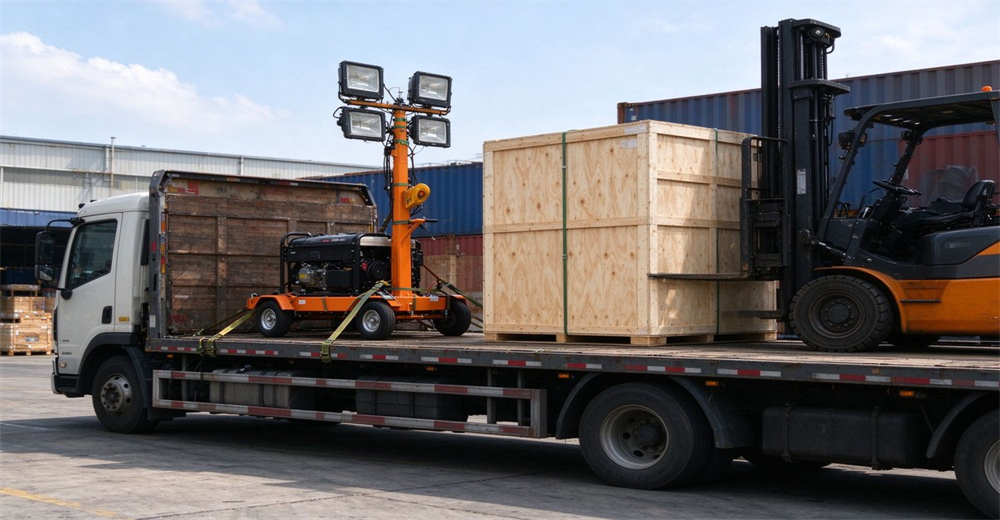


Close-up of OEM custom logo printing on diesel light tower lamp housing, branding customization for work light for construction


Diesel Light Tower FAQ
Can diesel light towers handle overnight concrete pouring at night?
Yes, that is a core use.
Stage one tower per corner of the pour so the pump, vibrator and finishers all work under even light.

Choose LED heads for cooler fuel use over a long pour, and keep a jerry can of clean diesel on the apron so a mid-shift refuel never stops the pump truck at night on site.


How are diesel light towers used for emergency road repair?
Tow one compact tower to the closed lane, drop the jacks and raise the mast over the work zone.
Aim heads low so they light asphalt and workers without blinding passing traffic.

Set up one tower per two hundred meters of lane, leave tail reflectors facing traffic, and keep the unit clear of the roller path safely after dark.


How much fuel does a diesel light tower burn per hour?
It depends on lamp load and model. Four 500W LED heads sip less than four 1000W heads, and metal halide heads sit between them.

Idling with lights off uses very little. Exact hourly consumption is stated in the spec sheet for your chosen model and is confirmed in the contract, subject to contract with us before production.


How loud is the engine and is it safe near residential areas?
The measured noise is around 72 dB at seven meters, similar to a busy vacuum cleaner. That is acceptable on industrial sites and most after-hours road jobs, but it may draw complaints next to housing.

For noise-sensitive zones, choose LED heads and park the tower away from bedroom windows on site at night.


Should I buy or rent a diesel light tower for a one-year project?
It depends on your hours. Under about six nights a month, renting keeps cash free and pushes repair risk to the rental shop.

Above that, or if you reuse the unit next year, ownership saves money. Many contractors own the year-round workhorses and rent spike units for the busy season each year on site today.


Diesel tower versus solar tower: which is better for night construction?
Diesel wins for heavy overnight wattage, cold weather and sites where a fuel truck can reach you. Solar wins for quiet, emission-free, long-deployment posts.

A dusty, wet, high-power concrete pour leans diesel; a quiet remote camp leans solar. Read our comparison of the solar mobile light tower comparison before you decide carefully.


What is the MOQ and can you print our logo on the light tower?
MOQ depends on model and customization; we handle both single-unit orders and fleet orders.
Yes, OEM branding is standard: your logo on the lamp frame, tow bar and nameplate, plus chassis paint color to match your fleet.

Send artwork and your voltage or frequency needs, and we return a sample photo before production starts.


Wholesale Pricing and MOQ for Contractors
Bulk pricing for construction fleets

Contractors and fleets buy in numbers for one simple reason: one work light for construction lights one face, and a real project has several faces moving at once.
A fleet of three to five units covers a whole overnight site without begging the rental yard.Bulk orders also share one container, one customs file and one spare-parts kit.
Wholesale pricing is built on three levers: model mix, customization level and order quantity.
Three identical 500W LED units cost less per unit than three fully customized units with custom paint and special voltage.
Send us your bill of quantities and we return a clean line-item quote with no hidden add-ons buried later in the deal.
The ordering process below is what to expect after your first email.It is designed so a procurement officer can move from inquiry to crate without chasing documents.

Every timing cell reads "subject to contract" because production slots shift with the factory calendar and shipping season to your destination port on the water.

OEM customization is where fleet buyers stamp identity.Your logo prints on the lamp housing, the tow bar and the warning decal.
Chassis paint can match your company colors, and the control panel labels can be printed in your local language.
We send a photo of the mocked-up unit for approval before we cut any steel in the shop.
MOQ is not a rigid wall.One unit for a pilot project is welcome, and a twenty-unit fleet for a national rental rollout is welcome too.
What changes is per-unit pricing and spare-parts bundling.
Tell us the year-one plan and the year-two plan, and we will structure the order to match both phases of your fleet growth plan.
Government and tender buyers get formal spec sheets, compliance notes and packing lists aligned to tender language.
We do not publish discounts online; pricing is quoted per order after your voltage, frequency, mast and lamp choices are locked.
The right work light for construction fleet is priced to your tender.Browse our full range of emergency lighting equipment to match every face.


Step

Buyer Provides

We Deliver

Timing

Inquiry

Site area / schedule / qty

Spec sheet + quote

Subject to contract

Config confirm

Model / lamp / engine choice

Configuration confirmation

Subject to contract

OEM custom

Logo / color / nameplate

Mock-up photo approval

Subject to contract

Production & ship

Deposit

Finished unit + QC report

Subject to contract
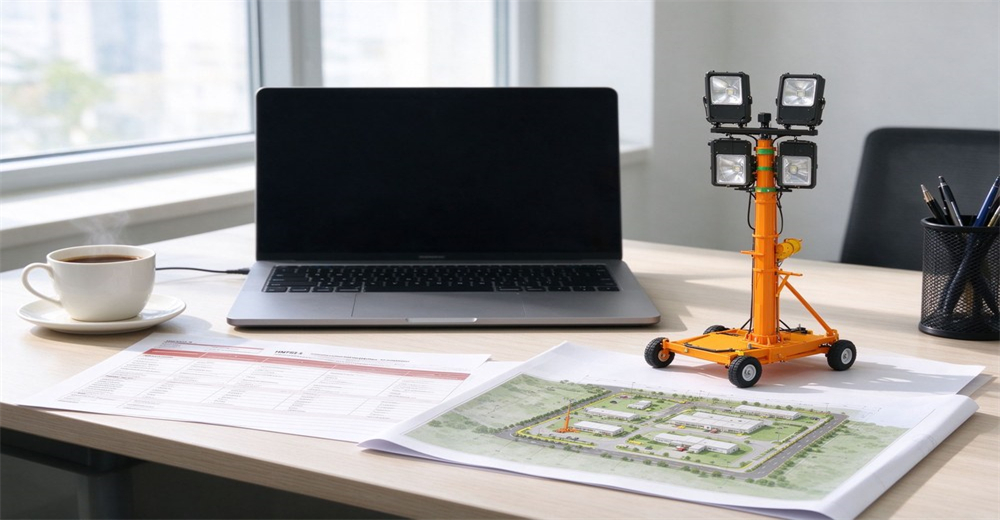

Diesel light tower loaded onto flatbed truck with wooden crates for export shipping, delivery of construction lighting equipment from China


Lead time, OEM and shipping
Lead time follows a simple rule: stocked base models move faster than custom builds.A standard HMF968L-4x500W with no special paint ships on the next production slot.
A fleet with custom logos, special voltage and fitted spare parts kits needs the agreed OEM sample approval step first.Both timings are stated in your proforma invoice clearly.
Shipping is by sea in packed crates, around 1.4 x 1.2 x 1.5 meters per unit, or loaded as rolling chassis into a container for larger fleets.
We pack the unit crated with the mast secured, the tank drained for sea transit and the battery isolated.Destination port and incoterms are agreed on the quotation with you directly.
After delivery, support continues.We send a maintenance schedule, a fuse and filter cross-reference, and a contact line for technical questions.
Local mechanics handle routine service; we back up parts lists and diagrams.
Spare battery and charger for diesel light tower orders ship together on request so your fleet starts strong on day one safely.
Next step is short.Send us four lines: your site area, your shift hours, your preferred lamp type of LED 500W, LED 1000W or metal halide, and your unit quantity.
We return a model shortlist, a spec sheet and a quote.The emergency lighting is also in our learning center for your crew.
That is the whole picture: a tough, towable, self-powered area light built for dark sites.
Whether you pour concrete overnight, light a mine after the shift change or stage an emergency corridor at midnight, this diesel family is the work light for construction teams who refuse to wait for sunrise.
Standards referenced on this page: IEC lighting standards · OSHA workplace safety · US Department of Energy · NFPA fire safety codes · CDC emergency preparedness. These are general references only; local codes and your contract govern compliance.

© 2026 YIROUFANG TEXTILE - Made in China


If you have questions or suggestions,please leave us a message,we will reply you as soon as we can!

Related Product
  • Solar Powered Trailer Mounted Mobile Light Tower Solar Mobile Light Tower for Disaster Camps and Remote Sites
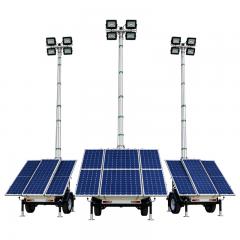
    This trailer-based solar mobile light tower is equipped with high-efficiency monocrystalline solar panels, adjustable LED floodlights and telescopic mast. Powered by gel battery, it offers stable off-grid lighting for construction, disaster relief, remote outposts and emergency rescue tasks. Note: Price for reference only. Exact price based on quantity, size, weight and custom details.
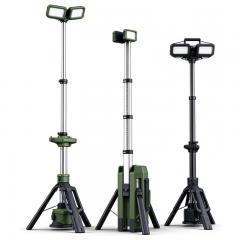
  • Rechargeable Emergency Work Flood Light Portable Telescopic Flood Light for Rescue and Road Work

    This TL-200 portable flood light adopts telescopic aluminum mast and dual LED heads, powered by lithium battery. It delivers stable bright illumination for fire rescue, roadside emergency, construction and disaster relief, easy to carry and fast setup. Note: Price for reference only. Exact price based on quantity, size, weight and custom details.
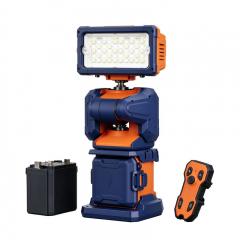
  • Wireless Remote Control PTZ Searchlight Remote Control Searchlight for Ports and Perimeter Security Water Rescue

    Remote pan tilt rescue light with wireless remote, magnetic base and long throw narrow beam. It supports horizontal and vertical rotation, salt spray resistant housing, suitable for water rescue, port, border patrol and industrial perimeter security. Bulk wholesale, OEM custom color and packaging available. Note: Price for reference only. Exact price based on quantity, size, weight and custom details.
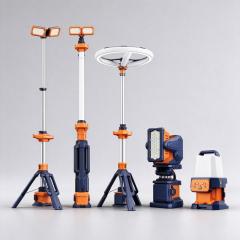
  • Emergency Camp Lighting System Disaster Emergency Lighting for Relief Camps and Rescue

    Disaster lighting family includes telescopic mast light, remote searchlight and handheld 360 light. Solar charging support, off-grid available, durable for earthquake rubble, flood rescue, camp lighting and emergency road repair. Note: Price for reference only. Exact price based on quantity, size, weight and custom details.
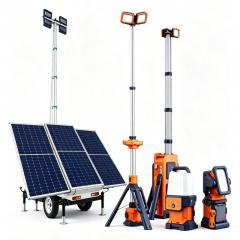
  • Portable Telescopic Emergency Light Emergency Lighting Supplier for Wholesale and Relief Tenders

    Full emergency lighting lineup includes solar light towers, diesel towers, telescopic lights and handheld rechargeable lights. IP rated, durable for disaster relief, construction, warehouse and night rescue, supports off-grid power supply for long time outdoor illumination. Note: Price for reference only. Exact price based on quantity, size, weight and custom details.

Copyright © Custom Disaster - Relief Bedding: Tents, Sleeping Bags, Blankets All Rights Reserved

Leave a message

    If you have questions or suggestions,please leave us a message,we will reply you as soon as we can!


the professional team to service !