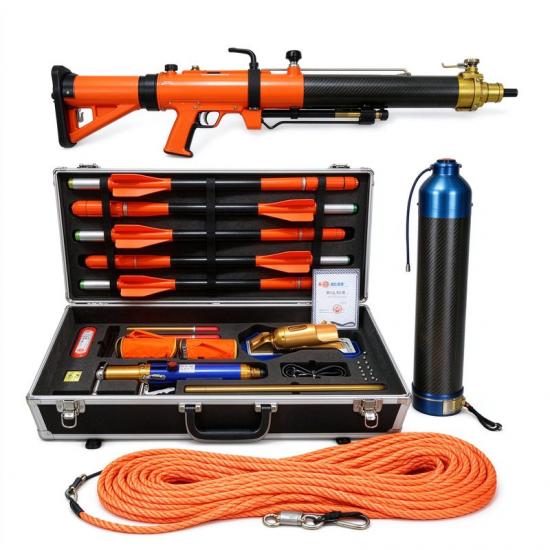
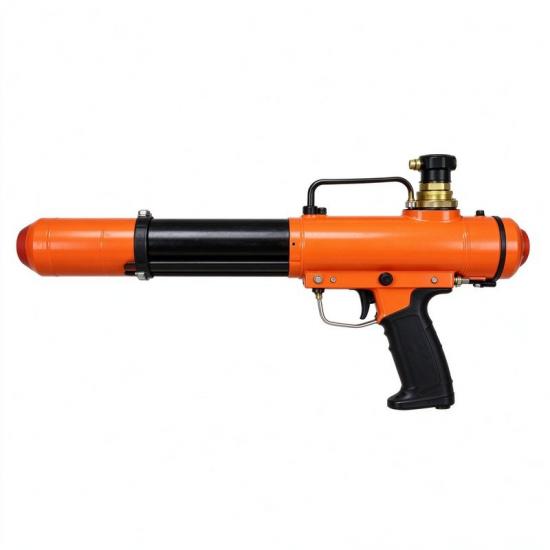
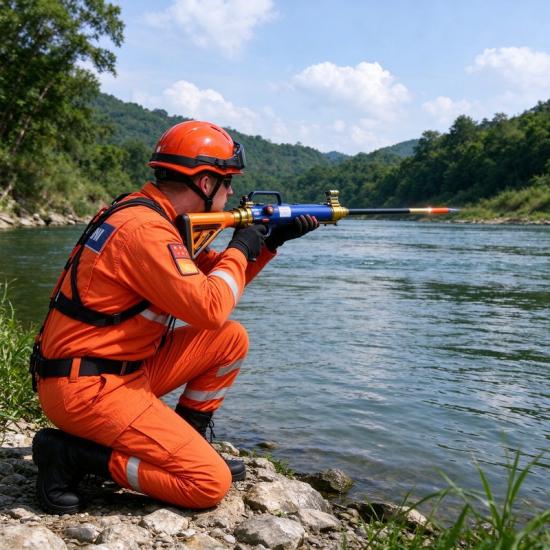
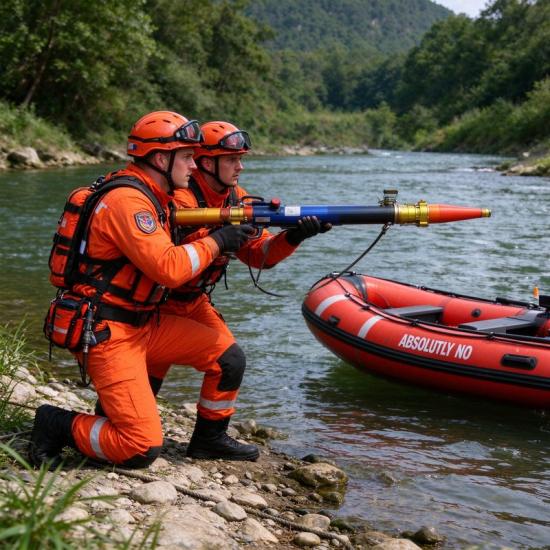
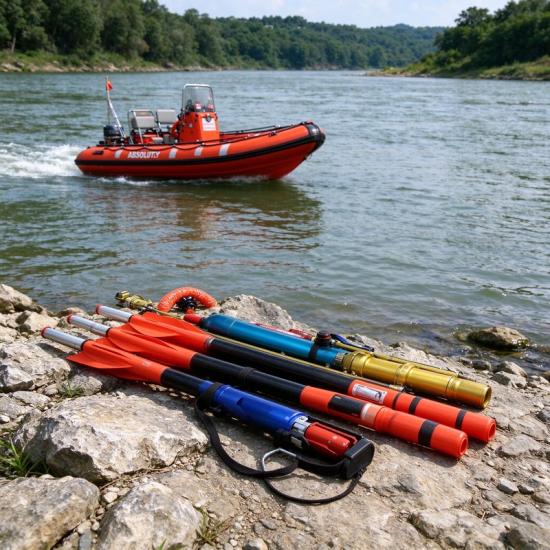
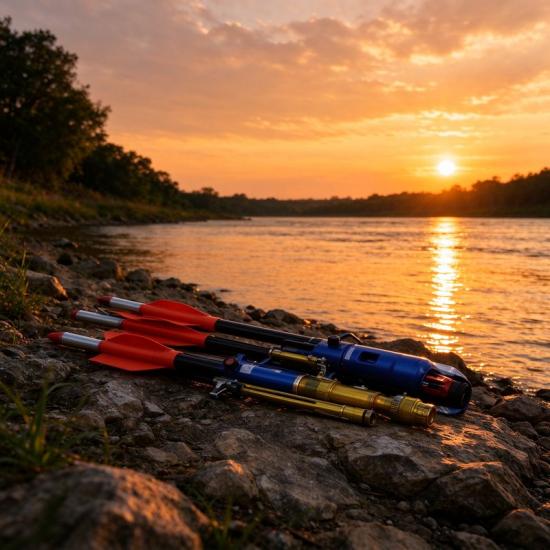
Long range pneumatic line thrower with carbon cylinder and pressure gauge. Packed in sturdy aluminum case, supports tripod installation. Designed for wide river, coastal, harbor and city embankment emergency water rescue.
Note: Price for reference only. Exact price based on quantity, size, weight and custom details.
model no. :
LT-06Brand:
YRFmarket price :
$119.8sale price :
$59.9price range :
30-100/$59.9Color :
Multiple Colorsport of dispatch :
Guangdong/GuangzhouPayment :
TT, Paypal, Western Unionmin order :
30original region :
Made in ChinaLead Time :
5-15days
Long Range Pneumatic Line Thrower 230m Land / 210m
Water Rescue Device
When the gap is too wide for a standard thrower, the long range pneumatic line thrower reaches 230 meters on land and 210 meters over water.
This long range line thrower pairs with a 250m spare rope for repeat missions.
 |

|
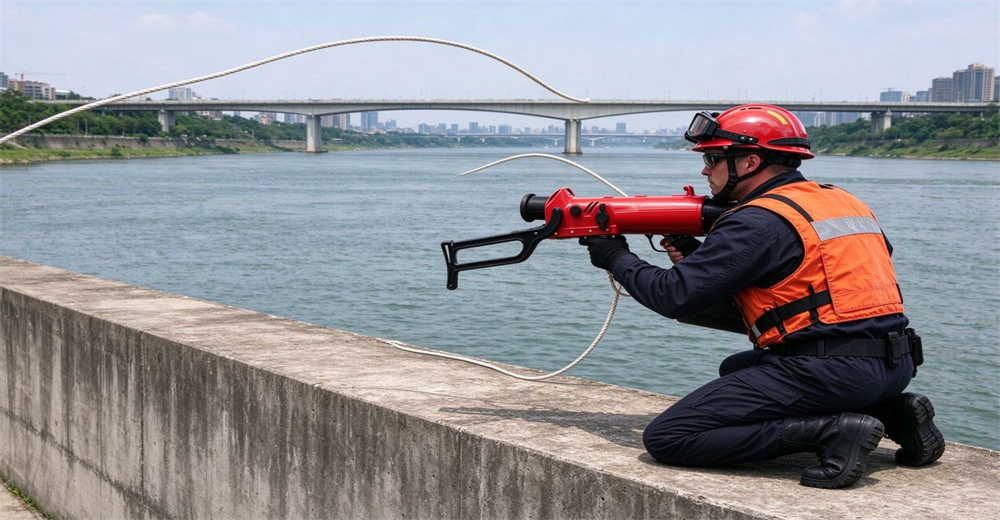
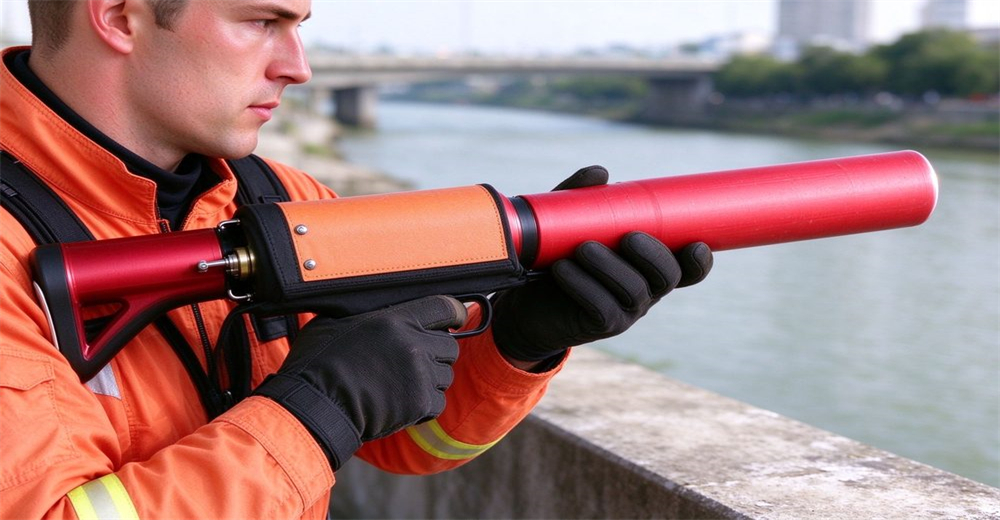
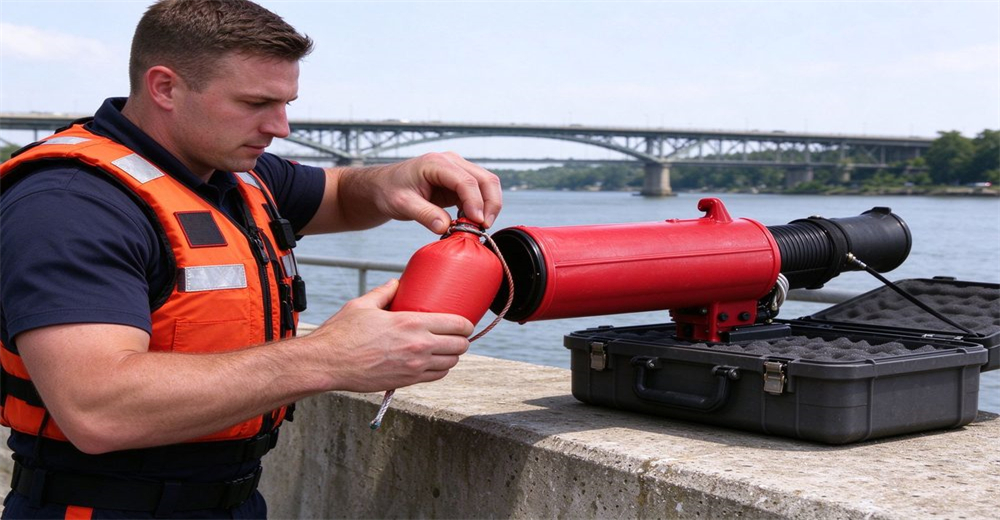
Kneeling on the concrete embankment beside the bridge, the operator aims the pneumatic line thrower across the open river. The 230m range puts the far bank in reach even where the channel is wide, and the standing water below gives the buoyant rope a clean flight path. Long range units like this are the first tool pulled from the truck when the gap is simply too wide for a standard thrower.
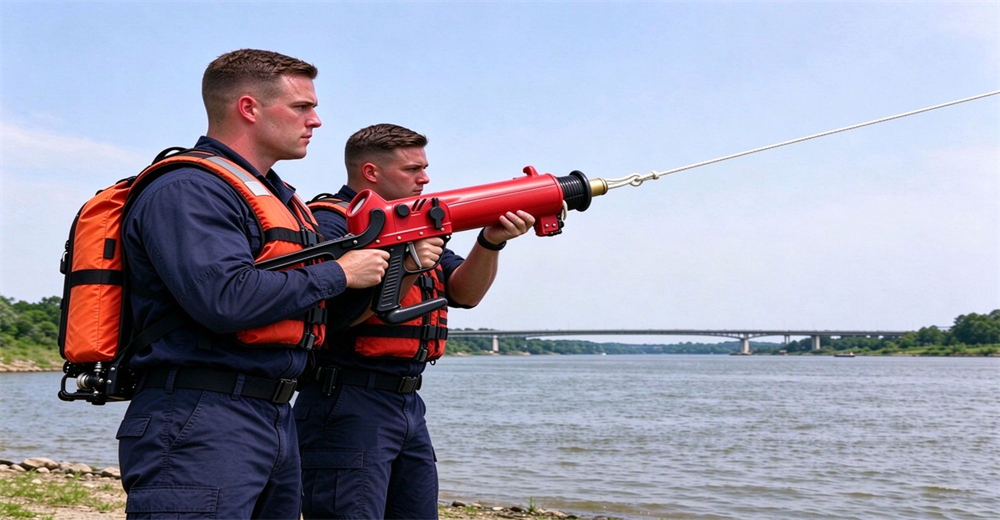
Two rescuers practice on the wide river bank with the pneumatic line thrower, timing the launch so the rope clears the current and lands on the far side. One watches the drop while the other feeds rope from the pack, then they swap roles. Wide-river teams run this drill until the whole cycle fits inside two minutes, because flood response is measured in exactly that time. The rope pack feeds smoothly from the open case during the drill.
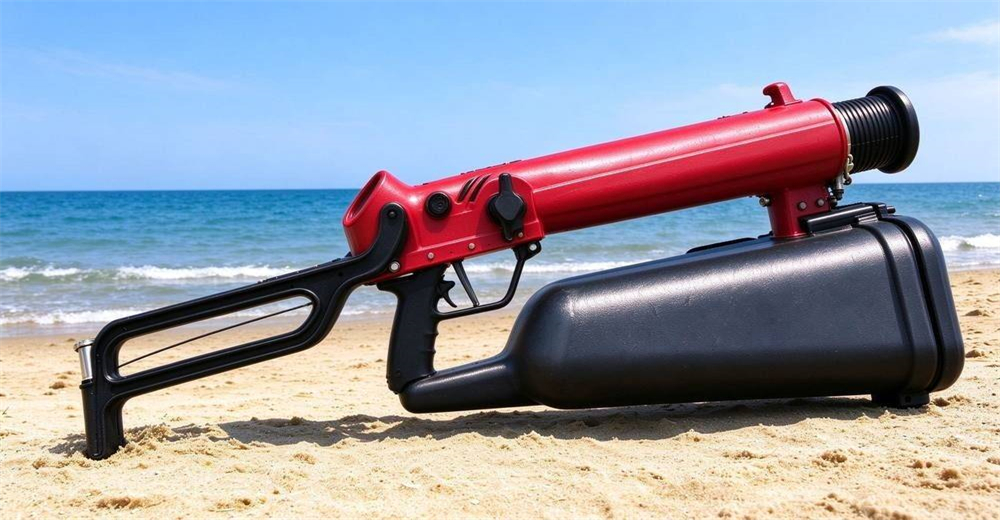
Standing on the sandy beach with the blue ocean behind, this pneumatic line thrower covers coastal rescue beyond inland rivers. The long barrel keeps the projectile stable in sea breeze, and the floating rope rides the surf for swimmer lines and boat connections. Coastal rescue services buy the same launcher for both flood season and year-round beach cover. Coastal crews also use the same launcher for pier-to-pier lines and beach patrol drills every summer.
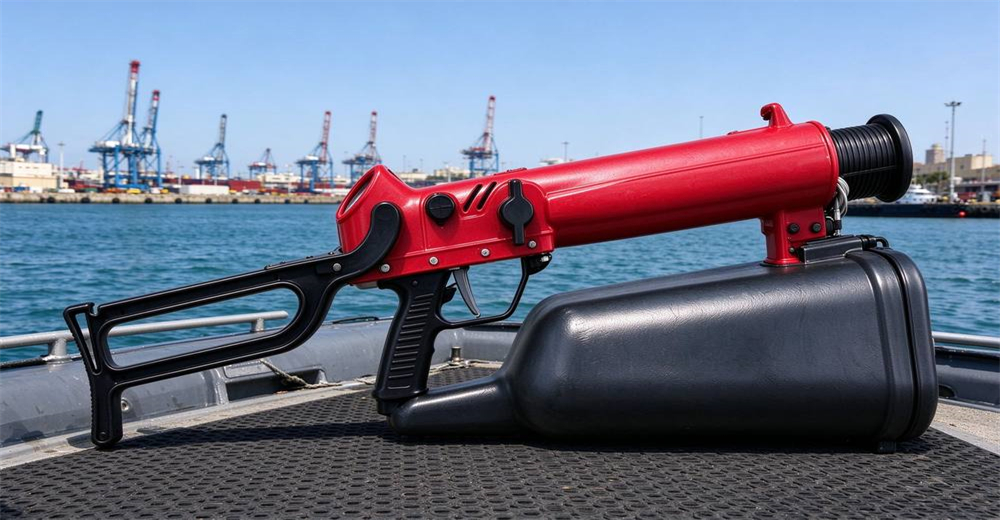
On the work boat deck in the harbor, the long range pneumatic line thrower fires a line between vessels or to the shore during professional flood operations. The deck mount keeps the unit ready in heavy weather, and the buoyant cartridge clears the port infrastructure without snagging. Marine units rely on this launcher for tow lines, mooring lines and man-overboard responses. The deck mount keeps the unit ready in heavy weather and rough seas.
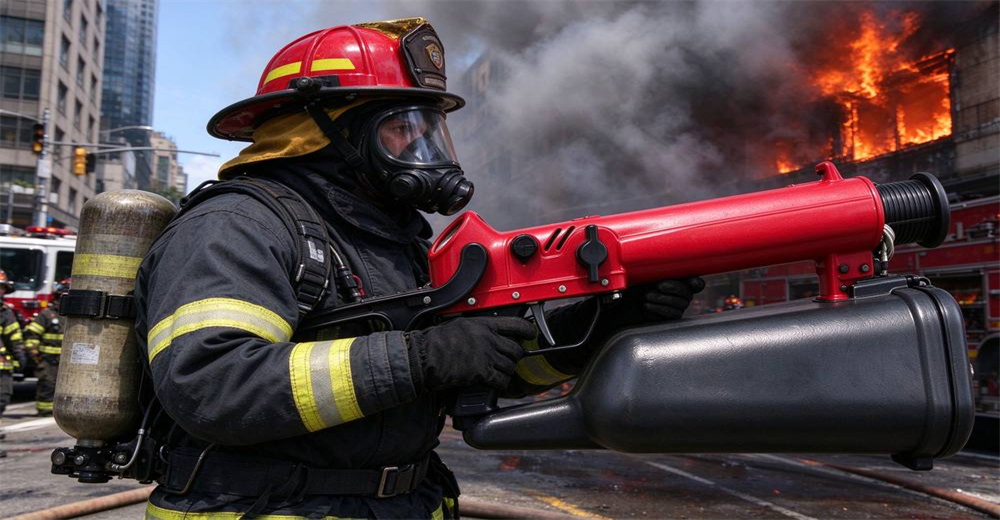
Held by a firefighter near the building line, the pneumatic line thrower reaches a flood-isolated rooftop or a stranded upper floor when the streets are underwater. The same 230m shot that crosses a river also bridges a flooded industrial zone, feeding rope to a balcony or a roof edge. This dual role, water and structure rescue, is why fire departments carry a long range launcher on every flood truck. Fire units keep a spare cartridge box on the truck for repeat shots.
What Is a Long Range Pneumatic Line Thrower?
The 230m thrower is the fastest way to span a wide flood channel.
A standard pneumatic line thrower reaches 80-130 meters.This long range rescue thrower extends that to 200-230 meters on land and 130-210 meters over water.
This 230m thrower keeps rescue teams on the far bank covered in one launch.
This is the long range rescue thrower gap-bridging equipment for wide rivers, large flood zones, and offshore transfers where a shorter thrower simply cannot reach the target.
The 8.5MPa working pressure sits between the 7MPa portable systems and the 20MPa Korean backpack.As a high pressure pneumatic thrower, this unit uses a 1.5L cylinder for power, with an initial projectile velocity of 60m/s.
The higher velocity is what pushes the projectile farther , at 60m/s, the projectile has more kinetic energy to overcome rope drag and wind.
Recoil is 5300N , noticeable, but manageable for a trained operator with proper stance.This is not a shoulder-fired toy; it is a professional rescue tool.As a high pressure pneumatic thrower, it delivers consistent performance.
A two-person crew is recommended: one aims and shoots, the other manages the rope spool. and fires, the other manages the rope spool.
When procurement teams evaluate a long range rescue thrower, they look at recoil management, cylinder capacity, and real-world range under wind , this unit is designed for all three.
This unit is for teams that face wide-distance scenarios.
If your rescue rivers are under 100 meters wide, the Korean backpack or portable unit is simpler.
and cheaper.
The long range unit is for when the gap exceeds what those can cover.
This pneumatic line thrower fills the gap between portable units and extreme-range specialists.
Why not just use a throw bag?A throw bag reaches 20-30 meters, and the thrower adds another 50-70 meters.
That covers small rivers and lakes.
But not the 150-300 meter wide waterways that water authority teams face daily.
When the gap is too wide for a throw bag, the long range thrower is the next step up.
It is the professional-grade tool for.
when amateur equipment simply cannot reach the target.
Why not use a boat?
Boats are slow, especially in strong current or flooded areas with debris.
A thrower fires a line in seconds , the boat might take 10-15 minutes to navigate to the target.
In rescue, seconds matter.
The thrower gets a line across immediately, while the boat is still being prepared and launched.
Parameter
Value
Unit
Note
Model
PTQ8.5-Y230S210
,
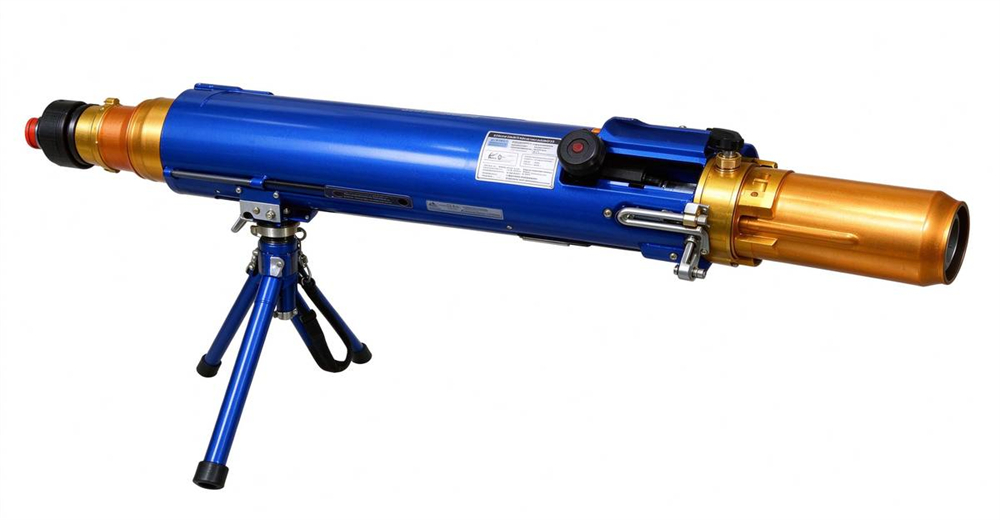
Long range blue gun
Working pressure
8.5
MPa
1.5L cylinder
Land range
200-230
meters
Optimal angle
Water range
130-210
meters
Open water
Total weight
7.5
kg
Complete kit
Initial velocity
60
m/s
Projectile speed
Recoil
5300
N
Firing recoil force
Rope length
250
meters
3mm diameter
Cylinder
1.5
L
Integrated
Standard
GB/T 27906-2011
China national standard
Technical Parameters
Flood rescue services choose this range for wide channel crossings.
#
Item
Qty
Purpose
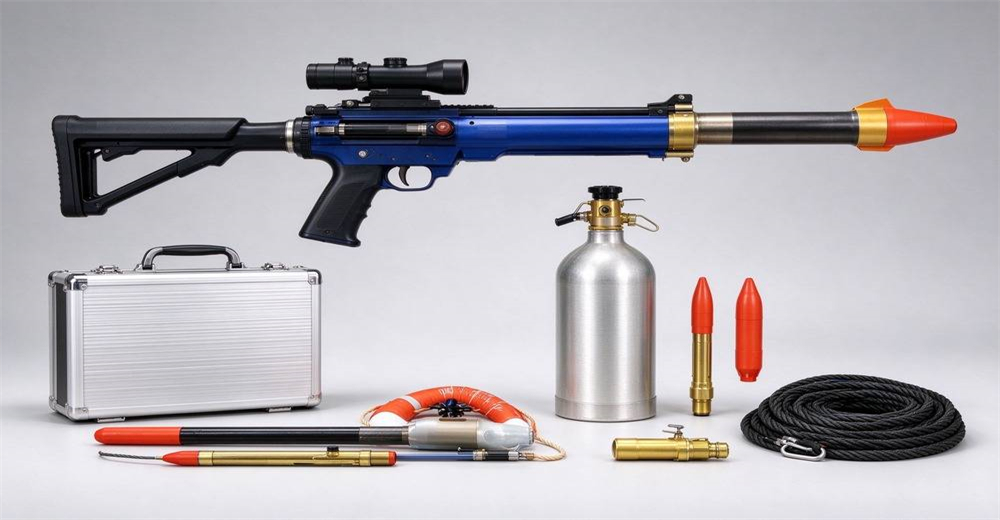
1
Long range launcher (blue gun style)
1 pc
Main firing device
2
1.5L cylinder
1 pc
Power source
3
Rescue rope
250m
3mm line
4
Projectile shells
,
Firing projectiles
5
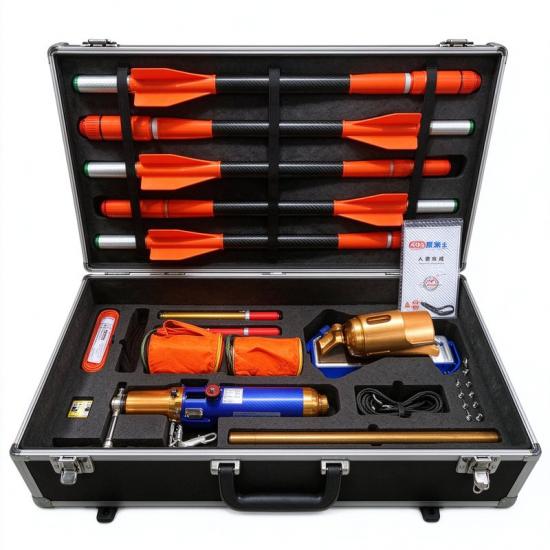
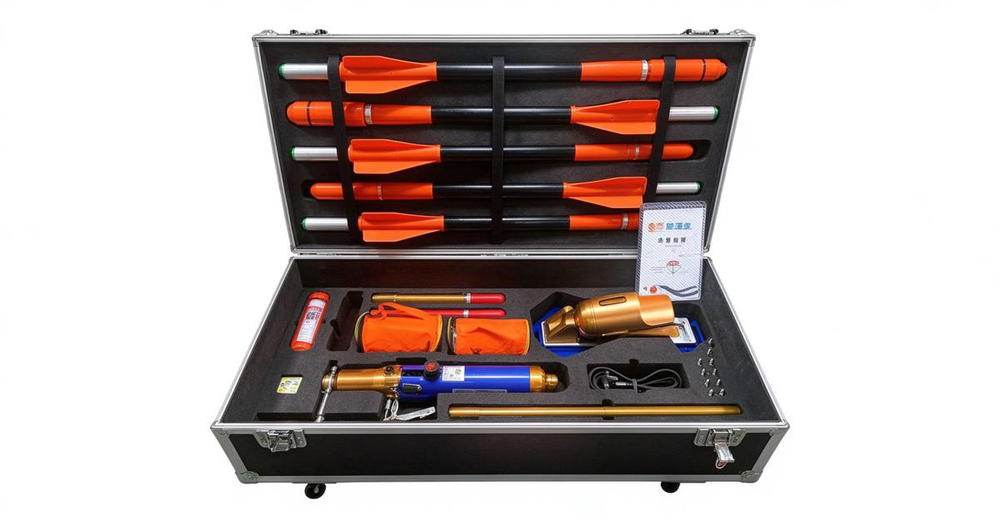
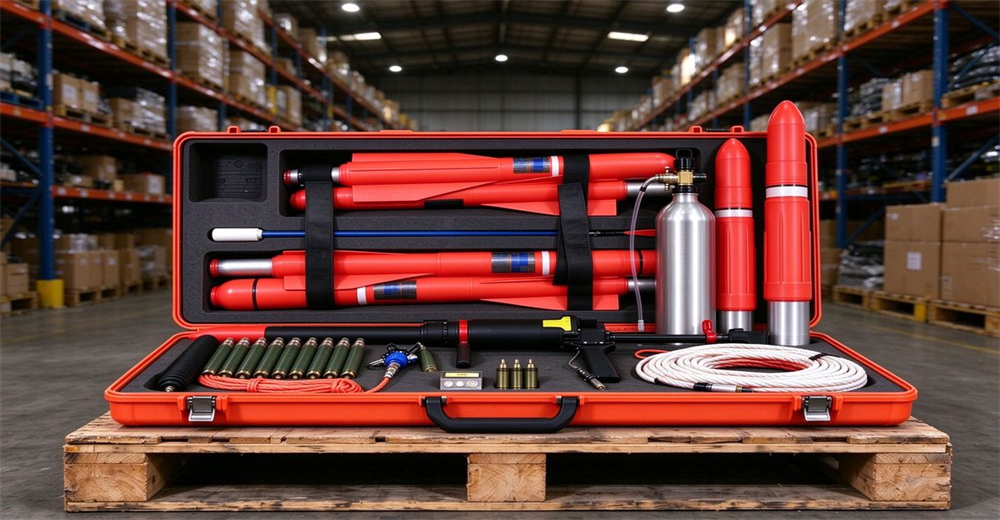
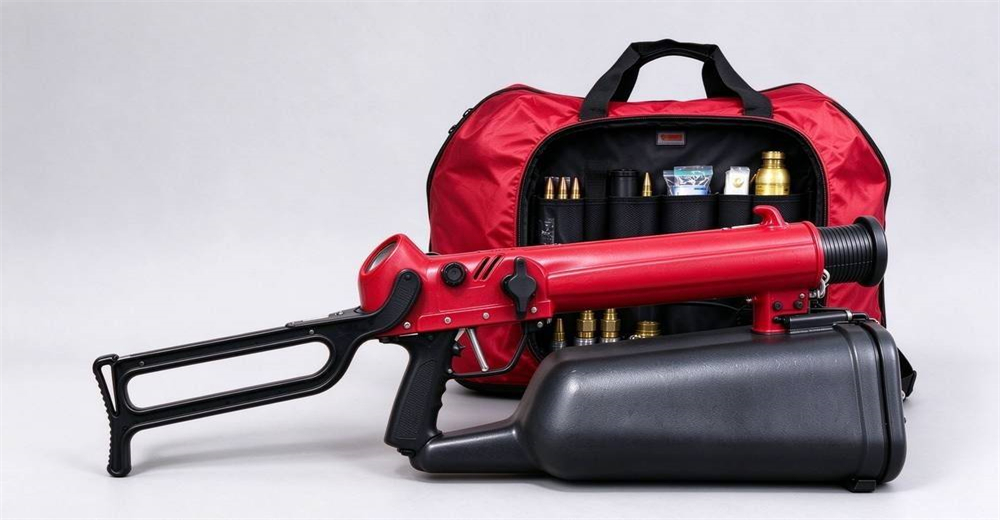
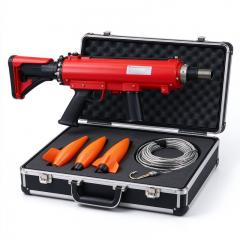
Hard transport case
1 pc
Storage and transport
The pneumatic line thrower stays ready on every flood truck before the water rises.
Rescue teams store the pneumatic line thrower at every flood station.
What's in the Box
Every item serves a specific role.
The pneumatic line thrower is ready on every flood response vehicle.
Crews mount the pneumatic line thrower on the boat rail for harbor operations.
The launcher is the main firing device , it holds the cylinder, the barrel, and the trigger mechanism.
The 1.5L cylinder stores the compressed air.
That powers the shot.
The 250m rescue rope is the line that gets fired across the gap.
The projectile shells are the disposable cartridges that hold the rope and fire out of the barrel.
The hard transport case protects everything during storage and transport.
The pneumatic line thrower team practices the launch drill on every shift.
Rope System
The 3mm rescue rope of this pneumatic line thrower is 250 meters long , enough for the maximum 230-meter land range plus a margin.
Every pneumatic line thrower ships with a protective carry case.
It is designed to float on water, critical for water rescue where a sinking rope is useless.
Rope Strength for Long Range
Rope strength is matched to the long-range mission.
At 250 meters of rope, wind and drag have more effect than on shorter ranges.
The rope is built to withstand the additional forces of long-distance flight , friction against the air, sag under gravity, and the pull of the projectile at the far end.
Spare ropes are available separately.
For long-range operations, we recommend keeping at least one spare 250m rope per unit.
Long-distance shots put more stress on the rope , it may fray against the barrel, get abraded against rock edges on the far bank, or be lost in fast current.
Inspecting a 250m Rescue Rope
How do you inspect a 250m rescue rope?Run it through your hands slowly from end to end , all 250 meters.
Check for: broken filaments (small fuzz that wasn't there when new). that wasn't there when new).
Flattened sections (where the rope has been crushed against rocks), discoloration (sun damage or chemical exposure), and stiff spots (water damage inside the braid).
At 250 meters, you need to check the entire length, not just the visible parts.
A rope that looks fine at one end can have damage in the middle.
That you only discover under load , which is the least desirable time to find out.
Storage matters even more for long ropes.
A 250m rope takes up a lot of space , it needs to be spooled properly on a dedicated reel.
Not stuffed into a bag.
The transport case has a rope compartment designed for this.
After water deployment, rinse the rope with fresh water and air dry it dry completely before spooling it back.
Salt water.
Or muddy water left in the braid will degrade the fibers over time, reducing the rope's strength just when you need it most.
Cylinder Power System
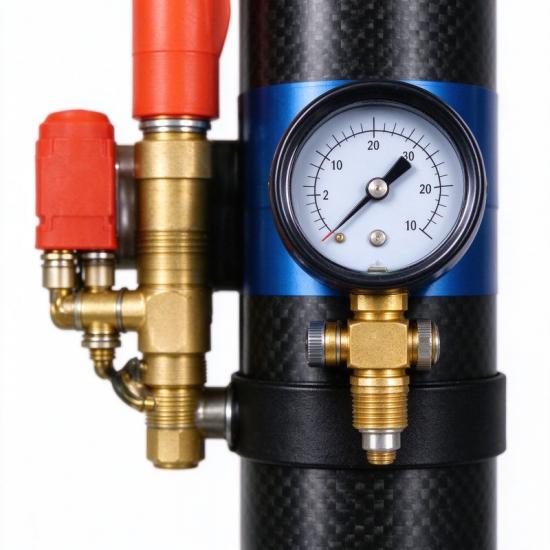
The 1.5L integrated cylinder provides the compressed air that fires the projectile.
At 8.5MPa, it holds enough air for multiple shots per fill , typical teams get 5-8 launches per cylinder charge, depending on projectile type and pressure level.
How does the cylinder system work?The cylinder is a pressure vessel that stores compressed air at 8.5MPa.
When you fire, a valve opens and the air rushes into the barrel.
Pushing the projectile forward.
The 60m/s initial velocity comes from this sudden release of compressed air , the higher the pressure and the larger the cylinder.
The faster the projectile goes.
The 1.5L cylinder size balances power with weight: enough air for multiple shots, but not so heavy that the launcher becomes unwieldy.
To refill the cylinder, you need a high-pressure air source , a breathing air compressor or external air bank.
The cylinder is not disposable; it is a reusable pressure vessel.
That requires periodic hydrostatic testing per regulation.
This means your team needs access to a compressor, or a service center that can refill the cylinder.
Factor this into your equipment budget , the cylinder is a long-term investment, not a consumable.
The recoil of 5300N is a direct result of the high velocity and pressure.
When you fire, the launcher pushes back against your shoulder with significant force.
This is why proper stance.
And two-person operation matter , a new operator unprepared for the recoil could lose control of the launcher.
The recoil also means you need a firm footing: on slippery ground or a boat deck, the recoil could knock you off balance.
Practice on solid ground first.
Then adapt to less stable positions.
Applications
Wide river rescue is the primary use.
Its 230m reach keeps crews working during flood zone rescue missions.
Buyers often compare the pneumatic line thrower against manual rope bags.
Coastal rescue crews keep the pneumatic line thrower on deck for harbor and beach operations.
When a river is 150-200 meters wide, a standard 80-meter thrower cannot reach across.
The long range unit bridges the gap, firing a rope from one bank to the other.
Water authority teams on major rivers rely on this range for their rescue coverage.
Flood rescue operations need long range because flood zones are chaotic.
A victim might be on a rooftop 150 meters away across flooded streets, or on a piece of debris in fast water.
A thrower that reaches 200 meters gives the team options when the terrain is impassable by boat.
Offshore and port operations use it for ship-to-ship line transfers when the vessels are farther apart than a standard thrower reaches.
In open water between two work boats, the long range unit covers the gap where a line-throwing gun of shorter range falls short.
Bridge rescue on major waterways also benefits.
When a person falls from a long-span bridge, the distance from bridge to water can exceed 100 meters vertically , combined with horizontal current drift.
The anchor point needs to be reachable from the bridge deck.
The long range unit covers this distance.
Let's look at a typical wide-river rescue scenario.
A river is 180 meters wide, with a strong current.
A boat has capsized in the middle.
And the two crew members are clinging to the overturned hull.
A rescue boat cannot reach them quickly because of the strong current and floating debris.
The rescue team sets up on the near bank, carrying the long range thrower.
They aim across the river, fire a rescue line to the capsized boat, the line lands near the crew.
They clip in, and are pulled to safety along the line.
Without the 230m range, the team would have had to launch a boat into the current , a much slower and more dangerous operation.
Another scenario: flood rescue in a wide flood zone.
A residential neighborhood is flooded.
Water covering the streets to a depth of 2 meters.
An elderly resident is trapped on a second-floor balcony.
150 meters across flooded streets.
A boat cannot navigate the flooded streets because of submerged cars and power lines.
The rescue team carries the long range thrower on foot to a position near the target.
They fire a line to the balcony, the resident grabs it, clips on.
And is pulled to safety along the line.
The 230m range made this possible , a shorter thrower would have fallen short.
Is this the right unit? Best for wide rivers (150m+), flood zones, and offshore transfers. If your rescue scenarios are under 100m, the Korean backpack or portable unit is simpler and cheaper. For 350m+ see the PTQ8.5-Y350S250Q80.
What if you need both short range and long range?Many teams solve this by carrying two units: a portable 170m unit for close-in rescue.
And this 230m long range unit for wider gaps.
The portable unit goes on foot to the rescue scene, while the long range unit stays in the rescue vehicle and is deployed.
when the gap exceeds the portable range.
This combination gives you flexibility , you are not stuck with only one range option.
How to Use
Step 1 Inspect: Check launcher, cylinder pressure, safety pin, rope condition, projectile loaded.
Winter teams store the pneumatic line thrower with dry cartridges.
Step 2 Aim: For long range, use a slightly elevated angle (30-40 degrees) to maximize distance.
Windage matters more at long range , compensate for crosswind.
For wide river crossings, the pneumatic line thrower delivers a consistent 230m shot without refilling.
Step 3 Fire: Firm stance, two hands on the launcher, squeeze trigger.
Expect noticeable recoil.
Never point at people.
Step 4 Recover: Pull rope back, recover projectile, reset for next shot.
How do you know the right angle?It comes with practice.
Start at 30 degrees for medium range, then adjust up to 40 degrees for maximum distance.
If the shot falls short.
Increase the angle slightly.
If it goes too far, lower the angle.
Wind also affects this: a headwind reduces range, so aim a bit higher.
A tailwind increases range, so you can aim lower.
These adjustments come with experience , that is why training matters.
Safety Warnings
Never point this pneumatic line thrower at people, animals or property.
Recoil is significant (5300N) , proper stance and grip required.
Two-person operation recommended: one fires, one manages rope.
Keep safety pin engaged until ready to fire.
Do not exceed 8.5MPa working pressure.
Wear eye protection during practice.
Long range shots require wind judgment , crosswind pushes projectile sideways.
Proper training required before live use.
The cylinder is a pressure vessel , do not expose to heat or open flame.
Do not modify the launcher or use non-standard parts. Only use manufacturer-recommended consumables.
In cold weather, cylinder pressure may decrease. Allow extra range margin in low-temperature conditions.
After firing, the launcher body may be warm from the gas expansion. Let it cool before handling the breech area.
On a boat deck or slippery surface, the recoil could knock you off balance. Practice on solid ground first.
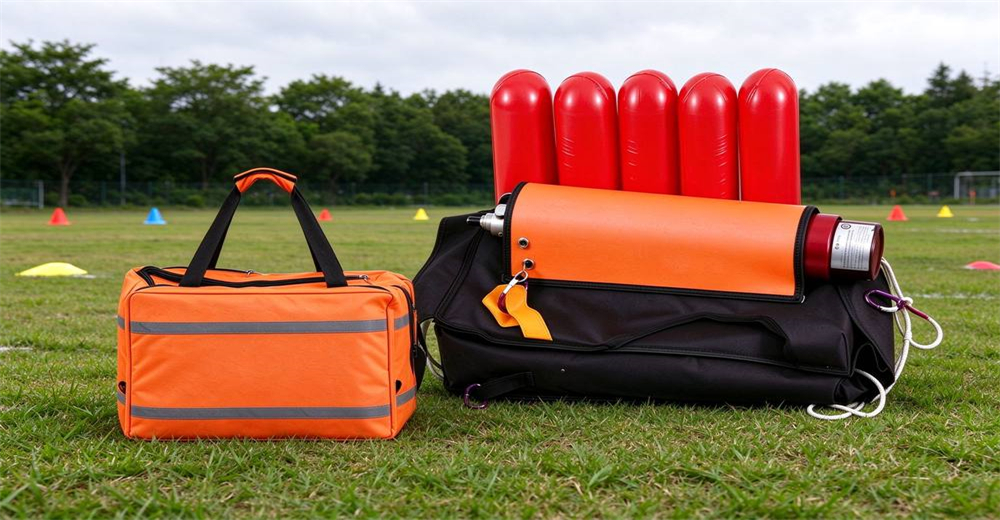
Training and Drills
This long range pneumatic line thrower is a professional tool.
The pneumatic line thrower fires clean after months in storage.
New operators should not fire it across a real waterway without proper training.
We recommend a structured progression: classroom familiarization, dry runs with zero pressure, low-pressure firing at a safe target, then full-pressure drills at a proper range.
Wind judgment is a critical skill for this pneumatic line thrower.
At 200+ meters, a crosswind that is barely noticeable at ground level pushes the projectile sideways by many meters.
Training should include practice judging wind speed and compensating aim accordingly.
Annual recertification includes: equipment inspection, cylinder pressure pressure check, live firing at simulated targets, windage practice, and emergency troubleshooting (what to do if the shot falls short, what if the rope tangles.
What if the cylinder pressure drops unexpectedly).
Training time varies. For operators with water rescue experience rescue certification, the thrower-specific training takes about 6-10 hours: classroom familiarization (2 hours), dry runs with zero pressure (1 hour).
Low-pressure firing practice (2 hours), and full-pressure drills at a training facility (2-4 hours).
The long range unit is more complex than the portable models , the wind judgment and recoil management require more practice time.
What does a typical drill look like? Scenario: a training boat is 200 meters out on a lake.
The team practices: set up the launcher, check cylinder pressure, load the projectile.
Aim at the boat, fire, confirm the rope reaches the boat, then recover the line.
The drill is repeated from different angles and wind conditions.
The team also practices what to do when the shot falls short , adjust the angle, fire again, and re-evaluate.
Before the first shot, confirm these key points: hold the launcher firmly firmly to manage recoil, account for crosswind drift, and use the correct firing angle for maximum range.
Firing at too low an angle for maximum range (the projectile hits the ground halfway), and not having the rope spool ready (the rope tangles during flight).
Training should explicitly cover these error modes.
Which Model to Choose?
This: 230m Long Range
Korean 126m
Portable 170m
Land range
200-230m
126m
170m
Water range
130-210m
79m
120m
Weight
7.5kg
<3.5kg
<3kg
Best for
Wide rivers, flood, offshore
River/lake rescue
Portable on-foot rescue
Specification
How do you decide which model is right for your team?Start by answering one question: what is the widest gap you need to cross?
Routine maintenance of the pneumatic line thrower takes under five minutes.
If your rescue scenarios are mostly on rivers under 100 meters wide, the Korean backpack (126m land range) is the standard choice , it is lightweight, easy to carry.
And covers most typical rescue scenarios.
If you need a bit more range but still want portability, the 170m portable unit adds range without the weight of the long range system.
If your waterways are 150-250 meters wide , major rivers, wide flood zones, offshore gaps , the 230m long range unit is the right choice.
It is heavier (7.5kg).
And requires a compressor for cylinder refills, but it gives you the reach you need.
For even wider gaps (300+ meters), you need the 350m professional model or the 640m extreme range unit.
Who Buys This Long Range Thrower?
Most commonly: water authority and river management teams; flood rescue and civil defense organizations; offshore support vessel operators; port and harbor authorities with wide waterways; and professional rescue teams covering large geographic areas.
Less common: small lake patrols (over-specified); urban fire departments (they need shorter range, more maneuverable units); recreational clubs.
Unsure what to pick? Share your scenario and we will recommend.
Let's break down the typical buyer profiles in more detail.Water authority and river management teams
buy this unit because they are responsible for rescue on major rivers , waterways that are 150-300 meters wide.
A standard 80m thrower cannot reach across these rivers, so they need the long range unit.
The 230m land range and 210m water range cover the full width of most major rivers, giving them the reach they need for rescue operations.
Flood rescue and civil defense organizations
deploy this in large-scale flood operations.
In a wide flood zone, victims may be scattered across hundreds of meters of flooded terrain.
The long range thrower gives them the ability to reach victims across flooded streets where boats cannot navigate.
The 7.5kg weight means it is designed for vehicle transport between positions, not long hikes on foot , which fits the civil defense deployment model of staging vehicles at strategic points.
Offshore support vessel operators
use it for ship-to-ship line transfers.
When two work boats are operating in open water, the distance between them may be 100-200 meters.
A standard line-throwing gun of shorter range falls short.
The long range unit covers the gap, allowing the vessels to transfer a line for towing, cargo transfer, or personnel movement.
Port and harbor authorities with wide waterways use it for rescue operations within the port.A large port may have navigation channels 200+ meters wide, with commercial vessels moving through.
When a person falls overboard in a wide channel, the rescue team needs equipment that can reach across the channel quickly , the long range thrower fills that role.
Packaging, Shipping and Consumables
Each unit packs into a hard transport case.
A training video covers the pneumatic line thrower step by step.
Each pneumatic line thrower ships with two full cylinder sets for extended operations.
Carton approx.
60×45×40cm, gross weight approx.
10-12kg.
Sample orders: express, 7-10 days. Bulk orders: sea freight FCL/LCL, FOB/CIF/EXW. FCL/LCL, FOB/CIF/EXW.Cylinders: shipped per regulation.
Consumables: spare ropes, projectile shells, seals available for repeat orders.
What does the hard transport case look like?It is a heavy-duty plastic case with foam interior cutouts for the launcher, cylinder, rope spool.
, and projectiles.
The foam protects the equipment during transport , no rattling, no parts rubbing against each other.
The case has latches and a carry handle, and is designed to be stacked with other equipment in a rescue vehicle.
What is the delivery lead time? time?
Sample orders dispatch within 7-10 days by express. by express.
Bulk production runs 2-4 weeks by volume, plus shipping time and transit. time. typically 2-4 weeks for production, plus shipping time.
For tenders and government procurement, we can provide product spec sheets and packing lists to support your submission.
Custom Options for Bulk Orders
OEM logo: Your organization logo on the launcher body and transport case.
Custom case color: Standard case color available. Other colors for bulk orders.
Additional consumables: Extra rope lengths and spare projectiles.
Local language labels: Technical labels in your local language if needed.
Extra consumables bundle: Add spare ropes, projectile shells, and seals to your initial order so you have spares on hand.
When water authority teams evaluate a long range rescue thrower, they need to know it works as a high pressure pneumatic thrower across wide rivers.
This 8.5MPa unit delivers 200-230m land range and 130-210m water range , enough for most wide-water rescue scenarios without stepping up to the 350m professional model.
FAQ
Meets GB/T 27906-2011.
A quick dry of the rope keeps the pneumatic line thrower ready for the next call.
Bulk orders of the pneumatic line thrower include a free spare rope spool.
As a China supplier of long range rescue throwers, contact info@yrftextile.com for pricing.
Maintenance Schedule
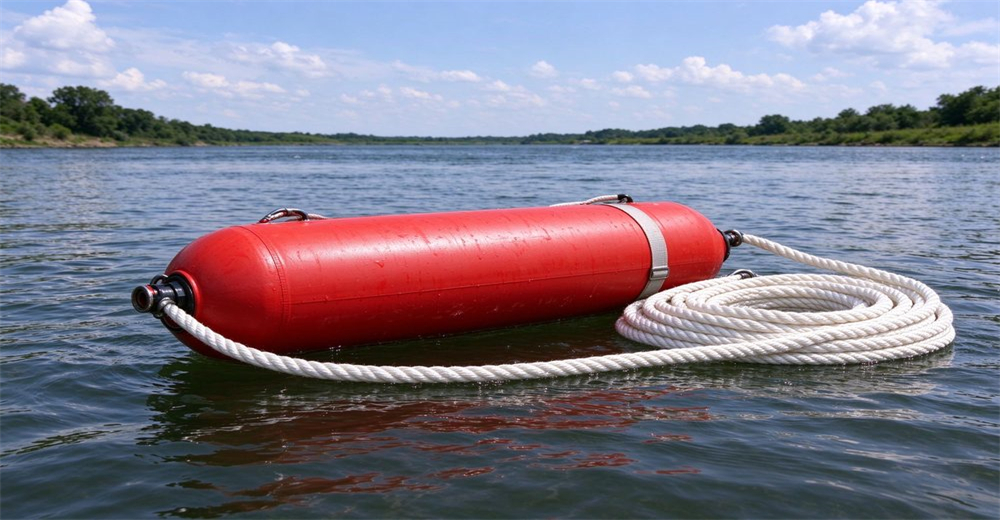
Placing a buoy cartridge into the launch cylinder
The pneumatic line thrower fits standard rescue vehicle racks.
Monthly checks keep the pneumatic line thrower ready, and spares are available on request.
When
What to Check
Before each use
Cylinder pressure, safety pin, rope wear, projectile loaded
After each use
Clean launcher and case, recover projectiles
Monthly
Seal condition, rope fraying, case latches
Annually
Cylinder hydro test per regulation, full service
Regular maintenance keeps the unit ready for service.
After every use, wipe the launcher body with a damp cloth and check the that no grit or debris has gotten into the breech mechanism, and inspect the rope for signs of wear.
The transport case latches should be checked monthly , a failed latch means the gear falls out during transport.
Store this long range unit in a cool, dry equipment room. dry equipment room.
Keep it clear of direct sunlight and chemical storage areas. and chemical storage areas.
The cylinder should be stored at operating pressure or slightly below.
, do not store it completely empty for long periods, as this can damage the internal seals.
A properly maintained unit will be ready when your team need it , and in rescue work, "ready when you need it" is the whole point. ready when you need it , and in rescue work, "ready when you need it" is the whole point.
How far does this pneumatic line thrower reach in real conditions?
Spec is 200-230m land / 130-210m water.
Actual range depends on angle, wind and rope condition. and rope condition.
Plan for the lower number.
Is it heavy to carry?
7.5kg total.
This pneumatic line thrower is designed for vehicle transport between rescue scenes, not long hikes on foot.
For on-foot portability, see the 170m portable unit.
How much does it cost?
The price varies with configuration and quantity.
Email info@yrftextile.com for a quote.
What is the MOQ?
Flexible MOQ.
Sample orders welcome.
Bulk pricing per contract.
How many shots per cylinder?
Typically 5-8 launches per cylinder charge, depending on projectile type and pressure level.
Do I need a compressor?
Yes, to refill the 1.5L cylinder you need a high-pressure air source , a breathing air compressor or external air bank.
Factor this into your equipment budget.
What is the real range in wind?
Spec is 200-230m land / 130-210m water.
A crosswind shortens range and drifts the trajectory. sideways.
Allow for the lower number in windy conditions. windy conditions.
Can one person operate it?
Two-person operation is recommended: one fires, one manages the rope.
The recoil and rope management require a team.
Can I get my logo on it?
Yes.
OEM logo on the launcher body and transport case for bulk orders.
What if the shot falls short?
Adjust the angle setting, re-aim, and fire again.
Long range shots require wind judgment and angle adjustment.
What is the difference between this and the portable thrower?
This long range unit reaches 200-230m with the 8.5MPa cylinder system.
The portable thrower is under 3kg, CO2-only, and reaches 170m maximum.
Choose based on the gap distance you need to cover.
Do I need special training to operate it?
Yes.
This long range thrower is a professional tool.
Operators need water rescue certification before live use. before live use.
Wind judgment and recoil management require specific training.
What spare parts should we keep in stock?
Recommended spares: seal kits, projectile types (land and water), rope spools, angle selector mechanism parts.
The cylinder needs periodic hydrostatic testing per regulation.
Can it be used in cold weather?
Yes, but cylinder pressure may decrease in low temperatures.
Add extra range margin in cold weather.
The launcher body and components are rated for typical rescue operating temperatures.
This long range pneumatic line thrower covers wide gaps. For 350m+ see PTQ8.5-Y350S250Q80. For 640m extreme range see PTQ13-Y640S440Q180.
Related Products
If you are looking at this long range unit, you may also need:
Korean Style Rescue Thrower (PTQ20-Y100S70) , 20MPa, 126m land / 79m water, for shorter range missions
Portable Lightweight Thrower (PTQ7.0-Y150S100) , Under 3kg, 170m land / 120m water, for on-foot operations
Professional 350m Thrower (PTQ8.5-Y350S250Q80) , 350m land / 250m water, 5-angle system
Extreme Range 640m Thrower (PTQ13-Y640S440Q180) , 640m land / 440m water / 180m anchor hook, dual barrel
Browse by Scenario
Hunting for equipment for a specific rescue job?
OEM logos can be printed on the pneumatic line thrower carry case.
Browse our scenario-based collections:
Water Rescue Equipment Collection , throwers + life jackets + rescue ropes for river, lake and flood operations
Fire Fighting & Rescue Equipment , breathing apparatus + rescue throwers + protective gear for fire brigades
Flood Relief Supplies , tents + blankets + rescue throwers + emergency kits for disaster relief
Related Articles
Long Range Rescue Equipment: When You Need It
Flood Rescue Thrower: Buyer's Guide
Offshore Line Throwing: Marine Equipment Guide
Email info@yrftextile.com with your quantity, port and customization requirements for wholesale rates.
Whether you are a water authority upgrading your rescue fleet or an offshore operator outfitting your support vessels, we help you choose the right pneumatic line thrower
configuration and deliver it safely to your door.
This long range pneumatic line thrower
fills a specific niche: it bridges the gap between portable rescue equipment (which only reaches 100-170 meters) and extreme-range systems (which reach 350+ meters but are heavy and specialized).
If your rescue scenarios are mostly under 100 meters, the Korean backpack or portable unit is simpler and cheaper.
If you regularly face 200+ meter gaps , wide rivers, flood zones, offshore transfers.
, this unit is the right tool.
For even longer range, see the 350m professional model (PTQ8.5-Y350S250Q80) or the 640m extreme range unit (PTQ13-Y640S440Q180).
© YRF Textile.
Long range pneumatic line thrower and rescue equipment.
Contact: info@yrftextile.com
Specifications as confirmed by the factory apply to each order.
Previous :
Professional Long Range Pneumatic Line Thrower for Extreme River RescueNext :
Lightweight Pneumatic Line Thrower with Folding Hook for Fire Professional Rescue Launcher, Aluminum Alloy, Fire Fighting Essential
This orange-yellow professional rescue launcher is made of aviation-grade aluminum alloy, with maximum working pressure of 200bar, throwing distance of 150-230 meters on land and 80-210 meters on water. Certified by the National Fire Equipment Quality Standard, it reaches maximum initial velocity of 60m/s. It provides efficient solutions for fire teams, flood control, and water rescue operations, saving lives in critical moments as essential equipment for all rescue teams.
 Customized Life-saving Thrower, High Strength, Long-range Rescue
This professional life-saving thrower is made of high-strength composite materials, with a throwing distance of 50 meters and a load-bearing capacity of 150kg, achieving a 99% rescue success rate. Its orange-yellow design ensures high visibility on water, equipped with non-slip handle and high-strength rescue rope. Specifically designed for flood control, water rescue and emergency disaster relief, it is essential equipment for fire departments, maritime rescue units, water rescue teams and flood control forces, participating in over 200 flood rescue missions annually.
 High-Pressure Pneumatic Rope Launcher, Rescue Special, 120m Range
This high-pressure pneumatic rope launcher uses compressed air as power source, with projection distance ≥80 meters on water and ≥110 meters on land, equipped with 120-meter high-strength rescue rope. The main body weighs less than 3.5kg, offers simple and quick operation, and features a spark-free design ensuring safe use in flammable environments. The accompanying auto-inflating life ring inflates within 5 seconds with buoyancy >8kg. Ideal for flood disaster relief, water rescue, maritime rescue and other complex scenarios, it's essential equipment for emergency rescue departments.
 Wholesale Pneumatic Line Thrower: 100m–640m Rescue Rope Launcher
This pneumatic line thrower delivers reliable long‑distance rope deployment for swift‑water, flood, maritime and ice rescue scenarios. Multiple configurations cover short, long and ultra‑long throwing distances. Complete kits include launcher, projectiles, rescue ropes, CO2 cylinders and protective carry case. Quick setup, simple operation for fire, coast guard and emergency rescue teams worldwide. Note: Price for reference only. Exact price based on quantity, size, weight and custom details.
 Korean Style Pneumatic Rescue Thrower PTQ20-Y100S70 | 20 MPa ≥100 m Land / ≥70 m Water
Korean Style Pneumatic Rescue Thrower PTQ20-Y100S70, 20 MPa shoulder-fired launcher. ≥100m land range and ≥70m water range, equipped with auto inflating lifebuoy head and 2000N high tensile rope. Complies with GB/T 27906-2011. Complete aluminum hard case kit. Support bulk wholesale, OEM custom logo for fire, coast guard and flood rescue teams. Note: Price for reference only. Exact price based on quantity, size, weight and custom details.
 American Style Anchor Hook Rescue Thrower | PTQ20-Y125S100 & PTQ7-Y150S110Q55
American Style Anchor Hook Pneumatic Rescue Thrower, frame-mounted design with recoil buffer. Equipped with heavy-duty anchor claw for high-rise, cliff and maritime rescue. Delivers long-distance rope deployment for swiftwater, urban flood and offshore emergency rescue. Complete kit with launcher, projectiles, rope and protective case. Support bulk wholesale and OEM customization for fire and coast guard teams. Note: Price for reference only. Exact price based on quantity, size, weight and custom details.
Copyright © Custom Disaster - Relief Bedding: Tents, Sleeping Bags, Blankets All Rights Reserved
the professional team to service !